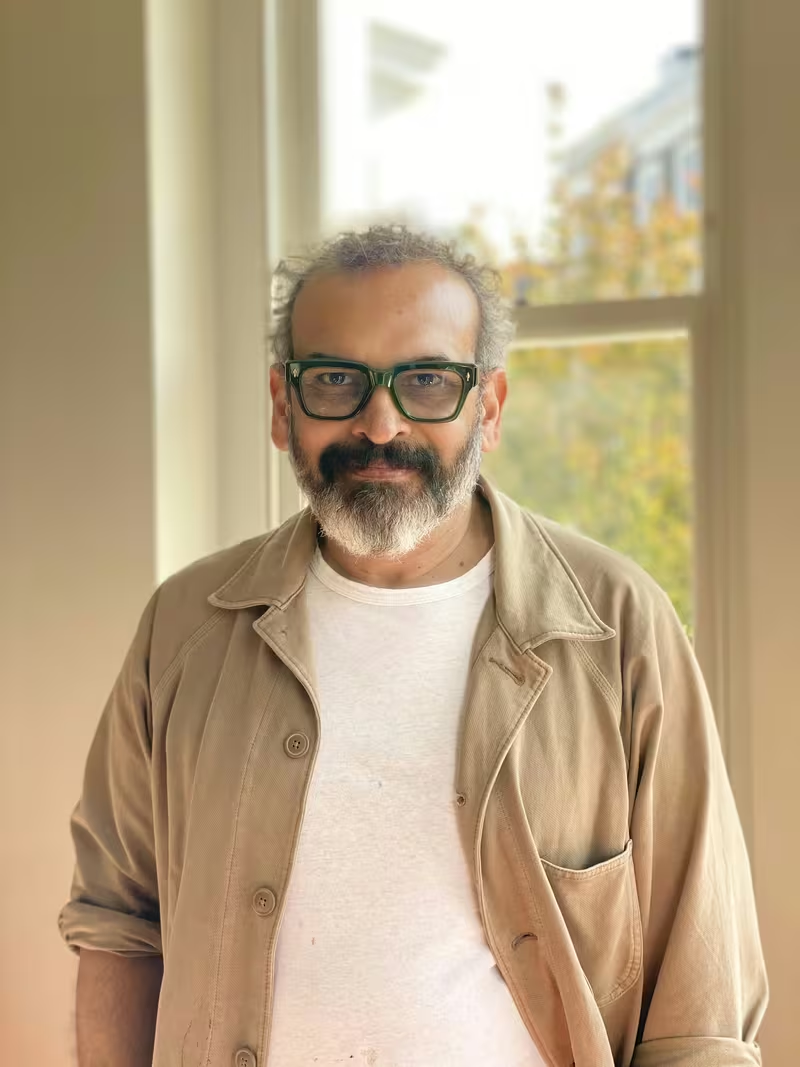
Subodh Gupta: The Alchemist of the Everyday
In the grand theatre of contemporary art, few figures have cast as long and gleaming a shadow as Subodh Gupta. An artist born from the soil of Bihar, he has risen to become one of India's most celebrated and internationally recognized creative voices. Gupta is an alchemist of the modern age, not one who turns lead into gold, but one who transforms the mundane, ubiquitous stainless steel utensils of Indian kitchens into monumental sculptures that speak a universal language of migration, memory, globalization, and the complex tapestry of life itself. His work is a thunderous symphony composed from the quiet, rhythmic clatter of a billion Indian homes, a testament to the idea that profound meaning can be found in the most ordinary of objects.
Early Life: The Forging of an Artist in Khagaul
Subodh Gupta was born in 1964 in Khagaul, a small railway town near Patna, Bihar. This setting was not a mere backdrop to his childhood; it was the crucible in which his artistic sensibilities were forged. His father worked as a railway guard, and the constant movement of trains, the transient lives of passengers, and the stark contrast between his rural home and the industrial might of the railways became early, powerful influences. Khagaul was a microcosm of a changing India—a place where tradition and modernity collided on the railway platform every day.
Life in provincial Bihar in the 1960s and 70s was a world away from the metropolitan art capitals. Here, art was not found in galleries but in the rituals of daily life, in the craftsmanship of local artisans, and in the vibrant visual culture of street theatre and religious festivals. Gupta initially found his creative outlet in acting, joining a local theatre group. This experience with performance and stagecraft would later inform the theatricality and grand scale of his installations.
His formal artistic training began when he enrolled at the College of Arts & Crafts, Patna, from which he graduated in 1988 with a Bachelor of Fine Arts in Painting. His time in Patna was formative. To support himself, he worked as a newspaper designer and illustrator, honing his graphic sensibilities. His early paintings from this period already bore the seeds of his later concerns, often depicting the struggles and aspirations of the common man, the Bihari migrant, and the complex socio-political landscape of the region. The identity of being a 'Bihari'—an identity often associated with migration, labour, and stereotypes in the larger Indian consciousness—became a recurring and defiant theme in his work.
Career: From Canvas to Cosmos of Steel
In 1990, like countless others before him, Gupta made the journey from his home state to the bustling metropolis of Delhi. This move was a pivotal moment, plunging him into the heart of India's burgeoning contemporary art scene. Initially, he continued to focus on painting, but his artistic vocabulary was expanding, searching for a more potent medium to express his ideas.
The late 1990s marked a radical shift in his practice. Gupta began to move away from the two-dimensional canvas and embrace sculpture and installation. He started incorporating found objects, materials that were intimately tied to his memories and the cultural fabric of India. One of his early breakthrough works, 'My Mother and Me' (1997), used cow dung—a material of immense ritualistic and practical significance in rural India—molded over a minimalist metal armature. The work was a deeply personal and powerful exploration of purity, tradition, and the sacredness of the domestic sphere.
It was around this time that he discovered his signature material: stainless steel. The gleaming, sterile, and yet deeply familiar pots, pans, tiffins, thalis, and buckets of the Indian kitchen became his medium. For Gupta, these objects were not just utilitarian items; they were vessels of memory, carriers of cultural DNA. They represented the aspirations of a rising Indian middle class, the rituals of food and family, the cycles of life and death, and the vast, unseen labour of women in the domestic space.
His works began to grow in scale and ambition, capturing the attention of the international art world.
Major Works & Milestones:
'Bihari' (1999): A provocative self-portrait where Gupta, naked and covered in cow dung, stares defiantly at the viewer, the word 'Bihari' painted in Devanagari across his torso. It was a powerful statement on identity, regional prejudice, and the act of reclaiming a label often used pejoratively.
'Very Hungry God' (2006): This is arguably his most iconic work. A monumental skull, over three meters high, meticulously constructed from thousands of gleaming stainless steel utensils. Exhibited to great acclaim at the Palazzo Grassi in Venice during the 2007 Biennale, the sculpture is a stunning memento mori for the age of globalization. It speaks of insatiable consumption, famine, excess, and the divine, all at once. The skull, a universal symbol of death, is built from objects that sustain life, creating a profound and unsettling paradox.
'This is not a fountain' (2006): A direct and clever dialogue with Western art history, this installation features a torrent of stainless steel buckets, taps, and pipes, seemingly frozen in the act of pouring. The title is a nod to Marcel Duchamp's revolutionary 'Fountain' and René Magritte's 'The Treachery of Images'. Gupta recontextualizes the concept of the 'readymade' by using objects rooted in the Indian experience, questioning authenticity and the flow of cultural influence.
'Line of Control' (2008): One of his most ambitious and politically charged works, this installation is a colossal mushroom cloud made entirely of stainless steel pots and pans. Exhibited at the Tate Britain, the title directly references the contentious border between India and Pakistan. The work is a chilling and beautiful commentary on the threat of nuclear conflict, transforming instruments of nourishment and domestic harmony into a terrifying symbol of mass destruction. It speaks to the fragility of peace and the absurd reality of a border that divides a shared culinary and cultural history.
'Aam Khas' (2010): Translating to 'Ordinary and Special', this work features an iconic Indian Ambassador car, a symbol of post-independence socialist bureaucracy and middle-class aspiration, cast in gleaming aluminum and laden with luggage. It is a sculpture about journeys—both personal and national—and the weight of history and ambition that we carry.
Gupta's practice extends beyond sculpture. He is a versatile artist who has produced significant work in video, performance, and photography, consistently exploring the themes of identity, migration, and the complex interplay between the local and the global.
Legacy: An Icon of a New India
Subodh Gupta's rise to prominence coincided with India's economic liberalization in the 1990s and its subsequent emergence on the global stage. His art became a powerful symbol of this new, confident India—an India that could look inwards at its own cultural specifics and project them outwards as a universal artistic statement.
His historical significance lies in his ability to elevate the mundane to the magnificent. Before Gupta, the stainless steel thali was just a plate. After Gupta, it became a pixel in a larger, complex narrative of modern Indian identity. He gave a new artistic language to the objects of post-colonial, liberalizing India, much like Andy Warhol did for the Campbell's soup can in post-war America. He made the world see the profound cultural weight and aesthetic beauty in items that were previously invisible due to their very ubiquity.
His influence on a younger generation of Indian artists is immeasurable. He demonstrated that compelling, world-class art could be made from the materials of one's own immediate environment. He broke down the hierarchical distinctions between craft and fine art, the domestic and the public, the local and the international.
Today, Subodh Gupta is one of India's most important living artists. His works are housed in the permanent collections of major international museums, including the Guggenheim, the Tate Modern in London, and the Centre Pompidou in Paris. He continues to live and work in Gurugram, creating art that challenges, provokes, and dazzles. While his public image was impacted by allegations of sexual misconduct in 2018 as part of the #MeToo movement, which he denied and which resulted in a court-ordered takedown of the social media posts, his artistic legacy remains profoundly influential. He remains a key figure whose work serves as a gleaming, complex, and indispensable chronicle of India's journey in the 21st century.