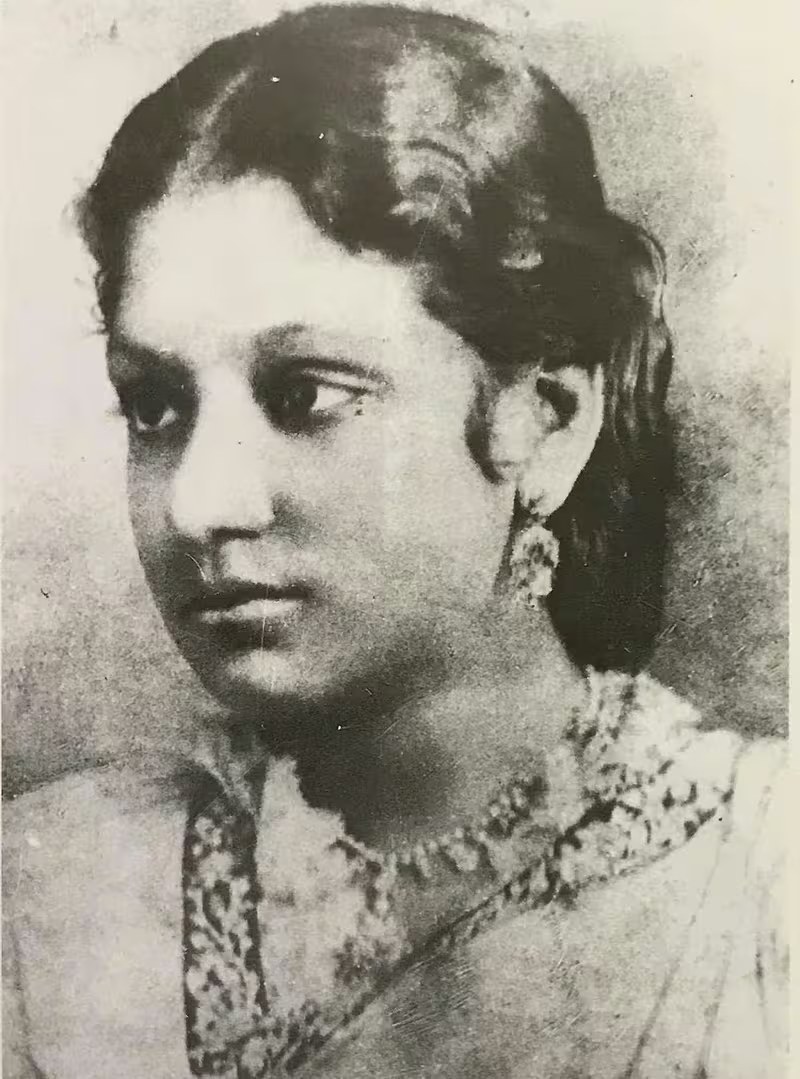
Sunayani Devi: The Quiet Revolutionary of the Bengal School
In the grand theatre of the Bengal Renaissance, where intellectual and artistic giants reshaped India's cultural landscape, a quiet revolution was taking place within the cloistered walls of a Calcutta home. This revolution was not waged with fiery speeches or bold manifestos, but with gentle brushstrokes, soft colours, and a profound connection to the soil. Its architect was Sunayani Devi (1875-1962), a woman who, without any formal training, emerged from the shadows of her celebrated male relatives to become one of India's first and most original modern women artists.
Her story is not one of rebellion against tradition, but of creation from within it. In a world that confined women of her class to the antahpur (the inner quarters of the home), Sunayani Devi transformed her domestic space into a studio, her daily rituals into inspiration, and her heritage into a new visual language. She was the self-taught master whose work, rooted in the folk traditions of Bengal, offered a powerful and authentic alternative to the dominant artistic currents of her time.
Early Life & A World of Culture
Sunayani Devi was born on June 18, 1875, into the very heart of Bengal's cultural aristocracy: the Tagore family of Jorasanko, Calcutta. The Jorasanko Thakur Bari was not merely a home; it was a crucible of creativity, a nerve centre of the Bengal Renaissance. Here, poetry, music, theatre, and philosophy were part of the daily air. She was the daughter of Gunendranath Tagore and the younger sister of Gaganendranath and Abanindranath Tagore, who would become the trailblazers of the Bengal School of Art. Her uncle was the legendary polymath and Nobel laureate, Rabindranath Tagore.
Growing up in this intellectually charged environment, Sunayani was immersed in a world of high culture. Yet, the opportunities afforded to the men of the family were not extended to the women in the same way. While her brothers received formal education and artistic training, Sunayani's upbringing was typical for a girl of her high-caste background. She was educated at home and, in 1887, at the tender age of twelve, was married to Rajanimohan Chattopadhyay, the grandson of the great social reformer Raja Ram Mohan Roy.
Her life, like that of her peers, was centred around her family and the management of a large household. The world of professional art, of exhibitions and public acclaim, seemed impossibly distant. For years, her creative instincts found expression in traditional domestic arts—decorating the home, creating beautiful alpana (ritual floor paintings) during festivals, and crafting dolls for her children. These were not seen as 'art' in the formal sense, but as the graceful accomplishments of a cultured homemaker. However, the artistic spirit of Jorasanko had been planted deep within her, waiting for the right moment to bloom.
The Emergence of an Artist
The turning point came around 1905, when Sunayani was thirty years old. From the seclusion of her home, she would watch her brothers, Abanindranath and Gaganendranath, at work. She observed their techniques, the way they mixed colours and brought figures to life on paper. Inspired, she picked up a brush herself. Her initial canvases were simple wooden plaques, and her pigments were often sourced from the earth and plants around her home, just as they were for the village artisans of Bengal.
Her process was entirely intuitive. Unburdened by the academic conventions of Western art or even the specific wash techniques being developed by her brother Abanindranath, Sunayani drew from a deeper, more personal wellspring of inspiration. Her art was a direct reflection of the world she knew: the stories she heard from her mother and grandmother, the mythological epics of the Ramayana and Mahabharata, the Vaishnava tales of Radha and Krishna, and the quiet, intimate moments of domestic life.
Her style was unlike anything else being produced by the Bengal School. Where many of her contemporaries sought to create a refined, pan-Indian aesthetic inspired by Ajanta murals and Mughal miniatures, Sunayani's work was unapologetically local and rooted in folk traditions. Her paintings echoed the bold, simple lines of Bengali patachitra (scroll paintings), the expressive forms of terracotta toys and clay putul (dolls), and the fluid grace of alpana designs. Her figures, especially her women, were characterized by their soft, rounded forms, serene expressions, and large, luminous, almond-shaped eyes that seemed to hold a world of emotion. She used watercolour to achieve a flat, matte finish, giving her works the quality of a fresco, a stark contrast to the ethereal, misty wash technique favoured by her brother.
Career & Major Contributions
Sunayani Devi never sought a career as a professional artist, yet her undeniable talent could not remain hidden for long. Her brothers were the first to recognize the unique power of her work and began to exhibit it alongside their own. In 1908, her paintings were shown at the inaugural exhibition of the Indian Society of Oriental Art in Calcutta, a society co-founded by her brothers to promote a new, nationalist art form.
Her work immediately stood out for its sincerity and originality. While she was part of the Bengal School movement by association, her artistic voice was distinct. Her paintings like "Sati," depicting a woman's ultimate sacrifice with a haunting, ethereal grace, and "Milk-Maids," a lyrical portrayal of village life, showcased her ability to infuse traditional themes with a profound and personal sensitivity.
International recognition soon followed. Her work was included in the 1911 London exhibition of the Indian Society of Oriental Art. In 1924, her paintings travelled to the United States as part of a major exhibition. However, the most significant critical validation came from the Austrian art historian Stella Kramrisch. In a landmark 1922 essay for the German art journal Der Cicerone, Kramrisch hailed Sunayani Devi as a truly modern artist. She argued that while other Bengal School artists were consciously reviving past traditions, Sunayani's art was a living continuation of an unbroken folk lineage. Kramrisch famously declared her the “first genuine modern painter of India,” a painter whose work was not an intellectual exercise but a pure, unmediated expression of indigenous creativity.
This was a revolutionary assessment. It repositioned Sunayani Devi from the periphery to the very centre of the conversation about modern Indian art. Kramrisch saw in her "primitive" style not a lack of sophistication, but an abundance of authenticity. Works like "Ardhanarishwar" (the androgynous form of Shiva and Parvati) and "Yashoda and Krishna" were celebrated for their spiritual depth and their seamless blend of the divine and the everyday.
Legacy & Lasting Influence
Sunayani Devi's active painting period was relatively short. After the deaths of her husband and one of her sons in the late 1930s, she largely withdrew from her art, finding it difficult to paint amidst her grief. She passed away in 1962, having lived a long and impactful, yet publicly quiet, life.
Her historical significance is immense and multi-layered. Firstly, she stands as a pioneer for women in Indian art. At a time when the art world was almost exclusively male, she carved out a space for female creativity, demonstrating that the antahpur could be a site of profound artistic production. She did not need to leave her home to find her voice; she found it within the very world that sought to contain her.
Secondly, her work played a crucial role in validating folk art as a vital source for modernism. Long before artists like Jamini Roy made the folk idiom their signature, Sunayani Devi had instinctively turned to the artistic traditions of rural Bengal. She demonstrated that modernity in Indian art did not have to mean a rejection of the local or the "primitive." Her art was a testament to the enduring power of these traditions, proving they were not relics of the past but living resources for the present.
Today, Sunayani Devi is remembered as a gentle but formidable force in Indian art history. Her work is housed in prestigious collections, including the National Gallery of Modern Art in New Delhi and the Victoria Memorial Hall in Kolkata. Art historians are increasingly re-evaluating her contribution, moving her out of the long shadows cast by her famous brothers and recognizing her as a singular talent in her own right. Her life story is a powerful reminder that great art can emerge from the most unexpected of places, and that the quietest voices can often be the most revolutionary.