Sunita Williams: A Star Above Earth
In the vast, silent theatre of space, few have left footprints as indelible as Sunita Lyn Williams. An American astronaut, naval officer, and test pilot, her story is not just one of breaking records, but of breaking barriers—for women, for science, and for the global Indian diaspora that watched with pride as one of their own reached for the stars. With a career marked by grit, intelligence, and an enduring connection to her heritage, Sunita Williams embodies the spirit of exploration in the 21st century.
Early Life & Background: Forging a Path
Sunita Lyn Williams was born on September 19, 1965, in Euclid, Ohio, into a home that was a confluence of cultures. She was the youngest of three children born to Dr. Deepak Pandya, a neuroanatomist from Gujarat, India, and Bonnie (Zalokar) Pandya, a Slovenian-American. Her father had immigrated from Ahmedabad to the United States for his medical residency, bringing with him the rich traditions of his homeland. This blend of Indian and Slovenian heritage, nurtured in the American Midwest, gave Sunita a unique and expansive worldview from a young age.
Growing up in Needham, Massachusetts, Sunita was an active and curious child, though she did not initially dream of becoming an astronaut. Her interests were more terrestrial; she was an avid athlete and had a deep love for animals. It was her older brother, Jay, who first charted a course towards the military by attending the U.S. Naval Academy. Initially, Sunita had no intention of following in his footsteps, but a visit to the academy during his final year changed her perspective. She saw a path that combined intellectual challenge with physical rigor and a profound sense of service.
After graduating from Needham High School in 1983, she enrolled at the U.S. Naval Academy. It was a demanding environment, but it was here that her destiny began to take shape. She earned her Bachelor of Science degree in Physical Science in 1987 and was commissioned as an Ensign in the United States Navy. The world of aviation beckoned, and she soon found her calling in the cockpit of a helicopter.
Career & Major Contributions: From the Seas to the Stars
A Distinguished Naval Aviator
Williams's journey to space began not in a rocket, but in the roaring belly of a helicopter. After being designated a Naval Aviator in July 1989, she began flying H-46 Sea Knight helicopters. Her service took her across the globe, including deployments to the Mediterranean, Red Sea, and the Persian Gulf in support of Operation Desert Shield during the Gulf War. Her skills were not just for combat; she also flew humanitarian missions, providing relief in the aftermath of Hurricane Andrew in Miami in 1992.
Her exceptional piloting skills and technical acumen led her to be selected for the U.S. Naval Test Pilot School, a prestigious institution for the best and brightest in military aviation. She graduated in 1993 and went on to work as a test pilot, flying dozens of different aircraft and pushing them to their limits. By the time NASA came calling, she had logged over 3,000 flight hours—a testament to her mastery of the skies.
Joining NASA
In June 1998, Sunita Williams was selected by NASA to be part of Astronaut Group 17. After years of rigorous training, she was ready for her first journey beyond Earth's atmosphere. Her moment arrived on December 9, 2006, when she launched aboard the Space Shuttle Discovery on mission STS-116 to the International Space Station (ISS).
First Spaceflight: Expedition 14/15
Arriving at the ISS, Williams joined the Expedition 14 crew and later transitioned to Expedition 15. Her 195-day stay in orbit was nothing short of historic. She conducted four spacewalks, or Extra-Vehicular Activities (EVAs), totaling 29 hours and 17 minutes. This shattered the existing record for the most spacewalk time by a woman, a clear demonstration of her skill and endurance in the unforgiving vacuum of space.
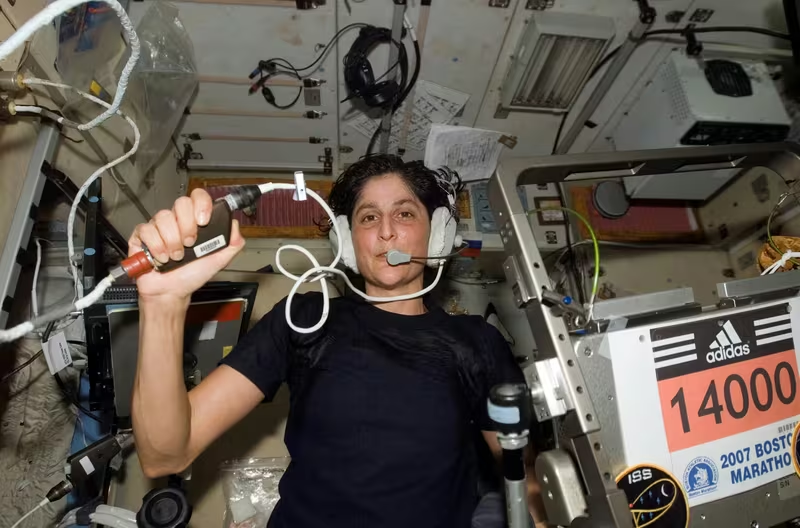
But it was an event inside the station that captured the world's imagination. On April 16, 2007, as thousands ran the Boston Marathon on Earth, Williams ran it with them. Strapped to the station's treadmill to counteract the effects of microgravity, she completed the 26.2-mile race in 4 hours and 24 minutes while orbiting the planet at 17,500 miles per hour. It was a powerful symbol of human determination and a deeply personal feat for the Massachusetts-raised astronaut.
During this mission, she also brought a piece of her Indian heritage with her. Among her personal items were a small idol of the Hindu deity Ganesha, a copy of the Bhagavad Gita, and, famously, some samosas. This act resonated deeply in India, a poignant reminder that while she was an American astronaut, she carried the spirit of her ancestral home with her to the final frontier.
Second Spaceflight: Commander of the ISS
Williams returned to space on July 15, 2012, launching from the Baikonur Cosmodrome in Kazakhstan aboard a Russian Soyuz spacecraft. During this mission, she served as a flight engineer for Expedition 32 before making history once again. On September 17, 2012, she took command of the International Space Station for Expedition 33, becoming only the second woman in history to hold the prestigious post.
As commander, she was responsible for the station, its crew, and the complex array of scientific experiments being conducted. During this 127-day mission, she performed three more spacewalks, bringing her career total to seven and setting a new world record for total cumulative spacewalk time for a female astronaut at 50 hours and 40 minutes. Her leadership and technical expertise were instrumental to the success of the expedition.
Pioneering the Commercial Crew Era
After accumulating 322 days in space across two missions, Williams's work was far from over. In 2015, she was selected as one of the first four astronauts for NASA's Commercial Crew Program, a groundbreaking initiative to partner with private companies like Boeing and SpaceX to build the next generation of American spacecraft. She was assigned to fly on Boeing's CST-100 Starliner.
The path was fraught with challenges and delays, but Williams remained a steadfast leader in the program. On June 5, 2024, she made her third journey to space, launching as the pilot of the Starliner's first-ever crewed test flight to the ISS. This historic mission marked a new era in human spaceflight, and at its helm was a veteran astronaut continuing to push the boundaries of what is possible.
Legacy & Influence: A Beacon of Inspiration
Sunita Williams's legacy is multifaceted, extending from the annals of space exploration to the hearts of millions in India and around the world.
A Trailblazer in Space
Her records for spacewalks and her command of the ISS have cemented her place as one of the most accomplished astronauts of her generation. She has been a pivotal figure in the post-Space Shuttle era, bridging the gap between reliance on Russian Soyuz vehicles and the dawn of commercial spaceflight. Her work on the Starliner program ensures her influence will be felt for decades to come, as new generations of astronauts fly on the vehicles she helped develop and test.
An Icon for the Indian Diaspora
In India, Sunita Williams is more than just an astronaut; she is a national hero. Her achievements are a source of immense pride, a symbol of what the Indian diaspora can accomplish on the world stage. When she visited India in 2007, she was greeted with overwhelming enthusiasm. She traveled to her father's ancestral village of Jhulasan in Gujarat, where she was celebrated as the "daughter of the universe." She spoke to students and dignitaries, including the then-President of India, Dr. A.P.J. Abdul Kalam, himself a renowned aerospace scientist.
Her simple, heartfelt gestures—carrying the Gita and Ganesha to space—created a powerful connection. They showed that one could be at the pinnacle of modern science and technology while remaining grounded in ancient heritage and culture. For countless young Indians, especially girls, she became a powerful role model, proving that a career in science and exploration was within their reach.
Remembered Today
Today, Sunita Williams continues to serve as an active astronaut, a living legend whose career is still being written. She is remembered not just for her records but for her approachable and down-to-earth personality. She is the astronaut who ran a marathon in space, who took her Jack Russell terrier Gorby's picture with her on missions, and who speaks with passion and humility about the profound experience of seeing Earth from above. Her journey from the suburbs of Ohio to the command of the International Space Station is a powerful narrative of perseverance, cultural pride, and the unending human quest to explore the cosmos.