Surdas - The Poet Who Saw God
In the vast, luminous tapestry of Indian history, certain threads shine with a divine, otherworldly light. One such thread is the life of Surdas, the 16th-century blind poet whose songs of devotion to Lord Krishna have echoed through the centuries, shaping the spiritual and cultural landscape of the subcontinent. Though deprived of physical sight, Surdas possessed an inner vision so profound that he could paint the most intricate, emotionally resonant portraits of the divine child Krishna, his playful antics, and his divine love. His work is not merely poetry; it is a testament to the power of bhakti—unconditional devotion—a path to experiencing the divine that transcends the senses.
Surdas was a towering figure of the Bhakti movement, a spiritual revolution that swept across medieval India, emphasizing a personal, emotional relationship with God over rigid rituals and caste hierarchies. Through his sublime verses, composed in the sweet, melodic cadence of Braj Bhasha, he made the esoteric tales of the scriptures accessible to the common person, transforming the deity of Krishna from a distant, epic hero into an intimate, beloved member of every household. His legacy is not confined to religious texts; it lives in the lullabies sung by mothers, the vibrant miniature paintings of Rajasthan, and the devotional music that fills temples across North India.
Early Life & Background
The precise details of Surdas's early life are veiled by the mists of time, as is common for many saints of his era, whose stories were passed down through oral tradition long before being written. Tradition places his birth around 1483 in a village named Sihi, near Delhi. A defining feature of his identity, passed down through generations of hagiography, is that he was blind from birth. This physical limitation became the central paradox of his life: the man who could not see the world created the most vivid visual imagery of the divine in Indian literature. This very fact was seen by his followers not as a disability, but as a sign of his unique spiritual purpose—his eyes were closed to the material world so they could remain perpetually open to the divine spectacle of Krishna's lilas (divine plays).
Lacking formal education in the traditional sense, Surdas was gifted with an extraordinary memory and a naturally melodious voice. As a young boy, he is said to have left his home, living a life of austerity and singing devotional songs. He eventually settled at Gau Ghat, a sacred bathing spot on the banks of the Yamuna River between Agra and Mathura. Here, he spent his days composing and singing padas (devotional verses), mostly in a vein of humility and supplication (vinaya).
The most pivotal moment of his formative years was his encounter with the great philosopher and spiritual preceptor, Shri Vallabhacharya, the founder of the Pushtimarg sect. Around 1510, Vallabhacharya was passing through Gau Ghat and heard the young Surdas sing. Impressed by his devotion but sensing a lack of joyful expression, the guru approached him. He gently advised Surdas that instead of only pleading with God, he should use his immense talent to sing of the glorious life and playful pastimes of Krishna. Vallabhacharya initiated him into his spiritual tradition, Pushtimarg ('The Path of Grace'), and instructed him to focus his compositions on the Bhagavata Purana, the primary text detailing Krishna's life.
This meeting was a profound turning point. It gave Surdas a clear purpose and a rich theological framework for his devotion. Under Vallabhacharya's guidance, his poetry blossomed, moving from verses of supplication to a vibrant, joyous celebration of Krishna's every aspect. He relocated to the Braj region—the sacred landscape of Mathura, Vrindavan, and Govardhan Hill where Krishna was believed to have spent his youth—and dedicated the remainder of his long life to this singular, divine mission.
Career & Major Contributions
Surdas's career was not one of worldly ambition but of spiritual immersion. His court was the temple, his audience was God, and his currency was devotion. He became one of the most revered members of the Ashtachhap (literally, 'Eight Seals'), a group of eight devotional poets handpicked by Vallabhacharya and his son, Vitthalnath, to be the official temple poets for the Shrinathji temple at Govardhan. These poets were the primary architects of the musical and literary traditions of the Pushtimarg sect, and Surdas was considered their brightest star.
The Sur Sagar: An Ocean of Devotion
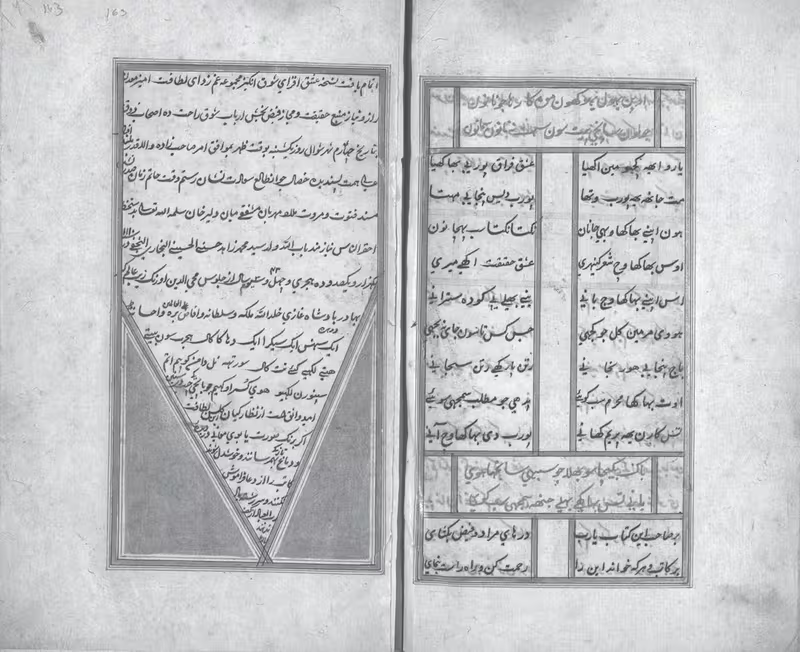
Surdas's magnum opus is the Sur Sagar ('The Ocean of Sur's Melodies'). According to tradition, this monumental work originally contained 100,000 verses, mirroring the 100,000 verses of the Bhagavata Purana. While only about 8,000 of these verses have survived, they constitute one of the most significant collections in Hindi literature. The Sur Sagar is not a linear narrative but a lyrical exploration of Krishna's life and virtues.
Its most celebrated sections are those dedicated to Bal Lila, the depiction of Krishna's childhood. Here, Surdas's genius is unparalleled. With the loving, minutely observant eye of a doting mother, he captures every nuance of a child's world. He describes Krishna's first steps, his lisping words, his playful arguments with his mother Yashoda, and his mischievous pranks like stealing butter (makhan chori). One of his most famous padas begins, "Maiya, mori main nahin makhan khayo" ("O Mother, I did not eat the butter!"), a delightful depiction of a child's innocent denial in the face of overwhelming evidence. Through these verses, Surdas masterfully explores the psychology of childhood and the depths of maternal love, making the divine accessible and relatable.
Other parts of the Sur Sagar delve into Krishna's youthful romance with Radha and the gopis (milkmaids) of Vrindavan, culminating in the ecstatic Rasa Lila, the divine circular dance. A particularly profound section is the Bhramar Geet ('The Song of the Bee'). It details the dialogue between the gopis, heartbroken by Krishna's departure to Mathura, and his messenger, Uddhava, who comes to console them with a philosophical message of a formless, abstract God. The gopis, in their simple but powerful devotion, reject this dry intellectualism, arguing for the supremacy of saguna bhakti—love for a personal, embodied God. This section is a masterpiece of emotional depth and philosophical debate, championing the path of love over the path of knowledge.
Musical and Literary Prowess
Surdas was as much a musician as he was a poet. His padas were composed to be sung and were set to specific ragas of Indian classical music. His contributions form a foundational element of Haveli Sangeet, the devotional music specific to the Pushtimarg tradition. By composing in Braj Bhasha, the local dialect of the Mathura region, he performed a monumental service to literature. He elevated a spoken dialect to the status of a refined literary language, proving it capable of expressing the most sublime philosophical and emotional ideas. His work paved the way for future poets and cemented Braj Bhasha as the preeminent language of Krishna devotion for centuries.
Legacy & Influence
Surdas passed away around 1563 in Parsauli, a village near Govardhan Hill, the very land he had immortalized in his poetry. But his voice was far from silenced. His legacy is a living, breathing tradition that continues to nourish the soul of India.
Historical and Cultural Significance
Surdas's most enduring legacy is his humanization of the divine. His poetry brought Lord Krishna out of the sanctum sanctorum and into the courtyards and homes of ordinary people. His descriptions of Krishna's childhood are so definitive that for millions of devotees, the image of 'Bal Gopal' or 'Makhan Chor' is the one painted by Surdas's words. His work provided a spiritual anchor for millions during a turbulent period in Indian history, offering a path of personal devotion that was inclusive and emotionally fulfilling.
His influence extended deep into the arts. The vivid imagery in the Sur Sagar became a direct source of inspiration for entire schools of miniature painting, particularly the Rajasthani and Kangra styles. Countless artworks depict scenes straight from his verses: Yashoda churning butter while a mischievous Krishna looks on, the gopis surrounding Krishna during the Rasa Lila, or Radha waiting longingly by the Yamuna. His padas also became integral to classical dance forms like Kathak, which use his poetry for abhinaya (expressional dance).
How He Is Remembered Today
Today, Surdas is revered as a Sant Kavi (saint-poet), a title that acknowledges him as both a literary genius and a spiritual master. His bhajans remain among the most popular and frequently sung devotional songs in North India. From humble village gatherings to grand classical music concerts, the words "Akhiyan Hari darshan ki pyasi" ("My eyes thirst for the sight of God") resonate with the same emotional power as they did five centuries ago.
His life story, particularly the paradox of his blindness and his divine sight, serves as a powerful metaphor for the nature of true faith. It teaches that spiritual vision is not dependent on physical senses but on the purity and intensity of one's devotion. Surdas did not just write about Krishna; he lived and breathed his presence. Through the inner eye of his soul, he saw a world more vibrant and real than the one perceived by ordinary sight, and through the immortal gift of his poetry, he allows us to see it too.