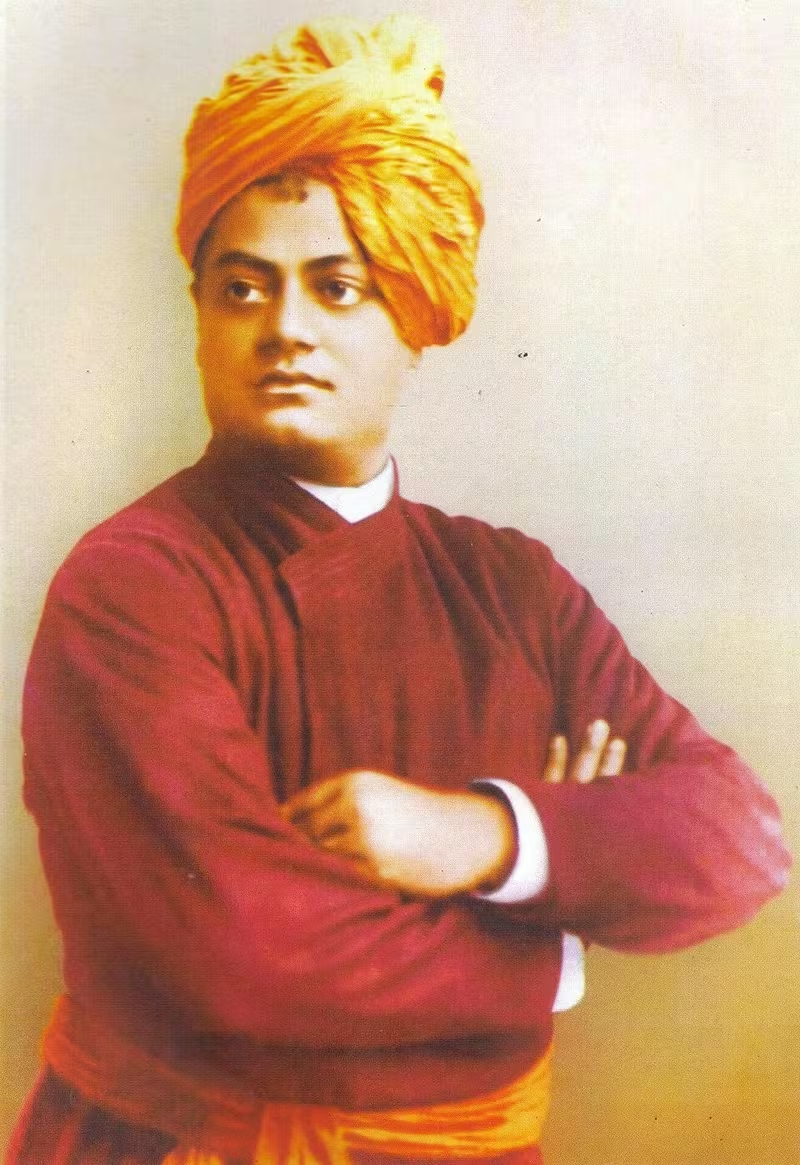
Swami Vivekananda - The Monk Who Awakened a Nation
In the grand tapestry of modern Indian history, few threads shine as brightly or are woven as intricately as that of Swami Vivekananda. He was more than a monk; he was a spiritual dynamo, a philosopher of profound insight, a patriot of immense passion, and a cultural ambassador who built a bridge of understanding between the East and the West. In a life that spanned a mere 39 years, from his birth on January 12, 1863, to his passing on July 4, 1902, Narendranath Datta transformed into Swami Vivekananda, a name that would echo through the corridors of time as a call to strength, self-belief, and service.
The Dawn of a Luminary: Early Life & Background
Born Narendranath Datta into an affluent Kayastha family in Calcutta, the cultural capital of British India, the future Swami was a product of a unique confluence of tradition and modernity. His father, Vishwanath Datta, was a successful attorney at the Calcutta High Court, a man of rational temperament and liberal views. His mother, Bhuvaneshwari Devi, was a devout woman, steeped in the epics of the Ramayana and Mahabharata, from whom Narendra inherited a deep spiritual inclination.
From a young age, Narendra was a paradox. He was restless, intensely energetic, and a natural leader among his peers, yet he also possessed a deeply contemplative side, often practicing meditation and displaying a precocious fascination with wandering ascetics. His intellectual gifts were undeniable. He devoured books on Western philosophy, logic, history, and science with an insatiable appetite. He studied at the Metropolitan Institution and later at the Presidency College, before graduating from the General Assembly's Institution (now Scottish Church College) with a Bachelor of Arts degree in 1884.
This period of intense intellectual activity plunged him into a spiritual crisis. The rationalism of Western thinkers like John Stuart Mill and Herbert Spencer clashed with his innate spiritual faith. He joined the Brahmo Samaj, a reformist movement that sought a monotheistic, rational interpretation of Hinduism, but it failed to provide the ultimate answer he sought. His soul ached for a definitive truth, for a direct, personal experience of God. His burning question, which he posed to every spiritual leader he met, was simple yet profound: "Sir, have you seen God?" None could give him a convincing, affirmative answer. The search had left him weary, skeptical, and on the brink of agnosticism.
The Crucible of Faith: Meeting Sri Ramakrishna
In November 1881, the trajectory of Narendranath's life was irrevocably altered. He was taken to meet a simple, semi-literate temple priest at the Dakshineswar Kali Temple named Ramakrishna Paramahamsa. To this unassuming mystic, Narendra posed his now-famous question. Without a moment's hesitation, Ramakrishna replied, "Yes, I have. I see Him just as I see you here, only in a much more intense sense."
Narendra was stunned. For the first time, he had met someone whose spiritual claims were not based on scripture or dogma, but on direct, verifiable experience. Though initially skeptical, he found himself drawn back to Dakshineswar again and again. What followed was a tumultuous and transformative five-year discipleship. Narendra, the rational intellectual, tested his master relentlessly, while Ramakrishna, with infinite patience and unconditional love, slowly dismantled his disciple's doubts, guiding him towards the profound truths of Advaita Vedanta—the non-dualistic philosophy that posits the ultimate oneness of the individual soul (Atman) with the absolute reality (Brahman).
When Sri Ramakrishna passed away from throat cancer in August 1886, he entrusted the care of his young monastic disciples to Narendra. In a dilapidated house in Baranagar, these young men took formal monastic vows, and Narendranath Datta became Swami Vivekananda, the leader of a new spiritual brotherhood. He was now the keeper of a sacred flame, but he knew he had to understand the vessel—India itself—before he could share its light with the world.
A Voice for the Ages: Career and Major Contributions
The Wandering Monk: Discovering the Soul of India
In 1888, with his guru's blessings as his only guide, Swami Vivekananda embarked on an extensive journey across the length and breadth of India as a parivrajaka, a wandering monk. For nearly five years, he walked, begged for his food, and slept under the open sky or in the humble dwellings of strangers. This was his Bharat Parikrama, a pilgrimage to discover the soul of his motherland.
He saw firsthand the staggering paradox of India: a land of sublime philosophical heights and abysmal poverty, of deep-rooted faith and crippling social inertia. He conversed with scholars, princes, and destitute peasants. This journey seared into his conscience the urgent need for the material and spiritual upliftment of the masses. His mission crystallized during a moment of profound meditation on the last rock of India at Kanyakumari in late December 1892. He saw that India's salvation lay not in esoteric withdrawal, but in a dynamic application of its highest spiritual truths to serve its people. He decided he must go to the West to seek resources to help his impoverished countrymen and, in return, offer the world India's timeless spiritual wisdom.
The Chicago Address: A Storm of Spirit in the West
With the support of his disciples and the patronage of the Raja of Khetri, Swami Vivekananda sailed for America to attend the Parliament of the World's Religions in Chicago. He arrived in July 1893 with little money and no formal credentials. After facing considerable hardship, he was finally given a chance to speak on the opening day of the Parliament on September 11, 1893.
When his turn came, the young, unknown monk in saffron robes stood before an audience of nearly seven thousand. He began his address not with a formal salutation, but with five simple, heartfelt words: "Sisters and Brothers of America." The effect was electric. The entire assembly rose to its feet in a thunderous, two-minute-long standing ovation before he had even uttered another word.
In his brief but powerful speech, he championed a message of universal tolerance and acceptance, quoting a Hindu hymn: "As the different streams having their sources in different places all mingle their water in the sea, so, O Lord, the different paths which men take through different tendencies, various though they appear, crooked or straight, all lead to Thee." He spoke not of a sectarian creed, but of a universal religion that could embrace all of humanity. In the days that followed, he elucidated the core principles of Vedanta, presenting Hinduism not as an exotic, idolatrous faith, but as a profound, rational, and scientific philosophy. The American press hailed him as "the cyclonic monk from India," and he became the star of the Parliament.
The Practical Vedantist: Mission in the West and East
Vivekananda spent the next three and a half years in America and England, delivering hundreds of lectures, holding classes, and attracting a dedicated group of Western disciples, including the Irish-born Margaret Noble, who would become Sister Nivedita; J.J. Goodwin, who transcribed his speeches; and Sara Bull, who became a lifelong supporter.
His core message was Practical Vedanta. He taught that the highest spiritual truths of the Upanishads—that the divine is within every being—were not meant for forest-dwelling ascetics alone. They had to be lived and realized in everyday life, through what he called the four yogas:
- Jnana Yoga: The path of knowledge and discrimination.
- Bhakti Yoga: The path of devotion and love.
- Karma Yoga: The path of selfless action.
- Raja Yoga: The path of meditation and psychic control.
He founded the Vedanta Society of New York in 1894, laying the groundwork for a movement that would continue to spread Indian philosophical thought throughout the West.
The Architect of Service: The Ramakrishna Mission
Swami Vivekananda returned to India in January 1897 to a hero's welcome. His success in the West had instilled a new sense of confidence and pride in Indians, who had long been taught to feel inferior under colonial rule. He delivered a series of electrifying lectures, from Colombo to Almora, calling upon his countrymen to awaken their dormant spiritual energy and channel it into the service of the nation.
He admonished them to abandon meaningless ritualism and social evils, and instead worship the Daridra Narayana—God in the form of the poor, the ignorant, and the downtrodden. "So long as the millions live in hunger and ignorance," he thundered, "I hold every man a traitor who, having been educated at their expense, pays not the least heed to them!"
To give institutional shape to his vision, he founded the Ramakrishna Mission on May 1, 1897. Its motto, Atmano Mokshartham Jagat Hitaya Cha ("For one's own salvation and for the welfare of the world"), encapsulated his revolutionary synthesis of the contemplative and active ideals. The Ramakrishna Math and Mission would be an order of monks dedicated not only to spiritual practice but also to active social service through hospitals, schools, orphanages, and disaster relief work—a model of organized service previously unknown in Indian monasticism.
The Echo of Eternity: Legacy and Influence
The Revitalization of a Faith
Vivekananda's greatest contribution was arguably the revitalization of Hinduism itself. He rescued it from centuries of stagnation and presented its highest philosophies in a modern, rational, and accessible language. He gave Hindus a renewed sense of pride in their spiritual heritage and provided a powerful intellectual defense against the critiques of Western missionaries and colonial rulers.
The Soul of a Nation's Freedom
Though he never participated in politics, Swami Vivekananda is widely regarded as one of the spiritual fathers of the Indian independence movement. His call for fearlessness (abhaya), self-reliance, and service to the motherland ignited a new spirit of nationalism. He awakened the youth of India, urging them to build their character on a foundation of strength and service. Leaders from Mahatma Gandhi and Jawaharlal Nehru to Subhas Chandra Bose and Aurobindo Ghosh acknowledged his profound influence on their own thinking and on the national consciousness.
A Bridge Across Worlds
Vivekananda was a masterful interpreter of cultures. He explained the spiritual depth of the East to the materialistic West and, in turn, urged India to learn from the West's dynamism, organizational skills, and scientific spirit. He envisioned a world where the two hemispheres would enrich each other, creating a more balanced and complete humanity.
The Final Sunset
Years of relentless work, both in India and abroad, took a toll on his health. He made a second, shorter trip to the West from 1899 to 1900 but returned to India exhausted. He spent his final days at the Belur Math, the monastery he had established on the banks of the Ganga. On July 4, 1902, after a day of meditation and teaching, Swami Vivekananda entered mahasamadhi—a yogi's final, conscious departure from the body. He was only 39.
He had once said, "It may be that I shall find it good to get outside my body—to cast it off like a worn-out garment. But I shall not cease to work! I shall inspire men everywhere, until the world shall know that it is one with God." True to his word, his spirit and his message—a clarion call to awaken the divine potential within—continue to inspire millions across the globe, proving that the fire he lit continues to illuminate the path for all humanity.