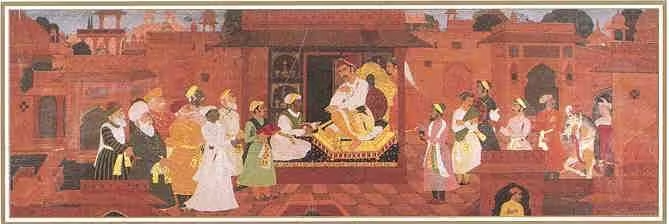
Mian Tansen: The Emperor of Melody in Akbar's Court
In the gilded halls of Fatehpur Sikri, amidst the shimmering silks and profound discussions of Emperor Akbar's court, one voice could command the absolute attention of the entire Mughal Empire. This was the voice of Mian Tansen, born Rāmtanu Panday (1493 - 1589), a musician so sublime that his name became synonymous with the soul of Hindustani classical music. He was not merely a court musician; he was a Navratna, one of the nine jewels of the imperial court, a cultural titan whose contributions forged the very grammar of North Indian music, leaving a legacy that resonates in every raga performed today.
The Making of a Maestro: Early Life in Gwalior
Rāmtanu Panday was born in 1493 in the vicinity of Gwalior, a city that was then a formidable cultural and political center in northern India. His father, Mukund Panday, was a wealthy poet and musician, and it was in this artistically rich environment that the young Rāmtanu's prodigious talents were first nurtured. Gwalior, under the patronage of rulers like Raja Man Singh Tomar (1486–1516), had cultivated a sophisticated musical tradition, particularly the majestic and structured vocal form known as dhrupad. This was the world that shaped Tansen's formative years, immersing him in a tradition that valued discipline, devotion, and profound emotional depth.
However, the most pivotal chapter of his education began when he became a disciple of the legendary saint-musician Swami Haridas in Vrindavan. This was not a formal, institutional education but an immersion into the guru-shishya parampara, a sacred tradition of master-disciple learning. Under the tutelage of Swami Haridas, Tansen’s musical training transcended mere technical proficiency. He learned that music was a form of worship (nadopasana), a path to divine connection. For years, he honed his craft in the devotional atmosphere of Vrindavan, mastering the intricate structures of ragas and the spiritual essence that gave them life. This period endowed him with a deep understanding of the ancient roots of Indian music, a foundation upon which he would later build his own monumental innovations.
The Path to the Imperial Court: From Rewa to Fatehpur Sikri
As his reputation as a vocalist and composer of unparalleled skill grew, Tansen found patronage at the court of Raja Ramchandra Singh of Rewa (in modern-day Madhya Pradesh). For nearly five decades, he was the court's most celebrated artist. The Raja and Tansen shared a deep bond of mutual admiration; the king was a knowledgeable patron, and the musician was the jewel of his kingdom. Tansen’s fame, however, was too immense to be contained within a single kingdom.
Word of his extraordinary talent eventually reached the ears of the Mughal Emperor Akbar, a great connoisseur of the arts who was actively building a syncretic culture that blended the best of Indian and Perso-Islamic traditions. Around 1562, Akbar sent a request—a polite but firm imperial summons—to Raja Ramchandra, asking for Tansen to join the Mughal court. Though reluctant to part with his cherished musician, the Raja understood the command's weight and sent Tansen to the imperial capital with gifts and his blessings.
Upon his arrival, Tansen’s performance left Emperor Akbar utterly spellbound. The Emperor, recognizing the divine gift in Tansen's voice, welcomed him into his inner circle. He bestowed upon him the honorific title Mian, a term of respect and endearment, and from that day forward, Rāmtanu Panday was known to the world as Mian Tansen.
The Voice of an Empire: Tansen at the Court of Akbar
At the Mughal court, Tansen's genius flourished. He was not just a performer but a central figure in the cultural life of the empire, one of the famed Navratnas (Nine Jewels). This elite group included luminaries like the administrator Todar Mal, the advisor Birbal, and the poet Faizi. Tansen’s inclusion signified that his art was considered as vital to the empire's health and prestige as statecraft and military might.
Akbar held Tansen in the highest esteem, and numerous accounts from court chronicles, such as the Akbarnama, attest to their close relationship. The emperor would often summon Tansen to perform at all hours, finding solace and inspiration in his music. Tansen's melodies filled the grand halls of Agra and Fatehpur Sikri, accompanying private moments of reflection and magnificent public celebrations alike. His music was the soundtrack to a golden age of Mughal rule.
His role extended beyond performance. He was an innovator and a theorist who synthesized the austere, temple-born dhrupad style of his training with the refined aesthetic sensibilities of the Persian masters at the Mughal court. This fusion gave his music a unique character—it was at once deeply spiritual and profoundly artistic, grand yet intimate.
The Architect of Ragas: Musical Innovations and Compositions
Tansen's most significant contributions lie in his work as a composer and his refinement of the raga system. A raga is not merely a scale but a complex melodic framework for improvisation, each associated with a specific time of day, season, and mood (rasa). Tansen is credited with creating and popularizing several foundational ragas that remain central to Hindustani classical music today.
Among his most celebrated creations are:
- Miyan Ki Todi: A morning raga filled with a sense of gentle pathos and devotion.
- Miyan Ki Malhar: A powerful monsoon raga, believed to possess the ability to invoke rain.
- Miyan Ki Sarang: A raga typically performed in the early afternoon, brimming with poignant and romantic emotions.
- Darbari Kanhra: Perhaps his most monumental creation, a majestic and contemplative late-night raga. Its deep, resonant notes and slow, deliberate tempo (vilambit laya) are said to have been composed to capture the grandeur and gravitas of Akbar's imperial court (darbar).
His mastery was so complete that it gave rise to incredible legends that, while likely apocryphal, illustrate the immense power attributed to his music. The most famous of these tales is that he could light lamps by singing Raga Deepak (the raga of fire) and bring forth rain by performing Raga Megh Malhar (the raga of clouds). These stories, passed down through generations, are a testament to the popular belief that Tansen's music was not just entertainment but a force of nature itself, a direct conduit to the elemental and the divine.
An Enduring Legacy: The Senia Gharana and a Timeless Influence
Mian Tansen passed away in 1589 in Agra. According to his wishes, he was buried in his hometown of Gwalior, near the tomb of his Sufi spiritual guide, Shaikh Muhammad Ghaus. This final resting place is symbolic of the syncretic spiritual world Tansen inhabited, honoring both his Hindu heritage and his deep connections to Sufi mysticism.
His death did not mark an end but a new beginning. His musical legacy was carried forward by his children—notably his sons Bilas Khan, Surat Sen, and his daughter Saraswati—and their descendants. This lineage gave rise to the Senia Gharana, a school of music that has produced some of the most revered instrumentalists and vocalists in Indian history. Musicians who trace their musical ancestry to Tansen, whether through bloodline or discipleship, are considered part of this prestigious tradition, which has profoundly shaped the development of instruments like the sitar and sarod.
Tansen’s influence is immeasurable. He stands as a pillar of the cultural synthesis that defined Akbar's reign, a symbol of how Hindu and Islamic artistic traditions could merge to create something uniquely brilliant and enduring. His compositions in the dhrupad style are still performed and studied meticulously, serving as a benchmark for classical purity and expression.
Today, his memory is honored in Gwalior every year with the Tansen Samaroh, a national music festival where leading artists from across India gather to perform at his tomb. It is a living tribute to the man who was more than just a musician—he was a Sangeet Samrat, an Emperor of Melody, whose voice continues to echo through the corridors of Indian history.