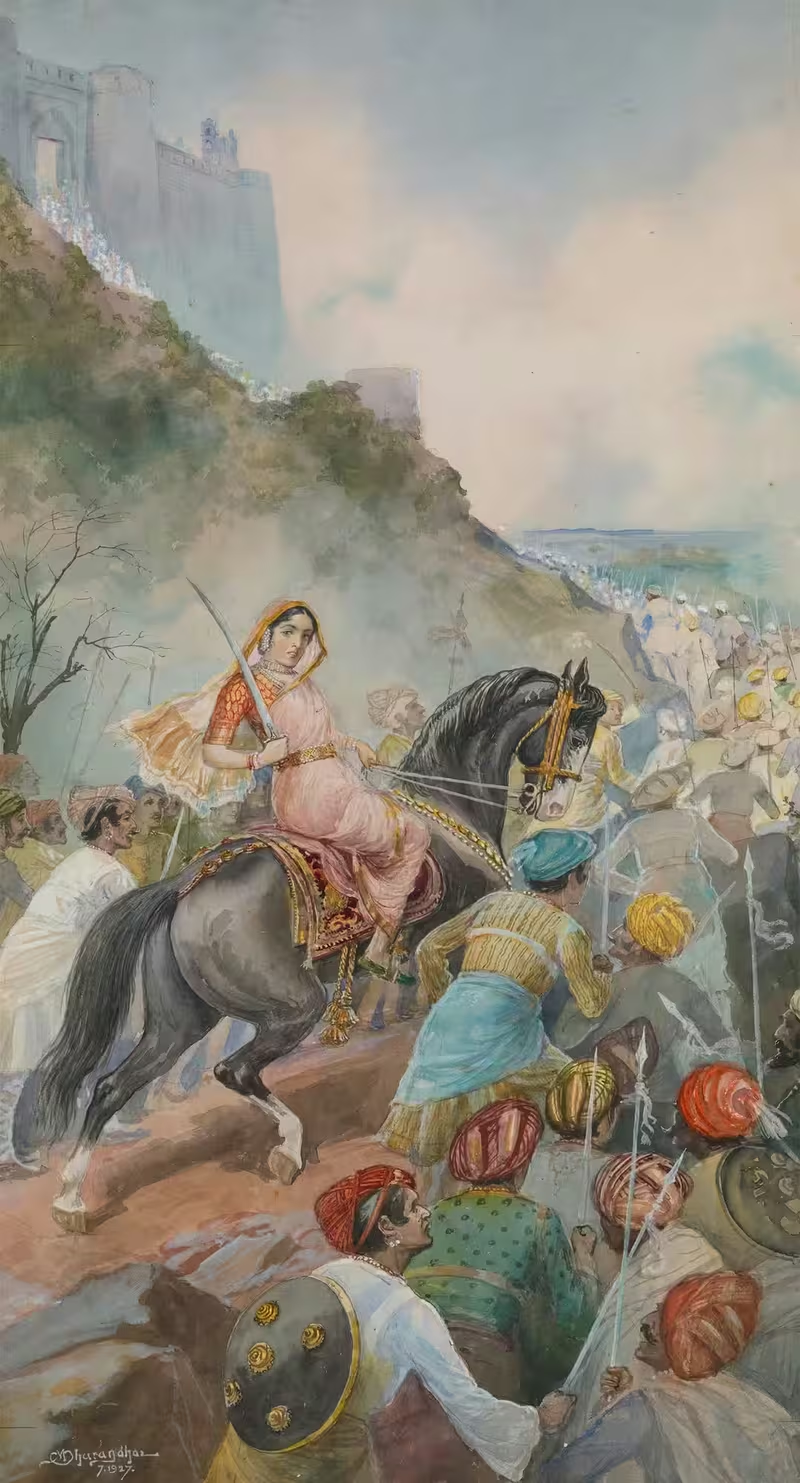
The Queen of the Marathas: Maharani Tarabai Bhonsle
In the grand tapestry of Indian history, woven with tales of emperors and empires, few threads shine with the fierce, resilient brilliance of Maharani Tarabai Bhonsle (1675-1761). She was not a queen who inherited a stable throne but one who forged her authority in the crucible of war. At a time when the Maratha Empire faced its darkest hour, with its king dead and the formidable Mughal Emperor Aurangzeb poised for its annihilation, Tarabai rose not merely as a regent, but as the very shield of her people. For seven critical years, this warrior queen stared down the most powerful man in the world and did not blink, orchestrating a resistance so tenacious that it exhausted the Mughal war machine and irrevocably altered the destiny of India.
Early Life: Forged in the Shadow of a New Empire
Tarabai was born in 1675 into a world of conflict and aspiration. She was the daughter of Hambirrao Mohite, the celebrated Sarsenapati (Commander-in-Chief) of Chhatrapati Shivaji Maharaj's army. Her lineage was not just noble; it was martial. From her earliest days, she was surrounded by the architects of Maratha Swaraj (self-rule). The court she grew up in was not one of idle luxury but a dynamic hub of strategy, statecraft, and constant military readiness. The air itself was thick with discussions of guerrilla warfare, fort management, and the grand vision of an independent Maratha polity.
At the tender age of eight, she was married to Rajaram, the younger son of Shivaji Maharaj. This union cemented her family's high standing and placed her directly at the heart of the Maratha royal family. While specific records of her formal education are scarce, her later actions are a testament to an exceptional upbringing. She was evidently well-versed in military strategy, political administration, and diplomacy, skills honed by observing her father and the complex machinery of Shivaji's court. She was not raised to be a sheltered queen but a partner in the great Maratha enterprise.
The Crucible: Rise from Queen Consort to Warrior Regent
The late 17th century was a period of existential crisis for the Marathas. Following the death of Shivaji in 1680, Emperor Aurangzeb, sensing weakness, descended upon the Deccan with the full, overwhelming might of the Mughal Empire. In 1689, the Marathas suffered a catastrophic blow: Chhatrapati Sambhaji Maharaj, Shivaji's successor, was captured and brutally executed. The capital, Raigad, fell, and the royal family was scattered.
In this chaos, Tarabai's husband, Rajaram, became the new Chhatrapati. To escape the Mughal dragnet, he undertook a perilous journey south to the fort of Jinji (Gingee) in modern-day Tamil Nadu, establishing a court-in-exile. Tarabai accompanied him, witnessing firsthand the brutal realities of a kingdom under siege. The years at Jinji were her political apprenticeship, where she observed the decentralized, fluid nature of Maratha warfare and the immense challenge of holding an empire together from a distance.
In March 1700, disaster struck again. Rajaram, who had recently returned to Maharashtra, died of an illness at Sinhagad fort. The Maratha cause seemed utterly lost. Their king was dead, their treasury was depleted, and the aged but relentless Aurangzeb was personally overseeing the campaign to crush them once and for all. Many Maratha sardars (commanders) were demoralized, considering surrender.
It was in this moment of profound despair that the 25-year-old widow, Tarabai, stepped into the breach. Brushing aside court intrigues and patriarchal conventions, she acted with astonishing speed and resolve. She declared her infant son, Shivaji II, as the heir and proclaimed herself the Regent. It was an audacious move, a direct challenge to both internal defeatism and external aggression. She refused to be a grieving widow; she chose to be a warrior.
The Seven-Year War: Defying an Emperor
The period from 1700 to 1707 marks the zenith of Tarabai's career and her most enduring legacy. She transformed a desperate, defensive struggle into a full-blown war of attrition that would break the back of the Mughal Empire. Her leadership was not symbolic; it was direct, hands-on, and brilliant.
A Master of Strategy: Tarabai understood that the Marathas could not defeat the vast, heavily armed Mughal army in conventional, pitched battles. Instead, she embraced and perfected Shivaji's strategy of ganimi kava (guerrilla warfare). She authorized her commanders—men like Dhanaji Jadhav and Santaji Ghorpade—to lead lightning-fast raids deep into Mughal territory, striking at their supply lines, disrupting their communications, and plundering their wealthy provinces in Malwa and Gujarat. This audacious strategy served two purposes: it replenished the Maratha treasury and demoralized the enemy, turning their own lands against them.
Administrative Genius: While her generals fought in the field, Tarabai managed the state. She moved constantly between the great hill forts of Maharashtra, such as Panhala and Vishalgad, turning them into command centers. She personally directed operations, appointed officers based on merit, and established an efficient intelligence network that kept her informed of Mughal movements. She held court, dispensed justice, and managed revenues, ensuring that the war effort never flagged for want of resources or leadership.
Her incredible capacity did not go unnoticed by her enemies. The Mughal historian Khafi Khan, who had little reason to praise a Maratha leader, wrote with grudging admiration:
"She was a clever, intelligent woman, and had obtained a reputation during her husband's lifetime for her knowledge of civil and military matters... She won the hearts of her officers, and for all the struggles and schemes, the campaigns and sieges of Aurangzeb up to the end of his reign, the power of the Marathas waxed and became so consolidated that they penetrated into the old territories of the imperial throne, plundering and levying blackmail from far beyond the Deccan."
Aurangzeb, accustomed to swift victories, found himself trapped in a frustrating quagmire. For every fort he captured after a long and costly siege, the Marathas would simply reclaim another. The Deccan plateau, which he had intended to be his crowning conquest, became a graveyard for his armies and his treasury. The war, which he had begun in 1681, stretched into its third decade, with no end in sight. The relentless resistance led by Tarabai had broken not just his army, but his will. In 1707, a weary and disillusioned Aurangzeb died in Ahmednagar, his Deccan dream in ruins. His death was, in many ways, Tarabai's greatest victory.
A Kingdom Divided: The Civil War and Political Decline
The withdrawal of the Mughal threat did not bring peace. Instead, it created a new, internal conflict. In a shrewd political move, Aurangzeb's successor, Bahadur Shah I, released Shahu, the son of the executed Sambhaji Maharaj, who had been a captive in the Mughal court since 1689. Shahu's return split the Maratha leadership.
Tarabai viewed Shahu as a Mughal pawn, raised in the enemy camp and unfit to lead an independent Maratha state. She fiercely contested his claim to the throne, championing the legitimacy of her son, Shivaji II. This led to a tragic civil war. At the Battle of Khed in 1707, Shahu, aided by the brilliant administrator Balaji Vishwanath (the future first Peshwa), defeated Tarabai's forces. Many influential Maratha sardars, swayed by Shahu's legitimate lineage as the elder heir, defected to his side.
Forced to retreat, Tarabai established a rival court at Panhala, which later became the capital of the Kolhapur kingdom. She continued to rule as regent for her son, creating a separate Maratha sphere of influence. However, her fortunes turned once more. In 1714, a palace coup orchestrated by her co-wife, Rajasbai, saw both Tarabai and her son imprisoned. Rajasbai placed her own son, Sambhaji II, on the Kolhapur throne. The warrior queen who had defied an emperor spent the next sixteen years as a political prisoner.
The Final Act: The Kingmaker of Satara
Tarabai's story, however, was not over. In 1730, she was released and went to live in Satara under the watch of Chhatrapati Shahu, who treated his aunt with courtesy. For nearly two decades, she remained in the political wilderness. But upon Shahu's death in 1749 without a male heir, the now 74-year-old Tarabai made a stunning final gambit for power.
The state was on the verge of being completely controlled by the powerful Peshwa, Balaji Baji Rao. At this critical juncture, Tarabai produced a young man named Ramraja, claiming he was her grandson, secretly raised in obscurity to protect him from assassins. She presented him as the legitimate heir to Shivaji's throne.
Initially, the Peshwa accepted her claim and Ramraja was crowned Chhatrapati. But Tarabai, seeking to reclaim the authority of the Bhonsle family from the Brahmin Peshwas, soon clashed with both the new king and the Peshwa. In a dramatic turn, she declared Ramraja an imposter and, in 1750, imprisoned him in Satara fort. She attempted to rule in his name, but the Peshwa's power was too deeply entrenched. Ultimately, she was forced to reconcile with the Peshwa, accepting his de facto control while she retained nominal authority over the Satara court. She passed away in 1761, at the remarkable age of 86, having outlived nearly all her allies and adversaries.
Legacy: The Indomitable Spirit of Swaraj
Maharani Tarabai Bhonsle's legacy is monumental. Her most critical contribution was the salvation of the Maratha Empire. In the seven years following Rajaram's death, she was the single most important reason the Maratha state did not collapse. Her leadership transformed a regional power into a pan-Indian force that would dominate the 18th century.
She stands as a towering figure of female power in Indian history. In an age dominated by men, she commanded armies, managed a sprawling state, and dictated policy, earning the respect and fear of her contemporaries. She was not merely a queen; she was a sovereign in her own right, whose strategic vision and indomitable will were a match for the greatest empire of her time.
Her life was a saga of dizzying highs and crushing lows—a queen, a regent, a celebrated warrior, a prisoner, and a kingmaker. Through it all, she embodied the fierce, unyielding spirit of Maratha Swaraj. Maharani Tarabai Bhonsle remains an enduring symbol of courage, resilience, and the profound impact one leader can have in the darkest of times.