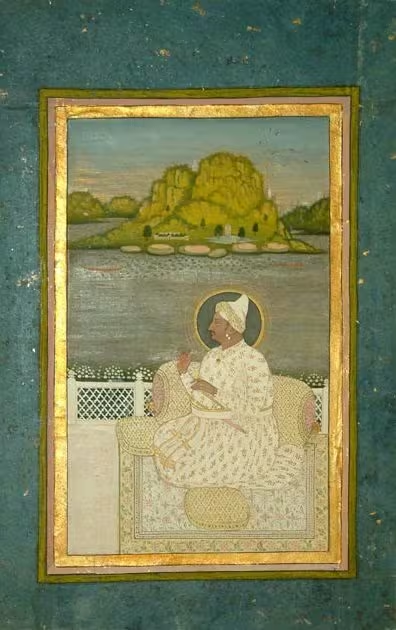
The Architect of an Empire: Raja Todar Mal
In the grand tapestry of the Mughal Empire, woven with threads of conquest, culture, and colossal ambition, the name Raja Todar Mal stands out not as a king or a conqueror, but as the master weaver of its very fabric. He was the administrative genius, the financial visionary who transformed Akbar’s sprawling territories from a loosely held collection of domains into a structured, stable, and prosperous state. While emperors wielded the sword, Todar Mal wielded the pen, the ledger, and the measuring rod, creating a system of governance so robust that its echoes can be found in the administrative DNA of the Indian subcontinent centuries later. As one of the legendary Navratnas (Nine Jewels) of Akbar’s court, his story is one of merit, meticulousness, and the enduring power of good governance.
Early Life & Background
Born around 1503 in the town of Laharpur in modern-day Uttar Pradesh, Todar Mal came from a Hindu Khatri family. The historical records, including the detailed chronicles of Akbar’s reign, are largely silent on the specifics of his early years and education. This silence, however, speaks volumes about the man he would become. He enters the stage of history not through noble lineage but through sheer, undeniable competence. His profound understanding of accountancy, logistics, and public administration suggests a rigorous and practical education, honed not in the courts of kings but likely in the crucible of local revenue management.
His talents were too bright to remain confined. The first major chronicled chapter of his life begins not with the Mughals, but with their formidable rival, the Afghan ruler Sher Shah Suri.
Career & Major Contributions
Todar Mal’s career is a masterclass in adaptability and excellence, marked by loyal service to different masters and a consistent rise based purely on his capabilities. He was a rare figure who was not just a bureaucrat but also a capable military commander, demonstrating a versatility that made him indispensable.
Service under Sher Shah Suri
Before Akbar's reign consolidated Mughal power, the brief but brilliant rule of Sher Shah Suri laid the groundwork for many of the administrative reforms that would later define the Mughal era. It was in this dynamic environment that Todar Mal first made his mark. His most notable achievement under Suri was the construction of the formidable Rohtas Fort in Punjab.
This was no simple building project. The fort was a strategic necessity, designed to subdue the rebellious Gakhar tribes of the region. The Gakhars actively resisted its construction, refusing to work for wages. It was here that Todar Mal’s administrative acumen shone. According to historical accounts, he implemented a clever economic strategy, initially offering one red ashrafi (gold coin) for every stone slab delivered. When the Gakhars, tempted by the high price, began to supply stones, he progressively lowered the rate. This deft management of resources and human psychology ensured the completion of a critical military outpost and cemented his reputation as a man who could deliver results under the most challenging circumstances.
Rise in the Mughal Administration
Following the collapse of the Sur Empire and the restoration of Mughal rule under Humayun, Todar Mal’s skills were quickly recognized by the new regime. He formally entered Mughal service under Emperor Akbar, who had an uncanny eye for talent, regardless of faith or background. His initial roles involved surveying and managing revenue in various territories, where he consistently impressed the young emperor with his integrity and efficiency.
However, Todar Mal was far from a desk-bound official. Akbar entrusted him with crucial responsibilities on the battlefield, where he proved to be a cool-headed and reliable commander.
The Gujarat Campaign (1572-73): After Akbar’s swift conquest of the wealthy province of Gujarat, the monumental task of assessing its land and establishing a stable revenue system was handed to Todar Mal. Within a short period, he conducted a thorough survey and settlement, laying the administrative foundation for Mughal rule in this vital coastal region. This exercise served as a crucial pilot project for the grand reforms he would later implement across the empire.
The Bengal Campaign (1575-76): His military prowess was put to its greatest test in the arduous campaign to annex Bengal from the Afghan ruler Daud Khan Karrani. Serving alongside the Mughal governor Munim Khan, Todar Mal was the strategic backbone of the army. At the decisive Battle of Tukaroi (1575), when the Mughal vanguard collapsed and Munim Khan was wounded, panic began to set in. It was Todar Mal who rallied the troops, refusing to retreat and declaring, “The empire is ours!” His steadfastness turned the tide, leading to a crucial Mughal victory. He pursued the enemy relentlessly and was instrumental in securing the treaty that followed.
His service as a mansabdar (a military and administrative rank) saw him lead campaigns across the empire, proving that the man of numbers was equally a man of war.
The Architect of Mughal Finance: The Dahsala System
Todar Mal's most enduring legacy is the revolutionary land revenue system known as the Dahsala Bandobast (or Zabti system), formally instituted around 1580. Before this, the Mughal revenue system was often inconsistent, relying on annual estimates, crop-sharing agreements (batai), or other ad-hoc arrangements. These methods were prone to corruption, created uncertainty for the peasants, and made state income unpredictable.
Appointed as the Diwan-i-Ashraf (head of the finance ministry) in 1582, Todar Mal implemented a comprehensive, data-driven system that would become the financial bedrock of the empire for over a century. It was a marvel of systematic administration:
Standardized Measurement (Paimaish): The first step was to accurately measure the land. Todar Mal replaced the easily manipulated hemp rope with a standardized bamboo rod (tanab) joined by iron rings. This simple innovation prevented fraud and ensured that land records were precise.
Land Classification: All land was surveyed and classified into four categories based on the continuity of its cultivation:
- Polaj: Land that was cultivated annually.
- Parauti: Land left fallow for a year or two to recover fertility.
- Chachar: Land left uncultivated for three to four years.
- Banjar: Land left uncultivated for five or more years.
This system was inherently fair. Taxes were levied at a lower rate on less fertile or fallow lands, encouraging farmers to bring them back into cultivation.
Data Collection - The Ten-Year Average: The core of the Dahsala (ten-year) system was its use of extensive data. For each administrative region (dastur), Todar Mal’s officials compiled crop yield and price data for the previous ten years (from the 15th to the 24th year of Akbar's reign, 1570-1580).
Fixing the State's Share: Based on this ten-year data, an average yield for each crop was calculated. The state's share was then fixed at one-third of this average produce. This share was then converted into a cash rate (dastur-ul-amal) based on the average price of that crop over the same ten-year period. The result was a fixed, per-unit-of-area cash tax for each crop, which would remain stable for a period of time.
The Impact of the Dahsala System was profound:
- Certainty for All: The peasant knew exactly how much tax he had to pay, and the state knew exactly how much revenue it could expect. This stability fostered agricultural investment and planning.
- Reduced Corruption: By fixing the rates, the system minimized the discretionary power of local tax collectors and officials (amils and karkuns), who could no longer extort peasants.
- Stimulated the Economy: The demand for cash payments encouraged the cultivation of cash crops and monetized the rural economy, integrating it more closely with urban markets.
- Centralized Control: It created a unified and systematic financial administration directly controlled by the central government, strengthening the emperor's authority over distant provinces.
Furthermore, Todar Mal made Persian the mandatory language of Mughal administration. This move streamlined record-keeping and created a unified class of literate officials across the empire, further cementing central control.
Legacy & Influence
Raja Todar Mal passed away in 1589 in Lahore, shortly after returning from a campaign. An anecdote from his final years perfectly captures his indispensability. Feeling his age, he sought Akbar's permission to retire to Haridwar to spend his last days in prayer. The emperor reluctantly agreed, but Todar Mal had barely departed when Akbar sent an urgent message recalling him, stating that his duty to serve the people was a form of worship far greater than any pilgrimage. He returned to his post and served until his death.
His legacy is monumental and multifaceted:
The Foundation of Mughal Prosperity: The financial and administrative systems he designed were the engine of the Mughal Empire's golden age. The immense wealth that funded the architectural splendors of Shah Jahan and the empire's vast armies was a direct result of the stability Todar Mal's reforms provided.
A Blueprint for Future Governance: The principles of the Dahsala system—systematic land survey, classification, and fixed revenue rates—became the gold standard for Indian administration. Elements of his system were adopted by the Marathas and, centuries later, heavily influenced the land settlement policies of the British Raj, particularly the Ryotwari system.
A Symbol of Meritocracy: In an age defined by birthright, Todar Mal’s rise to one of the highest offices in the empire is a powerful testament to Akbar’s policy of promoting talent regardless of religion. He remained a devout Hindu throughout his life, and his success demonstrated that skill and loyalty were the ultimate currencies in Akbar's court.
Patron of Culture: Beyond his administrative work, Todar Mal was also a patron of his faith. He is widely credited with rebuilding the revered Kashi Vishwanath Temple in Varanasi in 1585, a site that had been demolished by earlier rulers. This act cemented his place not just as an imperial official, but as a pillar of his community.
Today, Raja Todar Mal is remembered not for the battles he won, but for the order he created. He was the silent architect who designed the scaffolding that allowed the Mughal Empire to reach its magnificent heights. His work ensured that the empire was more than just a military conquest; it was a functioning, organized, and enduring state, a legacy of a mind that saw a grand design in the humble details of a peasant’s field and a state’s ledger.