Tukaram: The Soul of Maharashtra's Bhakti Movement
In the fertile plains of the Deccan, during a time of great political upheaval and social rigidity, a voice arose from the heart of a common man—a voice so pure, so honest, and so filled with divine love that it would echo through the centuries. This was the voice of Tukaram (1577-1650), a grocer from the town of Dehu who became one of the most revered saint-poets in Indian history. His life was a testament to the power of unwavering faith in the face of immense personal tragedy and societal opposition. Through his thousands of lyrical, soul-stirring poems, known as Abhangas, Tukaram not only expressed his intimate relationship with his beloved deity, Vitthala, but also challenged the hollow rituals and oppressive social hierarchies of his time, forever shaping the spiritual and cultural landscape of Maharashtra.
Early Life & Background
Birth in the Land of Saints
Tukaram was born in Dehu, a small town on the banks of the sacred Indrayani river, near modern-day Pune. His family, with the surname More, belonged to the Kunbi (cultivator) or Vani (grocer) caste. His parents, Bolhoba and Kanakai, were devout followers of the Varkari Sampradaya, a deeply rooted Bhakti tradition centered on the worship of Vitthala of Pandharpur. The Varkari faith, with its emphasis on egalitarianism, simple devotion, and the annual pilgrimage (wari) to Pandharpur, was the spiritual bedrock of Tukaram's household. From his earliest days, he was immersed in the chants, songs, and stories of a lineage of saints like Dnyaneshwar, Namdev, and Eknath, whose teachings flowed through the community like the river beside his home.
A Life Interrupted by Tragedy
As a young man, Tukaram followed the family trade, taking on the responsibilities of a householder. He was married twice; his first wife, Rakhumabai, was of frail health, and he later married Jijabai (often called Avali), who was known for her worldly and pragmatic nature. For a time, his life was one of ordinary commerce and domesticity. However, this semblance of normalcy was shattered by a catastrophic famine that ravaged the Deccan region between 1629 and 1631. This event was a crucible that forged his spiritual destiny.
The famine brought unimaginable suffering. Crops failed, businesses collapsed, and starvation was rampant. Tukaram witnessed death and despair on a scale that broke his spirit. He lost his parents, his first wife Rakhumabai, and one of his sons to the famine. His business failed, leaving him in debt and despair. This profound personal loss and the immense suffering he saw around him triggered a deep spiritual crisis. He lost all interest in worldly pursuits, viewing them as transient and illusory.
Seeking solace and answers, Tukaram retreated from the world. He began spending long periods in solitude, meditating on the nearby Bhandara and Bhamnath hills. He immersed himself in the study of the works of his spiritual predecessors—Dnyaneshwar's Dnyaneshwari, Eknath's Bhagavata, and Namdev's vast corpus of Abhangas. He did not receive a formal Sanskrit-based education like a Brahmin scholar; his learning was direct, experiential, and rooted in the vernacular Marathi traditions of the Varkari saints. It was in this period of intense introspection, grief, and spiritual seeking that the poet within him was born.
The Path of Bhakti: Career & Major Contributions
The Voice of Vitthala
Emerging from his period of seclusion, Tukaram was a transformed man. His heart overflowed with devotion for Vitthala, the compassionate, brick-standing deity of Pandharpur. This devotion began to pour out of him in the form of Abhangas—literally, 'unbroken' or 'uninterrupted' verses. These were not complex theological treatises but spontaneous, heartfelt conversations with his God. Composed in simple, everyday Marathi, his poetry was raw, autobiographical, and intensely emotional. He spoke of his doubts, his despair, his moments of ecstatic union with the divine, and his observations of the world around him.
His Abhangas covered a vast spectrum of themes:
- Personal Devotion: Many verses are direct appeals to Vitthala, whom he addressed as a friend, a mother, a father, and a master. He pleaded, argued, celebrated, and complained, showcasing an intimacy with the divine that was revolutionary.
- Social Critique: Tukaram was an unflinching critic of social hypocrisy. He condemned caste arrogance, the emptiness of ritual without devotion, the greed of false holy men, and the vanity of worldly power. He famously wrote, "He who experiences the pain of others is a true saint, and God resides in him."
- Moral and Ethical Teachings: His poetry is rich with practical wisdom, advising listeners on humility, compassion, truthfulness, and the importance of selfless service.
Kirtan: The Stage for Spiritual Revolution
Tukaram's primary medium for sharing his insights was the kirtan, a form of musical discourse. Standing before the village temple in Dehu, he would sing his Abhangas, weaving them together with stories and commentary. His kirtans were not exclusive gatherings; they attracted people from all walks of life—farmers, laborers, women, and even those considered 'low-caste'. In a society rigidly divided by caste, his stage was a space of radical equality where the only qualification was a yearning heart. His powerful, authentic voice and the emotional depth of his poetry held audiences captive, creating a powerful sense of shared spiritual community.
Conflict with Orthodoxy: The Trial by Water
Tukaram's growing popularity and his message of devotion over ritual brought him into direct conflict with the orthodox Brahmin establishment. Figures like Rameshwar Bhat, a learned scholar, saw Tukaram—a Shudra by caste—as a threat. They argued that he had no right to interpret sacred texts or preach religious truths. The conflict reached a climax when Tukaram was ordered to destroy his life's work by sinking his manuscripts into the Indrayani river.
This was a moment of profound crisis. To Tukaram, his Abhangas were not mere poems but divine revelations. With a heavy heart, he complied with the decree. The traditional account of what followed has become a cornerstone of his legend. For thirteen days, Tukaram sat on the riverbank, fasting and praying to Vitthala, refusing to eat or drink until his work was returned. On the thirteenth day, the manuscripts miraculously reappeared, floating on the surface of the water, completely unharmed. While historians view this as a powerful hagiographical narrative, the story symbolizes a profound victory: the triumph of authentic, heartfelt devotion over rigid, dogmatic authority. The event silenced many of his critics and solidified his status as a true saint in the eyes of the common people.
Influence on Shivaji Maharaj
Tukaram’s era coincided with the rise of the Maratha warrior-king, Chhatrapati Shivaji Maharaj. The saint's teachings of righteousness, duty (dharma), and spiritual strength provided a moral and cultural foundation for the nascent Maratha identity and the movement for Swaraj (self-rule). Traditional accounts tell of Shivaji's deep reverence for Tukaram. It is said that Shivaji, moved by his kirtans, once sought to renounce his kingdom and become Tukaram's disciple. The saint gently dissuaded him, reminding the king that his dharma was to rule with justice and protect his people. He refused the lavish gifts Shivaji offered, underscoring his complete detachment from worldly wealth. This interaction, whether literal or symbolic, highlights the immense moral authority Tukaram commanded, influencing even the most powerful figures of his time.
Legacy & Influence
The Spire of the Varkari Temple
In the Varkari tradition, the lineage of saints is often envisioned as a temple, with Dnyaneshwar laying the foundation and Namdev building the walls. Sant Tukaram is revered as the kalas, the crowning spire of this temple. He did not start a new sect, but he revitalized and consolidated the Bhakti movement in Maharashtra, making its philosophy accessible to every household. His Tukaram Gatha, the definitive collection of his Abhangas, is considered a sacred text by the Varkaris, second only to the Dnyaneshwari.
A Literary and Musical Titan
Tukaram's impact on Marathi literature is immeasurable. He demonstrated the profound philosophical and emotional capacity of the vernacular language, elevating it to a vehicle for the highest spiritual expression. His simple, direct, and powerful style has influenced generations of writers. His Abhangas are not just read; they are sung. They form the core of a genre of devotional music known as abhangavani, and are an integral part of classical and folk music traditions across Maharashtra.
An Enduring Social and Spiritual Symbol
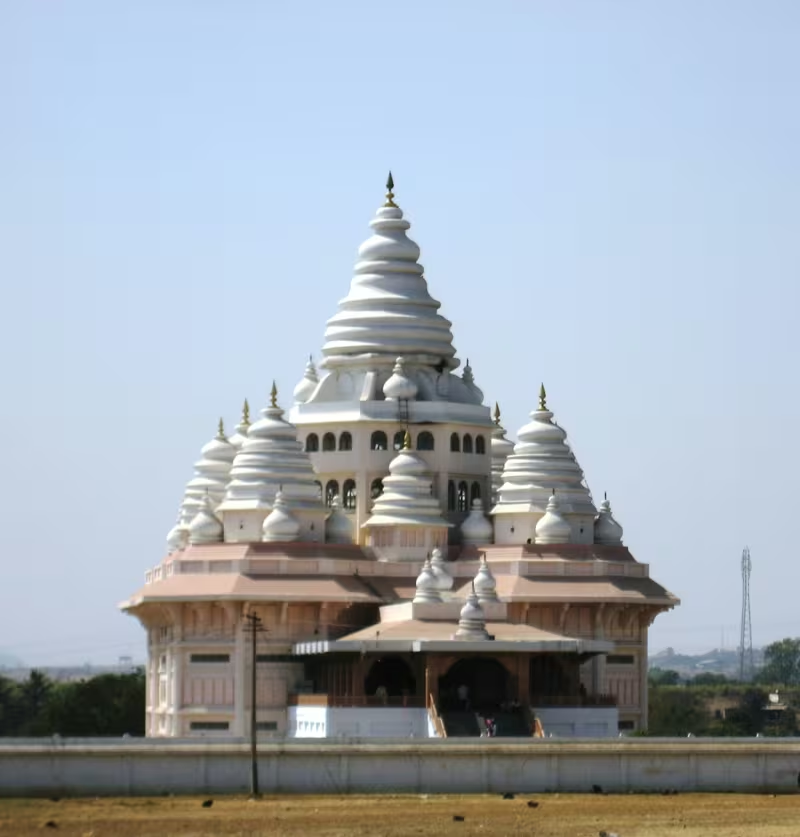
Today, Sant Tukaram's legacy is more vibrant than ever. His hometown of Dehu is a major pilgrimage center. Every year, the wari pilgrimage to Pandharpur begins with his palkhi (palanquin) carrying his symbolic sandals from Dehu, with hundreds of thousands of devotees walking for weeks, singing his Abhangas along the way. This living tradition is a powerful testament to his enduring influence.
His life and teachings continue to resonate because they speak to universal human experiences: suffering, seeking, doubt, and the profound joy of love and faith. In a world still grappling with inequality and intolerance, Tukaram’s unwavering belief in a God who resides in all beings, regardless of caste or creed, remains a radical and deeply relevant message of hope and unity.
The grocer from Dehu who spoke to God in the language of the people ultimately became the voice of a civilization. His life remains a powerful reminder that the deepest spiritual truths are not confined to ancient scriptures or ornate temples, but can be found in a sincere heart, an honest voice, and a life lived in unwavering devotion.