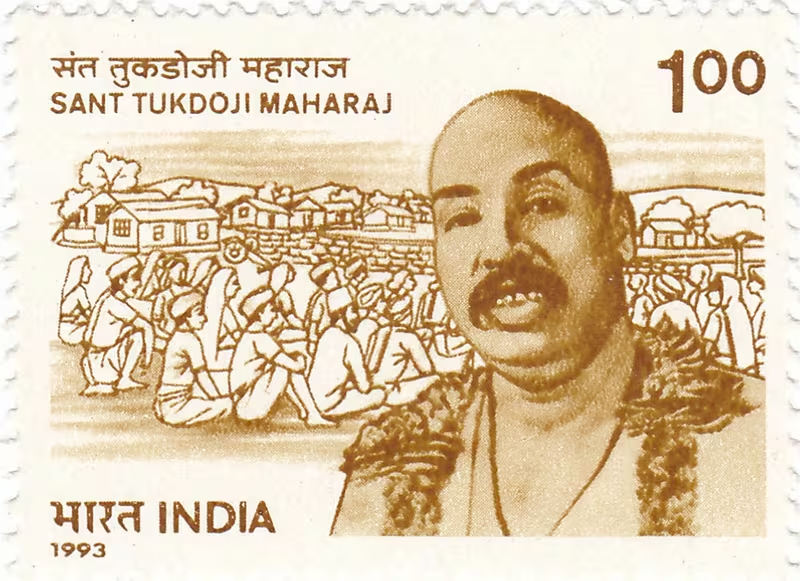
A Saint for the Nation: The Life and Legacy of Tukdoji Maharaj
In the tumultuous landscape of early 20th-century India, a time of fervent nationalism and deep-seated social challenges, a unique voice emerged from the soil of Maharashtra. It was a voice that sang not only of divine devotion but also of national duty, social justice, and rural self-reliance. This was the voice of Tukdoji Maharaj, a spiritual leader who transcended the confines of an ashram to become a powerful force for social transformation. He was a saint who walked among the people, a poet whose words ignited a revolution in the villages, and a patriot whose actions earned him the revered title of Rashtrasant—the National Saint. His life is a testament to the profound idea that true spirituality lies not in renouncing the world, but in reforming it.
Early Life & Spiritual Awakening
Tukdoji Maharaj was born Manik Bandoji Ingle on April 30, 1909, in the small village of Yawali in the Amravati district of Maharashtra. His origins were humble, a fact that grounded him in the realities of rural life—its poverty, its social stratification, and its untapped potential. From a young age, Manik displayed little interest in formal schooling. Instead, he was drawn to the spiritual and devotional traditions that permeated the cultural fabric of his region. He spent hours in solitude, meditating and composing simple devotional verses, or bhajans.
His spiritual quest led him to the guidance of Guru Adkoji Maharaj of Warkhed. This mentorship was a pivotal turning point. Recognizing the young boy's innate poetic and spiritual talent, Adkoji Maharaj gave him a new name. Because Manik composed poignant, short couplets known as tukdas, his guru affectionately called him "Tukdya," or Tukdoji. The name stuck, and Manik Ingle began his journey as Tukdoji Maharaj.
Seeking deeper spiritual realization, Tukdoji embarked on a period of intense sadhana (spiritual practice) in the dense forests of Ramtek, near Nagpur. This period of austerity and contemplation was profoundly formative. It was here that he honed his philosophical vision, a unique synthesis of Vedantic wisdom, the devotional path of the Bhakti saints, and a pragmatic approach to social service. He emerged from this period not as a recluse, but as a dynamic spiritual leader with a clear mission: to awaken the soul of rural India.
Career & Major Contributions
Tukdoji Maharaj’s career was a masterclass in grassroots activism fueled by spiritual energy. He understood that to reform India, one had to begin with its villages. His contributions were multifaceted, addressing everything from social evils and national identity to global peace.
The Kirtan as a Tool for Mass Education
His primary instrument of change was the traditional kirtan—a form of musical storytelling and devotional singing. In his hands, the kirtan was transformed from a purely religious performance into a powerful platform for mass education. He used simple, accessible language—a blend of Marathi and Hindi—to speak directly to the hearts and minds of the common people. His kirtans were not just about mythology and devotion; they were vibrant discourses on:
- Social Reform: He fiercely attacked the evils of the caste system, untouchability, superstition, and ruinous customs like extravagant wedding expenses and animal sacrifice.
- Public Health and Hygiene: He sang about the importance of cleanliness (
Swachhata), sanitation, and temperance, urging villagers to give up alcohol and other addictions. - Nationalism: During the freedom struggle, his
kirtansbecame powerful calls for national unity and resistance against British rule.
To further break down social barriers, he introduced the concept of Samuhik Prarthana (community prayer). Thousands of people, irrespective of caste or creed, would gather to pray together, fostering a sense of unity and shared purpose.
The Gramgeeta: An Epic for the Village
Perhaps his most enduring contribution is his magnum opus, the Gramgeeta (The Song of the Village). Composed in simple, poetic language, this epic text is a comprehensive guide to rural reconstruction. It is a spiritual and practical handbook that lays out a blueprint for the ideal village, one that is self-reliant, harmonious, and prosperous. The Gramgeeta is not a theoretical treatise; it is a practical manual that covers:
- Gram Swaraj (Village Self-Rule): It details how villages can manage their own affairs, from governance to justice.
- Social Harmony: It provides guidance on resolving conflicts and eradicating caste and religious discrimination.
- Economic Development: It offers practical advice on agriculture, animal husbandry, and local industries.
- Education and Health: It emphasizes the need for education for all and outlines principles of healthy living.
In essence, the Gramgeeta codified his life's message: the divine can be found in the service of the community, and the path to national salvation runs through the revitalized lanes of India’s villages.
A Freedom Fighter and Nation-Builder
Tukdoji Maharaj was not a passive observer of the political churn around him. He was an active participant in India’s freedom struggle. His patriotic songs and fiery speeches inspired thousands to join the movement. During the Quit India Movement of 1942, he was a prominent voice of defiance, leading protests and mobilizing people across the Vidarbha region. His activism led to his arrest and imprisonment by the British authorities.
After India gained independence in 1947, his work took on a new dimension. He dedicated himself to the task of nation-building. He collaborated with other great leaders of his time, including Vinoba Bhave in the Bhoodan (land gift) Movement, which encouraged wealthy landowners to voluntarily donate land to the landless. He also played a crucial role in the rehabilitation of refugees following the Partition.
To institutionalize his efforts, he founded the Akhil Bharatiya Shri Gurudev Seva Mandal in 1943. This organization became the vehicle for carrying his message of service, reform, and spiritual development across the country, establishing a network of volunteers dedicated to rural upliftment.
Legacy & Influence
The impact of Tukdoji Maharaj on modern Indian history is profound and lasting. He demonstrated that spirituality and social action are two sides of the same coin. His legacy is not confined to ashrams or religious texts; it lives on in the empowered communities he helped build and the timeless principles he espoused.
The Title of "Rashtrasant"
In recognition of his selfless service to the nation, Dr. Rajendra Prasad, the first President of India, formally conferred upon him the title of Rashtrasant. This title was not merely an honorific; it was a perfect encapsulation of his identity. He was a Sant (saint) whose sadhana was the service of the Rashtra (nation). He bridged the gap between the spiritual and the secular, proving that a person of God could also be a patriot and a nation-builder of the highest order.
A Global Emissary of Peace
His influence extended beyond India's borders. In 1955, he was invited to the World Conference of Religions and World Peace in Japan. There, before a global audience, he shared his vision of universal brotherhood, religious harmony, and the importance of spiritual values in achieving world peace. He presented the Gramgeeta as a model not just for Indian villages, but for communities worldwide seeking a more harmonious and sustainable way of life.
Enduring Relevance
Tukdoji Maharaj passed away on October 11, 1968, but his teachings remain more relevant than ever. His emphasis on village self-reliance resonates with modern calls for decentralized governance and sustainable development. His passionate advocacy for cleanliness prefigured national campaigns like the Swachh Bharat Abhiyan. His message of social harmony and national integration is a powerful antidote to the divisive forces that challenge India today.
His ashram at Mozari in Amravati district continues to be a vibrant center of his work, and the Shri Gurudev Seva Mandal carries his mission forward. His bhajans are still sung in villages across Maharashtra, and the Gramgeeta continues to be read and revered as a source of practical wisdom and spiritual guidance.
Tukdoji Maharaj was a true Karma Yogi—a saint of action. He saw God in the poor, the downtrodden, and the forgotten. He did not ask people to retreat from the world to find salvation; he taught them to find it in the selfless service of their fellow human beings. He was a beacon of hope, a catalyst for change, and a spiritual architect of modern India, whose life and work remain an enduring source of inspiration for generations to come.