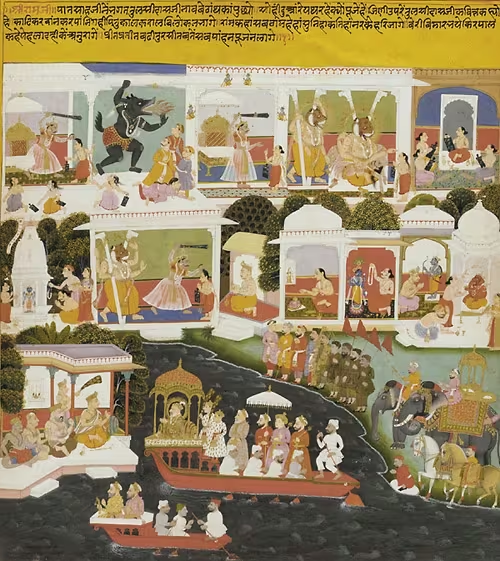
Tulsidas: The Soul of the Ramcharitmanas
In the vast, sprawling tapestry of medieval India, a period of immense political change and profound spiritual awakening, few voices echo through the centuries with the clarity and resonance of Goswami Tulsidas. He was not a king, a conqueror, or a court chronicler, but a humble poet-saint whose magnum opus, the Ramcharitmanas, would transcend the confines of literature to become the very soul of a culture. In the 16th century, as the Mughal Empire consolidated its power, Tulsidas embarked on a spiritual and literary quest: to bring the sacred story of Rama out of the exclusive domain of Sanskrit and into the hearts and homes of the common people. His work was a revolution, not of swords, but of words, one that democratized devotion and forever shaped the religious landscape of North India.
Early Life & Background
The precise details of Tulsidas's early life are shrouded in the mists of time, with hagiographical accounts often blending with historical fact. While traditional sources place his birth year around 1511 CE, modern scholarship often suggests a later date, closer to 1532. The location of his birth is similarly debated, with several places in present-day Uttar Pradesh, most notably Rajapur, laying claim to the honour.
According to traditional biographies, he was born as Rambola. These accounts often contain miraculous elements, suggesting he was born with a full set of teeth and uttered the name "Ram" at birth, portending his life's singular devotion. While these stories highlight his perceived spiritual destiny, verifiable historical records from this period of his life are scarce.
What is more certain is the trajectory of his formative years. After being left to fend for himself at a young age, he was adopted by the Vaishnava ascetic Narharidas, who became his first guru. Under Narharidas's tutelage at Sukar-khet (modern Soron), the young Tulsidas was initiated into the traditions of Vaishnavism and first heard the story of Rama. This was the foundational experience that would ignite a lifelong passion.
His quest for knowledge eventually led him to the sacred city of Varanasi (Kashi), the pre-eminent centre of Hindu learning. There, he studied under the guidance of the great scholar Shesha Sanatana. For over a decade, Tulsidas immersed himself in the study of the Sanskrit scriptures—the Vedas, the Upanishads, the Puranas, and the philosophical schools of Hindu thought. This rigorous classical education provided him with the profound scholarly depth that would later underpin his vernacular poetry.
Traditional accounts pinpoint a pivotal moment of personal transformation. After his education, he is said to have married a woman named Ratnavali and been deeply attached to her. The story goes that his wife, in a moment of frustration with his worldly attachment, sharply rebuked him, remarking that if he possessed even half the devotion for Lord Rama that he had for her, he would achieve salvation. These words, whether historical or allegorical, are said to have struck him like lightning, severing his worldly attachments and setting him firmly on the path of an ascetic, wholly dedicated to the devotion of Rama.
Career & Major Contributions
After renouncing worldly life, Tulsidas travelled extensively across India as a wandering mendicant, visiting sacred pilgrimage sites and absorbing the diverse spiritual currents of the time. His travels eventually brought him to Ayodhya, the legendary birthplace of Rama, and it was here that his life's greatest work would begin.
The Ramcharitmanas: A Lake of Rama's Deeds
Tulsidas's most significant contribution to world literature and Indian spirituality is the Ramcharitmanas ("The Lake of the Deeds of Rama"). At the time, the epic story of Rama was primarily accessible through Valmiki's Ramayana, a sublime masterpiece composed in classical Sanskrit. While revered, its language made it inaccessible to the vast majority of the population who spoke vernacular dialects.
Tulsidas envisioned a retelling that would speak directly to the people in their own language. According to tradition, he received a divine command in a dream from Lord Shiva and Goddess Parvati in Varanasi to compose the epic in the common tongue. He began this monumental task in Ayodhya in the year 1574 CE (Vikram Samvat 1631), on Ram Navami, the day celebrating Rama's birth. Over the next two years, seven months, and twenty-six days, he meticulously crafted his epic, primarily in Ayodhya, with later portions completed in Varanasi.
His choice of language—Awadhi, an Eastern Hindi dialect spoken across the Gangetic plains—was a revolutionary act. It challenged the Brahminical orthodoxy that held Sanskrit as the only appropriate vehicle for sacred texts. The Ramcharitmanas was not a mere translation of Valmiki's work; it was a transcreation, a devotional retelling that infused the narrative with the profound emotionalism of the Bhakti movement. Tulsidas structured his epic into seven Kands (books), mirroring the original, but his focus was less on the epic's heroic grandeur and more on the divine grace and moral perfection of Rama. He presented Rama not only as an ideal king and man (Maryada Purushottam) but as the supreme, compassionate deity, an accessible object of loving devotion (bhakti).
The work's poetic brilliance, its simple yet profound philosophical insights, and its deep emotional appeal resonated powerfully with the public. It quickly spread throughout North India, recited in temples, sung by wandering bards, and shared in homes, becoming the most influential version of the Ramayana for millions.
Other Luminous Works
While the Ramcharitmanas remains his crowning achievement, Tulsidas was a prolific author with a dozen major works to his credit, showcasing his mastery over both Awadhi and Braj Bhasha dialects.
Vinaya Patrika (Petition of Humility): A deeply personal and moving collection of 279 hymns, structured as a petition to the court of Lord Rama. It is a masterpiece of devotional poetry, expressing the soul's yearning for divine grace and redemption from the frailties of the human condition.
Kavitavali: Composed in the Kavitta and Chhappai meters of Braj Bhasha, this work presents episodes from Rama's life with vivid, dramatic imagery, particularly focusing on the heroic and majestic aspects of his story.
Dohavali: A collection of over 500 independent couplets (dohas) and quatrains (sorathas) that dispense wisdom on morality, ethics, righteous living, and devotion. Many of these couplets have become popular proverbs in the Hindi-speaking world.
Hanuman Chalisa: Though its attribution is sometimes debated, Tulsidas is widely credited with composing this forty-verse hymn in praise of Hanuman. It is arguably one of the most widely recited religious texts in modern Hinduism, a powerful and beloved prayer for strength, courage, and divine protection.
Tulsidas spent the final decades of his long life in Varanasi, a revered figure. He is credited with founding the Sankatmochan Hanuman Temple at the spot where he is believed to have had a vision of the deity. He passed away in 1623 CE at Assi Ghat on the banks of the Ganga, leaving behind a literary and spiritual legacy of unparalleled magnitude.
Legacy & Influence
The impact of Goswami Tulsidas on Indian culture is immeasurable. His work was not merely a literary event but a socio-religious phenomenon that redefined the spiritual landscape of North India.
Spiritual and Religious Transformation
Tulsidas was the foremost saint of the Rambhakti (devotion to Rama) school. The Ramcharitmanas became the cornerstone of this tradition, effectively becoming the sacred scripture for hundreds of millions of people. For many, it is not just a poem but a divinely inspired text, a guide to righteous living and a source of spiritual solace. His portrayal of Rama as a compassionate, accessible God brought the divine into the everyday lives of ordinary people, fostering a deeply personal and emotional form of devotion that continues to thrive today.
Cultural Unification and the Ramlila
The Ramcharitmanas provided a common cultural and ethical framework for the Hindi heartland. Its verses transcended caste and creed, becoming a unifying force in a politically fragmented era. Perhaps its most vibrant legacy is the popularization of the Ramlila—the traditional folk enactment of Rama's life. While forms of Ram-centric theatre existed before him, Tulsidas's epic provided a standardized, universally accepted script. The annual Ramlila performances, now a UNESCO-recognized Intangible Cultural Heritage of Humanity, draw their dialogues, scenes, and devotional fervor directly from the pages of the Ramcharitmanas.
Literary Eminence
In the realm of literature, Tulsidas is regarded as one of the greatest poets in Indian history. He elevated the vernacular dialects of Awadhi and Braj Bhasha to the status of sublime literary languages, demonstrating that the deepest philosophical and emotional truths could be expressed with as much power and beauty as in classical Sanskrit. His masterful use of poetic meters like the doha and chaupai set a standard that influenced generations of subsequent Hindi poets.
Enduring Relevance
Today, Goswami Tulsidas is remembered not just as a poet but as a Jagatguru (world teacher) and a guiding light of the Bhakti tradition. His verses are quoted in daily conversation, his hymns are sung in temples and homes, and his life's work continues to be a source of moral and spiritual guidance. The ghat in Varanasi where he spent his final years is now known as Tulsi Ghat, a testament to his enduring presence. In a world often marked by division and conflict, the message of Tulsidas—of unwavering faith, righteous conduct, and universal love, all centered on the divine figure of Rama—remains as powerful and relevant as it was five centuries ago.