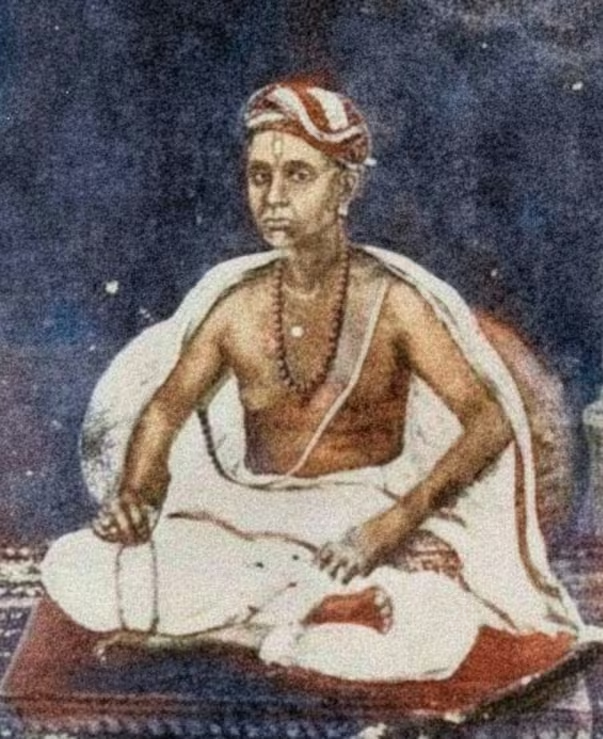
A Divine Melody: The Life and Legacy of Sadguru Sri Tyāgarāja Swāmi
In the fertile delta of the river Cauvery, a land steeped in centuries of art, music, and devotion, was born a soul whose voice would echo through the ages. Sadguru Sri Tyāgarāja Swāmi (1767-1847) was not merely a musician; he was a saint, a poet, and a spiritual revolutionary who transformed the very fabric of South Indian classical music. As one of the revered Trimurti (Trinity) of Carnatic music, his life was a testament to the power of bhakti (devotion), and his compositions remain the cornerstone of the art form, a divine bridge between the mortal and the eternal.
Early Life & Background: The Seeds of Devotion
Tyagaraja was born on the 4th of May, 1767, in the temple town of Tiruvarur in the Thanjavur district of modern-day Tamil Nadu. He was named Tyagaraja, after the presiding deity of the grand Tiruvarur temple, Lord Shiva. His parents, Kakarla Ramabrahmam and Sitamma, were Smarta Brahmins of the Mulukanadu sect, whose family had migrated from the Prakasam district of present-day Andhra Pradesh. This heritage is crucial, as Telugu, their mother tongue, would become the primary language for his divine outpourings.
The household was one of profound piety and learning. Ramabrahmam was a scholar and an exponent of the Ramayana, and the epic's hero, Lord Rama, was the family's chosen deity (ishta devata). From his earliest days, Tyagaraja was immersed in an atmosphere of sacred chanting, scriptural recitation, and devotional music. His mother, a singer of devotional hymns, provided his first exposure to the melodic arts. The stories of Rama were not just tales; they were the living, breathing reality of his childhood.
Recognizing his son's extraordinary musical aptitude, Ramabrahmam placed him under the tutelage of Sonti Venkataramanayya, one of the foremost music scholars of the Thanjavur court. Under his guru's guidance, the young Tyagaraja's genius blossomed. He absorbed the complex theoretical structures of Carnatic music, but for him, music was never a mere intellectual exercise. It was Nadopasana—worship through sound. He believed that the notes of the scale, the saptaswaras, had emerged from the primordial sound of Om, and to sing was to engage in a form of yoga, a direct communion with the divine.
His spiritual and musical education went hand in hand. He delved deep into the Vedas, the Upanishads, the Puranas, and other sacred texts, mastering both Sanskrit and Telugu. This profound scriptural knowledge would later form the philosophical bedrock of his compositions, lending them a depth and wisdom that transcended mere musicality.
Career & Major Contributions: A Life of Unwavering Devotion
Tyagaraja's career was a radical departure from the norm for musicians of his time. The 18th-century Thanjavur court, under rulers like King Serfoji II, was a vibrant hub of artistic patronage. Most accomplished musicians sought the stability and prestige of a court appointment. Tyagaraja, however, made a conscious and unwavering choice to reject all forms of royal patronage. He embraced a life of unchavritti, a simple, ascetic lifestyle of a mendicant, sustaining himself and his family on alms of rice collected daily.
This decision was not born of pride, but of principle. He believed his music belonged only to his Lord, Rama. To sing in praise of a mortal king, he felt, would be a betrayal of his art and his devotion. The most famous anecdote illustrating this resolve involves an invitation from King Serfoji II. The king, having heard of Tyagaraja's sublime music, sent emissaries laden with gifts, inviting him to be the royal composer. Tyagaraja unequivocally refused, spontaneously composing one of his most celebrated kritis, “Nidhi Chala Sukhama?” (“Does wealth bring more happiness?”). In this powerful composition in the raga Kalyani, he asks a profound question: What brings true happiness—proximity to the divine presence of Rama, or the fleeting treasures of the material world?
The Composer and His Masterpieces
Freed from the constraints of courtly life, Tyagaraja's creativity flowed like a sacred river. Tradition holds that he composed over 24,000 kritis, mirroring the number of verses in the Valmiki Ramayana, though only around 700 have survived to the present day. These compositions represent the pinnacle of the kriti form, a perfect and inseparable synthesis of sahitya (lyrics), raga (melody), and tala (rhythm).
His primary contributions include:
Perfection of the Kriti: While he did not invent the kriti, Tyagaraja refined its structure—consisting of a pallavi (refrain), anupallavi (second verse), and one or more charanams (stanzas)—into its most aesthetically and emotionally potent form. His kritis became the gold standard, a model for all subsequent composers.
The Pancharatna Kritis: Considered his magnum opus, the “Five Gems” are a set of five monumental compositions, each set in one of the five ghana (heavy or profound) ragas: Nata, Gaula, Arabhi, Varali, and Sri. These are not merely songs but elaborate musical theses, showcasing his complete mastery over every facet of Carnatic music—intricate rhythmic patterns, complex melodic improvisations (sangatis), and profound lyrical content. Composed in praise of Rama, they are the centerpiece of the annual Tyagaraja Aradhana festival.
Musical Dramas (Geya-natakas): Tyagaraja also authored two operas, demonstrating his skill in narrative composition. Prahlada Bhakti Vijayam tells the story of the devotee Prahlada, while Nauka Charitam (The Boat Story) is a beautiful and imaginative tale of Lord Krishna and the gopis on the Yamuna river. These works combine soulful music with engaging drama and philosophical depth.
Utsava Sampradaya and Divyanama Kritis: Understanding the need for communal worship, he also composed simpler, congregational pieces. The Utsava Sampradaya Kritis were designed to be sung during daily temple rituals (utsavams), while the Divyanama Kritis are choral songs that celebrate the divine names of the Lord. These works made his music accessible to all, not just trained concert artists.
His compositions are a universe unto themselves, expressing every shade of human and divine emotion. There is the joy of divine vision in “Kanugontini,” the anguish of separation in “Endaro Mahanubhavulu,” the philosophical inquiry in “Manasu Swaadheena,” and the absolute surrender in “Sarana Sarana.” He handled a vast array of ragas, popularizing many like Kharaharapriya and Harikambhoji, and his treatment of them became the definitive interpretation for generations to come.
Legacy & Influence: The Eternal Saint
On January 6, 1847, on the sacred day of Pushya Bahula Panchami, Tyagaraja attained samadhi in Tiruvaiyaru, on the banks of the Cauvery. But his presence never left the world of music. His legacy is immeasurable, a living tradition that continues to nourish and inspire.
The Trinity of Carnatic Music
Tyagaraja is revered as one of the Trimurti of Carnatic music, alongside his contemporaries, Muthuswami Dikshitar (1775-1835) and Syama Sastri (1762-1827). All three lived in the Thanjavur district and their collective genius shaped the future of the art form. While Sastri was a master of rhythm and Dikshitar a scholar of complex musical theory and Sanskrit poetry, Tyagaraja was the apostle of bhakti. His contribution was to infuse Carnatic music with an unparalleled emotional and spiritual intensity, making it a direct path to divine experience.
The Guru-Sishya Parampara
Tyagaraja's legacy was meticulously preserved and propagated by his numerous disciples. Through a strong guru-sishya parampara (master-disciple lineage), his compositions were passed down orally and later notated, ensuring their authenticity. Disciples like the Umayalpuram brothers (Krishna Bhagavathar and Sundara Bhagavathar) and Walajapet Venkataramana Bhagavathar became important torchbearers of his musical tradition.
The Tyagaraja Aradhana
Perhaps the most vibrant testament to his enduring influence is the Tyagaraja Aradhana, an annual festival held at his samadhi (memorial) in Tiruvaiyaru. Every year, during the anniversary of his passing, thousands of musicians, from venerable masters to young students, gather to pay homage. The highlight of the festival is the group rendering of the Pancharatna Kritis. The collective sound of hundreds of voices and instruments singing these masterpieces in unison is a powerful, soul-stirring experience—a symbol of the unity and devotion that Tyagaraja inspired.
An Enduring Inspiration
Today, Tyagaraja's compositions form the heart of any Carnatic music concert. No performance is considered complete without one of his kritis. His life story serves as an ideal for artistic integrity and spiritual conviction. He proved that the greatest art is not born in the luxury of palaces but in the purity of a heart devoted to a higher ideal. He was the poet of the soul, a composer who heard the music of the cosmos and translated it for humanity. In the timeless melodies of Sadguru Sri Tyāgarāja Swāmi, Lord Rama continues to live, and the path of devotion through music remains forever open.