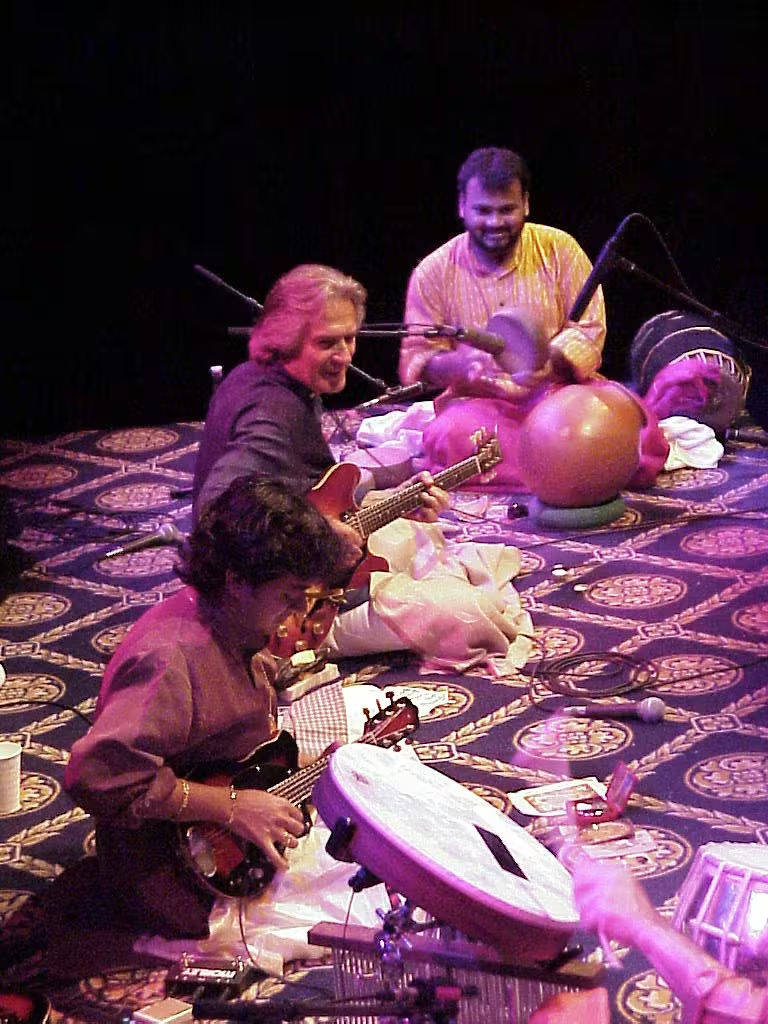
U. Srinivas - The Mandolin Maestro
In the hallowed halls of Carnatic music, a tradition defined by millennia of vocal purity and the venerable sounds of the veena, violin, and mridangam, a new voice emerged in the late 20th century. It was a sound at once alien and intimately familiar—a bright, crystalline tone that could cascade with lightning speed and yet bend and weep with the profound, microtonal grace of the human voice. This was the sound of the mandolin, an instrument of European folk origin, reborn in the hands of a boy wonder from Andhra Pradesh: Uppalapu Srinivas.
More than just a musician, U. Srinivas was a phenomenon. A child prodigy of almost divine ability, he single-handedly elevated the mandolin from a curious novelty to a mainstream solo instrument in the demanding world of South Indian classical music. His life, though tragically short, represents one of the most significant instrumental innovations in modern Indian history. He was not merely a performer; he was a pioneer who reimagined the boundaries of his art, earning the title 'Mandolin Srinivas' and forever fusing his name with the instrument he mastered.
The Dawn of a Prodigy: Early Life & Unlikely Beginnings
Uppalapu Srinivas was born on February 28, 1969, in Palakollu, a town in the West Godavari district of Andhra Pradesh. Music was the very air he breathed. His father, U. Satyanarayana, was a clarinetist and a student of the classical tradition, ensuring that the foundational notes of Carnatic music were a constant presence in the home. It was into this sonorous environment that a legend was born.
The fated encounter occurred when Srinivas was merely six years old. He discovered his father's mandolin, an instrument Satyanarayana played as a pastime. While his father taught his students, the young boy would listen intently. In private, he would pick up the small instrument and, with an intuition that defied his age, begin to replicate the complex Carnatic phrases he had overheard. When his father finally heard him, he was stunned. The boy was not just strumming; he was playing with a clarity and understanding that was nothing short of prodigious.
Recognizing this extraordinary gift, Satyanarayana became his son's first guru. However, they faced a formidable technical challenge. The standard acoustic mandolin, with its paired strings and fixed frets, was ill-suited for the soul of Carnatic music: the gamaka, the intricate oscillations and slides between notes that give each raga its unique emotional colour. A Western instrument could play the notes, but could it sing them?
This is where Srinivas's journey as an innovator began. He and his father began modifying the instrument. They switched to a solid-body electric mandolin, whose pickup and amplifier allowed for the long, sustained notes essential for Carnatic music. Crucially, they customized the stringing, reducing the standard eight strings to five (and sometimes four). This change in tension and spacing gave Srinivas the physical room to bend the strings, allowing him to coax out the delicate, soul-stirring gamakas that had, until then, been the exclusive domain of the voice, veena, and violin.
As his talent blossomed, his father knew the boy needed a master's guidance. He took him to Rudraraju Subbaraju, a seasoned vocalist and a disciple of the legendary Chembai Vaidyanatha Bhagavathar. Subbaraju was, by his own admission, initially skeptical. To teach the sacred compositions of the masters to a child holding an obscure foreign instrument seemed almost sacrilegious. He gave the young Srinivas a test, singing a difficult phrase and asking him to repeat it. The boy not only replicated it perfectly on his mandolin but embellished it with a fluency that left the guru speechless. From that moment on, Subbaraju dedicated himself to nurturing this once-in-a-generation talent.
The Ascent of a Maestro: A Revolutionary Career
Srinivas’s public ascent was meteoric. His first major performance was in 1978, at the Thyagaraja Aradhana festival in Gudivada, Andhra Pradesh. He was just nine years old. Word of the “boy with the mandolin” began to spread like wildfire through the classical music community.
The true turning point came in 1981. At the age of twelve, Srinivas was invited to perform during the prestigious December Music Season in Chennai, the epicenter of the Carnatic world. It was a daunting prospect. The Chennai audience was known for its deep knowledge and conservative tastes. Many arrived at the Indian Fine Arts Society that evening out of sheer curiosity, expecting to see a novelty act. What they witnessed was a revolution.
As the story goes, the notoriously sharp-penned and influential music critic Subbudu was in attendance. Initially dismissive, he was so captivated by the boy's virtuosity and profound musicality that he left his seat, rushed to the stage mid-concert, and garlanded the young artist—an unprecedented gesture of approval. That single performance shattered all skepticism. U. Srinivas was no longer a curiosity; he was a force of nature.
His technique was a marvel. He possessed a breathtaking command of rhythm (laya) and an encyclopedic knowledge of ragas. His playing style was a perfect synthesis of intellect and emotion. He could execute blistering-fast passages (durita kala) with flawless precision and then, in the next moment, render a slow, meditative alapana that explored the deepest emotional contours of a raga. He made the mandolin emulate the gayaki (singing) style, so much so that listeners often forgot they were hearing a fretted instrument and instead felt they were listening to a master vocalist.
By the mid-1980s, his fame had crossed national borders. He performed at the Berlin Jazz Festival in 1983, captivating a completely new audience. He would go on to grace the world's most prestigious stages, from London's Royal Albert Hall to the Hollywood Bowl, collaborating with a diverse array of global musicians.
One of his most significant international collaborations began in the late 1990s when he was invited by the legendary British jazz-fusion guitarist John McLaughlin to join his iconic group, Remember Shakti. Taking the place of violinist L. Shankar, Srinivas joined a pantheon of virtuosos including Zakir Hussain on tabla, Shankar Mahadevan on vocals, and V. Selvaganesh on kanjira. His electrifying duels with McLaughlin became the stuff of legend, a brilliant dialogue between two distinct musical philosophies. Through Shakti, Srinivas introduced the Carnatic mandolin to a massive global audience, demonstrating its power and versatility on the world stage.
His collaborative spirit knew no bounds, leading him to work with artists like Michael Nyman, Michael Brook, Nigel Kennedy, and Trey Gunn. Yet, he never diluted the purity of his Carnatic roots. Whether playing a traditional kriti or a fusion piece, his music was always grounded in the rich grammar of his tradition.
For his immense contributions, accolades poured in. In 1998, at the age of 29, he was awarded the Padma Shri, one of India's highest civilian honours, making him one of its youngest recipients. In 2010, he received the prestigious Sangeet Natak Akademi Award, the highest recognition for a performing artist in India.
An Unfinished Melody: Legacy and Influence
The most profound legacy of U. Srinivas is the instrument he left behind. Before him, the mandolin had no place in the Carnatic pantheon. After him, an entire school of Carnatic mandolin playing was born. He created a new bani (style), and today, the instrument is a respected and accepted part of the classical concert circuit, with many young musicians following in his footsteps, most notably his own talented brother, U. Rajesh.
He was more than an instrumentalist; he was a cultural ambassador. Through his collaborations, he built bridges between Indian classical music and other world traditions, fostering a dialogue based on mutual respect and pure musical joy. He showed the world that the intricate melodies and complex rhythms of Carnatic music had a universal appeal.
Despite his global fame and god-like status among fans, Srinivas remained a deeply humble and spiritual individual. He was famously shy and soft-spoken, a man who let his music speak for him. For him, music was not a performance but a form of devotion, a sacred offering (nadopasana). His focus was never on showmanship but on achieving a state of pure musical immersion.
On September 19, 2014, the music world was plunged into darkness. At the tragically young age of 45, U. Srinivas passed away following complications from a liver transplant. The news sent a shockwave across the globe. Tributes poured in from every corner of the musical spectrum—from Carnatic legends to jazz improvisers and rock guitarists. All mourned the loss of a unique genius and a gentle soul.
U. Srinivas's life was an unfinished melody, but his impact is eternal. He took a simple folk instrument from the West and infused it with the ancient, sophisticated spirit of India. He proved that tradition is not a static relic but a living, breathing entity that can be expanded by visionaries. Today, when the sound of the mandolin is heard in a Carnatic concert, it is not just an instrument playing; it is the enduring spirit of Mandolin Srinivas, the boy prodigy who made wood and wire sing with the voice of the divine.