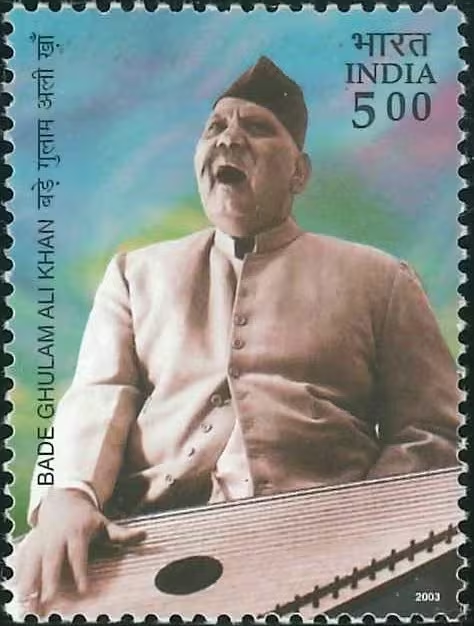
The Voice of a Century: Ustad Bade Ghulam Ali Khan
In the grand pantheon of Hindustani classical music, few names resonate with the same power, majesty, and emotional depth as Ustad Bade Ghulam Ali Khan. Often hailed as the Tansen of the 20th century, he was not merely a singer but a musical phenomenon. His voice, a force of nature with a three-octave range, could traverse the most intricate melodic passages with breathtaking speed and precision, yet could also deliver a note so tender it felt like a caress. As the preeminent exponent of the Patiala Gharana, he redefined its aesthetic, creating a unique and compelling style that continues to influence musicians to this day. His life, spanning the twilight of the British Raj, the trauma of Partition, and the dawn of independent India, is a story of relentless dedication, artistic innovation, and the unifying power of music.
Early Life & The Crucible of Patiala
Bade Ghulam Ali Khan was born into a formidable musical lineage in 1902 in Kasur, a town in the Punjab province of British India (now in Pakistan). Music was the air he breathed. His family was the fountainhead of the Patiala Gharana, a school of music known for its emotional expression, rhythmic complexity, and emphasis on flawless vocal technique. His father, Ali Baksh Khan, was a noted vocalist, and his uncle, Kale Khan, was a celebrated court musician in the princely state of Jammu and Kashmir. From a very young age, the boy was immersed in a world of complex ragas and disciplined riyaaz (practice).
His formal training began under his gifted uncle, Kale Khan. However, this tutelage was cut short by Kale Khan’s untimely death when Bade Ghulam Ali was still a child. The responsibility then fell to his father, who subjected him to a grueling and exacting regimen. The young prodigy was made to practice for hours on end, often beginning before dawn, honing his vocal cords to achieve the power and flexibility that would later become his hallmark.
Beyond vocal training, he was also taught to play the sarangi. This experience proved to be profoundly influential. The sarangi, an instrument known for its ability to mimic the nuances of the human voice, taught him the art of the meend (glide between notes) and the gamak (a heavy, oscillating ornament). He internalized the instrument's soul-stirring, lyrical quality, which he would later masterfully translate into his own singing, giving his voice a unique, plaintive texture that set him apart from his contemporaries.
His formative years in Lahore were a period of intense absorption. He listened to and learned from the great masters of his time, demonstrating an open-mindedness that would become a cornerstone of his art. He assimilated the gravitas of the Gwalior Gharana, the romantic flourishes of the Kirana Gharana, and the intricate rhythmic play of the Jaipur Gharana, all while remaining firmly rooted in his Patiala tradition.
Career & The Conquest of India
After years of relentless practice, Bade Ghulam Ali Khan began performing in public. While he gained recognition in the musical circles of Punjab, his ascent to national stardom came in 1938. At a major music conference in Calcutta (now Kolkata), he delivered a performance that left the audience spellbound. The cognoscenti of Bengal, a major center for classical arts, were captivated by his peerless virtuosity, the emotional intensity of his delivery, and the sheer magnetism of his presence. Overnight, he became a sensation. From that point on, there was no looking back.
His music was a revolutionary synthesis. He created a distinct style, often referred to as the Patiala-Kasur gayaki (singing style), that was both intellectually rigorous and immensely appealing. His khayal renditions were marked by incredible tayyari (readiness or technical brilliance), with lightning-fast taans (rapid melodic passages) delivered with perfect clarity and control. He never sacrificed emotion for virtuosity; each note was imbued with feeling, and his improvisations were a masterclass in creative genius.
Perhaps his most significant contribution was the elevation of the thumri, a semi-classical form. He infused the Punjab-ang thumri with a new depth and dignity. He brought the emotional weight of khayal to the romantic and devotional themes of thumri, creating compositions that were both technically dazzling and profoundly moving. His renditions of classics like “Yaad Piya Ki Aaye” and “Ka Karun Sajni Aaye Na Balam” are not just songs; they are timeless expressions of love and longing that have become benchmarks for the form.
His fame reached such heights that even the world of cinema came calling. In 1960, the director K. Asif was determined to have the Ustad’s voice in his magnum opus, Mughal-e-Azam. Bade Ghulam Ali Khan was famously reluctant to sing for films. To politely decline, he quoted an astronomical fee of ₹25,000 per song, at a time when the industry's top playback singers earned around ₹500. To his astonishment, the producers agreed without hesitation. He recorded two unforgettable songs for the film, “Prem Jogan Ban Ke” and “Shubh Din Aayo,” lending his classical gravitas to the silver screen and immortalizing his voice for a mass audience.
The Partition of India in 1947 was a moment of profound personal and professional crisis. As a resident of Kasur, he automatically became a citizen of the newly created Pakistan. While he was respected there, he felt artistically isolated. The major centers of classical music, the most discerning audiences, and the bulk of his admirers were in India. Deeply unhappy, he longed to return. After years of effort, and with the help of Indian government officials like B.V. Keskar, he was finally granted Indian citizenship in 1957. He settled in Bombay (now Mumbai), a move celebrated by music lovers across the country.
Legacy & An Enduring Influence
In 1961, Ustad Bade Ghulam Ali Khan suffered a severe stroke that left him partially paralyzed and affected his speech. For any other artist, this would have been a career-ending tragedy. But the Ustad’s spirit was indomitable. Through sheer willpower and a love for his art, he gradually regained some of his abilities and, against all odds, returned to the concert stage. While his voice may have lost some of its thunderous power, it had gained a new layer of pathos and spiritual depth. These later concerts were a testament to his courage and his unbreakable bond with music.
He was honored with the Sangeet Natak Akademi Award in 1962 and the Padma Bhushan, India's third-highest civilian award, in the same year. He spent his final years in Hyderabad, and passed away on April 25, 1968, leaving behind a void in the world of music that can never be filled.
Ustad Bade Ghulam Ali Khan’s legacy is monumental. He is remembered not just as a musician, but as a musical institution.
The Modern Patiala Gharana: He is the undisputed patriarch of the modern Patiala Gharana. His innovations and unique stylistic blend became the new standard, influencing generations of musicians, including his son Munawar Ali Khan, and disciples like Ajoy Chakrabarty and Parveen Sultana.
A Benchmark for Vocalism: His technical mastery set a new benchmark for Hindustani vocal music. His name became synonymous with unparalleled
tayyari, perfect diction, and immense vocal power. His famous adage captures his philosophy: “If I don't practice for a day, I notice it. If I don't practice for two days, my accompanists notice it. If I don't practice for three days, the audience notices it.”The Soul of Thumri: He breathed new life into the thumri, transforming it from a lighter form into a profound art form capable of expressing the deepest human emotions. His thumris remain the quintessential examples of the genre.
Today, his recordings are treasured as sacred relics of a golden era. They are a source of learning for students and a source of sublime joy for listeners. Ustad Bade Ghulam Ali Khan was more than a master musician; he was a cultural bridge, an artist who transcended the borders of nation and creed. His voice, once heard, is never forgotten—a timeless, majestic force that continues to echo through the corridors of Indian history.