Uttama Chola: The Pious Guardian of a Golden Age
In the grand, sweeping tapestry of the Chola dynasty, a narrative dominated by mighty conquerors and visionary builders, the reign of Uttama Chola stands as a quiet, yet profoundly significant, interlude. Ascending the throne under the darkest of clouds—the assassination of his cousin and crown prince, Aditya II—Uttama's rule was not one of glorious conquest but of crucial consolidation. He was the calm after the storm, a pious guardian who held the empire together, healed its political wounds, and unwittingly set the stage for one of Indian history's most brilliant epochs under his successor, the great Rajaraja I.
Early Life & A Contested Claim
Born Madurantaka, he was the son of Gandaraditya Chola and the formidable Queen Sembiyan Mahadevi. His lineage was both a blessing and a burden. His father, Gandaraditya, was an anomaly among the martial Cholas; he was a mystic and a poet, a devout Shaivite who authored the sacred Tamil hymn Tiruvisaippa. His heart was more in the hallowed halls of temples than on the blood-soaked battlefield. Gandaraditya ruled for a short period before passing away when Madurantaka was just a child, leaving his son's claim to the throne tenuous.
The Chola line of succession did not adhere to strict primogeniture. Power flowed to the most capable or politically astute claimant. After Gandaraditya's death, the crown passed to his brother, Arinjaya, and then to Arinjaya's son, Sundara Chola (Parantaka II). Sundara Chola's reign was a time of resurgence, reclaiming territories and prestige. His sons were the very embodiment of Chola martial prowess: the fiery, charismatic crown prince Aditya II, and the astute, beloved Arulmozhivarman, the future Rajaraja I.
Growing up, Madurantaka was a prince in the shadows. While his cousins earned glory in campaigns against the Rashtrakutas and Pandyas, he was raised under the profound influence of his mother, Sembiyan Mahadevi. A queen of immense piety, political skill, and artistic taste, she channeled her energies into one of the greatest temple-building movements in Tamil history. She initiated the practice of systematically rebuilding brick temples in enduring granite (karrali), and her patronage defined an entire era of Chola art. Madurantaka inherited her deep devotion to Shiva, a trait that would define his life and reign, setting him apart from the warrior-princes who surrounded him.
He watched as his cousin, the valiant Aditya II, was anointed crown prince. For all intents and purposes, Madurantaka's direct claim to the throne seemed to have been permanently superseded. He was a prince of a bypassed lineage, destined, it seemed, for a life of quiet nobility and religious observance.
The Shadow of Assassination & A Kingdom's Compromise
The course of Chola history was irrevocably altered in 969 CE. In a palace at Kadambur, the celebrated crown prince, Aditya II, was brutally murdered. The empire was shaken to its core. The assassination was a political earthquake, and its aftershocks would shape the next two decades. The Thiruvalangadu copper plates of Rajendra Chola I describe the event with poignant brevity, stating that after Aditya “ascended to the heavens, the sun of the solar dynasty set.”
The identity of the conspirators remained a state secret for years, but suspicion naturally fell on the one man who stood to gain the most: Madurantaka. He was the only other viable claimant to the throne. This suspicion has shadowed his name for over a millennium, forming the central mystery of his life. There is no direct inscriptional evidence linking him to the crime. However, the fact that his successor, Rajaraja I, waited until after Uttama's death to punish the assassins (as recorded in the Udayarkudi inscription) has been interpreted by many historians as a sign of Rajaraja’s inability or unwillingness to act against his powerful uncle.
In the chaotic aftermath of the murder, the aged and grief-stricken Emperor Sundara Chola was unable to provide firm leadership. The Chola nobility and citizenry, according to inscriptions, clamored for his younger son, Arulmozhivarman, to ascend the throne. But in a masterstroke of political sagacity and filial piety, Arulmozhivarman refused. He deferred to his uncle's legitimate claim, insisting that Madurantaka should rule. This was a monumental compromise. Madurantaka was made heir apparent, and he peacefully ascended the throne as Uttama Chola upon Sundara Chola's death around 970 CE. In return, it was understood that Arulmozhivarman would be his undisputed successor. This pact, sealed in the shadow of tragedy, averted a catastrophic civil war and preserved the unity of the Chola realm.
A Reign of Piety and Stability
Uttama Chola's reign, lasting approximately fifteen years until 985 CE, was a period of deliberate peace. He launched no major military campaigns, focusing instead on internal administration, religious patronage, and economic consolidation. He understood that what the kingdom needed was not more territory, but stability and healing.
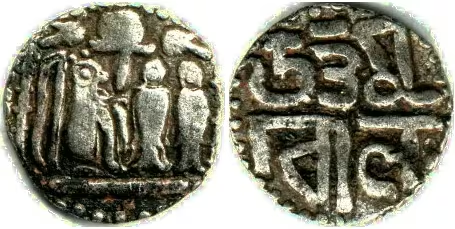
A Numismatic Pioneer: One of Uttama's most significant and lasting contributions was in the field of numismatics. He was the first Chola monarch to issue a series of gold and silver coins bearing his own name and titles. Prior Chola coinage was largely anonymous. Uttama's coins typically featured the iconic Chola dynastic crest: a seated tiger, flanked by the Pandya twin fish and the Chera bow, symbolizing Chola paramountcy over the Tamil country. Crucially, inscribed alongside in Nagari script was the title Uttama Chola. This act was a powerful assertion of royal authority, helping to standardize the currency and project the king's personal sovereignty across the empire.
Patron of the Faith: True to his upbringing, Uttama's reign was a golden era for Shaivism. While his mother, Sembiyan Mahadevi, remained the primary force behind the temple movement, Uttama provided the royal sanction and resources she needed. Together, they presided over the transformation of numerous temples, creating architectural and sculptural masterpieces. The artistic style of this period, often called the Sembiyan style, is noted for its refined elegance, grace, and iconographic precision. Temples like the Umamaheswarar shrine at Konerirajapuram stand as a testament to the artistic heights achieved under their patronage. Uttama's deep personal piety reinforced the Chola identity as protectors and patrons of the Shaivite faith, a legacy that Rajaraja I would elevate to unprecedented heights with his Brihadisvara Temple.
A Mentorship in Governance: Throughout Uttama Chola's reign, Arulmozhivarman served as his loyal heir apparent. This period was an invaluable apprenticeship for the future Rajaraja I. He was intimately involved in the empire's administration, learning the complexities of governance, finance, and diplomacy without the immediate pressures of the crown. He travelled the realm, inspected local assemblies, and built the network of loyal officers who would later help him execute his grand imperial vision. Uttama honored his side of their pact, and the relationship between the ruling king and his successor appeared to be one of mutual respect and cooperation.
Legacy: The Bridge to a Golden Age
Uttama Chola died in 985 CE. As agreed, the transition of power was seamless. Arulmozhivarman ascended the throne, took the title Rajaraja Chola, and in the coming decades, would forge the Cholas into the most formidable military and cultural power in South Asia.
Uttama Chola's legacy is complex. He is often remembered not for what he did, but for the circumstances of his ascension and the greatness of his successor. The unresolved mystery of Aditya II's assassination will forever cling to his name, casting him as a figure of ambiguity in popular imagination, most famously in Kalki Krishnamurthy's epic novel Ponniyin Selvan.
However, a deeper historical assessment reveals his true importance. He was the quintessential transitional monarch. His peaceful, inwardly-focused reign was precisely the balm the wounded Chola state needed. By choosing stability over expansion and compromise over conflict, he allowed the empire to consolidate its resources and recover from a deep political crisis. He was the bridge that safely carried the Chola dynasty from the promising era of Sundara Chola to the unparalleled imperial zenith of Rajaraja I.
His pioneering coinage asserted royal authority in a new, tangible way, and his patronage of religion, in concert with his mother, enriched the cultural and artistic fabric of the Tamil land. Uttama Chola may not have been a great conqueror, but his steady, pious, and pragmatic rule was an act of statesmanship that proved just as vital. He was the guardian who kept the flame of the empire burning steadily, allowing it to erupt into a glorious blaze under the son of Ponni, Rajaraja the Great.