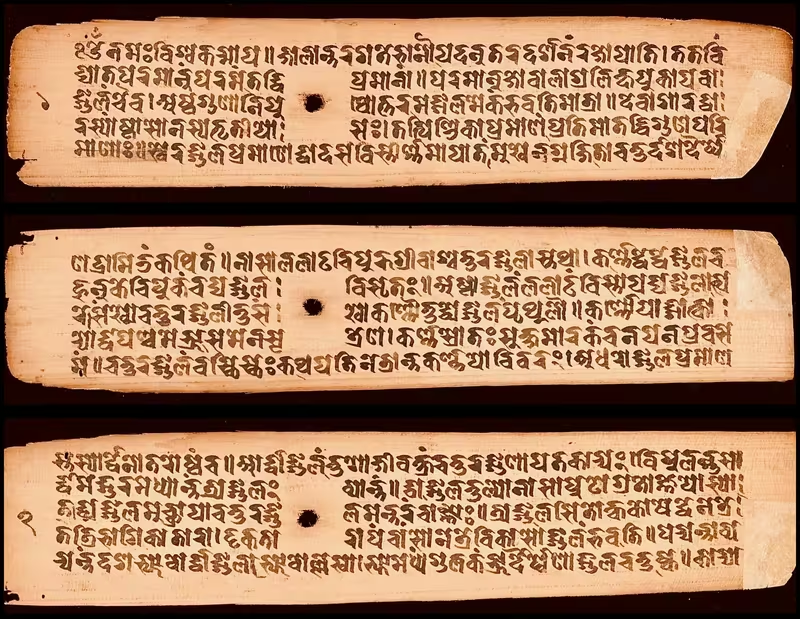
The Celestial Sage of Ujjain: Varāhamihira
In the vibrant tapestry of India's Gupta period, often hailed as its Golden Age, lived a mind of extraordinary brilliance and breadth. Varāhamihira (505–587 CE) was not merely an astronomer; he was a polymath whose intellect roamed across mathematics, astrology, architecture, hydrology, and botany. Flourishing in the intellectual crucible of Ujjain, he became one of history's great synthesizers of knowledge, weaving together indigenous Indian traditions with the sophisticated astronomical systems of the Hellenistic world. His monumental works, particularly the Pancha-siddhantika and the Brihat-Samhita, stand as enduring testaments to a scientific spirit that sought to comprehend the cosmos and humanity's place within it.
Early Life & Background
Varāhamihira was born in 505 CE into a family of Brahmins residing in the Avanti region, the historical heartland of which was the magnificent city of Ujjain. In his own work, the Brihat Jataka, he offers a rare, documented glimpse into his origins, stating that his father, Adityadasa, was his first teacher in the celestial sciences. He credits his father with bestowing upon him the foundational knowledge of Jyotisha—the traditional Indian system of astronomy and astrology.
He is said to have studied at Kapitthaka, a location believed to be near Ujjain. This was no ordinary education. Ujjain was not just a prosperous capital; it was a nerve center of ancient Indian science. For centuries, it had been recognized as the prime meridian for Hindu astronomers, the geographical and intellectual zero-point from which the heavens were mapped. The city’s observatories and libraries buzzed with the exchange of ideas, drawing scholars from across the subcontinent and beyond.
Living in this environment, the young Varāhamihira was immersed in a world of vigorous intellectual debate. The Gupta Empire's extensive trade routes, stretching to the Roman Empire and Persia, were conduits not just for goods but for knowledge. Greek, Egyptian, and Roman astronomical texts and ideas flowed into centers like Ujjain, where they were studied, debated, and assimilated by Indian scholars. It was this unique confluence of indigenous and foreign wisdom that shaped Varāhamihira's formative years and set the stage for his life's work.
Career & Major Contributions
Varāhamihira's genius lay in his ability to master, critique, and synthesize vast and disparate fields of knowledge. He was not a reclusive theorist but a practical scientist and chronicler whose works reflect a deep engagement with the world around him. His contributions transformed the study of the cosmos in India.
The Pancha-siddhantika (The Five Astronomical Canons)
Considered his magnum opus in astronomy, the Pancha-siddhantika, composed around 575 CE, is a landmark text. Its name literally means "The Five Treatises," and it serves as a comprehensive summary and comparison of the five major astronomical schools (siddhantas) prevalent in his time. This work is invaluable not only for its content but because it preserves the core principles of earlier texts, some of which are now lost to history.
The five siddhantas he consolidated were:
- Surya Siddhanta: The most respected and accurate of the Indian systems, which Varāhamihira himself held in the highest esteem. Its calculations for planetary motions and eclipses were remarkably advanced.
- Paitamaha Siddhanta: An older, more traditional Indian system, which he included for historical completeness but noted was less accurate.
- Vasishtha Siddhanta: Another ancient Indian system, which he also found to be less precise than the Surya Siddhanta.
- Romaka Siddhanta: The "Doctrine of the Romans," this system was based on the astronomical knowledge of the Greco-Roman world, likely influenced by the work of Hipparchus and Ptolemy. It used a tropical solar year and was a clear example of the cross-cultural exchange of the era.
- Paulisa Siddhanta: The "Doctrine of Paul," this was another school of Hellenistic origin. Varāhamihira noted its calculations, including its reckoning of the length of the year, which was remarkably close to the actual value.
By presenting these five systems side-by-side, Varāhamihira created a comparative study of unparalleled scope. He did not simply list them; he analyzed their strengths and weaknesses, corrected their errors, and proposed his own improved calculations, particularly regarding the ayanamsa, or the precession of the equinoxes. The Pancha-siddhantika is a masterclass in scientific scholarship, demonstrating a mind that valued empirical accuracy and intellectual honesty above adherence to a single dogma.
The Brihat-Samhita (The Great Compilation)
If the Pancha-siddhantika reveals the astronomer, the Brihat-Samhita unveils the polymath. This encyclopedic work is a breathtaking survey of the knowledge and culture of 6th-century India. Written in over 100 chapters, it covers an astonishing range of subjects, revealing how deeply the study of the cosmos was integrated with every aspect of human life. Its topics include:
- Astronomy & Meteorology: Planetary movements, eclipses, comets, and the prediction of rainfall based on atmospheric and celestial signs.
- Geography & Hydrology: He provided early theories on the formation of earthquakes and, remarkably, a detailed chapter on water divination (dākārgala). He described how the presence of certain plants, termite mounds, and soil types could indicate underground water sources—an early form of scientific hydrology.
- Architecture & Vastu: Detailed guidelines for town planning, temple construction, and residential architecture.
- Gemology: The qualities, origins, and values of diamonds, pearls, rubies, and other precious stones.
- Botany & Agriculture: Advice on planting crops, treating plant diseases, and creating perfumes from various flowers and herbs.
- Human Relations: Chapters on matrimony, omens, and human physiognomy.
The Brihat-Samhita is more than a collection of facts; it is a cultural artifact. It offers historians an unparalleled window into the beliefs, practices, and scientific temperament of the Gupta era, all filtered through the discerning intellect of one man.
Contributions to Mathematics
Embedded within his astronomical works are significant contributions to mathematics. Varāhamihira was a master of trigonometry, which was the essential mathematical tool for astronomical calculations. He refined the sine tables developed by the earlier master, Aryabhata, and presented several important trigonometric identities, including a version of the fundamental formula:
sin²(x) + cos²(x) = 1
Perhaps most notably, his work contains one of the earliest known descriptions of what is now called Pascal's Triangle. He used a method he called Meru Prastāra ("the mountain staircase") to calculate binomial coefficients, a concept that would only be popularized in Europe by Blaise Pascal over a millennium later. This demonstrates the advanced state of combinatorial mathematics in India during his time.
Legacy & Influence
Varāhamihira passed away in 587 CE, leaving behind a body of work that would shape Indian science and culture for centuries. His historical significance is immense, both for what he created and what he preserved.
Tradition places Varāhamihira as one of the Navaratnas (Nine Gems), the legendary group of nine extraordinary intellectuals at the court of a king named Vikramaditya, often identified with the Gupta emperor Chandragupta II. While the historical accuracy and timeline of this assembly are debated by scholars, the inclusion of Varāhamihira's name in this prestigious group speaks volumes about the towering stature he achieved in Indian cultural memory.
His greatest legacy is his role as a synthesizer. In an age of burgeoning knowledge, he did not retreat into a single tradition. Instead, he fearlessly embraced ideas from diverse cultures, subjecting them to rigorous mathematical scrutiny. He exemplified an open, rationalist spirit, respecting the wisdom of the past while always pushing for greater accuracy and understanding. He demonstrated that Indian science could absorb and enhance foreign knowledge without losing its own identity.
His works became canonical texts. For centuries, astronomers and astrologers across India studied the Pancha-siddhantika and the Brihat Jataka. The Brihat-Samhita remains an invaluable source for historians seeking to reconstruct the daily life, technology, and worldview of ancient India.
Varāhamihira's influence extended far beyond India's borders. In the 11th century, the Persian scholar Al-Biruni, who traveled extensively in India and wrote a comprehensive account of its society and sciences, studied Varāhamihira's texts in detail. He quoted him extensively and with great respect, introducing the Indian master's ideas to the Islamic world, which would later serve as a bridge to medieval Europe.
Today, Varāhamihira is remembered as a titan of India's intellectual heritage. He was a man who looked to the stars not just with wonder, but with the sharp, analytical gaze of a mathematician. He saw the universe as an ordered, knowable system, and he dedicated his life to deciphering its intricate patterns—in the majestic dance of the planets, the subtle signs of the earth, and the complex fabric of human society.