Vasishthiputra Pulumavi: The Satavahana Emperor Who Sailed East
In the grand tapestry of ancient Indian history, some figures blaze across the firmament like comets, their conquests and glory illuminating an entire era. One such figure was Gautamiputra Satakarni, the 23rd ruler of the Satavahana dynasty, who restored his family's fortunes and carved out an empire that stretched across the Deccan. To inherit such a legacy is both a privilege and a profound burden. This was the world into which his son and successor, Vasishthiputra Sri Pulumavi, stepped around 130 CE. More than just a custodian of his father's triumphs, Pulumavi was a ruler who navigated the treacherous currents of shifting alliances and resurgent enemies, consolidating the empire while simultaneously steering its focus towards new horizons, forever altering the destiny of the Satavahana dynasty.
Early Life & The Weight of Legacy
Our knowledge of Pulumavi's early life comes not from personal chronicles but from the stone-etched records of his family. He was the son of the legendary Gautamiputra Satakarni and the powerful Queen Vasishthi Balasri. His very name, Vasishthiputra, meaning "son of Vasishthi," is a testament to the Satavahana practice of metronymics, where rulers identified themselves through their maternal lineage, highlighting the esteemed position of royal women in the dynasty. This name appears consistently on his inscriptions and coins, a permanent link to his mother, who would later commission a magnificent inscription at Nashik celebrating the achievements of his father.
While specific details of his education are lost to time, it is certain that as the heir to the most powerful throne in the Deccan, Pulumavi's upbringing would have been one of rigorous training. He would have been schooled in the arthashastra (statecraft), dhanurvidya (archery and warfare), and the complex administrative machinery required to govern a multicultural, multilingual empire. He grew up in the shadow of his father's near-mythical victories—the crushing defeat of the Western Kshatrapas, the Shakas, Yavanas (Greeks), and Pahlavas (Parthians). He inherited not just a throne, but a mandate: to preserve and expand the dominion of the Satavahanas, the self-proclaimed "Lords of Dakshinapatha" (the Southern Region).
He ascended the throne at the Satavahana capital, Pratishthana (modern Paithan in Maharashtra), a thriving metropolis on the banks of the Godavari River. The empire he inherited was vast, stretching from the Arabian Sea to the Bay of Bengal and from the Narmada River in the north to the Krishna River in the south.
A Reign of Consolidation, Conflict, and Coinage
Pulumavi's reign, which the Matsya Purana suggests lasted for 24 years, was not one of idle inheritance. It was a dynamic period marked by three key themes: a fierce rivalry with a resurgent enemy, a strategic expansion eastward, and a remarkable numismatic legacy that gives us a literal portrait of the king.
The Saka Resurgence: A Duel of Titans
The greatest challenge to Pulumavi's authority came from the north-west, from the very enemy his father had so decisively vanquished: the Western Kshatrapas. A new, formidable Saka ruler, Rudradaman I, had risen to power in Ujjain. Ambitious and capable, Rudradaman was determined to reclaim the territories his predecessors had lost to Gautamiputra Satakarni.
The most dramatic account of this conflict comes not from a Satavahana source, but from Rudradaman's own remarkable Junagadh rock inscription in Gujarat. In this lengthy Sanskrit eulogy, Rudradaman boasts of his many achievements, including a direct confrontation with the Lord of the Deccan. The inscription states that he:
"...twice in fair fight completely defeated Satakarni, the lord of Dakshinapatha, but did not destroy him on account of the nearness of their connection."
Historians almost universally agree that the "Satakarni" mentioned here is Vasishthiputra Pulumavi. The military defeats were significant, likely resulting in Pulumavi losing control over some of the northern provinces his father had conquered, such as Malwa and parts of the Konkan coast. The phrase "nearness of their connection" is tantalizingly cryptic but is widely interpreted to mean that Rudradaman had given his daughter in marriage to Pulumavi. This matrimonial alliance, a common tool of ancient diplomacy, likely saved the Satavahana ruler from complete annihilation and stabilized a tense frontier, even if it came at the cost of territory.
This conflict marks a pivotal moment. It halted the Satavahana northern expansion and re-established the Western Kshatrapas as a major power, setting the stage for decades of rivalry between the two dynasties.
The Eastern Thrust and Maritime Ambition
While facing pressure in the north-west, Pulumavi astutely turned his attention eastward. His reign saw a significant expansion of Satavahana influence along the Coromandel Coast and into the fertile Krishna-Guntur region of modern-day Andhra Pradesh. This was not just a territorial grab; it was a strategic pivot towards the lucrative networks of maritime trade flowing from the ports of the eastern seaboard.
The most compelling evidence for this eastward focus is Pulumavi's unique coinage. Among his most famous issues are lead and potin coins bearing the striking image of a two-masted ship. These coins, found predominantly in the coastal Andhra region, are a powerful symbol of the Satavahanas' burgeoning naval and mercantile power. The ship, depicted with rigging and possibly a rudder, is not a mere artistic flourish but a clear statement of intent and control over sea trade routes that connected southern India to Southeast Asia and the Roman Empire.
Inscriptions from his reign found at Amaravati and other sites in Andhra Pradesh further confirm his firm control over this region. By shifting the empire's center of gravity eastward, Pulumavi laid the groundwork for the dynasty's future. The Andhra region would become the final heartland of the later Satavahanas, allowing the dynasty to endure for nearly another century.
The King's Portrait: A Numismatic Revolution
Beyond the ship-motif coins, Pulumavi left behind an equally important numismatic legacy: he was one of the first indigenous Indian rulers to issue silver coins featuring a realistic portrait of himself. These coins were likely inspired by the coinage of his rivals, the Western Kshatrapas, who had inherited the Hellenistic tradition of portraiture.
Pulumavi's silver coins typically show a bust of the king in profile, with distinctly South Indian features, curly hair, and sometimes prominent earrings. The legend, written in Brahmi script and Prakrit language, encircles the portrait and reads: "Rano Vasithiputasa Siri Pulumavisa" (Of the King, Vasishthiputra Sri Pulumavi). The reverse of these coins featured the dynastic crest, often the "Ujjain symbol" (a cross with four circles at its ends) and a six-arched hill, representing the Satavahana lineage. These coins were more than currency; they were a powerful form of royal propaganda, circulating a recognizable image of the sovereign across the length and breadth of the empire.
Patronage and Governance
Like his predecessors, Pulumavi was a patron of both Brahmanism and Buddhism, a hallmark of the Satavahanas' inclusive religious policy. His inscriptions provide direct evidence of his support for Buddhist monastic communities.
- An inscription from the 19th year of his reign, found in a Nashik cave originally excavated by his father, records the grant of a village for the welfare of the Buddhist monks of the Bhadrayaniya sect.
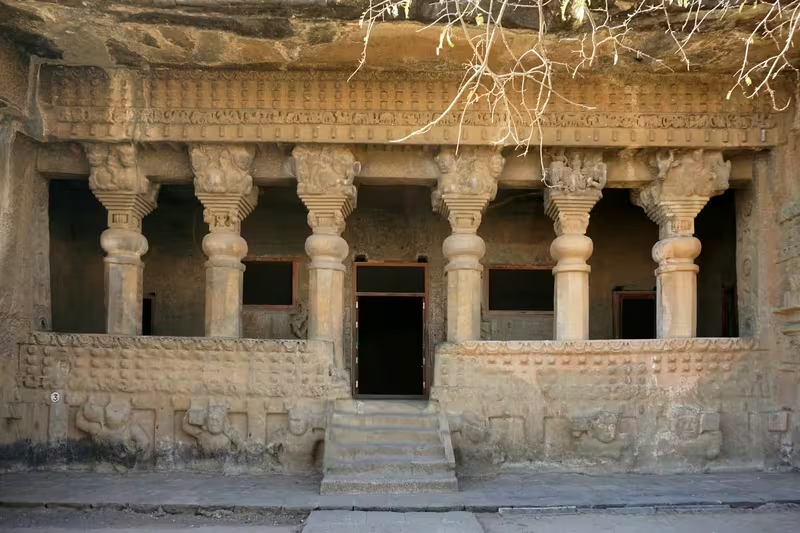
- Another inscription, from his 24th and final regnal year at Karle, documents a similar grant to the Mahasanghika sect of monks residing in the magnificent rock-cut chaitya hall there.
These acts of patronage were not merely about piety; they were crucial for integrating the powerful and wealthy Buddhist monastic orders into the state's administrative and economic fabric. The great Buddhist stupa at Amaravati, a masterpiece of ancient Indian art, also underwent significant expansion and embellishment during his reign, flourishing under his patronage.
Legacy & Influence
Vasishthiputra Sri Pulumavi's reign was a crucial turning point for the Satavahana empire. He is often overshadowed by the monumental military achievements of his father, but his own contributions were vital for the dynasty's survival and evolution.
His legacy can be summarized in three parts:
The Stabilizer: He inherited an empire at its zenith and, despite facing a powerful resurgent foe in Rudradaman I and suffering territorial losses, he successfully defended and held together the core of the Satavahana realm for over two decades. His reign was not one of decline, but of pragmatic consolidation.
The Visionary: His greatest strategic contribution was the eastward pivot. By expanding into and developing the coastal Andhra region, he opened up new avenues of wealth through maritime trade and established a new power base that would sustain the dynasty long after its western territories became untenable.
The Innovator: Through his portrait and ship-motif coins, Pulumavi left behind an invaluable historical and artistic record. His coins give us a face to a name from nearly two millennia ago and provide undeniable proof of the Satavahanas' maritime ambitions.
Vasishthiputra Sri Pulumavi was a ruler who demonstrated that true strength lies not only in conquest but also in adaptation and foresight. He navigated the complex geopolitical landscape of 2nd-century India with skill, securing his father's legacy while simultaneously charting a new course for his successors. He was the bridge between the apex of Satavahana power in the western Deccan and its final, flourishing phase in the east, ensuring that the name of the Satavahanas would echo through the annals of Indian history for generations to come.