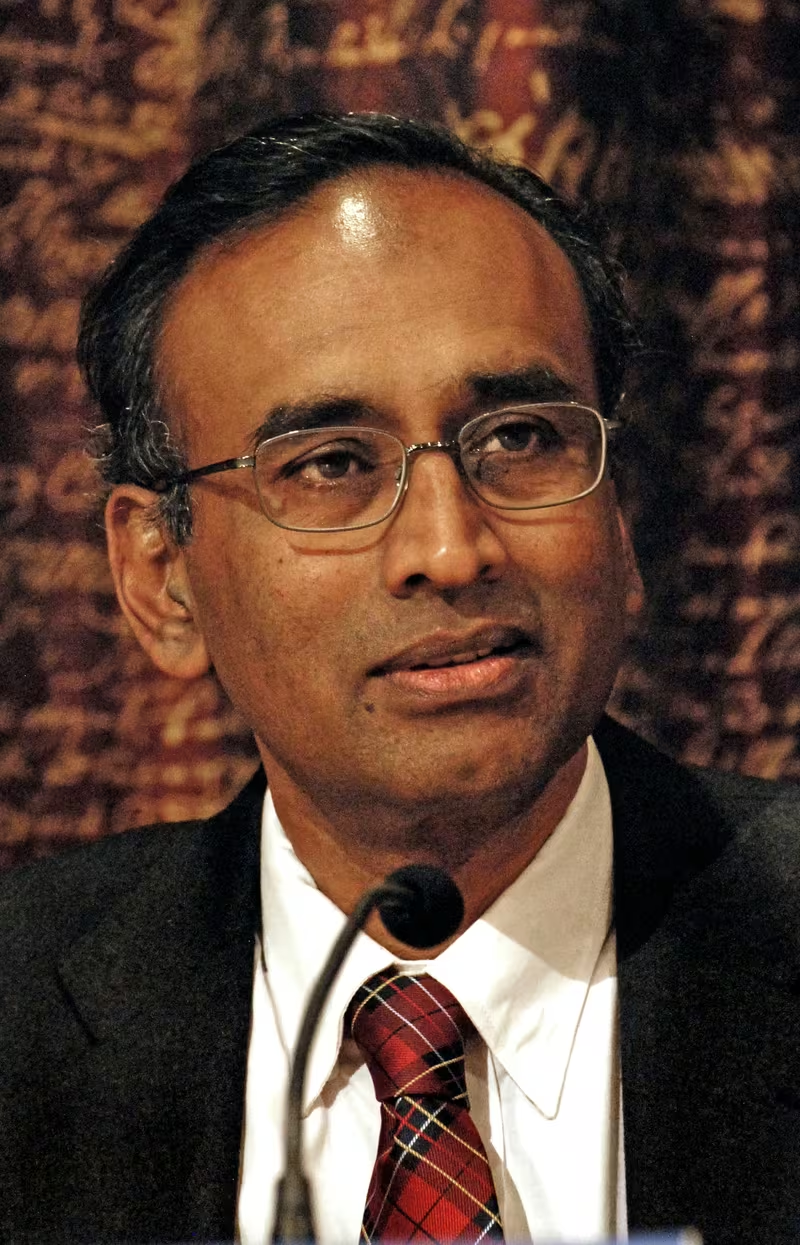
An Unlikely Biologist: The Story of Venkatraman Ramakrishnan
In the grand theatre of life, the most fundamental act is the creation of proteins. Every cell in every living organism contains miniature factories called ribosomes that tirelessly read the genetic blueprint—our DNA—and translate it into the proteins that form our tissues, power our muscles, and fight off disease. For decades, this molecular machine was a black box, its inner workings a profound mystery. That was until a physicist from a small town in India, armed with curiosity and a relentless spirit, decided to take a closer look. This is the story of Venkatraman 'Venki' Ramakrishnan, the man who mapped the ribosome and, in doing so, changed modern biology and medicine forever.
His journey from a physics student in Gujarat to a Nobel laureate at Cambridge is a testament to the power of interdisciplinary thinking, perseverance through failure, and the sheer intellectual thrill of scientific discovery. In 2009, he was jointly awarded the Nobel Prize in Chemistry, a crowning achievement that recognized a quest spanning decades and continents.
From Physics in Baroda to Biology in America
Venkatraman Ramakrishnan was born in 1952 in the temple town of Chidambaram, Tamil Nadu, into a family steeped in science. His father, C. V. Ramakrishnan, was a noted biochemist who would later head the Department of Biochemistry at the Maharaja Sayajirao University of Baroda, and his mother, Rajalakshmi, was also a scientist. Science was not just a profession in their household; it was the language of curiosity and reason.
When Venki was three, the family moved to Vadodara (then Baroda) in Gujarat, a city that would shape his formative years. He was a bright student, but his path was not immediately clear. When it came time to choose a field of study at the Maharaja Sayajirao University, he was faced with a choice between medicine and the basic sciences. He was denied admission to the prestigious Indian Institutes of Technology (IITs). Looking at the biology curriculum of the time, he found it to be a subject of rote memorization—classifying species and memorizing parts of anatomy—with little emphasis on the fundamental principles he craved. Physics, on the other hand, offered a world of elegant equations and universal laws. He chose physics, graduating with a Bachelor of Science degree in 1971.
His next move was to America, in pursuit of higher education. He enrolled at Ohio University for a Ph.D. in theoretical physics. He was chasing the legacy of giants like Einstein and Schrödinger, but soon came to a humbling realization. As he later recounted, he felt he would, at best, be a mediocre physicist. The field was becoming increasingly abstract, and he felt disconnected from the tangible, experimental world. It was during this period of introspection that he discovered a new and electrifying frontier: molecular biology. Articles in Scientific American magazine opened his eyes to a world where the fundamental questions of life were being answered at the molecular level. He was captivated by the idea that the complex machinery of life could be understood through the principles of physics and chemistry.
In a bold and career-defining move, he decided to switch fields entirely. After completing his physics Ph.D. in 1976, he enrolled as a biology graduate student at the University of California, San Diego. For two years, he was a student again, learning the language of DNA, RNA, and proteins from the ground up. It was a risk, but it was a risk driven by a renewed sense of purpose.
The Long and Winding Road to the Ribosome
His new journey led him to Yale University for postdoctoral research in the laboratory of Peter Moore. It was here that he was first introduced to the object that would define his life's work: the ribosome. At the time, scientists knew what the ribosome did—it built proteins—but they had no clear idea of how it looked or worked at an atomic level. Seeing its structure was the holy grail of structural biology.
Ramakrishnan's physics background gave him a unique advantage. He used a technique called neutron scattering to map the arrangement of proteins within a part of the ribosome known as the 30S ribosomal subunit. This was painstaking work, requiring immense patience and technical skill. But to truly understand the ribosome, he needed a far more powerful technique: X-ray crystallography.
The principle of X-ray crystallography is simple in theory but fiendishly difficult in practice. A scientist must first persuade millions of identical molecules to align themselves into a perfectly ordered, three-dimensional crystal. Then, they shoot a high-powered X-ray beam at the crystal. As the X-rays pass through, they are diffracted by the atoms in the crystal, creating a complex pattern of dots on a detector. By analyzing this pattern, scientists can mathematically reconstruct a 3D atomic map of the molecule. The problem was, the ribosome is an enormous and notoriously unstable molecular complex. Getting it to crystallize was considered by many to be an impossible task.
For nearly two decades, Ramakrishnan chased this impossible goal. First as a staff scientist at Brookhaven National Laboratory and later as a professor at the University of Utah, he and his small team worked relentlessly. Years were filled with failed experiments and incremental progress that often felt like no progress at all. It was a period of immense professional uncertainty. While other scientists were publishing regularly, his lab was focused on a single, high-risk, all-or-nothing project. This long period of struggle, however, forced him to develop innovative new methods for purifying and stabilizing the ribosome, laying the groundwork for the eventual breakthrough.
The Breakthrough in Cambridge
In 1999, Ramakrishnan made another pivotal move, relocating his lab to the prestigious MRC Laboratory of Molecular Biology (LMB) in Cambridge, UK. The LMB was legendary, the intellectual home of Francis Crick, James Watson, and Frederick Sanger—the architects of the molecular biology revolution. Here, surrounded by world-class talent and resources, the final pieces of the puzzle fell into place.
In the year 2000, the world of biology was electrified. In a landmark paper published in the journal Nature, Ramakrishnan's lab unveiled the first-ever high-resolution, atomic-level structure of the 30S ribosomal subunit. The image was a revelation. It showed in stunning detail the intricate tangle of RNA and protein chains, revealing the very heart of the protein-synthesis machine. It was like seeing the inner workings of a watch for the first time.
The race had been incredibly tight. Just weeks later, a group led by Thomas Steitz at Yale published the structure of the larger 50S ribosomal subunit. Another pioneer, Ada Yonath of the Weizmann Institute in Israel, had spent over two decades developing the crucial crystallization techniques that made these breakthroughs possible.
But Ramakrishnan's work went further. His group didn't just provide a static picture. They captured the ribosome in action, showing how it binds to the messenger RNA (mRNA) that carries the genetic instructions, and how it interacts with the transfer RNA (tRNA) molecules that ferry the amino acid building blocks. Crucially, his work revealed how the ribosome acts as a quality-control inspector, ensuring that the genetic code is read with astonishing accuracy. A single mistake could result in a faulty protein, leading to disease.
Furthermore, his structural maps showed exactly how different antibiotics—like tetracycline and streptomycin—bind to the bacterial ribosome. Many antibiotics work by jamming this essential machine in bacteria, stopping them from making the proteins they need to survive. By seeing precisely how they work, Ramakrishnan’s research opened the door for designing new, more effective antibiotics to combat the growing threat of drug-resistant superbugs.
Nobel Laureate and a Global Voice for Science
The impact of this collective work was monumental. In 2009, the Royal Swedish Academy of Sciences awarded the Nobel Prize in Chemistry jointly to Venkatraman Ramakrishnan, Thomas A. Steitz, and Ada E. Yonath "for studies of the structure and function of the ribosome."
For Ramakrishnan, the accolades did not stop there. In 2010, he was awarded the Padma Vibhushan, India's second-highest civilian honor. In 2012, he was knighted by Queen Elizabeth II for his services to molecular biology. A particularly significant honor came in 2015 when he was elected President of the Royal Society, the oldest and most prestigious scientific academy in the world. He was the first person of Indian origin to hold the position since its founding in 1660.
In his role as a scientific leader, Ramakrishnan has become a prominent public voice. He is a passionate advocate for curiosity-driven basic research, arguing that the greatest breakthroughs often come from exploring fundamental questions without an immediate application in mind. His own journey is a prime example: a decades-long quest to understand the ribosome has now become the foundation for developing life-saving drugs.
He is also known for his candor and intellectual honesty. In his acclaimed 2018 book, Gene Machine: The Race to Decipher the Secrets of the Ribosome, he provides a remarkably frank and humanizing account of the scientific process. He details not just the triumphs but also the anxieties, the dead ends, the fierce competition, and the personal sacrifices involved in top-tier research. It is a book that demystifies science and reveals the messy, exhilarating reality behind the discoveries.
Legacy of a Molecular Architect
Venkatraman Ramakrishnan's legacy is etched in every textbook of modern biology. He provided the atomic blueprint for one of life's most essential machines, transforming a fundamental area of science from a field of conjecture into one of precise, structural understanding. His work bridged the gap between the static world of the genetic code and the dynamic, functional world of proteins.
His journey is as inspiring as his science. It is a story of intellectual courage—the courage to abandon a familiar field for a new one, to tackle a problem others deemed impossible, and to persevere through two decades of uncertainty. From the classrooms of Baroda to the hallowed halls of Cambridge, Venki Ramakrishnan's life illustrates that the path to discovery is rarely straight, but for those driven by a deep and abiding curiosity, it is a journey worth taking.