Vidyapati - The Cuckoo Poet of Mithila
In the fertile plains of medieval Mithila, where the air was thick with the scent of mango blossoms and the murmur of Sanskrit shlokas, a voice arose that would echo for centuries. This was the voice of Vidyapati, the Maithil Kavi Kokil—the Cuckoo Poet of Mithila. A man of staggering genius, he was at once a courtier, a formidable Sanskrit scholar, a historian, and above all, a poet whose songs of divine love captured the very soul of the Bhakti movement. His verses, penned in the sweet cadence of the Maithili tongue, transcended the ornate walls of the royal court to become the folk anthems of an entire region, shaping the literary and spiritual landscape of eastern India forever.
Early Life & The Scholarly Soil of Mithila
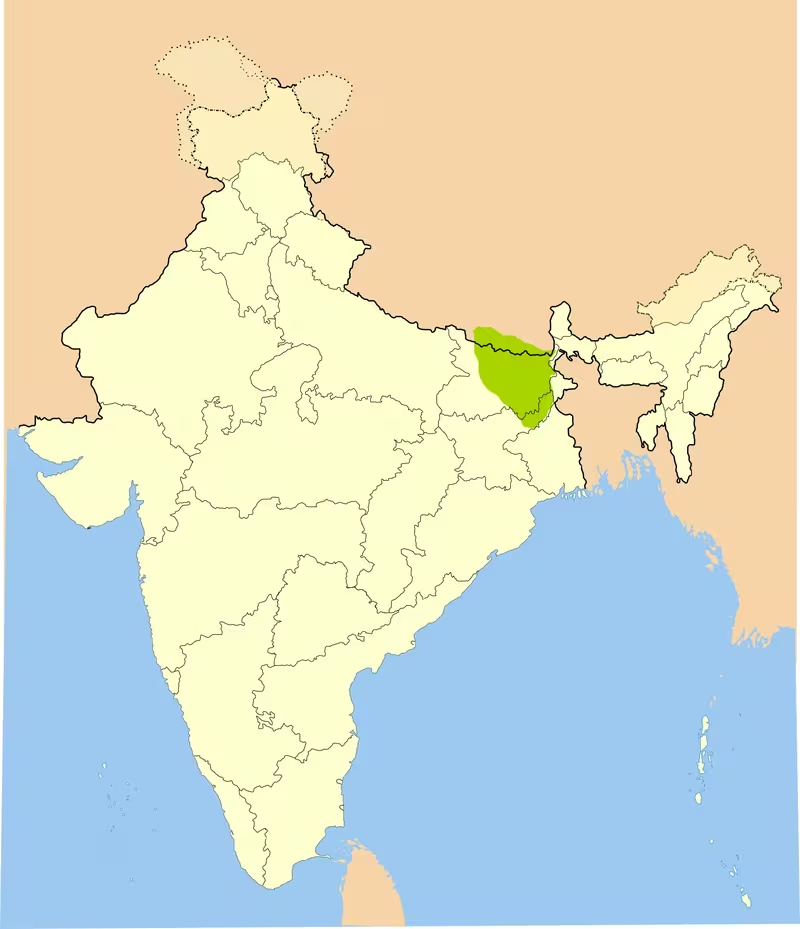
Vidyapati was born around the year 1352 in the village of Bisfi, located in the present-day Madhubani district of Bihar. To be born in Mithila in the 14th century was to be born into a world steeped in intellectual rigor and artistic tradition. The region was a renowned centre of Nyaya (logic) and Mimamsa philosophy, attracting scholars from across the subcontinent. Vidyapati entered a family that was a crucible of this very tradition. His father, Ganapati Thakur, was a distinguished Sanskrit scholar and a respected courtier in the service of the Oiniwar dynasty, the ruling house of Mithila.
From his earliest days, Vidyapati was immersed in an environment of profound learning. He received a traditional and exhaustive education, mastering the intricate rules of Sanskrit grammar (Vyakarana), the subtle arguments of logic (Nyaya), and the rich corpus of classical literature (Sahitya). But his education was not confined to texts alone. He absorbed the vibrant culture of Mithila: the ancient Shaivite and Shakta traditions that permeated daily life, the earthy folk songs sung by villagers during festivals and harvests, and the intoxicating influence of Jayadeva’s 12th-century masterpiece, the Gita Govinda, whose sensual yet devotional portrayal of Radha and Krishna’s love was spreading across the land.
This unique confluence of classical scholarship, folk tradition, and burgeoning Bhakti devotion would become the defining feature of Vidyapati’s genius. He was a man who could compose a complex treatise on law in scholastic Sanskrit and, in the next moment, craft a simple, heart-rending song in the people's language, Maithili.
The Courtier-Poet: Patronage and Prolific Genius
Vidyapati’s long and illustrious career was inextricably linked to the patronage of the Oiniwar kings of Mithila. He was not merely a poet seeking favour; he was a trusted friend, an astute advisor, and a chronicler of his patrons' glory. His relationship with the court provided him with the stability and intellectual environment to produce his vast and varied body of work.
His early patronage came from King Kirti Simha. To honour his patron’s military triumphs and re-establishment of power, Vidyapati composed the Kirtilata ("The Vine of Glory"). Written in Avahattha, a transitional language between the classical Apabhramsha and modern vernaculars, this work was a historical narrative celebrating the king's valour. It stands today as a vital linguistic and historical document, offering a rare glimpse into the political turmoil and courtly life of the 14th century.
However, the zenith of Vidyapati’s poetic creativity was reached under the patronage of King Siva Simha and his accomplished queen, Lakhima Devi, in the early 15th century. The court of Siva Simha was a vibrant centre of arts and culture, and the king and queen were ardent admirers of Vidyapati’s talent. It was in this fertile atmosphere that Vidyapati composed the majority of his immortal Maithili padas (songs). These were not written as a single book but as individual lyrical poems, set to music and performed in the royal court, celebrating the divine and deeply human love of Radha and Krishna.
His role extended far beyond that of a court poet. His deep knowledge of scriptures and law made him an invaluable asset to the state. He authored several prose works in Sanskrit that showcased his versatility as a scholar and a man of worldly affairs.
The Master of Three Tongues: A Diverse Literary Corpus
Vidyapati’s command over multiple languages—Sanskrit, Avahattha, and Maithili—allowed him to create a body of work unparalleled in its breadth and depth.
Sanskrit Works: His Sanskrit writings cemented his reputation as a Mahamahopadhyaya (a great teacher and scholar). These works demonstrate a sharp, analytical mind comfortable with complex subjects:
- Purusha Pariksha ("The Test of a Man"): A collection of moral fables and tales written to instruct young princes in the principles of ethics, politics, and human character. Through engaging stories, it explores themes of courage, intelligence, and folly.
- Likhnavali: A practical manual on the art of letter-writing, detailing the correct forms of address and composition for official and personal correspondence.
- Bhuparikramana: A geographical text detailing the main pilgrimage sites around the city of Naimisha.
- Shaivasarvasvasara and Gangavakyavali: These treatises on the worship of Lord Shiva and the sacred river Ganga, respectively, highlight his deep personal faith rooted in the Shaivite traditions of Mithila. They show a man deeply connected to the ancient rituals of his land, even as his poetry explored the newer frontiers of Vaishnava devotion.
Avahattha Works:
- Kirtilata and Kirtipataka: These historical eulogies are crucial linguistic artefacts. They capture a language in transition and provide a model of narrative poetry that blends historical detail with poetic embellishment, a style that would influence later historical writing in the region.
Maithili Works: It is in his Maithili padas that Vidyapati’s heart truly sings. In these songs, he gave literary form and timeless voice to the language of his people. He took the divine figures of Radha and Krishna and brought them down to earth, placing them in the familiar landscape of Mithila. His Radha is not an abstract goddess but a young Maithil girl, shy and hesitant, experiencing the overwhelming emotions of first love. We see her waiting anxiously by the riverbank, her heart fluttering like a bird, her every glance filled with longing. We feel her pain in separation (viraha), a sorrow as palpable as the dark monsoon clouds that gather overhead.
Vidyapati’s Krishna is a charming, divine lover, whose flute calls to the soul. The poet masterfully captures the entire spectrum of love (shringara rasa)—from the thrill of a stolen glance to the agony of misunderstanding and the bliss of reunion. His imagery is drawn directly from the world around him: the call of the cuckoo, the buzzing of bees on lotus flowers, the flash of lightning in a stormy sky. This fusion of the divine with the deeply personal and local is what made his poetry so powerful and universally appealing.
Beyond the Radha-Krishna cycle, he also composed devotional songs to Shiva—known as the Nacharis or Ugana songs. A beloved legend, deeply ingrained in the folklore of Mithila, tells of how Lord Shiva, enchanted by Vidyapati's devotion, came to serve him disguised as a humble servant named Ugana. The story, whether fact or folklore, illustrates the profound intimacy with the divine that people felt in his poetry.
Legacy & Enduring Influence
Vidyapati passed away around 1448, leaving behind a legacy that is as vast as it is profound. His influence radiated outwards from Mithila, carried by pilgrims, saints, and wandering minstrels.
The Father of Maithili Literature: Vidyapati is unequivocally credited with elevating Maithili from a regional dialect to a potent literary language. By choosing to write his most sublime poetry in the vernacular, he gave it a prestige and dignity that paved the way for all future Maithili writers.
A Catalyst for the Bhakti Movement: While the Bhakti movement was a pan-Indian phenomenon, Vidyapati’s songs became one of its most powerful vehicles in the east. His work created a unique bridge. It blended the sophisticated aesthetics of classical Sanskrit court poetry with the raw, emotional devotion of Bhakti. His songs travelled to Bengal, where the great 15th-century saint Chaitanya Mahaprabhu encountered them. Deeply moved by their emotional intensity, Chaitanya incorporated Vidyapati’s padas into the devotional practice of Gaudiya Vaishnavism. Through this channel, Vidyapati's influence spread further to Odisha and Assam, inspiring generations of poets.
A Pan-Regional Icon: So immense was his popularity in Bengal that for centuries, he was often claimed as a Bengali poet. The themes, style, and emotional landscape of his poetry directly influenced the celebrated Bengali Padavali tradition.
Today, Vidyapati remains a towering cultural icon. In Mithila, he is not just a historical figure but a living presence. His songs are an integral part of life’s key moments—sung at weddings, seasonal festivals, and religious ceremonies. He is remembered by the epithet he earned in his own lifetime: the Maithil Kavi Kokil, whose song, once heard, is never forgotten. He stands as a testament to the power of a poet who could master the grammar of the gods while speaking the language of the human heart.