Vijaya Dasa - The Saint Who Revived a Movement
In the grand tapestry of Indian spiritual history, certain figures emerge not just as contributors, but as vital restorers of a fading light. In the 18th-century Deccan, a time of political fragmentation and social change, the luminous Haridasa movement of Karnataka, which had once flourished under the likes of the great Purandara Dasa, had lost its momentum. It was into this spiritual vacuum that a humble man named Dasappa, forged in the crucible of poverty and despair, would rise to become Vijaya Dasa (1682-1755), a saint, poet, and composer who single-handedly revitalized the tradition and ensured its legacy for generations to come.
Believed by his followers to be an incarnation of the ancient sage Bhrigu, Vijaya Dasa became the architect of a new dawn for the Bhakti movement. Through his soul-stirring compositions, his profound compassion, and his ability to nurture other spiritual giants, he built a bridge from the golden past to a vibrant future, forever etching his name as one of the most significant figures in the lineage of Haridasas.
Early Life: The Trials of Dasappa
Vijaya Dasa was born in 1682 in the small village of Cheekalaparvi, located in the Raichur district of modern-day Karnataka. His parents, Srinivasappa and Kusamma, were a poor Deshastha Madhva Brahmin couple. They named their son Dasappa. From his earliest days, Dasappa’s life was defined by relentless poverty. While his family's lineage afforded him a place within the Brahminical tradition, their economic reality was one of constant struggle.
He underwent the sacred thread ceremony, the Upanayana, a rite of passage that formally initiates a young Brahmin into the study of the Vedas. However, the family's dire circumstances prevented him from pursuing any significant formal education. He acquired a basic knowledge of Kannada and Sanskrit, but the path of a scholar, often pursued by those of his background, was closed to him. Instead, his formative years were an education in hardship.
As a young man, Dasappa married and took on the responsibilities of a householder, but this only deepened his financial anxieties. Unable to find a stable means of livelihood, he was plagued by a sense of failure and despondency. The world seemed to offer him nothing but deprivation. This profound dissatisfaction with his material existence became the fertile ground from which his spiritual quest would later spring. Disillusioned with his life, Dasappa decided to abandon his worldly duties and embark on a pilgrimage to the holy city of Kashi (Varanasi), seeking answers and perhaps an escape from his suffering.
The Turning Point: A Divine Mandate in Kashi
The journey to Kashi was long and arduous, reflecting the internal turmoil that drove him. Upon reaching the sacred city on the banks of the Ganga, his despair did not immediately lift. He spent his days in penury, his spiritual quest seemingly as fruitless as his earlier material pursuits. It was here, at his lowest point, that a transformative event occurred, one that is central to his hagiography and marks the birth of Vijaya Dasa.
According to tradition, one night, Dasappa had a vivid dream. In this dream, the venerable Purandara Dasa (c. 1484–1564), the most revered of all Haridasa saints, appeared before him. The great saint initiated him into the Haridasa order, bestowing upon him the sacred ankita nama (pen name) of “Vijaya Vittala.” An ankita is a symbolic signature that every Haridasa composer incorporates into their songs, dedicating their work to their chosen form of Lord Vishnu.
Purandara Dasa, in this divine vision, commanded him to return to Karnataka. His new purpose was not to renounce the world in asceticism, but to embrace it through devotion. He was instructed to compose songs—Devaranamas—in simple, accessible Kannada, to spread the philosophy of Madhvacharya's Dvaita Vedanta and the message of Hari Sarvottamatva (the supremacy of Lord Hari). Dasappa awoke a changed man. The despair was gone, replaced by a profound sense of purpose and divine grace. He was no longer Dasappa, the failed householder; he was Vijaya Dasa, the servant of Vijaya Vittala.
He returned to Karnataka with a new identity and a divine mission. His life from this point forward was a testament to this spiritual rebirth. He dedicated himself entirely to composing music, singing the praises of the Lord, and spreading the message of Bhakti.
Career & Major Contributions: The Torchbearer of the Dasakuta
Upon his return, Vijaya Dasa became the central figure in the 18th-century revival of the Haridasa tradition, often referred to as the Dasakuta. He traveled extensively on foot, visiting sacred sites and sharing his devotional compositions with the common people.
The Prolific Composer
Vijaya Dasa’s primary contribution was his vast body of musical and poetic work. While tradition credits him with an astonishing 25,000 compositions, the surviving works are a treasure of Kannada devotional literature. His songs, which include kirtanas, suladis, and ugaabhogas, are celebrated for several key qualities:
- Lyrical Simplicity: He used a simple, colloquial Kannada that was easily understood by everyone, regardless of their level of education. This was a deliberate choice to democratize spirituality, breaking down the barriers of complex Sanskrit scholasticism.
- Philosophical Depth: Beneath the simple language lay the profound tenets of Dvaita philosophy. He masterfully wove complex ideas about the nature of God, the soul, and reality into accessible and melodious verses. His famous composition, “Nee mayeyolago, ninnolage mayeyo” (“Are you within Maya, or is Maya within you?”), is a brilliant example of a song that prompts deep philosophical inquiry in a beautifully simple form.
- Emotional Fervor: His songs are imbued with a palpable sense of bhakti—a deep, personal, and emotional love for God. They express a range of devotional moods, from ecstatic praise to humble supplication.
Every composition was faithfully signed with his ankita, Vijaya Vittala, a constant reminder of the divine source of his inspiration.
The Guru and Nurturer of Saints
Perhaps even more significant than his own compositions was Vijaya Dasa’s role as a spiritual guide. He had an uncanny ability to identify individuals with great spiritual potential and nurture them into becoming saints themselves. He became the patriarch of a new generation of Haridasas, ensuring the movement would thrive long after he was gone. Two of his most famous disciples were Gopala Dasa and Jagannatha Dasa.
The story of his relationship with Gopala Dasa is a cornerstone of his legacy. Gopala Dasa, a promising devotee, was afflicted with a severe stomach ailment and was told he had only a short time to live. When Vijaya Dasa learned of this, he was overcome with compassion. Through his divine insight, he knew Gopala Dasa had a great spiritual mission to fulfill. In an act of supreme spiritual sacrifice, Vijaya Dasa is said to have miraculously transferred 40 years of his own lifespan to his disciple. Gopala Dasa was instantly cured and went on to become one of the most revered Haridasa saints, living a long life dedicated to composing and teaching.
Similarly, his encounter with Jagannatha Dasa highlights his role as a master. Jagannatha Dasa was initially a proud Sanskrit scholar who looked down upon the Kannada devotional songs of the Haridasas. Stricken by a debilitating illness that no medicine could cure, he was humbled and sought out Vijaya Dasa for help. Recognizing his potential but also his need for humility, Vijaya Dasa did not initiate him directly. Instead, he sent the ailing scholar to his disciple, Gopala Dasa. This act served a dual purpose: it cured Jagannatha Dasa and established a clear spiritual lineage (guru-shishya parampara), reinforcing the structure of the revitalized movement.
Legacy & Influence: The Second Father of the Haridasa Movement
Vijaya Dasa’s impact on the religious and cultural landscape of Karnataka is immeasurable. He is not merely remembered as a great saint but is revered as the 'second father' of the Haridasa movement, second only in influence to Purandara Dasa.
Historical Significance: He appeared at a critical juncture when the Haridasa tradition was at risk of fading into obscurity. His life and work created a powerful new wave of devotional fervor that swept across the land. He ensured the continuity of a tradition that has profoundly shaped the identity of Karnataka.
Enduring Musical and Literary Heritage: The compositions of Vijaya Dasa are a vital part of the Carnatic music tradition and Kannada literature. His Devaranamas are sung daily in the homes of devotees, performed in temples, and featured in classical music concerts. They continue to serve as a vehicle for both spiritual expression and moral instruction.
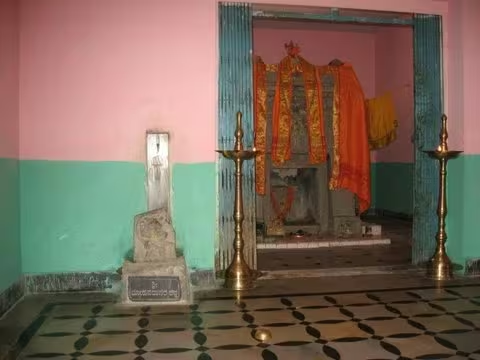
The Living Tradition: Vijaya Dasa passed away in 1755 at the age of 73. His mortal remains are enshrined in a Brindavana (a sacred tomb-shrine) in Chippagiri, located in modern-day Anantapur district of Andhra Pradesh. This site remains a major pilgrimage center for Madhvas and other devotees. Every year, his Aradhana (death anniversary) is celebrated with great devotion, with thousands gathering to sing the songs of ‘Vijaya Vittala’ and pay homage to the saint who gave them a renewed path to God.
Vijaya Dasa's life is a powerful narrative of transformation—from a man broken by worldly poverty to a spiritual giant who enriched the world with boundless devotion. He stands as a testament to the power of faith, the importance of a spiritual guide, and the enduring appeal of expressing the highest truths through the simple, profound medium of song.