Vijayalaya Chola: The Phoenix of Thanjavur and Founder of the Imperial Chola Dynasty
In the grand tapestry of Indian history, few stories are as compelling as the resurrection of a fallen power. Empires rise and fall, but for a name to fade into the whispers of a glorious past, only to be reborn centuries later with unprecedented might, is a testament to extraordinary vision and will. The architect of one such revival was Vijayalaya Chola, a figure who emerged from the shadows of vassalage to reignite the flame of a dynasty, transforming a forgotten lineage into the foundation of the formidable Imperial Chola Empire.
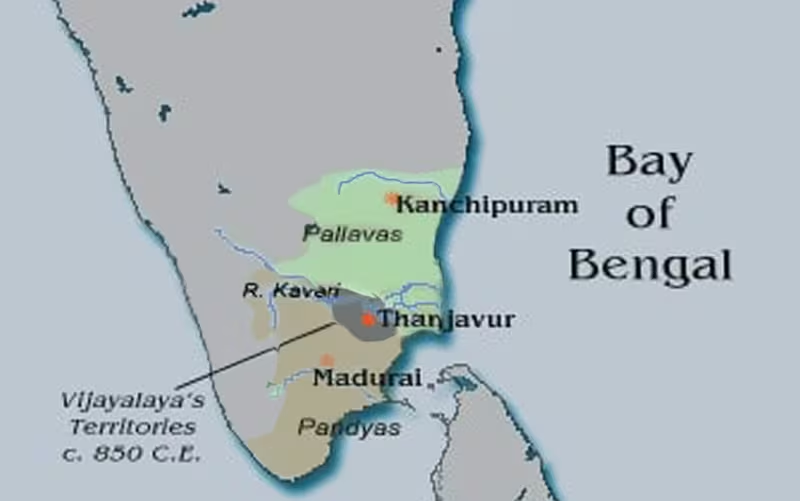
To understand the magnitude of Vijayalaya’s achievement, one must first grasp the political landscape of 9th century South India. The Tamil country, or Tamilakam, was a cauldron of shifting alliances and relentless conflict. The stage was dominated by three major powers: the Pallavas of Kanchipuram, the Pandyas of Madurai, and the Rashtrakutas of the Deccan, locked in a near-constant struggle for supremacy. In this epic drama, the Cholas were but a footnote. The descendants of the legendary Sangam-era kings like Karikala Chola, who had once commanded immense power, were now reduced to the status of minor chieftains, ruling a small, ancestral territory around Uraiyur, the ancient Chola capital. They held their land at the pleasure of their overlords, the Pallavas, their imperial past a distant, almost mythical, memory.
It was from this position of relative obscurity that Vijayalaya Chola (r. c. 848 – 871 CE) rose. He was not a king born to an established throne, but a feudatory who saw opportunity in chaos. With a single, audacious act of strategic genius, he would not only reclaim his family’s honour but also set in motion a chain of events that would lead to the rise of one of India’s greatest maritime empires.
The Shadow of a Glorious Past: Early Life and Political Context
Specific details of Vijayalaya's birth and early life are lost to history, a common fate for figures who begin their careers outside the major circles of power. The historical records that survive, primarily copper-plate inscriptions from his successors like the Tiruvalangadu plates of Rajendra Chola I, focus on his monumental achievements rather than his formative years. What is known with certainty is that he hailed from the ancient Chola lineage and served as a loyal feudatory to the Pallava kings.
His domain was a modest territory nestled on the northern bank of the River Kaveri. From here, he would have witnessed the violent ebb and flow of the Pallava-Pandya conflict. This was his education: a real-world masterclass in military strategy, political opportunism, and the fragility of power. He saw firsthand how the constant warfare between the two dominant kingdoms exhausted their resources and created power vacuums in the fertile Kaveri delta. For an ambitious local leader, this instability was not a threat, but an invitation.
The key to the region was the fortified city of Thanjavur (Tanjore). It was a prize of immense strategic value, controlling the heart of the delta. In the mid-9th century, Thanjavur was held by the Muttaraiyars, a powerful clan of chieftains who were themselves formidable local rulers. Crucially, they were staunch allies of the Pandyas of Madurai, acting as a buffer against Pallava influence in the south. To strike at Thanjavur was to strike at the heart of Pandya power in the region.
Seizing Destiny: The Conquest of Thanjavur
The opportune moment arrived around 850 CE. The Pandyas, under Varagunavarman II, were engaged in a protracted and draining war with the Pallavas. Their attention and military resources were focused northward. Vijayalaya, observing this from the sidelines, recognized his chance. In a move of stunning audacity, he marshalled his forces and launched a swift attack on Thanjavur.
The Muttaraiyar chieftain was caught unprepared. The ensuing battle was fierce, but Vijayalaya’s ambition was fiercer. He defeated the Muttaraiyar forces, captured the fortress of Thanjavur, and in doing so, announced the dramatic return of the Cholas to the main stage of South Indian politics. This was not merely a raid for plunder; it was a calculated seizure of a new capital, a declaration of intent. He immediately transferred his allegiance and capital from the ancestral home of Uraiyur to the newly conquered, far more defensible city of Thanjavur.
This single act was a masterstroke. It accomplished three critical objectives simultaneously:
- It established a new, powerful Chola capital: Thanjavur would become the nucleus of the burgeoning Chola state, a center from which his successors would launch their imperial conquests.
- It crippled Pandya influence: By ousting their key allies, the Muttaraiyars, Vijayalaya created a Chola-controlled wedge deep within a traditional sphere of Pandya power.
- It asserted Chola independence: While he likely maintained a nominal relationship with his Pallava overlords initially, the capture of a major city was a clear signal that the Cholas were no longer content to be mere subordinates.
To sanctify his conquest and legitimize his new rule, Vijayalaya immediately undertook a significant act of piety and power. He constructed a temple within Thanjavur dedicated to the goddess Nisumbhasudani, a fearsome form of Durga, the slayer of demons. This was a powerful political statement. By installing a temple to a goddess of war and victory, he was seeking divine sanction for his rule and positioning himself as a righteous king and protector of the dharma, a tradition his imperial successors would continue with magnificent grandeur.
The Battle of Thripurambiyam: A Legacy Forged in Blood
Vijayalaya's seizure of Thanjavur did not go unchallenged. The Pandyas, enraged by the loss of their allies and the rise of a new threat, sought to crush the nascent Chola power. The decades following the conquest of Thanjavur were marked by continuous skirmishes. The Cholas, now positioned between the Pallava hammer and the Pandya anvil, had to navigate their diplomacy and military strategy with extreme care.
The culmination of this hostility came around 879-880 CE at the pivotal Battle of Thripurambiyam (near modern-day Kumbakonam). By this time, Vijayalaya was an old man, a veteran warrior who, according to the Tiruvalangadu plates, bore hundreds of scars from his numerous battles. He was likely too aged or infirm to lead the army himself. The mantle of command had passed to his capable son and heir, Aditya I.
The battle was a monumental clash. On one side stood the Pandya king Varagunavarman II, determined to reassert his authority. On the other was a grand alliance forged out of necessity, comprising the Pallava king Aparajita, the Western Ganga king Prithvipati I, and the Chola prince Aditya I. Though technically fighting under the Pallava banner, Aditya and the Chola forces had the most to gain—or lose.
The battle was a bloody and decisive affair. The Pandya army was routed, their power in the Kaveri region shattered for a generation. The victory came at a great cost; the Ganga king Prithvipati I died a hero’s death on the battlefield. But for the Cholas, the outcome was an unmitigated triumph. Aditya I had distinguished himself as a brilliant commander, earning the gratitude of his Pallava overlord. More importantly, the victory eliminated their primary rival, the Pandyas, from the equation for the foreseeable future.
This victory, secured by his son, was the ultimate vindication of Vijayalaya's life's work. The foundation he had laid at Thanjavur was now secure, cemented by the blood of his enemies at Thripurambiyam.
Legacy and Influence: The Seed of an Empire
Vijayalaya Chola passed away around 871 CE, before the decisive battle that secured his kingdom. Yet, his legacy is not measured by the length of his reign or the breadth of his territory, but by the sheer transformative impact of his actions. He is remembered today as the 'Founder of the Imperial Chola Dynasty' for several profound reasons.
First and foremost, he resurrected a dynasty. He inherited a name rich in history but poor in power and, through sheer force of will, made it relevant again. He gave the Cholas a new capital, a new sense of purpose, and a foothold on the path to empire.
Second, he fundamentally altered the geopolitical map of South India. His actions catalysed the decline of both the Pallavas and the Pandyas. His son, Aditya I, would use the prestige gained at Thripurambiyam to turn on his weakened Pallava overlords, conquering their lands and formally establishing the sovereign Chola kingdom. Vijayalaya's move was the first domino to fall in the collapse of the old order.
Third, by establishing his capital at Thanjavur, he set the stage for one of the most glorious chapters in Indian art and architecture. The small temple he built for Nisumbhasudani was the humble precursor to the architectural marvels his descendants would raise. A little over a century later, his great-grandson, Rajaraja I, would consecrate the Brihadisvara Temple in the same city—a testament to the imperial grandeur that grew from the seed Vijayalaya had planted.
Vijayalaya's story is the archetypal tale of a visionary founder. He did not live to see the Chola navy command the Bay of Bengal or witness Chola emissaries in the court of the Chinese Emperor. He did not build the grand temples or conquer distant lands. But without his initial, courageous gamble—the seizure of Thanjavur from a superior foe—none of it would have been possible. He was the firm foundation upon which the magnificent imperial edifice was built by his successors: Aditya I, Parantaka I, Rajaraja I, and Rajendra I. He was the spark that reignited a forgotten fire, a fire that would burn brightly across Southern India and Southeast Asia for the next four hundred years.