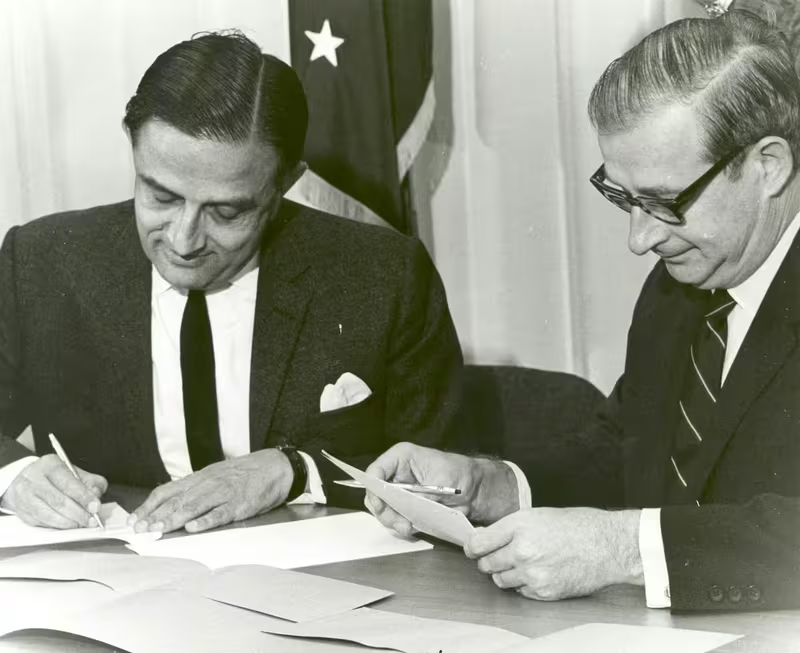
Vikram Sarabhai: The Visionary Who Dreamt of the Stars for India
In the grand tapestry of modern Indian history, few threads are as luminous and transformative as the life of Dr. Vikram Ambalal Sarabhai. He was not merely a scientist; he was an architect of institutions, a dreamer with a pragmatist's blueprint, and the undisputed father of a space program born not out of rivalry, but out of a profound commitment to national development. His story is the story of how a newly independent nation, grappling with immense challenges, dared to reach for the cosmos to solve its problems on Earth.
Early Life & A World of Influence
Vikram Sarabhai was born on August 12, 1919, in the bustling city of Ahmedabad, Gujarat, into a family that was a crucible of industry, philanthropy, and nationalism. The Sarabhai family were prominent industrialists, their wealth and influence built upon the textile mills that were the lifeblood of the city. Yet, their home was more than a mansion of affluence; it was a hub of intellectual and political ferment.
His father, Ambalal Sarabhai, was a forward-thinking industrialist, and his mother, Sarla Devi, a woman of immense intellect and conviction. They chose not to send their eight children to a conventional school. Instead, they established a private, experimental school at their sprawling home, the 'Retreat', based on the progressive principles of Maria Montessori. Here, in a vibrant, inquiry-driven environment, young Vikram’s curiosity was nurtured without the constraints of rote learning. The family had close ties with leaders of the Indian independence movement, and figures like Mahatma Gandhi, Rabindranath Tagore, and Jawaharlal Nehru were frequent visitors. Growing up amidst these conversations about India's future undoubtedly instilled in Sarabhai a deep-seated sense of purpose and national duty.
For his higher education, Sarabhai attended Gujarat College before sailing to England to study at the prestigious University of Cambridge. He enrolled at St. John's College and earned his Tripos in Natural Sciences in 1940. However, the outbreak of World War II forced his return to India. This historical disruption proved to be a pivotal moment in his career. Back home, he joined the Indian Institute of Science (IISc) in Bangalore, where he began his research on cosmic rays under the mentorship of the Nobel laureate Sir C.V. Raman. The cosmic ray research, studying particles from outer space, was quite literally his first foray into the cosmos.
After the war, in 1945, he returned to Cambridge to complete his doctoral studies. In 1947, the same year India awoke to freedom, Vikram Sarabhai was awarded his PhD for his thesis, "Cosmic Ray Investigations in Tropical Latitudes." The synchronicity was perfect: as his nation was being born, so was the foundation of his life's work.
The Institution Builder: From Cosmic Rays to a Nation's Rise
Dr. Sarabhai's return to a newly independent India was marked by an extraordinary burst of creative energy. He possessed a rare gift: the ability to see a need, conceptualize a solution in the form of an institution, and then inspire others to build it with him.
Physical Research Laboratory (PRL): The Cradle of Space Science
In November 1947, with support from his family's charitable trusts, Sarabhai founded the Physical Research Laboratory (PRL) in Ahmedabad. It began modestly, with a few rooms at his home, focusing on his primary interest: cosmic rays. But Sarabhai's vision for PRL was far grander. He saw it as the nucleus for modern science in India, a place that would cultivate a scientific temper and create the human capital needed for a technological future. PRL quickly grew into a premier institute, earning the moniker "cradle of space sciences in India," and it was here that the seeds of the Indian space program were sown.
A Vision for Space: Technology for the Common Man
The late 1950s and early 1960s were dominated by the Cold War Space Race between the United States and the Soviet Union, a contest for geopolitical prestige. Dr. Sarabhai watched these developments not with an eye to compete, but with a revolutionary idea. He was convinced that for a developing country like India, space technology was not a luxury but a powerful tool for leapfrogging developmental hurdles. He envisioned satellites providing nationwide education, advanced weather forecasting to protect farmers and fishermen, and remote sensing to manage natural resources.
He articulated this unique vision with powerful clarity:
"There are some who question the relevance of space activities in a developing nation. To us, there is no ambiguity of purpose. We do not have the fantasy of competing with the economically advanced nations in the exploration of the Moon or the planets or manned space-flight. But we are convinced that if we are to play a meaningful role nationally, and in the comity of nations, we must be second to none in the application of advanced technologies to the real problems of man and society."
This philosophy became the guiding principle of the Indian space program, setting it apart from all others in the world.
Laying the Foundation: INCOSPAR and the Thumba Launchpad
In 1962, Sarabhai persuaded Prime Minister Jawaharlal Nehru, a man with a deep commitment to science, to establish the Indian National Committee for Space Research (INCOSPAR), with Sarabhai as its first chairman. The first task was to find a suitable location for a rocket launching station. Scientific requirements pointed to a site near the Earth's geomagnetic equator, which led the search team to Thumba, a small fishing village in Kerala.
Thumba, however, was home to a fishing community and a historic church, St. Mary Magdalene Church. What followed is a legendary tale of scientific persuasion and community spirit. Dr. Sarabhai and his colleagues, including a young A.P.J. Abdul Kalam, approached the local bishop. Sarabhai spoke not of rockets and satellites, but of how science could uplift the lives of the very people who lived there. The bishop, convinced of this noble purpose, addressed his congregation during Sunday mass and received their wholehearted consent to relocate. The church building became the first workshop, the bishop’s house the first office, and the local cattle sheds the canteens.
On November 21, 1963, India took its first step into the space age. A small American-made sounding rocket, the Nike-Apache, lifted off from the shores of Thumba. The launch was a study in frugal innovation and determination; rocket parts were transported on bicycles and bullock carts. This humble beginning, powered by immense human spirit, marked the birth of India’s journey to the stars.
In 1969, Sarabhai formalized his vision by upgrading INCOSPAR into the Indian Space Research Organisation (ISRO) on India's Independence Day, August 15.
A Man of Many Visions
Dr. Sarabhai’s genius was not confined to space. He understood that national development required a holistic ecosystem of excellence.
- IIM Ahmedabad: Recognizing the need for professional managers to steer India's industries, he was a key figure in the establishment of the Indian Institute of Management, Ahmedabad (IIM-A) in 1961.
- ATIRA: He applied scientific methods to his family's traditional field by helping establish the Ahmedabad Textile Industry's Research Association (ATIRA).
- Darpana Academy: Along with his wife, the celebrated classical dancer Mrinalini Sarabhai, he founded the Darpana Academy of Performing Arts to preserve and promote India’s rich artistic heritage.
- Atomic Energy: After the tragic death of Dr. Homi J. Bhabha in 1966, Sarabhai took on the immense responsibility of chairing India's Atomic Energy Commission, carrying forward the nation's nuclear program with a focus on energy independence.
His work also led to the creation of the Vikram A. Sarabhai Community Science Centre, the Faster Breeder Test Reactor (FBTR) in Kalpakkam, and the Electronics Corporation of India Limited (ECIL), among many others. He was a force of nature, building the institutional bedrock for a modern India.
Legacy & Enduring Influence
Dr. Vikram Sarabhai's life was tragically cut short. On December 30, 1971, at the young age of 52, he passed away in his sleep at a hotel in Kovalam, near Thumba. He was there to lay the foundation stone for a new project. His sudden demise was a profound loss for a nation that had come to depend on his vision.
But Sarabhai had built his dreams to last. The seeds he had planted grew into mighty trees.
ISRO's Success: Every achievement of ISRO—from launching its first satellite, Aryabhata (a project he initiated), to the Satellite Launch Vehicle (SLV-3) program that he envisioned, to the Mars Orbiter Mission (Mangalyaan) and the historic Chandrayaan missions—is a testament to his foundational work. The landers for the Chandrayaan-2 and Chandrayaan-3 missions were aptly named 'Vikram' in his honour.
The SITE Experiment: His most audacious dream, the Satellite Instructional Television Experiment (SITE), came to fruition in 1975-76. Using a NASA satellite, India broadcasted specially created educational programs to 2,400 villages across the country. It was the largest sociological experiment in the world and proved Sarabhai's core belief that space technology could directly empower the most remote communities.
A Distinctive Path: Dr. Sarabhai's greatest legacy is the unique character of the Indian space program. He ensured its mission was always tethered to the needs of its people. Today, ISRO’s satellites are the backbone of India's communication, a guardian for its coasts, a guide for its farmers, and a lifeline during natural disasters. This is the living embodiment of the Sarabhai doctrine.
Vikram Sarabhai is remembered today not just through the institutions that bear his name, like the Vikram Sarabhai Space Centre (VSSC) in Thiruvananthapuram, but through the spirit of self-reliance, innovation, and societal purpose that he infused into Indian science. He was a gentle visionary, a leader who could inspire a prime minister and a fisherman with the same dream. He taught India not just to look up at the stars, but to bring their power down to Earth for the good of all.