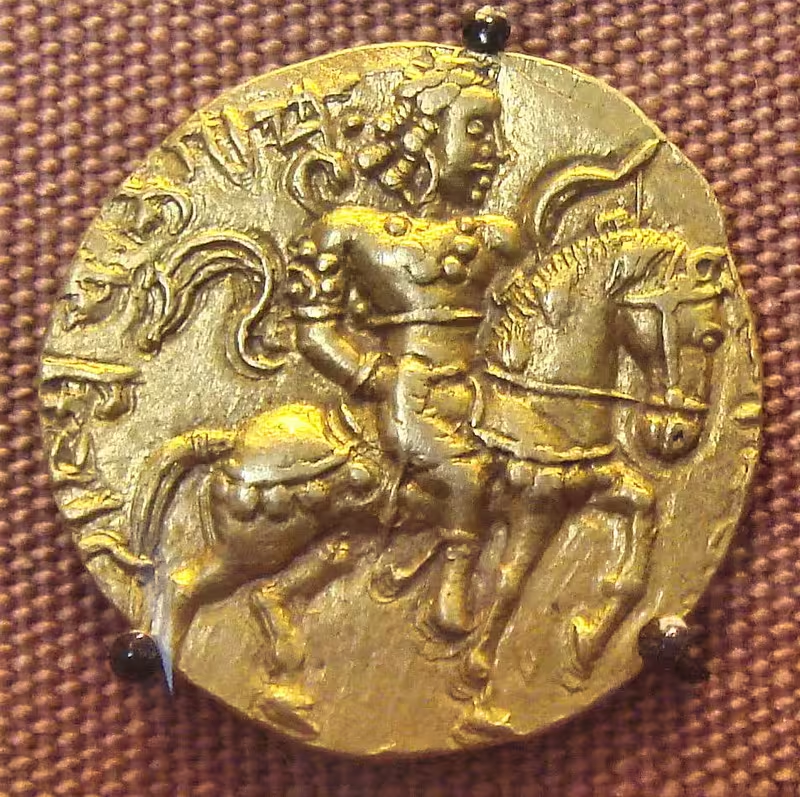
Vikramaditya - The Sun of Valour
In the grand tapestry of Indian history, few names resonate with the power of legend and the weight of ideal kingship as that of Vikramaditya. His name, meaning “Sun of Valour” (from Sanskrit vikrama, valour, and āditya, sun), evokes an image of a peerless ruler, a paragon of justice, a generous patron of the arts, and a warrior of indomitable courage. He is the central hero of two of India’s most beloved story collections, the Vetala Panchavimshati and the Simhasana Dwatrimshika. The Hindu lunisolar calendar, the Vikrama Samvat, used across the Indian subcontinent for centuries, is said to have been founded by him in 57 BCE to commemorate his decisive victory over the invading Shakas.
Yet, for all his fame, Vikramaditya remains one of history’s most profound enigmas. No definitive archaeological or epigraphic evidence from the 1st century BCE confirms the existence of a mighty emperor by this name ruling from Ujjain. Is he a historical figure whose deeds were magnified into legend, a composite of several great kings, or a purely literary creation embodying the ideal of righteous sovereignty? The quest to unravel the man from the myth is a journey into the heart of Indian tradition, where history and folklore are inextricably intertwined.
Early Life & Background: A Portrait from Legend
Historical records are silent on the birth, parentage, and early life of a king named Vikramaditya in the 1st century BCE. The figure we know is sculpted entirely from literary and folk traditions, which, while not historical proof, provide a rich narrative of his formative years.
According to the vast body of tales, Vikramaditya was a king who ruled from the ancient city of Ujjain, a thriving political, cultural, and astronomical hub in modern-day Madhya Pradesh. He is often depicted as a ruler of the Malava people. Tradition holds that he was a devout follower of Shiva and a staunch defender of Dharma (righteousness).
The legends do not focus on his lineage but on his character. He was said to possess superhuman courage, an unshakeable commitment to justice, and a deep empathy for his subjects. Stories abound of him roaming his own city in disguise at night to understand the true state of his people, a trope that would become a hallmark of the ideal monarch in Indian folklore. His education, as portrayed in these tales, was not merely in statecraft and warfare but in the esoteric arts and spiritual disciplines, granting him command over celestial beings and supernatural forces—a key element in his adventures with the vetala (a phantom-like spirit).
While these accounts are folkloric, they serve a crucial purpose: to establish Vikramaditya not as a man born into greatness, but as one who embodied it through his virtues and actions.
Career & Major Contributions: The Age of a Paragon
The reign of Vikramaditya, as described in literature, marks a golden age of peace, prosperity, and cultural efflorescence. His major contributions, cemented in the collective memory of India, are a blend of political achievement and unparalleled cultural patronage.
The Victory Over the Shakas and the Vikrama Samvat
The most significant political event associated with Vikramaditya is his monumental victory over the Shakas (Scythians), foreign invaders who had established kingdoms in western India. According to Jain historical traditions like the Kalakacharya-Kathanaka, the Shakas had overrun Ujjain, but Vikramaditya led a successful revolt, drove them out, and re-established righteous rule.
To commemorate this seminal victory, he is said to have initiated a new era, the Vikrama Samvat (Vikram Era), starting in 57 BCE. This act was more than just a calendar reform; it was a powerful statement of sovereignty and the restoration of Indian cultural pride. While the association of this era with a king named Vikramaditya only appears in texts from the 9th century CE onwards, the tradition has remained powerful. The Vikrama Samvat is still the official calendar of Nepal and is used in several states in northern, western, and central India.
The Navaratnas: A Constellation of Genius
Vikramaditya’s court is famed for having been adorned by the Navaratnas, or the “Nine Gems”—a brilliant assembly of the greatest poets, scholars, and scientists of the age. This tradition underscores his role as a supreme patron of learning and the arts. The traditional list of these nine luminaries includes:
- Kalidasa: The immortal poet and playwright of Sanskrit literature, author of masterpieces like Abhijnanasakuntalam and Meghadutam.
- Amarasimha: A lexicographer who compiled the celebrated Sanskrit thesaurus, the Amarakosha.
- Dhanvantari: A legendary physician and the father of Ayurveda.
- Varahamihira: A brilliant astronomer and astrologer, author of the Pancha-siddhantika and Brihat Samhita.
- Vararuchi: A grammarian and scholar.
- Ghatakarpara: A poet known for his work of the same name.
- Shanku: An architect.
- Kshapanaka: An astrologer.
- Vetala Bhatta: A magus or sorcerer.
It is crucial to note that modern scholarship has established that these nine figures were not contemporaries and lived in different centuries. For instance, Kalidasa and Varahamihira are widely believed to have lived during the Gupta period (c. 4th-6th centuries CE). This anachronism suggests that the legend of the Navaratnas may have been a later literary construct, possibly inspired by the brilliant court of the Gupta emperor Chandragupta II, who himself adopted the title Vikramaditya. Regardless, the legend firmly cemented Vikramaditya’s image as the ultimate connoisseur and patron of talent.
The Hero of Grand Narratives
Vikramaditya’s fame was immortalized through two major Sanskrit story cycles that have been translated and retold across India for centuries.
Vetala Panchavimshati (Twenty-five Tales of the Vetala): This gripping collection of tales features King Vikramaditya and his quest to capture a cunning vetala, a spirit inhabiting a corpse. As Vikram carries the corpse, the vetala narrates a story that ends with a complex moral riddle. If Vikram answers correctly, the vetala flies back to its tree, forcing the king to start over. If he knows the answer but stays silent, his head will shatter. The stories test Vikramaditya's wisdom, his understanding of Dharma, and his unwavering resolve, portraying him as a king who is both intellectually and physically courageous.
Simhasana Dwatrimshika (Thirty-two Tales of the Throne): This narrative is framed around the discovery of Vikramaditya’s lost throne by a later king, Bhoja. The magnificent throne is adorned with 32 celestial female statues (apsaras), who were cursed to turn to stone. Each time King Bhoja attempts to ascend the throne, one of the statues comes to life and narrates a story about Vikramaditya’s greatness—his generosity, justice, and selflessness—before asking Bhoja if he is worthy of sitting on it. Humbled, Bhoja admits he is not. These 32 tales collectively build an unparalleled portrait of the ideal king.
Legacy & Influence: The King Who Became an Ideal
While the historical man remains elusive, the legacy of the idea of Vikramaditya is immense and has profoundly shaped Indian culture, politics, and history.
The Historical Search and the Gupta Connection
Many historians argue that the legendary Vikramaditya is a composite figure, with his characteristics and achievements drawn from several powerful kings. The most prominent candidate for the historical basis of the legend is the Gupta Emperor Chandragupta II (reigned c. 380 – c. 415 CE).
Like the legendary Vikramaditya, Chandragupta II was a great conqueror who decisively defeated the Western Kshatrapas (a Saka dynasty). After this victory, he adopted the title Vikramaditya. His reign is considered the zenith of the Gupta Golden Age, marked by immense prosperity and a flourishing of arts and sciences. His capital was Pataliputra, but he also established a second capital at Ujjain after his western conquests, further linking him to the city of legend. It is highly plausible that the brilliant court of Chandragupta II, which included great minds, inspired the later legend of the Navaratnas, with Kalidasa being a prime example. Over time, the deeds of this historical Vikramaditya likely merged with and amplified the existing folk traditions of a just king from Ujjain.
An Enduring Title
The name Vikramaditya became more than a personal name; it transformed into a coveted title, a symbol of ultimate sovereignty and righteous power. For centuries after the Guptas, ambitious Indian kings who achieved significant military victories and established vast empires adopted the title to legitimize their rule and align themselves with the legendary ideal. The last Indian ruler to assume the title was Hemu, a Hindu general who briefly captured Delhi from the Mughals in 1556 CE.
The Archetype of the Ideal King
Vikramaditya’s most lasting legacy is his role as the archetypal king in the Indian psyche. He is not remembered merely for his conquests but for his character. In him, the three key royal virtues converge: Vikrama (valour), Tyaga (generosity), and Nyaya (justice). The stories paint him as a king who would sacrifice anything, even his own life, for the welfare of a subject or to uphold a promise. He embodies the principle of Ram Rajya—a reign of perfect justice, prosperity, and moral order.
Whether a single man who ruled in 57 BCE, a reflection of the great Gupta emperor, or a timeless literary creation, Vikramaditya represents a powerful and enduring Indian ideal. He is the king who listens to the voiceless, the warrior who defends the weak, the patron who recognizes genius, and the sage who can solve the most profound riddles of life. His throne may be lost to time, but his stories continue to teach, inspire, and define the very essence of noble leadership in the Indian imagination.