The Phoenix of Vatapi: Vikramaditya I, Restorer of the Chalukyas
In the annals of Deccan history, few stories are as dramatic as the fall and rise of the Chalukyas of Vatapi. At the heart of this saga of collapse and restoration stands a figure forged in the crucible of loss and driven by a singular, burning ambition: Vikramaditya I (r. c. 655 – 680 CE). He was not an emperor who inherited a stable throne, but a prince who had to reclaim a shattered kingdom. His reign was not one of peaceful construction, but of relentless warfare, a multi-decade quest to avenge the death of his legendary father, Pulakeshin II, and restore the glory of his house.
Early Life & Background: A Kingdom in Ruins
To understand Vikramaditya I, one must first understand the catastrophe that shaped him. He was one of the sons of the great Pulakeshin II, the Chalukya emperor who had expanded his domain across the Deccan, from the Narmada river in the north to the Kaveri in the south. Pulakeshin II was an imperial titan, famous for halting the northward march of the southern Pallavas and, most spectacularly, for defeating the mighty Emperor Harshavardhana of Kannauj on the banks of the Narmada.
By the early 640s CE, the Chalukya empire was at its zenith. But this power invited a formidable rival. The Pallava king of Kanchi, Narasimhavarman I, was a monarch of equal ambition and military genius. Seeking to avenge his own father's defeat at the hands of Pulakeshin, Narasimhavarman launched a massive invasion of the Chalukya kingdom around 642 CE.
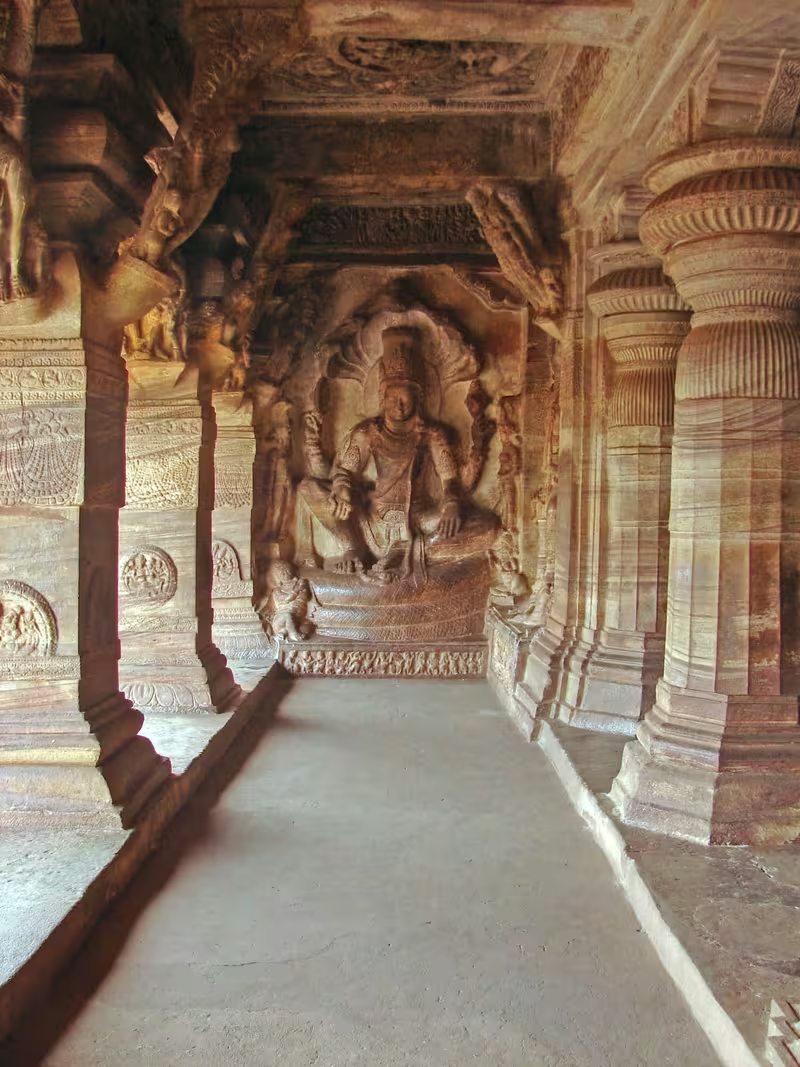
The campaign was a disaster for the Chalukyas. Pulakeshin II was defeated and likely killed in battle. The Chalukya army was scattered, and the unthinkable happened: the magnificent capital city of Vatapi (modern-day Badami in Karnataka) was captured, sacked, and occupied by the Pallava forces. Narasimhavarman I proudly took the title Vatapikonda—the “Conqueror of Vatapi.”
For the next thirteen years, the Chalukya empire ceased to exist as a unified entity. This period, from roughly 642 to 655 CE, is a dark interregnum in Chalukya history. The kingdom was fragmented, with Pulakeshin’s sons, including Vikramaditya, likely controlling small, scattered territories, unable to mount a united front. The central authority had vanished, and the Pallavas held dominion over the Chalukyan heartland. It was into this world of defeat and occupation that Vikramaditya I came of age. While specific details of his education are lost to time, his formative experience was undoubtedly the humiliation of his family and the dismemberment of his father’s empire. His entire youth was a lesson in loss, a motivation to reclaim what was stolen.
Career & Major Contributions: The Great Restoration
Around 655 CE, after more than a decade of chaos, Vikramaditya I succeeded in consolidating his power and ascended the fractured Chalukya throne. His coronation was not a celebration, but a declaration of intent. His life’s work was laid out before him: to expel the Pallavas, reunite the feudatories, and rebuild his father’s empire from the ground up.
A War on Three Fronts
Vikramaditya’s task was monumental. He faced not just the Pallavas but their powerful allies and vassals in the south—the Cholas, the Pandyas, and the Keralas. According to his own Gadval plates, he faced a confederacy of three kings, a likely reference to the Pallava monarch and his chief southern allies. With a force built from the remnants of his father's army and loyalist feudatories, he launched a relentless campaign.
His military strategy was brilliant and methodical. He first worked to secure his own heartland, driving the Pallava garrisons out of Chalukya territory and re-establishing control. One by one, he subdued the southern powers that had allied with his enemy. His inscriptions boast of victories over the Cholas, Pandyas, and Keralas, effectively isolating the Pallavas and breaking their southern coalition. This systematic dismantling of the enemy's support network was crucial to his eventual success.
The symbolic climax of this first phase was the liberation of Vatapi. Reclaiming the capital was a moment of immense political and emotional significance. The Chalukya banner once again flew over the city, and Vikramaditya I had begun to erase the shame of the past thirteen years.
The Invasion of Kanchi: An Emperor's Vengeance
Having restored his kingdom, Vikramaditya I turned his full attention to the source of his family's humiliation: the Pallava kingdom. He was not content with merely pushing the enemy back to their borders; he sought total victory, a reckoning for the death of his father and the sack of his capital.
He renewed the war against the Pallava king Parameshvaravarman I (r. c. 670–695 CE). Aided by his able son, the crown prince Vinayaditya, and his grandson Vijayaditya, Vikramaditya I led the Chalukya army deep into the heart of Pallava territory. The campaign was a stunning success. The Chalukya forces marched all the way to the Pallava capital, Kanchipuram, the very city from which Narasimhavarman I had launched his invasion two decades earlier.
In an incredible reversal of fortune, Vikramaditya I captured Kanchi. The Gadval plates vividly describe this triumph, stating that he “crushed the glory of Narasimha [Narasimhavarman I], destroyed the power of Mahendra [Mahendravarman II], and surpassed Isvara [Parameshvaravarman I] by his policy.” He encamped his army on the southern banks of the Kaveri river, deep in enemy territory, a clear statement of his dominance.
Unlike the Pallavas in Vatapi, Vikramaditya’s occupation of Kanchi seems to have been different. While he asserted his power, he also performed acts of piety. Later Chalukya inscriptions record that he made generous grants to the temples and learned Brahmins of Kanchi, symbolically “washing away the sins” of the city. He took the title Rajamalla, meaning “Sovereign of the Mallas (Pallavas),” a direct assertion of his supremacy.
The Pallava Counter-Attack
The war, however, was far from over. The Pallavas were a resilient power. Parameshvaravarman I, though defeated, managed to regroup his forces. Pallava records claim a great victory at the Battle of Peruvalanallur (near modern-day Tiruchirappalli) around 674 CE. According to these accounts, Parameshvaravarman I, leading a small force, routed the massive Chalukya army and pushed Vikramaditya I back. Chalukya records are silent on this specific engagement, which is not unusual when an army suffers a setback.
While the extent of the Chalukya defeat at Peruvalanallur is debated by historians, it is clear that the Pallavas managed to launch a formidable counter-offensive. They pursued the retreating Chalukya army all the way back to the banks of the Tungabhadra river. The conflict had become a grinding, back-and-forth struggle. Despite any setbacks, however, Vikramaditya I successfully defended his kingdom and maintained its integrity. He had achieved his primary goals: the Pallavas were expelled from Chalukya land, the empire was reunified, and Chalukya honor was restored.
An Administrator of a Warrior State
Vikramaditya I’s reign was almost entirely consumed by war, but he also laid the administrative groundwork for the empire’s future. He adopted titles that reflected his achievements and ideals, such as Satyashraya (“Refuge of Truth”), Anivarita (“The Unrestrained”), and the aforementioned Rajamalla. As a devout Hindu, particularly a follower of Shaivism, his inscriptions often begin with invocations to Lord Shiva. By ensuring a stable and powerful succession through his son Vinayaditya, who served as an active and loyal general, he avoided the kind of power vacuum that had destroyed the kingdom after his father’s death.
Legacy & Influence
Vikramaditya I died around 680 CE, leaving behind a kingdom reborn. His legacy is not that of a great builder of temples, but of something far more fundamental: he was the great restorer.
Savior of the Dynasty: His most important legacy is the revival of the Chalukya dynasty from the brink of total annihilation. Without his determination and military acumen, the Chalukyas of Vatapi might have been a mere footnote in history. He is, in effect, the second founder of the empire.
Shifting the Balance of Power: By defeating the Pallavas and their allies and occupying their capital, he decisively shifted the political and military balance of power in Southern India back in favor of the Chalukyas. He re-established the Chalukyas as the pre-eminent power of the Deccan, a position they would hold for another century.
A Legacy of Conflict: The capture of Kanchi did not end the Chalukya-Pallava rivalry; it intensified it. His actions set the stage for generations of conflict, with his successors, particularly his great-grandson Vikramaditya II, launching their own invasions of Kanchi to relive his glory. The great architectural flowering at the Chalukyan sites of Pattadakal and Aihole under his successors was funded by the wealth and stability he had secured through war.
The Archetype of the Warrior-King: Vikramaditya I became the embodiment of the righteous Hindu king who reclaims his dharma and avenges injustice. His life story—a prince who loses everything, endures hardship, and rises to reclaim his father’s throne and honor—is a powerful narrative that cemented his place as one of the most significant rulers of his time.
Vikramaditya I’s reign was a trial by fire. He inherited a name but no kingdom, a legacy but no throne. Through sheer force of will and strategic genius, he rebuilt an empire from its ashes. He stands as a testament to resilience, a phoenix king who ensured that the glory of Vatapi would not be forgotten.