Vikramaditya II - The Chalukya Lion of the Deccan
In the grand tapestry of Indian history, the 8th century was a time of seismic shifts. Empires clashed, new faiths arrived at the subcontinent's borders, and dynasties forged legacies in stone and steel. In the heart of the Deccan, on the grand throne of the Chalukyas of Vatapi (modern Badami), sat a ruler who would not only define this tumultuous era but rise to become its master: Vikramaditya II. His reign, though lasting just over a decade from 733 to 744 CE, was a brilliant crescendo for his dynasty—a period of unparalleled military triumph, architectural splendour, and the definitive safeguarding of the southern peninsula from foreign invasion.
Early Life & Background: Forged in an Age of Rivalry
Vikramaditya II was born into a legacy of power and a burning desire for vengeance. He was the son of Emperor Vijayaditya, a ruler whose long and largely peaceful reign had consolidated the gains of his predecessors. But the shadow of a past humiliation loomed large over the Chalukyan court. In 642 CE, the great Chalukya emperor Pulakeshin II had been defeated and killed, and the capital, Vatapi, had been sacked and occupied by the Pallava king Narasimhavarman I. The Pallavas of Kanchi, the Chalukyas' arch-rivals to the south, had inflicted a wound that festered for generations.
Vikramaditya's great-grandfather, Vikramaditya I, had restored the dynasty's fortunes, but the score was far from settled. This dynastic rivalry was the defining political reality of the Deccan, and it was into this crucible that the young prince was forged.
As the Yuvaraja (crown prince), Vikramaditya II did not wait in the wings. Inscriptions, such as the Kendur plates, attest to his active role in military campaigns during his father's reign. He learned the arts of war and statecraft not in a classroom, but on the battlefield, leading Chalukyan armies against their perennial foes. These early expeditions were his training ground, instilling in him a deep understanding of military strategy and an unyielding resolve to restore the absolute supremacy of his house.
When he finally ascended the throne in 733 CE, he was not a novice ruler but a seasoned commander, inheriting an empire that was stable and prosperous, yet hungry to reclaim its lost honour. The stage was set for a reign that would be anything but peaceful.
Career & Major Contributions: The Conqueror and the Patron
Vikramaditya II's reign was a whirlwind of military action, defined by two monumental conflicts that would reshape the map and destiny of southern India.
The Southern Conquests: The Humbling of Kanchi
Almost immediately upon his coronation, Vikramaditya II turned his gaze south. The objective was singular and deeply personal: the subjugation of the Pallava kingdom and the capture of its magnificent capital, Kanchipuram. He unleashed the full might of the Chalukyan war machine, a storm that had been gathering for nearly a century.
His invasion of the Pallava territory of Tondaimandalam was swift and decisive. The reigning Pallava king, Nandivarman II Pallavamalla, was overwhelmed and defeated. The Chalukyan army marched triumphantly into Kanchi, the city whose rulers had once desecrated Vatapi.
But here, Vikramaditya II made a choice that defined his legacy. Where the Pallavas had brought destruction, he brought magnanimity. The historical record, etched in stone by the emperor himself, is unequivocal. Instead of sacking the city, he entered it as a dignified conqueror. He visited the city's grand temples, particularly the Rajasimhesvara (now Kailasanatha) Temple, a masterpiece of Pallava architecture. Awestruck by its beauty, he did not deface it but instead made lavish donations of gold and jewels. He also ordered that the wealth and treasures of the city, which rightfully belonged to the temples and its people, be returned.
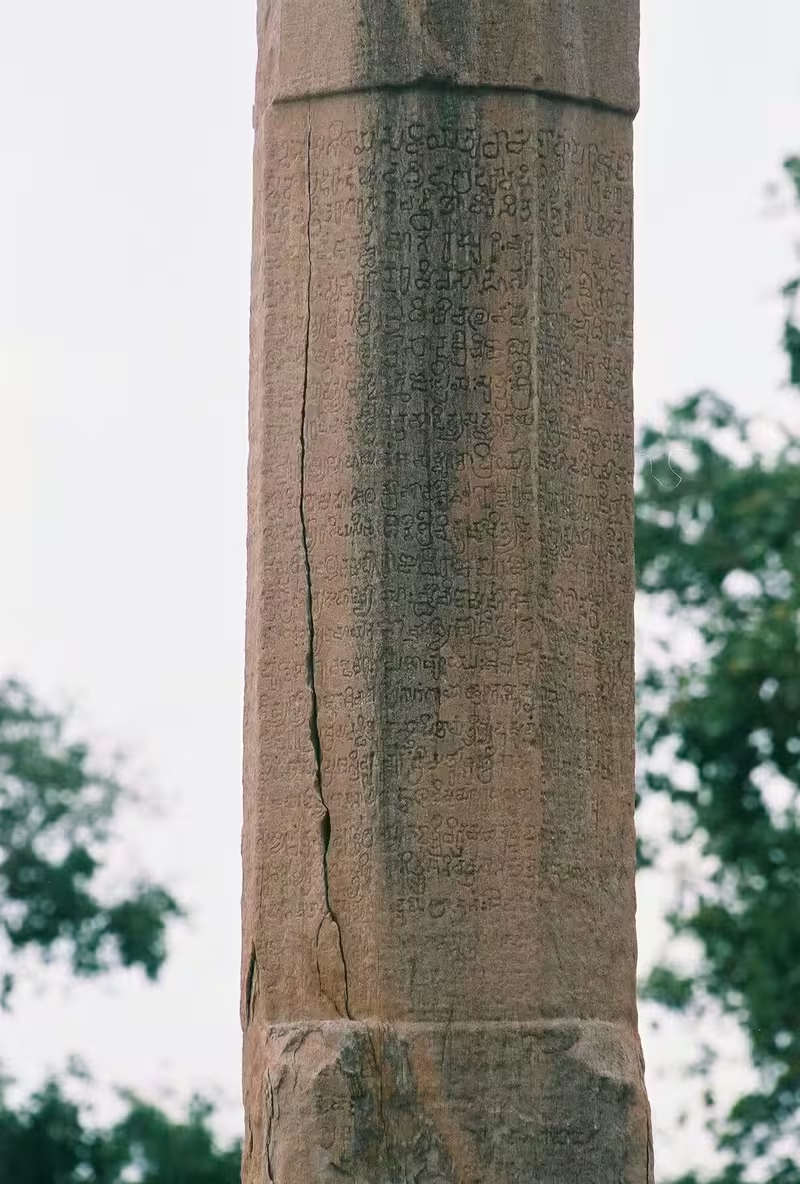
On a victory pillar within the Kailasanatha Temple's mandapa, he had a Kannada inscription carved—a permanent, public declaration of his conquest and his clemency. It was a powerful statement: the Chalukyas were not mere plunderers but supreme emperors, capable of both total victory and noble restraint. This act of entering the enemy capital and showering it with gifts, rather than flames, was the ultimate assertion of power.
His southern campaign did not end there. Inscriptions from his reign boast of victories over the traditional powers of the deep south—the Pandyas, Cholas, and Keralas, as well as the Kalabhras—extending Chalukyan influence to the very edge of the subcontinent.
Sources like the Vakkaleri plates state that Vikramaditya II overran Kanchi on three separate occasions. The third campaign was likely undertaken later in his reign, led by his son and crown prince, Kirtivarman II, to reassert Chalukyan dominance and aid their allies, the Western Ganga dynasty, against a resurgent Pallava threat. For the Chalukyas, the ghost of Vatapi had not only been exorcised; it had been replaced by the triumphant memory of Kanchi's conquest.
The Northern Shield: Halting the Arab Invasion
While Vikramaditya II was securing his southern flank, a formidable new power was testing the northern frontiers of his empire. The Umayyad Caliphate, having conquered Sindh in 712 CE, was pushing aggressively into India. By the 730s, Arab armies under the command of governors like Junaid ibn Abd al-Rahman al-Murri had swept through Kathiawar, Saurashtra, and were raiding deep into the region of Lata (southern Gujarat), which was ruled by a feudatory branch of the Chalukyas.
This was a threat of an entirely different order. The Arab forces were renowned for their speed, ferocity, and a string of victories that had seen them conquer territory from Spain to Central Asia. Several Indian kingdoms in the north had already fallen or been severely weakened.
The Chalukyan governor of Lata, Avanijanashraya Pulakeshin, rose to the occasion. Around 738 CE, near the city of Navsari, he marshalled his forces and met the invading Arab army in a pitched battle. The engagement was ferocious, but the Chalukyan forces, under Pulakeshin's brilliant command, inflicted a catastrophic defeat upon the Arabs. The invaders were routed so completely that their momentum was shattered, and they were forced into a full retreat back towards Sindh.
This victory at Navsari was a pivotal moment in Indian history. It effectively halted the southward expansion of the Caliphate's armies on the western coast for centuries, securing the Deccan and the southern peninsula from an invasion that could have irrevocably altered its cultural and political landscape.
As the suzerain emperor, the credit for this monumental victory ultimately belonged to Vikramaditya II. He had entrusted a vital frontier to a capable subordinate and, upon his feudatory's success, rewarded him handsomely. The Navsari plates, which document this event, record the titles that a grateful Vikramaditya bestowed upon Pulakeshin: Dakshinapatha-sadhara (Pillar of the Deccan) and, most tellingly, Anivartaka-nivartayitri (the Repeller of the Un-repellable). This victory cemented Vikramaditya’s status not just as a conqueror of regional rivals, but as a defender of the entire subcontinent.
The Patron of Pattadakal
Vikramaditya II's legacy was not only written on the battlefield but also carved in stone. His reign witnessed the zenith of Chalukyan art and architecture, particularly at the royal ceremonial centre of Pattadakal (a UNESCO World Heritage Site).
To commemorate his triumphant conquest of Kanchi, his two queens, the Haihaya princesses Lokamahadevi and Trailokyamahadevi, commissioned two magnificent temples. The senior queen, Lokamahadevi, sponsored the construction of the Lokeshvara temple, now famously known as the Virupaksha Temple. Her sister, Trailokyamahadevi, built the adjacent Trailokeshvara temple, now the Mallikarjuna Temple.
These temples were not merely acts of devotion; they were political statements. The Virupaksha Temple's design was directly inspired by the Kailasanatha Temple in Kanchi, the very structure that had so impressed Vikramaditya. He brought back sculptors and architects from the Pallava kingdom to work alongside Chalukyan artisans, fostering a remarkable synthesis of northern (Nagara) and southern (Dravida) architectural styles. The result was the crowning achievement of the Chalukyan era—a temple of exquisite proportions, covered in intricate carvings depicting tales from the epics, a testament to the empire's power, wealth, and sophisticated cultural taste.
Legacy & Influence
Vikramaditya II's death in 744 CE marked the end of a glorious chapter. His reign was the final, brilliant flare of the Badami Chalukya dynasty's power.
His historical significance is threefold. First, he was the Avenger of Vatapi, who decisively settled the long and bitter rivalry with the Pallavas, not with brute destruction, but with a calculated display of superior power and magnanimity. Second, he was the Savior of the South, whose strategic foresight and capable feudatories decisively stopped the Arab advance into the Deccan, a victory whose importance cannot be overstated. Finally, he was the Ultimate Chalukya Emperor, who presided over the dynasty's largest territorial extent and its most glorious cultural achievements.
The architectural marvels he and his queens patronized at Pattadakal had a lasting impact. The Virupaksha Temple itself became a model for the future, directly inspiring the design of the great Kailasa Temple at Ellora, built by the Rashtrakutas—the very dynasty that would soon overthrow the Chalukyas.
This is the poignant irony of Vikramaditya II's story. Despite his immense personal success, the seeds of his dynasty's decline were already present. Just a few years after his death, a powerful feudatory, Dantidurga of the Rashtrakuta clan, rose in rebellion. Vikramaditya's son and successor, Kirtivarman II, was unable to contain the uprising, and by 753 CE, the great Chalukya empire of Vatapi had been extinguished.
Vikramaditya II is thus remembered as the last great emperor of his line, a ruler who took his dynasty to its absolute zenith just before its sudden fall. He remains a towering figure in the history of the Deccan—a brilliant military strategist, a statesman of vision, and a patron of art whose legacy is forever enshrined in the glorious temples of Pattadakal and in the annals of a dynasty that, under his command, touched greatness.