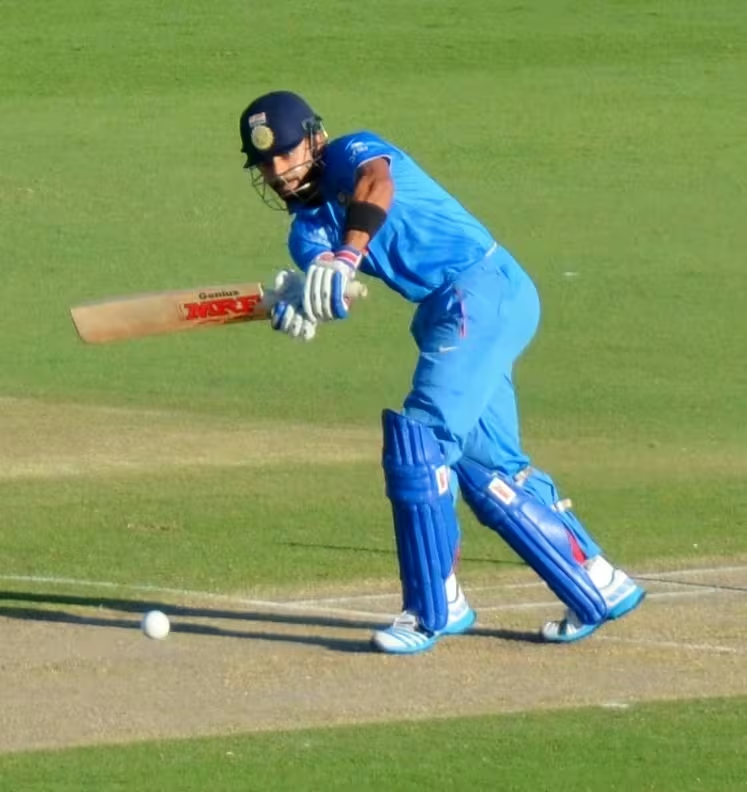
Virat Kohli - The King of Modern Cricket
In the grand tapestry of Indian cricket, a realm once ruled by the calm grace of Sunil Gavaskar and the divine artistry of Sachin Tendulkar, there emerged a new sovereign in the 21st century. He did not rule with quiet poise but with a fiery, untamed passion; his sceptre was not just a bat that scored runs, but an instrument that bludgeoned records into submission. This is the story of Virat Kohli, a name that has become synonymous with relentless ambition, unparalleled consistency, and a revolutionary zeal that forever altered the DNA of Indian cricket.
Born on November 5, 1988, in Delhi, Virat Kohli is more than just a cricketer; he is a cultural phenomenon. He embodies the spirit of a new India – assertive, confident, and unapologetically ambitious. From the dusty grounds of West Delhi to the grandest stadiums across the globe, his journey is a testament to prodigious talent forged in the crucible of personal tragedy and professional hardship, culminating in his coronation as 'King Kohli', one of the undisputed masters of the modern game.
Early Life & Background
Virat Kohli was born into a Punjabi Hindu family in Delhi, the youngest of three children. His father, Prem Kohli, was a criminal lawyer, and his mother, Saroj Kohli, a homemaker. From a very young age, his affinity for cricket was unmistakable. The story, now part of cricketing folklore, tells of a three-year-old Virat picking up a cricket bat, swinging it with surprising coordination, and asking his father to bowl to him. This was not a fleeting childhood fancy; it was the first flicker of a fire that would one day consume the cricketing world.
Recognizing his son's prodigious talent, Prem Kohli enrolled him in the West Delhi Cricket Academy in 1998 when Virat was just nine years old. Under the tutelage of coach Rajkumar Sharma, the young boy’s raw, aggressive talent was meticulously honed. His father became his greatest supporter, driving him to practice sessions and matches daily, instilling a discipline and work ethic that would become the bedrock of his career.
Kohli's formal education at Vishal Bharti Public School soon took a backseat to his cricketing education. He quickly rose through the ranks of Delhi's junior cricket scene, representing the city at Under-15, Under-17, and Under-19 levels. His performances were not just good; they were dominant, marking him as a special talent destined for higher honours.
However, the most defining moment of his formative years arrived under the bleakest of circumstances. In December 2006, an 18-year-old Kohli was playing a crucial Ranji Trophy match for Delhi against Karnataka. Overnight, his father, his anchor and guide, passed away from a cerebral stroke. The next morning, to the astonishment of his teammates and coach, Virat Kohli walked out to bat. He calmly resumed his innings, scoring a match-saving 90 runs before being dismissed. He went directly to his father's funeral from the cricket ground. This single act of fortitude revealed a mental toughness far beyond his years. In that moment of profound grief, a boy was forged into a man, and a cricketer into a warrior. Kohli has often stated that this day changed his life forever, cementing a resolve to fulfil his father's dream with unwavering focus.
Career & Major Contributions
Kohli's ascent from a prodigious teenager to a global superstar was swift and spectacular. His career can be seen as a series of ever-higher peaks, each conquered with a blend of audacious skill and indomitable will.
The U-19 World Cup and International Debut
The first glimpse the world got of Kohli’s leadership was in 2008, when he captained the Indian Under-19 team to a glorious World Cup victory in Malaysia. His aggressive captaincy and crucial runs marked him as a future leader. Just months later, in August 2008, he made his One Day International (ODI) debut for India against Sri Lanka. While his initial years were about finding his footing, a maiden century against the same opposition in 2009 cemented his place in a star-studded batting lineup.
The 2011 World Cup and the Rise of the 'Chase Master'
Kohli was a vital, albeit junior, member of the Indian squad that lifted the 2011 ICC Cricket World Cup on home soil. His crucial 35 in the final, part of a steadying partnership with Gautam Gambhir after the early dismissals of Virender Sehwag and Sachin Tendulkar, was a sign of his big-match temperament. His words after the victory, as he helped carry Tendulkar on his shoulders for a lap of honour, became iconic: "He has carried the burden of the nation for 21 years. It was time we carried him."
Following the World Cup, Kohli truly came into his own, especially in ODIs. He developed a reputation as the 'Chase Master' for his extraordinary ability to pace an innings and thrive under the pressure of a run chase. His innings of 133 not out from just 86 balls against Sri Lanka in Hobart, Australia, in February 2012, is a classic example. India needed to chase 321 in under 40 overs to stay alive in the tournament; Kohli’s breathtaking assault ensured they did it in just 36.4 overs. This was the moment he transitioned from a great talent to a cricketing phenomenon.
Test Dominance and the Captaincy Era
After his Test debut in 2011, Kohli initially struggled to adapt to the longest format. However, his breakthrough came during the 2011-12 tour of Australia, where he scored a magnificent maiden Test century in Adelaide, standing tall amidst the ruins of a batting collapse. It was a statement of intent.
In late 2014, following MS Dhoni's surprise retirement from Test cricket, Kohli was handed the captaincy. He didn't just inherit a team; he sought to remake it in his own image. He championed a new, aggressive philosophy, famously known as the 'five-bowler theory', which prioritized taking 20 wickets to win a Test match over ensuring a draw. This bold strategy, combined with an unprecedented focus on fitness, transformed India into a formidable Test unit, especially overseas.
Under his leadership, India developed a lethal fast-bowling arsenal, with Jasprit Bumrah, Mohammed Shami, and Ishant Sharma becoming world-beaters. The results were historic. India held the ICC Test Championship mace for five consecutive years (2017-2021). The crowning achievement of his captaincy was leading India to its first-ever Test series victory in Australia in 2018-19, breaking a 71-year drought. He also led the team to the final of the inaugural ICC World Test Championship in 2021.
The Peak of Batting Prowess (2016-2018)
Between 2016 and 2018, Virat Kohli entered a phase of such sublime form that it bordered on the supernatural. He seemed to break records every time he walked to the crease. In 2016, he scored an unbelievable 973 runs in a single Indian Premier League (IPL) season, including four centuries. In Test cricket, he scored double centuries in four consecutive series. In ODIs, he became the fastest batsman in history to reach 8,000, 9,000, 10,000, 11,000, and 12,000 runs, systematically dismantling records set by his idol, Sachin Tendulkar. His consistent, high-impact performances across all three formats earned him the prestigious Sir Garfield Sobers Trophy for ICC Cricketer of the Year in both 2017 and 2018.
Legacy & Influence
Virat Kohli's legacy cannot be measured in mere runs and centuries. His impact on Indian cricket and culture is profound and multi-dimensional.
The Fitness Revolution
Perhaps Kohli’s greatest contribution, outside of his batting, is the fitness revolution he single-handedly spearheaded. In the early 2010s, he transformed himself from a talented but slightly chubby youngster into one of the fittest athletes on the planet. He made fitness a non-negotiable prerequisite for playing for India. The introduction of the demanding 'Yo-Yo test' as a selection criterion was a direct result of his philosophy. This cultural shift professionalized the sport in India to an unprecedented degree, creating a pool of supremely athletic cricketers capable of competing with intensity for all five days of a Test match.
Redefining Indian Aggression
Kohli's on-field persona was a departure from the calm, composed demeanour of his predecessors. He played with his heart on his sleeve, never shying away from a confrontation and always leading the charge with visible passion. This brand of controlled aggression resonated deeply with a young, aspirational Indian population. He showed that an Indian team could be dominant and aggressive, looking the opposition in the eye and giving as good as they got. He changed the very body language of Indian cricket.
A Global Icon
With his unparalleled success and charismatic personality, Kohli became one of the most marketable athletes in the world, frequently listed by Forbes alongside global icons like Lionel Messi and LeBron James. His brand endorsements and massive social media following made him a youth icon whose influence transcended the boundaries of sport. He represents the face of a modern, confident India that is comfortable on the global stage.
A Statistical Behemoth
Today, Virat Kohli stands firmly in the pantheon of cricket's all-time greats. His consistency across all three formats of the game—Test, ODI, and T20—is arguably unmatched in the history of the sport. As a member of the 'Fab Four' (along with Joe Root, Kane Williamson, and Steve Smith), he has often been hailed as the most complete batsman of his generation.
His legacy will be that of a transformative figure. He was not just a player who broke records; he was a leader who shattered old mindsets. He inherited a talented team and bequeathed a ruthless, world-beating unit. Virat Kohli's story is the story of a man who, through sheer force of will, passion, and an insatiable hunger for excellence, didn't just play the game—he changed it forever.