The Last Great Flame: Yajna Sri Satakarni and the Satavahana Resurgence
In the rich tapestry of Indian numismatics, few coins capture the imagination quite like those bearing the image of a two-masted ship, sails billowing, navigating the open sea. These are not mere pieces of currency; they are potent symbols of a bygone era, miniature testaments to an empire’s command over the waves. They are the most enduring legacy of Yajna Sri Satakarni, the last great ruler of the Satavahana dynasty, a man who, in the twilight of his empire, mounted a fierce and brilliant resurgence against encroaching forces.
Reigning for nearly three decades in the late 2nd and early 3rd centuries CE (c. 170-199 CE), Yajna Sri Satakarni inherited a kingdom that was a shadow of its former self. The once-mighty Satavahana empire, which had dominated the Deccan for centuries, was reeling from defeats and territorial losses. Yet, through military prowess, political acumen, and a vision that extended far beyond the land, he not only halted the decline but also restored a significant measure of his dynasty's lost glory. His story is one of reclamation, of a final, powerful assertion of sovereignty that echoed across the Indian subcontinent.
The Inherited Struggle
Specific details of Yajna Sri Satakarni's birth, parentage, and early life are lost to the mists of time, a common fate for many figures of ancient India. Historical records of the period, including the Puranas, focus on kingly succession and major events rather than personal biographies. However, the world into which he was born was one of geopolitical turmoil, defined by a single, overarching conflict: the relentless struggle between the Satavahanas and the Western Kshatrapas, also known as the Sakas.
By the mid-2nd century CE, the Satavahanas had suffered a series of devastating setbacks at the hands of the Saka ruler Rudradaman I. A formidable military leader, Rudradaman had wrested control of crucial territories, including northern Konkan, the Narmada valley, and the prosperous region of Malwa. In his famous Junagadh rock inscription, Rudradaman proudly proclaims to have twice defeated a Satavahana king, whom historians identify as Vasisthiputra Pulumavi, a predecessor of Yajna Sri. Though he spared the Satavahana ruler's life due to a familial relationship, the damage was done. The Satavahanas were pushed back into their core territories in the eastern and central Deccan.
Yajna Sri Satakarni ascended to a throne that governed a diminished but still substantial empire. From his capital, likely Pratishthana (modern Paithan in Maharashtra), he inherited the immense administrative and cultural legacy of his ancestors. The Satavahanas had fostered a cosmopolitan society, patronized both Brahmanism and Buddhism, and presided over lucrative trade networks that connected the heart of India to the Roman Empire in the west and Southeast Asia in the east. It was this legacy of power and prosperity that was under threat. The challenge for the new king was clear and monumental: he had to reverse the tide of Saka expansion and reclaim the lands and prestige that had been lost.
Career & Major Contributions: The Emperor Strikes Back
Yajna Sri Satakarni’s reign was defined by action. He was not a king who would passively accept the diminished status of his dynasty. His rule was a concerted and largely successful effort to restore the Satavahana empire to its former eminence.
The War of Reclamation
At the heart of his reign were his military campaigns against the Western Kshatrapas. Piecing together evidence from inscriptions, Puranic texts, and, most importantly, his coinage, a picture emerges of a calculated and aggressive military strategy. Yajna Sri launched a series of campaigns aimed at dislodging the Sakas from the territories they had seized.
His armies pushed north and west, successfully reconquering the vital regions of North Konkan and Western Maharashtra. Inscriptions bearing his name found at Kanheri (near Mumbai), Nashik in Maharashtra, and Chinna Ganjam in the Guntur district of Andhra Pradesh attest to the vastness of his restored empire. The Kanheri and Nashik inscriptions are particularly significant, as they prove his authority in regions that had been under Saka control. He had effectively re-established the Satavahana presence on the western coast, regaining control over crucial ports like Sopara and Kalyan, which were gateways to the rich maritime trade of the Arabian Sea.
His success was not limited to the west. The discovery of his coins in regions as far-flung as Gujarat, eastern Madhya Pradesh (the Tripuri region), and Vidarbha suggests that his influence and military victories extended deep into what was once Saka territory. He had not only defended his kingdom but had taken the fight to the enemy, turning a defensive struggle into a war of liberation and expansion.
A Numismatic Narrative: Coins that Speak Volumes
Perhaps the most compelling evidence of Yajna Sri Satakarni’s achievements comes from the coins he minted. Ancient Indian coinage was not just a medium of exchange; it was a canvas for projecting royal power, ideology, and economic might. Yajna Sri’s coins are among the most varied and historically significant of the entire Satavahana period.
His most famous numismatic innovation was the ship-type coin. Primarily found along the Andhra coast, these lead or potin coins feature a meticulously detailed, two-masted Indian ship on the obverse. This imagery was a powerful and unprecedented statement. It symbolized his control over both the eastern and western coastlines and proclaimed the naval strength and maritime trading prowess of his empire. The ports under his command were buzzing with activity, part of a globalized trade network that saw Indian spices, textiles, and gems exchanged for Roman gold and other foreign goods. The ship on his coin was a mark of this maritime orientation—a declaration that the Satavahana monarch was a samudradhipati, a lord of the oceans.
Further evidence of his military victories is found in the practice of restriking coins. Archaeologists have discovered silver coins of the earlier Saka ruler Nahapana that were overstruck with the dies of Yajna Sri Satakarni. This was the ultimate act of political dominance. By stamping his own symbols—the Satavahana dynastic crest of a three-arched hill (chaitya) and the Ujjain symbol—over the face of his defeated rival, he was symbolically and literally erasing his enemy’s authority and superimposing his own. Each restruck coin was a propaganda piece, a message to the people of the conquered territories that a new power was in charge.
The sheer geographical spread of his currency, from the Arabian Sea to the Bay of Bengal, underscores the extent of his empire. His coins, in silver, lead, and potin, were a unifying element across a vast and diverse realm, facilitating trade and solidifying his political authority.
Patronage of Culture and Religion
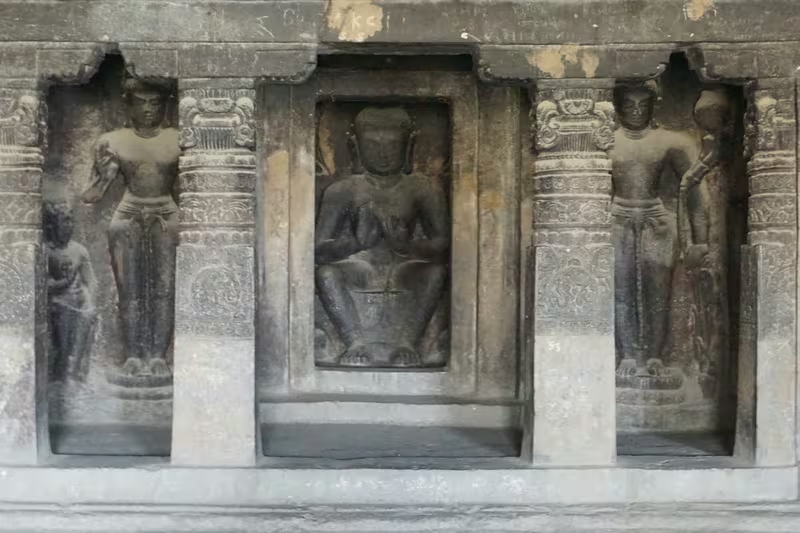
Like many great Satavahana rulers before him, Yajna Sri was a great patron of art, architecture, and religion. His reign saw continued support for the flourishing Buddhist monastic centres of the Deccan. An inscription in a cave at Kanheri records the meritorious gift of a Buddhist monk, confirming the king's rule over the area. At the Nashik caves, another inscription from the seventh year of his reign records the dedication of a cave to the Buddhist Sangha.
His name is also immortalized at the great stupas of Amaravati and Nagarjunakonda in the Andhra region. These sites, renowned for their magnificent limestone relief sculptures depicting the life of the Buddha, reached their artistic zenith during this period, likely due to the stability and prosperity his reign provided.
Tradition also strongly associates Yajna Sri Satakarni with one of the most important figures in the history of Buddhist philosophy, Acharya Nagarjuna. Nagarjuna, the founder of the Madhyamaka school of Mahayana Buddhism, is said to have been a contemporary and friend of the king. While direct inscriptional evidence of their relationship is lacking, the association is a powerful part of their shared legacy. The Buddhist tradition holds that Nagarjuna's famous work, the Suhrllekha or "Letter to a Friend," which outlines the core tenets of Buddhist ethics and philosophy for a layperson, was addressed to King Yajna Sri Satakarni. This connection, whether historically precise or not, paints a picture of a ruler who was not just a warrior but also a man of intellect and spiritual curiosity, presiding over a vibrant cultural and philosophical milieu.
Legacy & Influence: The Golden Autumn of the Satavahanas
Yajna Sri Satakarni’s reign represents the "golden autumn" of the Satavahana dynasty. It was a final, magnificent burst of imperial power and cultural efflorescence before the long winter of decline set in. His death, around the turn of the 3rd century CE, created a power vacuum that his successors were unable to fill. The empire soon began to fragment, with local governors and feudatories—like the Abhiras in the west, the Ikshvakus in the east, and the Chutus in the south—gradually asserting their independence. Within half a century of his passing, the great Satavahana empire, which had dominated the Deccan for over 400 years, faded into history.
His historical significance is immense. He stands as the last Satavahana ruler to command a truly pan-Deccan empire. His military victories checked the ambitions of the Western Kshatrapas for a generation, providing a crucial period of stability and security for the heartland of India. He proved that the Satavahana military machine, when led with vision and determination, was still a formidable force.
Today, Yajna Sri Satakarni is remembered primarily through the tangible artifacts of his reign. For historians and archaeologists, he is the king who re-established an empire, a fact testified by the geographical distribution of his inscriptions. For numismatists, he is the celebrated author of the ship-type coins, a unique and invaluable source of information on ancient Indian maritime history. These small metal discs continue to tell a grand story of naval power and global trade.
He represents the archetype of a capable ruler who fought against the odds to restore the fortunes of his lineage. While his resurgence ultimately could not prevent the eventual disintegration of his empire, Yajna Sri Satakarni ensured that the Satavahana dynasty did not fade away quietly. Instead, it departed from the stage of history with one last, defiant, and brilliant display of power, prosperity, and cultural grandeur.