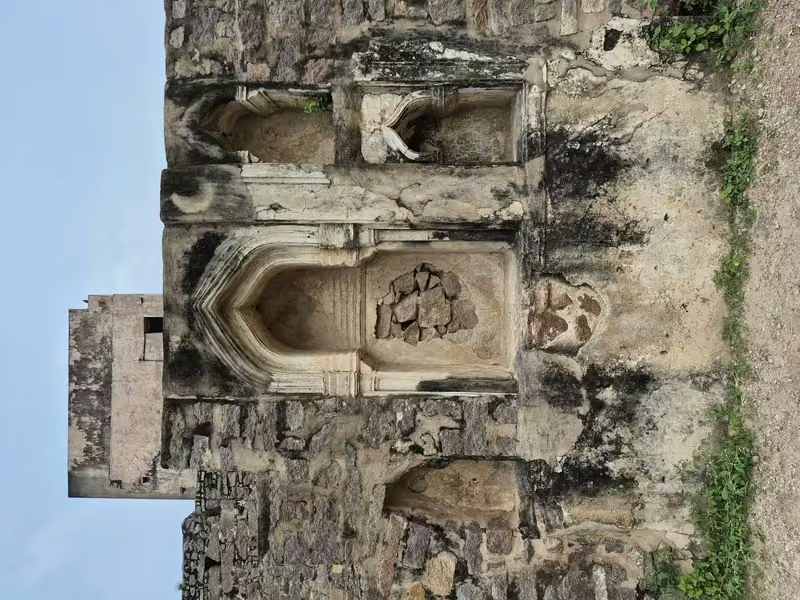
Overview
Golconda Fort stands as one of medieval India's most impressive fortified citadels, perched on a granite hill on the western outskirts of Hyderabad, Telangana. This magnificent fortress, whose name evokes images of legendary diamonds and impregnable defenses, has witnessed the rise and fall of multiple dynasties over nearly seven centuries. Originally constructed by the Kakatiya ruler Pratāparudra in the 11th century with mud walls, Golconda evolved into a formidable stone fortress and served as the capital of the Golconda Sultanate under the Qutb Shahi dynasty.
The fort's historical significance extends far beyond its military architecture. Golconda became synonymous with wealth and prosperity due to its proximity to the world-famous Kollur Mine and other diamond deposits in the region. The term "Golconda Diamonds" became legendary in the international gem trade, and the fort served as the primary trading center for these precious stones. Some of history's most famous diamonds, including the Koh-i-Noor, Hope Diamond, and Regent Diamond, passed through Golconda's markets before finding their way into royal treasuries across the world.
Today, though abandoned and in ruins, Golconda Fort remains a powerful testament to the architectural brilliance and strategic acumen of medieval India. The complex sprawls across a vast area, encompassing palaces, mosques, halls, water supply systems, and ingenious acoustic arrangements that allowed communication across great distances. Recognized for its cultural and historical importance, the fort was placed on UNESCO's tentative list for World Heritage Site status in 2014 as part of the "Monuments and Forts of the Deccan Sultanate."
History
Early Foundations: The Kakatiya Period
The origins of Golconda Fort date back to approximately the 11th century during the reign of the Kakatiya dynasty, which ruled much of present-day Telangana and Andhra Pradesh. Kakatiya ruler Pratāparudra established the initial fortification using mud walls, recognizing the strategic importance of the granite hill that offered natural defensive advantages. The Kakatiyas, known for their architectural achievements including the famous Warangal Fort and the Thousand Pillar Temple, chose this location for its commanding view of the surrounding plains and its defensibility.
The name "Golconda" itself has interesting linguistic origins. Some historians believe it derives from the Telugu word "Golla Konda," meaning "shepherd's hill," referring to a shepherd who is said to have discovered the site. Others suggest it comes from the Sanskrit "Gola Konda," meaning "round hill," describing its topography.
Transfer to the Bahmani Sultanate
The fort's history took a dramatic turn during the reign of Bahmani Sultan Mohammed Shah I. Following the first Bahmani-Vijayanagar War, the Kakatiya territory, including Golconda, was ceded to the Bahmani Sultanate from the Musunuri Nayakas, who had briefly controlled the region after the fall of the Kakatiyas. The Bahmani Sultanate, which ruled the Deccan from 1347 to 1527, recognized Golconda's strategic value and appointed governors to oversee the region.
Rise of the Golconda Sultanate
The most transformative period in Golconda's history began in the late 15th and early 16th centuries. Following the death of Sultan Mahmood Shah, the Bahmani Sultanate began to disintegrate, fragmenting into five independent sultanates known as the Deccan Sultanates. Sultan Quli Qutb-ul-Mulk, who had been appointed as the Governor of Telangana by the Bahmani rulers, declared independence around 1518 and established the Qutb Shahi dynasty.
Sultan Quli made the momentous decision to make Golconda his capital, recognizing its potential as both a military stronghold and commercial hub. Under his vision and that of his successors, Golconda was transformed from a relatively simple fortification into one of the most sophisticated fortress complexes in India. The mud walls were replaced and reinforced with massive stone fortifications, incorporating multiple layers of defense with eight gates, 87 semi-circular bastions, and an extensive fortification system.
The Diamond Trade Era
During the Qutb Shahi period, Golconda reached its zenith as a center of wealth and culture. The fort's location near the legendary diamond mines of the region, particularly the Kollur Mine on the Krishna River, transformed it into the world's premier diamond trading center. Merchants from across Asia, Europe, and the Middle East flocked to Golconda's markets, where rough diamonds were cut, polished, and traded.
The wealth generated by the diamond trade funded the construction of magnificent palaces, gardens, mosques, and tombs. The Qutb Shahi rulers became patrons of art, literature, and architecture, creating a cosmopolitan culture that blended Persian, Telugu, and Deccani traditions. The fort complex expanded to include royal quarters, administrative buildings, armories, water reservoirs, and elaborate gardens.
Decline and Fall
The glory of Golconda Fort came to an end in 1687 when the Mughal emperor Aurangzeb, after a prolonged siege lasting eight months, finally conquered the fortress. The fall of Golconda marked the end of the Qutb Shahi dynasty and the annexation of the kingdom into the Mughal Empire. According to historical accounts, the fort was considered virtually impregnable, and the Mughals succeeded only through the treachery of an insider who opened the gates.
Following the Mughal conquest, the capital was shifted to the newly founded city of Hyderabad, and Golconda Fort gradually fell into neglect. Over subsequent centuries, under various rulers including the Asaf Jahi dynasty (Nizams of Hyderabad), the fort was not maintained, and many structures deteriorated or were dismantled for building materials.
Architecture
Fortification System
Golconda Fort represents the pinnacle of medieval military architecture in the Deccan region. The fortification system consists of multiple concentric walls that create layers of defense, making the fort nearly impregnable in its time. The outer wall stretches approximately 11 kilometers in circumference, while the inner fortifications protect the citadel and royal quarters at the summit.
The fort complex includes eight massive gates (darwazas), each designed as a defensive checkpoint with provisions for pouring boiling oil or water on attackers. The main entrance, the Fateh Darwaza (Victory Gate), features large iron spikes on its doors to prevent war elephants from battering through. The gates are strategically placed at angles, forcing attackers to make vulnerable turns while under fire from defenders positioned on the walls above.
The defensive walls feature 87 semi-circular bastions, each equipped with guns and cannons. These bastions are positioned to provide overlapping fields of fire, ensuring that no section of the wall remains undefended. The walls themselves, constructed from large granite blocks, vary in thickness from 10 to 15 meters in some sections, making them resistant to cannon fire.
Acoustic System
One of Golconda Fort's most remarkable features is its sophisticated acoustic system, an engineering marvel that demonstrates the advanced understanding of sound propagation by medieval architects. A hand clap at the entrance of the fort, specifically at the Fateh Darwaza, can be clearly heard at the Bala Hissar pavilion at the highest point of the fort, approximately one kilometer away.
This acoustic system served as an early warning mechanism, allowing guards at the entrance to alert the citadel of approaching visitors or potential threats without the need for runners or visual signals. The sound travels through carefully designed channels and passages built into the structure, amplified by the shape and materials of the buildings. This ingenious system remained functional for defense and communication purposes throughout the fort's active period.
The Baradari
The Baradari, meaning "twelve-doors," is one of the most elegant structures within the fort complex. This pavilion features twelve arched openings that allow air to flow through, providing natural cooling even during hot summers. The Baradari served as a royal durbar hall where the sultan held court, received foreign dignitaries, and conducted state affairs.
The structure showcases the synthesis of Persian and Deccani architectural styles characteristic of Qutb Shahi architecture. The arches display intricate stucco work, and the proportions of the building create a sense of spaciousness and grandeur. Although much of the decorative work has been lost to time, enough remains to indicate the pavilion's original splendor.
Ambar Khana
The Ambar Khana (magazine or armory) was the storage facility for weapons, ammunition, and military supplies. This structure, built with thick walls and minimal openings, was designed to be explosion-proof and secure. The strategic placement of the Ambar Khana within the fort ensured that even if outer defenses were breached, the defenders would have access to weapons and supplies to continue their resistance.
Water Supply System
The designers of Golconda Fort created an ingenious water supply system that ensured the fort could withstand prolonged sieges. The system included multiple wells, interconnected through underground channels, and reservoirs built at various levels of the fort. Water was raised from the base of the hill to the summit using a series of Persian wheels (rahat) operated by bullocks.
The largest reservoir, located near the summit, could store enough water to supply the fort's population for several months. Additional smaller tanks and cisterns were distributed throughout the fort to provide local water sources. This elaborate system demonstrates the engineering prowess of the Qutb Shahi period and was crucial to the fort's reputation as virtually impregnable.
Royal Quarters and Palaces
The summit of Golconda Fort housed the royal quarters, including multiple palaces, harems, and administrative buildings. While most of these structures now lie in ruins, their foundations and remaining walls indicate the grandeur of the original constructions. The palaces featured open courtyards, audience halls, private chambers, and gardens.
The Shahi Mahal (Royal Palace) occupied the highest point of the fort and provided panoramic views of the surrounding countryside. This vantage point allowed the sultan to observe approaching forces from great distances and enjoy the cool breezes that swept across the hilltop.
Qutub Shahi Masjid
Within the fort complex stands the Qutub Shahi Masjid, a beautiful mosque that served the spiritual needs of the fort's inhabitants. The mosque features typical Qutb Shahi architectural elements including pointed arches, domes, and minarets. The prayer hall could accommodate hundreds of worshippers and featured carved pillars and decorated niches (mihrabs) indicating the direction of Mecca.
Cultural Significance
Center of Diamond Trade
Golconda's cultural significance is inextricably linked to the legendary Golconda Diamonds. The fort served as the primary marketplace and processing center for diamonds extracted from mines in the region, particularly the Kollur Mine on the Krishna River. The term "Golconda diamond" became synonymous with the highest quality gems, and the fort's markets attracted merchants, traders, and gem cutters from around the world.
Many of history's most famous diamonds passed through Golconda, including:
- The Koh-i-Noor (Mountain of Light), now part of the British Crown Jewels
- The Hope Diamond, displayed at the Smithsonian Institution
- The Regent Diamond, part of the French Crown Jewels
- The Wittelsbach-Graff Diamond
- The Dresden Green Diamond
The wealth generated by this trade supported the cultural flowering of the Qutb Shahi period and funded the construction of magnificent monuments throughout the kingdom, including the famous Qutb Shahi tombs and Charminar in Hyderabad.
Literary and Artistic Patronage
The Qutb Shahi rulers of Golconda were notable patrons of literature, arts, and music. The court attracted poets, scholars, and artists from across the Islamic world and the Deccan region. The sultans themselves often composed poetry in Persian, Telugu, and Urdu, contributing to the development of Dakhani Urdu literature.
The cosmopolitan culture of Golconda blended Persian influences brought by the rulers with indigenous Telugu traditions, creating a unique Deccani culture that influenced art, architecture, music, and cuisine across the region. This cultural synthesis became a defining characteristic of Hyderabad's identity that persists to the present day.
Religious Tolerance
The Qutb Shahi dynasty maintained a relatively tolerant approach to religious diversity. While the rulers were Muslims, they employed Hindus in important administrative and military positions and patronized both Islamic and Hindu cultural traditions. This policy of religious accommodation contributed to the stability and prosperity of the kingdom and allowed Golconda to flourish as a diverse, multicultural center.
UNESCO Recognition
In 2014, Golconda Fort, along with other forts and monuments of the Deccan Sultanates, was placed on UNESCO's tentative list of World Heritage Sites under the nomination "Monuments and Forts of the Deccan Sultanate." This tentative listing recognizes the fort's outstanding universal value as an example of medieval military architecture and its role in the cultural and economic history of the Deccan region.
The nomination highlights several aspects of Golconda's significance:
- Exceptional example of medieval fortification architecture adapted to the Deccan plateau's granite hills
- Association with the legendary diamond trade that influenced global gem markets for centuries
- Testament to the cultural synthesis of Persian and Deccani traditions during the Sultanate period
- Engineering innovations including the acoustic warning system and water supply infrastructure
The tentative listing represents an important step toward potential full World Heritage Site designation, which would ensure enhanced protection and conservation efforts for this remarkable monument. However, as of 2024, the nomination has not yet progressed to full inscription on the World Heritage List.
Visitor Information
How to Reach
Golconda Fort is conveniently located approximately 11 kilometers from the center of Hyderabad, making it easily accessible for visitors. The fort can be reached by:
By Air: The nearest airport is Rajiv Gandhi International Airport (HYD), located about 30 kilometers from the fort. Taxis and app-based cab services are readily available from the airport.
By Rail: Hyderabad's Nampally Railway Station and Secunderabad Railway Station are the main railheads, located 10-15 kilometers from the fort. Local buses, auto-rickshaws, and taxis connect the stations to Golconda.
By Road: Golconda is well-connected by the city's bus network (TSRTC). Direct buses run from major points in Hyderabad to Golconda Fort. Private vehicles can easily reach the fort via the ORR (Outer Ring Road) and Ibrahim Bagh Road.
Best Time to Visit
The ideal time to visit Golconda Fort is during the winter months from October to March when temperatures are moderate and comfortable for the considerable amount of walking and climbing required to explore the fort. During summer (April to June), temperatures can exceed 40°C (104°F), making the climb challenging, especially in the afternoon.
Morning visits (9:00-11:00 AM) and late afternoon visits (3:30-5:30 PM) are recommended to avoid the midday heat. The golden hour before sunset offers spectacular views from the summit and excellent photography opportunities, though visitors should allow enough time to descend before the fort closes.
Sound and Light Show
Golconda Fort hosts a renowned sound and light show in the evening that narrates the fort's history through dramatic lighting effects and narration. The show is conducted in multiple languages (English, Hindi, and Telugu) on different days. The spectacle brings the fort's history to life and is highly recommended for visitors interested in understanding the fort's historical narrative in an engaging format. Tickets for the sound and light show are separate from regular entry tickets and should be booked in advance, especially during peak tourist season.
Nearby Attractions
Qutb Shahi Tombs (1 km): The magnificent necropolis of the Qutb Shahi rulers, featuring stunning domed tombs set in landscaped gardens. These tombs represent some of the finest examples of Qutb Shahi architecture and are closely associated with Golconda's history.
Charminar (11 km): Hyderabad's iconic monument and the symbolic heart of the old city, built in 1591 by Sultan Muhammad Quli Qutb Shah.
Taramati Baradari (3 km): A historic pavilion complex once used for cultural performances, with connections to Golconda's royal family.
Mecca Masjid (12 km): One of the largest mosques in India, located near Charminar, showcasing Qutb Shahi architecture.
Hussain Sagar Lake (13 km): A large artificial lake with a massive Buddha statue, offering boating and recreational activities.
Conservation
Current Status
Golconda Fort is currently under the protection of the Archaeological Survey of India (ASI), which has classified it as a monument of national importance. Despite this protection, the fort faces numerous conservation challenges. Many structures within the complex have deteriorated significantly due to centuries of neglect, weathering, and vegetation growth. The roofs of several buildings have collapsed, walls show extensive damage from moisture and structural stress, and decorative elements have been lost or vandalized.
The overall conservation status can be characterized as "fair," with some areas in better condition than others. The main fortification walls and gates remain relatively intact and structurally sound, while interior structures, particularly the palaces and residential buildings, have suffered more extensive deterioration.
Conservation Challenges
Several factors threaten the long-term preservation of Golconda Fort:
Natural Weathering: The granite structure is subject to erosion from wind, rain, and temperature fluctuations. The Deccan's monsoons cause water damage, while the hot dry season creates expansion and contraction in the stone.
Vegetation Growth: Trees, shrubs, and plants have taken root in walls and structures, with their root systems causing cracks and structural damage. Removing vegetation without damaging historic fabric requires careful, specialized intervention.
Urban Encroachment: The expansion of Hyderabad has brought urban development close to the fort's boundaries, increasing pollution, vibration from traffic, and pressure on the site's buffer zones.
Tourism Impact: While visitor numbers are not excessive, the wear from foot traffic on staircases and pathways, along with occasional vandalism and littering, contributes to deterioration.
Funding Constraints: Comprehensive conservation of such a vast complex requires substantial financial resources that are not always available.
Conservation Efforts
The ASI conducts periodic maintenance and conservation work at Golconda Fort, including:
- Structural stabilization of vulnerable walls and buildings
- Removal of harmful vegetation while preserving historically significant trees
- Installation of signage and visitor information to enhance understanding while reducing inadvertent damage
- Monitoring of structural conditions through regular surveys
- Limited restoration of key structures to prevent further collapse
The inclusion of Golconda in UNESCO's tentative list in 2014 has helped draw attention to conservation needs and may lead to increased funding and international cooperation in preservation efforts. Several heritage organizations and local groups have also advocated for better conservation measures and public awareness about the fort's significance.
Future Prospects
For Golconda Fort to be adequately preserved for future generations, several initiatives are needed:
- Comprehensive conservation master plan addressing all structures within the complex
- Enhanced funding for conservation activities
- Implementation of sustainable tourism practices to minimize visitor impact
- Integration of modern conservation technologies including 3D scanning and digital documentation
- Training programs for specialized conservation craftspeople
- Strengthened buffer zone regulations to protect the fort from urban encroachment
- Community engagement programs to build local support for conservation


