Overview
Madurai stands as one of India's most ancient continuously inhabited cities, with a documented history spanning more than 2500 years. Located on the banks of the sacred Vaigai River in Tamil Nadu, this city has served as the cultural and religious heart of Tamil civilization since the 3rd century BCE. Known traditionally as "Thoongatha Nagaram" - the city that never sleeps - Madurai has been a constant beacon of Tamil culture, literature, commerce, and spirituality through the rise and fall of numerous dynasties.
As of the 2011 census, Madurai is the third largest metropolis in Tamil Nadu after Chennai and Coimbatore, with a population exceeding one million in the city proper and nearly 1.5 million in its metropolitan area, ranking it as the 31st largest urban agglomeration in India. The city serves as the administrative headquarters of Madurai district and is governed by the Madurai Municipal Corporation, one of India's oldest municipal bodies, established on November 1, 1866.
The significance of Madurai transcends its considerable population and administrative importance. It is universally recognized as the cultural capital of Tamil Nadu, having served as the seat of Tamil Sangam literature, the ancient academy of Tamil poets and scholars. The city's temples, particularly the magnificent Meenakshi Amman Temple, continue to attract millions of pilgrims and tourists annually, making Madurai a living testament to the continuity of Tamil Hindu traditions and architectural brilliance spanning over two millennia.
Etymology and Names
The name "Madurai" is believed to derive from the Tamil word "Madhuram," meaning sweetness, with various legends explaining this etymology. One popular tradition holds that the city was named after the divine nectar (madhu) that was said to have dripped from Lord Shiva's locks when he blessed the city. Another interpretation links it to "Marutham," referring to the fertile plains characteristic of the region's landscape.
Throughout its long history, Madurai has been known by several evocative names. The most famous of these is "Thoongatha Nagaram" (the city that never sleeps), reflecting its constant activity as a major commercial, religious, and cultural center. This name, still in popular use, testifies to the city's enduring vibrancy from ancient times to the present day. Ancient Tamil literature from the Sangam period frequently refers to Madurai as "Koodal," meaning assembly or gathering, highlighting its role as a meeting place for scholars, merchants, and pilgrims.
Foreign visitors and colonial writers sometimes called Madurai the "Athens of the East," comparing it to the ancient Greek center of learning and culture. This comparison, while Eurocentric, nonetheless acknowledged Madurai's historical significance as a center of education, philosophy, and the arts in the Tamil-speaking world.
Geography and Location
Madurai is situated at coordinates 9.9252°N latitude and 78.1198°E longitude in the southern part of Tamil Nadu. The city lies at an elevation of approximately 134 meters (440 feet) above sea level, positioned in the fertile plains created by the Vaigai River. This geographical positioning has been crucial to Madurai's historical development, providing both water resources and rich agricultural lands that supported a large urban population for millennia.
The Vaigai River, though not as continuously flowing as other major Indian rivers, has been the lifeline of Madurai throughout its history. The river's seasonal nature and the surrounding fertile alluvial plains created ideal conditions for both agriculture and urban settlement. The relatively flat terrain of the region facilitated the expansion of the city and the construction of its famous temples and monuments.
Madurai experiences a hot semi-arid climate (classified as BSh in the Köppen climate classification system). The city is characterized by hot summers, a monsoon season, and a mild winter. This climate pattern, typical of interior Tamil Nadu, has influenced the architectural styles developed in the region, including the massive temple complexes with their thick walls and water management systems designed to cope with the alternating wet and dry seasons.
The strategic location of Madurai, positioned inland but connected to coastal ports and surrounded by fertile agricultural land, made it an ideal center for trade and administration. Its position at the crossroads of trade routes connecting the eastern and western coasts of southern India contributed significantly to its historical importance and prosperity.
Ancient History
The origins of Madurai are lost in the mists of antiquity, with both archaeological evidence and literary references suggesting continuous human settlement in the area for at least 2500 years. The city is mentioned in ancient Tamil Sangam literature, which scholars generally date to between 300 BCE and 300 CE, indicating that Madurai was already a significant urban center during this period.
According to tradition, Madurai was the capital of the Pandya Dynasty, one of the three ancient Tamil kingdoms alongside the Cholas and Cheras. The Pandyas are mentioned in ancient sources including the Mahabharata and the writings of the Greek ambassador Megasthenes (circa 300 BCE), suggesting that Madurai's importance was recognized even beyond the Tamil-speaking world in ancient times.
The city's most significant early cultural achievement was its association with the Tamil Sangam, a legendary academy or assembly of Tamil poets and scholars. While the historicity of the Sangam as an institution is debated by scholars, the Tamil Sangam literature that survives provides invaluable insights into the society, economy, culture, and urban life of ancient Madurai. These texts describe a sophisticated city with well-organized trade, elaborate temples, and a vibrant cultural life.
Archaeological excavations in and around Madurai have revealed evidence of ancient settlements, though much of the ancient city lies beneath the modern urban sprawl. The continuous occupation and rebuilding of the site over millennia means that physical evidence from the earliest periods is limited, but the literary tradition firmly establishes Madurai as one of the most ancient cities of the Tamil land.
Historical Timeline
Early Pandya Period (circa 300 BCE - 300 CE)
The early centuries of Madurai's documented history coincide with the era of the Sangam literature and the early Pandya kings. During this period, Madurai served as the capital of the Pandya kingdom, which controlled much of southern Tamil Nadu. The city was already a major center of trade, receiving goods from across the Indian Ocean world and exporting Tamil products, including pearls, textiles, and spices.
The Tamil Sangam poetry of this era provides glimpses of Madurai's urban sophistication, describing its broad streets, prosperous markets, magnificent palaces, and temples. The Pandya kings patronized Tamil language and literature, establishing Madurai as the intellectual capital of the Tamil world, a position it has never entirely relinquished.
Medieval Period (6th - 14th Centuries CE)
Following the decline of the early Pandyas, Madurai came under the control of various powers including the Kalabhras, Pallavas, and later the Cholas. In the 13th century, the Later Pandyas regained control and Madurai experienced a renaissance. This period saw the expansion and embellishment of the city's temples, including significant additions to what would become the Meenakshi Temple complex.
The early 14th century brought dramatic changes when the Delhi Sultanate under Malik Kafur raided Madurai in 1310 CE, leading to the establishment of the Madurai Sultanate (1334-1378 CE). This brief period of Muslim rule ended when the Vijayanagara Empire extended its control over the region, appointing the Nayaks as local governors.
Nayak Dynasty (1529-1736 CE)
The Nayak period represents a golden age in Madurai's history. Under rulers like Thirumalai Nayak (1623-1659), the city underwent massive urban development. The famous Meenakshi Temple was substantially rebuilt and expanded during this period, reaching its current magnificent form. The Nayaks also constructed palaces, tanks, and fortifications that transformed Madurai into one of South India's most impressive cities.
The Nayak rulers were great patrons of arts and literature, and Madurai became a major center for Tamil literature, music, and dance. The city's economy flourished through both local production and international trade, with merchants from across Asia conducting business in its markets.
Colonial Era (1736-1947 CE)
The decline of the Nayak dynasty in the early 18th century led to a period of instability. The Nawab of Arcot and later the British East India Company vied for control of the region. By 1801, Madurai had come firmly under British control. The colonial period brought significant changes to the city's administration and economy.
The British established the Madurai Municipal Corporation on November 1, 1866, making it one of the oldest municipal bodies in India. Western-style education, infrastructure, and administrative systems were introduced, though these coexisted with traditional Tamil institutions and culture. Madurai also played a role in India's independence movement, with the Gandhi Memorial Museum now housed in the city commemorating this history.
Political Significance
Throughout its long history, Madurai's political significance has remained remarkably constant. As the capital of the Pandya Dynasty, it was the seat of Tamil political power for centuries. Even when conquered by outside forces, the city's strategic location and economic importance ensured that it remained a major administrative center.
Today, Madurai serves as the administrative headquarters of Madurai district, governed by the Madurai Municipal Corporation. The current mayor is V. Indirani Ponvasanth of the DMK party. The city's political importance extends beyond local administration; as the cultural capital of Tamil Nadu, Madurai plays a significant role in Tamil cultural politics and identity.
The population density of 6,878.9 persons per square kilometer reflects the city's continued importance as an urban center. With a metropolitan population of nearly 1.5 million, Madurai ranks as the third largest city in Tamil Nadu, ensuring its continued political and administrative significance in state and national affairs.
Religious and Cultural Importance
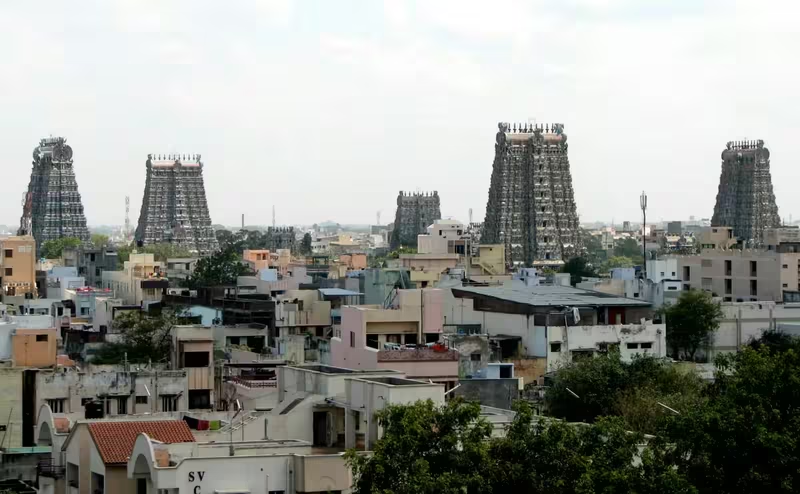
Madurai's primary identity for most Indians and international visitors is as one of the great temple cities of India. The Meenakshi Amman Temple, dedicated to Goddess Meenakshi (Parvati) and her consort Sundareswarar (Shiva), dominates the city both physically and spiritually. This massive temple complex, with its towering gopurams (gateway towers) covered in thousands of colorful sculptures, is one of the most important pilgrimage sites in India and a masterpiece of Dravidian architecture.
Beyond the Meenakshi Temple, Madurai is home to numerous other significant religious sites, including the Koodalazhagar Temple, dedicated to Vishnu, and various other Hindu temples that have served as centers of devotion for centuries. The city also has significant Muslim and Christian communities, with historic mosques and churches contributing to its diverse religious landscape.
Culturally, Madurai's importance cannot be overstated. As the legendary home of the Tamil Sangam, it has been regarded as the guardian of Tamil language and culture for over two millennia. Classical Tamil poetry, music, and dance traditions have flourished in Madurai continuously, making it a living repository of Tamil cultural heritage. The city continues to be a major center for Tamil literary activity, classical music, and traditional arts.
Economic Role
Madurai has functioned as a major economic hub for southern Tamil Nadu throughout its history. Ancient texts describe its bustling markets dealing in pearls, precious stones, textiles, and spices. The city's location enabled it to serve as a collection and distribution point for goods moving between the interior regions and the coast.
In the modern era, Madurai has maintained its economic significance. According to 2020 data, the city's GDP was approximately US$13.026 billion (equivalent to $15.83 billion in 2024), making it one of the wealthier cities in Tamil Nadu. The economy is diversified, with traditional sectors like textiles and handicrafts coexisting with modern industries including information technology, manufacturing, and services.
Tourism forms a significant part of Madurai's economy, with millions of pilgrims and tourists visiting annually, primarily to see the Meenakshi Temple and other historical sites. The city's economy benefits from its role as a regional commercial center, with excellent connectivity by road, rail, and air (Madurai Airport) facilitating trade and business activities.
Monuments and Architecture
While the Meenakshi Amman Temple overshadows other structures, Madurai contains numerous architectural treasures reflecting its long history. The Thirumalai Nayakkar Palace, built in 1636 CE, showcases the fusion of Dravidian and Islamic architectural styles characteristic of the Nayak period. Though only a quarter of the original palace survives, it remains an impressive monument with its massive pillars and grand courtyard.
The Gandhi Memorial Museum, housed in a historic palace structure, preserves artifacts and documents related to Mahatma Gandhi and India's independence movement. The museum building itself is architecturally significant, reflecting colonial-era adaptations of traditional Tamil architecture.
Various other temples scattered throughout the city, each with their own history and architectural merit, contribute to Madurai's rich built heritage. The city's traditional residential areas, with their narrow streets and traditional Tamil houses, offer glimpses into centuries-old urban planning patterns, though modern development has transformed much of the cityscape.
Modern City
Contemporary Madurai is a bustling metropolis that successfully balances its ancient heritage with modern development. The city remains deeply rooted in Tamil culture and traditions while embracing progress. With a population of over one million in the city proper and nearly 1.5 million in the metropolitan area, it ranks as the third largest city in Tamil Nadu and the 44th largest in India.
Modern infrastructure includes the Madurai Airport connecting the city to major Indian cities and international destinations, an extensive bus network centered on the MGR Bus Stand, and good rail connectivity. The telecommunications code is 0452, and the city uses postal codes in the 625xxx series. The official languages are Tamil and English, though Tamil dominates in daily use.
The city's time zone is UTC+5:30 (IST - Indian Standard Time). Educational institutions, healthcare facilities, and commercial establishments make Madurai a regional center for southern Tamil Nadu. Technology companies, including international firms like Honeywell, have established operations in the city, diversifying its economic base beyond traditional sectors.
Heritage and Tourism
Madurai's status as a major tourist destination is primarily due to its religious and architectural heritage, especially the Meenakshi Temple, which alone attracts 15,000-25,000 visitors on regular days and much larger crowds during festivals. The city's accessibility, with direct flights from major Indian cities and good road and rail connections, makes it an essential stop on South India tourist circuits.
Heritage conservation efforts face the ongoing challenge of balancing preservation with development needs in this ancient yet growing city. The Madurai Municipal Corporation, working with state and national heritage authorities, manages various conservation projects aimed at protecting the city's historical character while accommodating modern urban requirements.
Annual festivals, particularly the Meenakshi Thirukalyanam (the divine marriage of Meenakshi and Sundareswarar), draw massive crowds and showcase Madurai's living cultural traditions. These events maintain connections between the city's ancient past and its vibrant present.
Timeline
- circa 300 BCE: Establishment of Madurai as capital of Pandya Dynasty; beginning of Tamil Sangam period
- 1st-3rd Century CE: Flourishing of Tamil Sangam literature; Madurai mentioned in ancient texts and by foreign travelers
- 13th Century CE: Later Pandyas rule; major temple construction and urban development
- 1310 CE: Delhi Sultanate forces under Malik Kafur raid Madurai
- 1334-1378 CE: Brief period of Madurai Sultanate rule
- 1529 CE: Beginning of Nayak Dynasty rule
- 1623-1659 CE: Reign of Thirumalai Nayak; golden age of architecture and arts
- 1736 CE: Fall of Nayak Dynasty; beginning of period of political instability
- 1801 CE: British East India Company establishes control over Madurai
- 1866: Establishment of Madurai Municipal Corporation on November 1
- 1947: Indian independence; Madurai becomes part of independent India
- 1956: Madurai becomes part of Tamil Nadu state after linguistic reorganization
- 2011: Census records population of over 1 million in city, 1.47 million in metro area