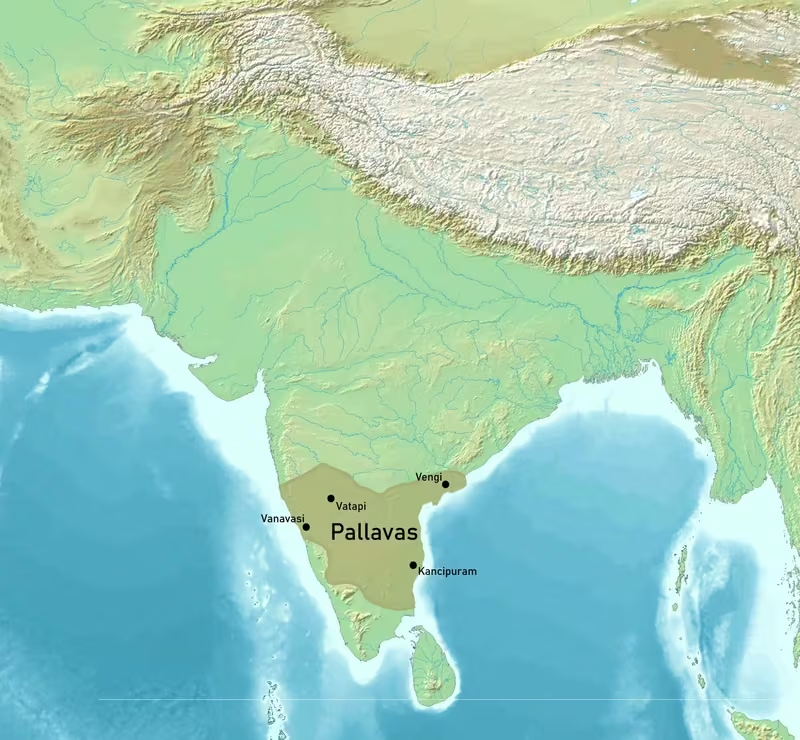
Overview
The Pallava dynasty stands as one of the most influential ruling houses in South Indian history, governing a significant portion of the Deccan region from 275 to 897 CE. With their capital firmly established at Kanchipuram, the Pallavas ruled over the region known as Tondaimandalam, which encompassed present-day northern Tamil Nadu and parts of southern Andhra Pradesh. What distinguished this dynasty was not merely their longevity of over six centuries, but their profound impact on South Indian culture, architecture, and artistic traditions that would reverberate through the ages.
Rising to prominence following the decline of the Satavahana Empire, whom they had previously served as feudatories, the Pallavas transformed from subordinate rulers into a formidable power in peninsular India. Under their patronage, the Dravidian architectural style reached new heights, with magnificent temple complexes and rock-cut cave shrines that continue to inspire awe. The dynasty skillfully balanced the promotion of Sanskrit literature and Hindu traditions with support for Tamil culture, Jainism, and Buddhism, creating a cosmopolitan cultural milieu that facilitated intellectual and artistic flourishing.
The Pallavas were not merely regional rulers but played a crucial role in shaping the broader trajectory of Indian civilization. Their architectural innovations established templates that would be followed for centuries, their script influenced writing systems across Southeast Asia, and their administrative practices set precedents for governance in the Tamil country. The dynasty's legacy extends far beyond their territorial conquests, embedded in the stone monuments, literary works, and cultural traditions that continue to define South India's identity.
Rise to Power
The origins of the Pallava dynasty remain a subject of scholarly debate, with various theories proposing different lineages and migration patterns. What is historically established is that the Pallavas emerged as significant political actors in the aftermath of the Satavahana Empire's decline in the 3rd century CE. Having served as feudatories under the Satavahanas, the Pallavas skillfully leveraged the power vacuum created by their former overlords' weakening grip on the Deccan to establish their own independent kingdom.
The dynasty's founding ruler, Simhavarman I, reigned from approximately 275 to 300 CE and laid the foundations for Pallava power in the Tondaimandalam region. Under his leadership, the Pallavas established Kanchipuram as their capital, a strategic choice that would prove instrumental in the dynasty's longevity. Kanchipuram's location provided excellent access to both inland and coastal trade routes, facilitating economic prosperity and military mobility.
The early Pallavas consolidated their position through a combination of military prowess, diplomatic alliances, and strategic marriages with other ruling families of the region. They also inherited and adapted the administrative systems of their predecessors, particularly from the Satavahanas and the Kalabhras, whom they replaced in certain territories. This pragmatic approach to statecraft, blending innovation with established practices, became a hallmark of Pallava governance.
The dynasty's rise coincided with broader transformations in South Indian politics, as the classical Tamil kingdoms reorganized and new power structures emerged across the peninsula. The Pallavas positioned themselves effectively within this changing landscape, asserting control over fertile agricultural lands and important pilgrimage centers, which provided both economic resources and religious legitimacy to their rule.
Golden Age
The Pallava dynasty reached its zenith during the 6th and 7th centuries CE, a period marked by territorial expansion, architectural innovation, and cultural efflorescence. This golden age witnessed the dynasty's power extending across much of present-day Tamil Nadu and Andhra Pradesh, with their influence reaching even further through trade and diplomatic relations.
During this period, Pallava rulers successfully defended their kingdom against repeated invasions by the Chalukyas of Badami, their principal rivals to the northwest. These conflicts, while demanding significant military and economic resources, also spurred the Pallavas to strengthen their administrative systems and fortifications. The dynasty maintained a powerful army and developed naval capabilities, recognizing the importance of controlling the eastern coastal regions and maritime trade routes.
The peak period also saw unprecedented artistic and architectural achievements. Pallava monarchs became great patrons of the arts, commissioning elaborate temple complexes that showcased innovative architectural techniques. The rock-cut cave temples and monolithic structures at Mahabalipuram, carved during this era, represent some of the finest examples of early Dravidian architecture. These monuments were not merely religious structures but also served as assertions of royal power and cultural sophistication.
Culturally, the Pallavas fostered a bilingual literary tradition, patronizing works in both Tamil and Sanskrit. This cultural policy reflected the dynasty's position at the intersection of Sanskritic and Dravidian traditions, and helped establish Kanchipuram as a major center of learning. Scholars, poets, and religious teachers gathered at the Pallava court, contributing to vibrant intellectual discourse that encompassed philosophy, theology, literature, and the sciences.
Administration and Governance
The Pallava administrative system represented a sophisticated blend of indigenous traditions and innovations adapted to the dynasty's specific needs. At the apex stood the monarch, who wielded supreme authority in matters of state, military affairs, and justice. The king was supported by a council of ministers who advised on policy and oversaw various departments of governance.
The kingdom was divided into administrative units called mandalams, which were further subdivided into nadus (districts) and individual villages. Each level had appointed officials responsible for revenue collection, law enforcement, and administration of justice. This hierarchical structure allowed for efficient governance across the dynasty's extensive territories while maintaining centralized control from Kanchipuram.
Revenue administration was particularly well-developed under the Pallavas. The dynasty maintained detailed records of land grants, taxation, and agricultural production, many documented on copper plates that have survived to provide invaluable historical information. These copper plate inscriptions reveal a complex system of land classification, taxation rates, and administrative procedures that ensured steady revenue flows to support the royal court, military, and religious institutions.
The Pallavas also developed a sophisticated legal system that drew upon both dharmashastra texts and local customary law. Village assemblies played important roles in local governance, particularly in agricultural communities, while royal officials handled more serious crimes and disputes that crossed jurisdictional boundaries. This combination of centralized authority and local autonomy proved effective in maintaining order across diverse regions.
Military Campaigns
The military history of the Pallava dynasty is characterized by numerous conflicts with neighboring powers, particularly the Chalukyas of Badami, the Pandyas, and various other regional kingdoms. These campaigns were driven by competition for control over fertile agricultural lands, trade routes, and strategic fortifications that could secure the dynasty's borders.
The most significant and prolonged conflict was with the Chalukya dynasty, which waged intermittent warfare with the Pallavas for control over the northern regions of the Tamil country and parts of Andhra Pradesh. These wars witnessed dramatic shifts in fortune, with both sides claiming victories and suffering defeats. Pallava rulers demonstrated considerable military skill in defending their heartland while occasionally launching successful counter-offensives into Chalukya territory.
The dynasty also maintained a naval presence, recognizing the strategic importance of controlling coastal areas and maritime trade routes. Pallava ships protected merchant vessels, suppressed piracy, and facilitated trade with Southeast Asian kingdoms. This naval power contributed to the dynasty's commercial prosperity and helped extend Pallava cultural influence across the Bay of Bengal.
Military success depended not only on the valor of Pallava armies but also on effective logistics, fortress management, and alliance-building. The dynasty maintained a standing army supplemented by feudatory forces, while strategic marriages and diplomatic relations helped secure their borders and create buffers against aggressive neighbors. This combination of military strength and diplomatic skill enabled the Pallavas to survive and thrive for over six centuries despite constant external pressures.
Cultural Contributions
The Pallava dynasty's cultural legacy represents perhaps their most enduring contribution to Indian civilization. Their patronage of architecture created monuments that continue to define South Indian temple design and have influenced religious architecture across Southeast Asia. The rock-cut cave temples at Mahabalipuram, including the famous Shore Temple and the Pancha Rathas, showcase the dynasty's architectural innovation and artistic sophistication. These structures demonstrate the transition from rock-cut architecture to free-standing stone temples, a development that would profoundly influence subsequent South Indian architecture.
The Kailasanathar Temple in Kanchipuram, built during the 7th century, exemplifies mature Pallava architectural style with its intricate carvings, mandapas, and vimanas. These temples were not merely places of worship but served as centers of learning, cultural performance, and community gathering. The sculptural programs adorning these structures depicted scenes from Hindu mythology, royal genealogies, and daily life, creating a rich visual narrative that communicated religious and political messages to diverse audiences.
The Pallava script, developed and refined during the dynasty's reign, became one of the most significant cultural exports of ancient India. This writing system influenced the development of scripts throughout Southeast Asia, including the Thai, Khmer, and Javanese scripts. This influence resulted from both trade contacts and the conscious adoption of Indian cultural forms by Southeast Asian kingdoms that looked to India for religious and administrative models.
Literature flourished under Pallava patronage, with the dynasty supporting both Sanskrit and Tamil literary traditions. Sanskrit poets produced kavyas (courtly epics) celebrating Pallava victories and virtues, while Tamil scholars continued developing the sangam literary tradition. This bilingual cultural policy reflected the Pallavas' sophisticated understanding of their diverse subjects and their position at the intersection of northern Sanskritic and southern Dravidian cultural spheres.
The dynasty also played a crucial role in the development of South Indian classical music and dance traditions. Temple inscriptions and sculptural evidence suggest that music, dance, and dramatic performances formed integral parts of temple worship and courtly entertainment. The natya (dance) sculptures at Pallava monuments provide valuable evidence for reconstructing ancient performance traditions.
Economy and Trade
The Pallava economy was fundamentally agricultural, based on the intensive cultivation of rice and other crops in the fertile river valleys and coastal plains of their territory. The dynasty invested in irrigation infrastructure, including tanks and channels that improved agricultural productivity. These investments not only increased revenue but also enhanced the dynasty's legitimacy by fulfilling the ruler's dharmic obligation to ensure prosperity for their subjects.
Trade formed another crucial pillar of Pallava economic prosperity. The dynasty's control over important port cities along the eastern coast facilitated maritime commerce with Southeast Asian kingdoms, bringing wealth through customs duties and encouraging craft production for export. Textiles, particularly fine cotton fabrics, formed major export commodities, along with precious stones, spices, and metalwork. In return, Pallava merchants imported gold, tin, and luxury goods that enhanced the courtly culture and provided additional revenue through trade taxes.
The dynasty maintained a sophisticated monetary system, minting gold and silver coins that facilitated commercial transactions. Archaeological evidence reveals active urban centers where craft production, trade, and service industries flourished. Guilds of merchants and artisans played important roles in economic life, sometimes receiving royal charters that granted them privileges and autonomy in managing their affairs.
Land grants to temples and Brahmins, documented in numerous copper plate inscriptions, created a complex network of economic relationships. These grants often included not just land but also the revenue from specific villages, creating intermediary landholding classes between the crown and the cultivators. This system ensured political loyalty while spreading the benefits of royal patronage across the kingdom's elite classes.
Decline and Fall
The decline of the Pallava dynasty was gradual, resulting from a combination of internal weaknesses and external pressures that accumulated over the 8th and 9th centuries. Continuous warfare with the Chalukyas had drained the dynasty's military and economic resources, even though the Pallavas successfully defended their core territories. These prolonged conflicts prevented the dynasty from effectively responding to new threats emerging from other directions.
The rise of the Chola dynasty in the southern regions of the Tamil country posed a particularly serious challenge. Initially subordinate to the Pallavas, the Cholas grew increasingly powerful during the 9th century, gradually asserting independence and then actively challenging Pallava authority. The resurgent Chola kingdom, revitalized under capable rulers, possessed both military strength and administrative efficiency that matched or exceeded Pallava capabilities.
Internal succession disputes also weakened the dynasty during its final decades. Competition among rival claimants to the throne diverted attention from external threats and created opportunities for ambitious feudatories to assert greater autonomy. The weakening of central authority made it difficult to maintain effective control over distant provinces and to mobilize resources for military campaigns.
The final phase of Pallava rule came during the reign of Aparajitavarman (885-897 CE), the dynasty's last significant monarch. Despite efforts to preserve Pallava power, Aparajitavarman faced overwhelming challenges from the expanding Chola kingdom. Around 897 CE, the Pallavas were decisively defeated, with their territories being absorbed by the Cholas in the south and the Eastern Chalukyas in the north. The dynasty that had ruled for over six centuries thus came to an end, though their cultural and architectural legacy continued to influence South Indian civilization.
Legacy
The Pallava dynasty's legacy extends far beyond their territorial conquests or political achievements, embedded deeply in the cultural, artistic, and religious traditions of South India and beyond. Their architectural innovations established the foundational principles of Dravidian temple architecture, influencing temple construction throughout South India for centuries. The basic temple plan developed by Pallava architects—featuring a garbhagriha (sanctum), mandapa (hall), and vimana (tower)—became the standard template elaborated upon by subsequent dynasties, particularly the Cholas.
The monuments created under Pallava patronage continue to attract pilgrims, tourists, and scholars, serving as both religious centers and historical sites that connect modern South Indians with their classical past. The Shore Temple at Mahabalipuram, designated a UNESCO World Heritage Site, stands as an iconic symbol of Indian cultural heritage and the dynasty's artistic achievements. These structures have inspired countless architects, sculptors, and artists across the centuries.
The Pallava script's influence across Southeast Asia represents another dimension of the dynasty's lasting impact. Through trade contacts and cultural exchanges, the Pallava writing system spread to regions that would develop their own distinctive scripts based on Pallava models. This linguistic legacy created connections between India and Southeast Asia that facilitated subsequent cultural and religious exchanges, contributing to the broader "Indianization" of Southeast Asian civilizations.
The dynasty's patronage of both Sanskrit and Tamil literature helped establish a bilingual cultural tradition that characterizes South Indian intellectual life to this day. By supporting both linguistic traditions, the Pallavas created a precedent for cultural synthesis that later South Indian dynasties would follow, enriching both Sanskritic and Dravidian literary traditions.
The Pallava administrative model, with its combination of centralized authority and local autonomy, influenced subsequent South Indian kingdoms. The system of land grants to temples and Brahmins, documented extensively in Pallava copper plates, became standard practice that shaped South Indian society's social and economic structures for centuries. These practices helped integrate religious institutions into the administrative framework, creating networks of patronage that stabilized kingdoms and facilitated cultural development.