Overview
The Chola dynasty stands as one of the most illustrious and long-lasting dynasties in Indian history, originating from the fertile plains of Tamil Nadu in Southern India. First documented in inscriptions from the 3rd century BCE during the Mauryan Empire under Ashoka, the Cholas evolved from regional chieftains to builders of a vast maritime empire that dominated the Indian Ocean trade routes. Their reign, spanning approximately 1,500 years with periods of eclipse and resurgence, represents a golden chapter in Tamil civilization and South Indian history.
As one of the Three Crowned Kings (Muvendar) of Tamilakam alongside the Cheras and Pandyas, the Cholas distinguished themselves through remarkable naval prowess, administrative efficiency, and cultural patronage. Their empire at its zenith extended far beyond the Indian subcontinent, with influence reaching the Maldives, Sri Lanka, and maritime Southeast Asia. The dynasty's achievements in temple architecture, bronze sculpture, literature, and statecraft continue to shape South Indian cultural identity and serve as subjects of scholarly fascination worldwide.
The Chola story is essentially one of two great periods: the Early Cholas of the Sangam age (circa 3rd century BCE to 3rd century CE) and the Medieval or Imperial Cholas (mid-9th century CE to 13th century CE). It was during the medieval period that the Cholas achieved their greatest glory, transforming from a regional power into an imperial force that would leave an indelible mark on Asian history.
Rise to Power
The early history of the Cholas emerges from the mists of legend and fragmented historical records. The earliest datable references appear in Ashokan inscriptions from the 3rd century BCE, which mention the Cholas among the independent kingdoms beyond Mauryan control. During this Sangam period (named after the legendary Tamil literary academies), the Cholas controlled the Kaveri delta region, with their capital at Puhar (Poompuhar), a prosperous port city that facilitated trade with the Roman Empire.
According to Tamil literary traditions, Ilamchetchenni is recognized as the first historically documented Chola ruler, though the dynasty claimed descent from the legendary Sangam king Karikala Chola. The early Cholas competed constantly with their neighbors, the Pandyas and Cheras, in the fertile and strategically vital Tamil country. However, following the Sangam age, the Cholas entered a period of decline, becoming subordinate to the rising Pallava dynasty by the 6th century CE.
The remarkable resurrection of Chola power began in the mid-9th century CE when Vijayalaya Chola captured Thanjavur from the Muttarayar chieftains around 850 CE. This event marked the beginning of the Medieval Chola period. Vijayalaya's successors, particularly Aditya I, expanded aggressively, defeating the Pallava king Aparajitavarman and ending Pallava dominance in the region. By systematically reducing the power of local chieftains and rival dynasties, the early Medieval Cholas laid the foundation for imperial expansion.
Golden Age
The golden age of the Chola Empire dawned with the accession of Rajaraja Chola I (985-1014 CE), considered one of the greatest rulers in Indian history. Rajaraja transformed the Chola kingdom into a true empire through systematic military campaigns, administrative reforms, and cultural patronage. His conquests included the subjugation of the Cheras, the conquest of the Pandyas, the invasion of Sri Lanka, and expeditions against the Western Chalukyas. Under his rule, the Chola navy became a formidable force, controlling trade routes across the Bay of Bengal and the Indian Ocean.
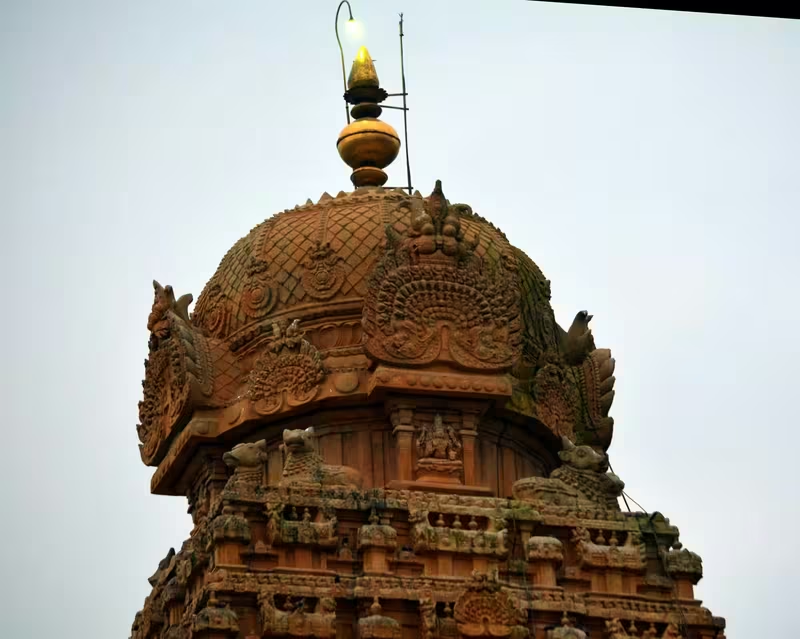
Rajaraja's architectural legacy includes the magnificent Brihadeeswara Temple at Thanjavur, completed in 1010 CE. This UNESCO World Heritage Site exemplifies Dravidian architecture at its finest, with its towering vimana (temple tower) reaching 216 feet. The temple served not only as a religious center but also as a statement of imperial power and artistic achievement. Its walls contain extensive inscriptions documenting Rajaraja's conquests, administrative systems, and the temple's vast landholdings.
The imperial expansion continued under Rajendra Chola I (1014-1044 CE), Rajaraja's son and successor. Rajendra conducted a remarkable military expedition to the Ganges valley, earning the title "Gangaikonda" (conqueror of the Ganges). To commemorate this achievement, he built a new capital at Gangaikonda Cholapuram with its own grand temple. Most significantly, Rajendra launched a successful naval expedition against the Srivijaya Empire in Southeast Asia (1025 CE), demonstrating the Cholas' unprecedented naval capabilities. This expedition secured control over vital maritime trade routes and extended Chola influence to the Malay Peninsula, Sumatra, and beyond.
The Chola Empire maintained its power and prestige through the reigns of subsequent rulers, including Kulothunga Chola I (1070-1122 CE), who united the Chola and Eastern Chalukya dynasties through his lineage. The empire remained a dominant force in South India until the late 12th century, controlling vast territories and facilitating a remarkable flowering of Tamil culture.
Administration and Governance
The Chola administrative system represents one of the most sophisticated governance structures in medieval India. At the apex stood the king (Chakravarti), who wielded supreme authority but governed through an elaborate bureaucratic hierarchy. The empire was divided into mandalams (provinces), which were further subdivided into valanadus (districts) and nadus (sub-districts), with villages forming the basic administrative unit.
The Cholas are particularly renowned for their system of local self-government through village assemblies. Two types of assemblies existed: the ur, comprising all taxpaying residents, and the sabha (also called mahasabha), restricted to Brahmin landowners in agrahara villages. These assemblies managed local taxation, irrigation, justice, and public works through elected committees. The democratic nature of these institutions, documented extensively in inscriptions, was remarkably advanced for its era.
Land revenue formed the backbone of Chola finances, and the dynasty conducted meticulous land surveys to assess productivity and tax liability. Land was classified into several categories based on usage and ownership, with detailed records maintained in temple inscriptions and government documents. The Cholas also developed an efficient system of temple administration, as temples owned vast lands and played crucial economic roles. Temple inscriptions served as public records, documenting donations, land transactions, and administrative decisions.
The military organization reflected the empire's expansionist character. The army comprised professional soldiers, including infantry, cavalry, and elephant corps, supplemented by militia raised from agricultural communities. However, the Cholas' most distinctive military arm was their navy, which consisted of various vessel types designed for warfare, troop transport, and trade protection. Naval bases were established along the coast, and the Cholas maintained maritime dominance through technological innovation and strategic positioning.
Military Campaigns
Chola military history encompasses a remarkable series of campaigns that extended from the Deccan to Southeast Asia. Rajaraja Chola I's systematic conquests began with the subjugation of the Chera kingdom on the Kerala coast, followed by campaigns against the Pandyas, which resulted in the incorporation of their territories. His invasion of Sri Lanka (modern-day Sri Lanka) proved particularly significant, with Chola forces occupying the northern portions of the island and establishing control over the strategically important port of Anuradhapura.
The conflict with the Western Chalukyas of Kalyani represented the Cholas' most sustained military challenge. Beginning under Rajaraja and continuing through multiple reigns, these wars were fought for control of the fertile Krishna-Tungabhadra doab region. While the Cholas achieved significant successes, including temporary occupation of Chalukyan territory, the conflict ultimately drained imperial resources without achieving decisive victory.
Rajendra Chola I's expedition to the Ganges valley around 1023 CE remains one of the most ambitious military undertakings in Indian history. The Chola army marched through Kalinga (Odisha), defeated the Pala king of Bengal, and reached the Ganges, bringing back sacred water to anoint the new capital. While not resulting in permanent territorial acquisition, this campaign demonstrated Chola military might and enhanced the dynasty's prestige throughout India.
The naval expedition against Srivijaya in 1025 CE showcased Chola maritime capabilities. The campaign targeted key Srivijayan ports in Sumatra and the Malay Peninsula, disrupting their monopoly over the Straits of Malacca. While the exact motivations remain debated—whether commercial, punitive, or expansionist—the expedition established Chola naval supremacy in Southeast Asian waters and facilitated direct trade relationships with China and Southeast Asian kingdoms.
Cultural Contributions
The Chola period represents the zenith of Tamil cultural expression, with achievements spanning architecture, sculpture, literature, and the performing arts. Chola temple architecture, characterized by towering vimanas, intricate sculptural programs, and massive stone construction, established the Dravidian architectural style that would influence temple building across South India and Southeast Asia. Besides the Brihadeeswara temples at Thanjavur and Gangaikonda Cholapuram, the Airavateswara Temple at Darasuram exemplifies the refinement of later Chola architecture with its exquisite stone carvings and architectural innovations.
Chola bronze sculpture achieved heights never surpassed in Indian art. The iconic Nataraja image—Shiva as the cosmic dancer within a ring of flames—was perfected during this period, embodying profound philosophical concepts in artistic form. Chola bronzes employed the lost-wax casting technique to create sculptures of remarkable grace and anatomical precision. These bronze images served ritual purposes in temple worship while demonstrating the extraordinary skill of Chola metalworkers. Today, Chola bronzes are treasured in museums worldwide and continue to inspire artists.
Tamil literature flourished under Chola patronage, particularly devotional poetry of the Bhakti movement. While the Bhakti saints (Nayanars and Alvars) preceded the imperial Cholas, the dynasty actively promoted their compositions and constructed temples celebrating their legacy. The Periya Puranam, composed by Sekkizhar during the reign of Kulothunga Chola II, narrates the lives of the 63 Nayanar saints and represents a masterpiece of Tamil literature. The Cholas also patronized Sanskrit literature, with several important philosophical and literary works produced during their reign.
The performing arts, particularly Bharatanatyam dance, developed sophisticated forms under Chola patronage. Temple sculptures and inscriptions document the presence of devadasis (temple dancers) who performed elaborate dance sequences as part of temple rituals. The theoretical foundations of dance and music were codified in texts like the Chidambara Mummanikkovai, establishing traditions that continue in contemporary South Indian classical arts.
Economy and Trade
The Chola economy rested on a foundation of highly productive agriculture, facilitated by the fertile Kaveri delta and an extensive irrigation network. The Cholas constructed numerous tanks, canals, and embankments to harness monsoon waters and extend cultivation. The Grand Anicut (Kallanai) on the Kaveri River, originally built before the Chola period but maintained and improved by them, stands as a testament to Tamil hydraulic engineering and continues to function today after more than 2,000 years.
Agricultural prosperity supported a complex economy with significant craft production and trade. Textile manufacturing, particularly of cotton and silk fabrics, employed numerous weavers and constituted a major export commodity. Metalworking, including the production of bronze sculptures and iron implements, represented another important economic sector. Villages often specialized in particular crafts, creating a network of economic interdependence across the empire.
Maritime trade formed a crucial component of Chola economic life. Chola ports along the Coromandel Coast facilitated commerce with Southeast Asia, China, Arabia, and East Africa. Tamil merchant guilds, particularly the Ayyavole and Manigramam, established trading colonies across the Indian Ocean world, spreading Tamil cultural influence alongside commercial connections. Chola rulers actively protected merchant interests, with royal inscriptions documenting arrangements for trader security and market regulation.
The Cholas maintained trade relationships with the Song Dynasty of China, evidenced by Chinese historical records mentioning embassies from the Chola kingdom. Archaeological finds of Chinese ceramics at South Indian sites and Tamil inscriptions in Southeast Asia document extensive commercial networks. The famous Chola maritime expedition to Srivijaya partly aimed to secure freedom of navigation through the Straits of Malacca, essential for trade with China.
Currency in the form of gold, silver, and copper coins facilitated commercial transactions, though barter and land grants remained important in rural areas. Temple inscriptions meticulously document monetary transactions, interest rates, and commercial disputes, providing invaluable insights into Chola economic life. Temples themselves functioned as economic institutions, serving as banks that loaned money at interest and as centers of commercial activity during festivals.
Decline and Fall
The decline of the Chola Empire resulted from multiple interconnected factors that gradually weakened imperial power from the late 12th century onward. The protracted conflict with the Western Chalukyas, while bringing glory, severely strained military and financial resources. Subsequent wars with the Hoysala and Pandya dynasties further depleted Chola strength. By the mid-13th century, the empire faced threats on multiple fronts without the resources to counter them effectively.
The resurgence of the Pandya dynasty under rulers like Jatavarman Sundara Pandya I proved particularly devastating. The Pandyas, once subordinate to the Cholas, gradually recovered their independence and began aggressive expansion. Repeated Pandya invasions targeted the Chola heartland, capturing important territories and destabilizing imperial administration. The Hoysalas of Karnataka simultaneously pressed from the west, creating a strategic vice that crushed Chola power.
Internal factors also contributed to decline. Succession disputes and weak rulers in the later period undermined central authority. The administrative system, once remarkably efficient, became increasingly unwieldy and corrupt. Local chieftains and provincial governors began asserting independence, fragmenting imperial unity. The temple establishment, which had grown enormously wealthy and powerful, sometimes competed with rather than supported royal authority.
Economic difficulties compounded political problems. The disruption of trade routes due to military conflicts reduced commercial revenues. Agricultural productivity may have declined due to the neglect of irrigation systems during prolonged warfare. The cost of maintaining armies and conducting campaigns exceeded available resources, forcing the empire to rely increasingly on subordinate allies whose loyalty proved questionable.
The final blow came in 1279 CE when the Pandya ruler Jatavarman Sundara Pandya III defeated Rajendra Chola III, the last significant Chola emperor. While remnants of the dynasty survived in reduced circumstances, and various Chola cadet branches continued ruling smaller territories, the main imperial line effectively ended. The former Chola territories were divided among the Pandyas, Hoysalas, and various smaller dynasties, marking the close of one of India's most remarkable imperial periods.
Legacy
The Chola legacy profoundly shaped South Indian civilization and extended far beyond the dynasty's political demise. In architecture, the Chola style became definitive of Tamil temple building, with subsequent dynasties continuing and elaborating upon Chola architectural principles. The great Chola temples remain active centers of worship and cultural pride, with the Brihadeeswara Temple designated as a UNESCO World Heritage Site recognizing its universal cultural value.
Chola administrative innovations influenced later South Indian kingdoms. The system of local self-government through village assemblies, though modified, persisted in various forms for centuries. The meticulous documentation of land rights, taxation, and administrative procedures established standards of governance that subsequent rulers emulated. The integration of temple institutions into administrative and economic structures continued to characterize South Indian political economy.
In the cultural sphere, Chola contributions to Tamil literature, music, and dance established classical traditions that remain vibrant today. The Bhakti devotional movement, patronized by the Cholas, profoundly influenced Hindu religious practice across India. The Tamil language itself was standardized and enriched during the Chola period, with inscriptions and literary works establishing linguistic norms. The Chola emphasis on Tamil cultural expression contributed to the strong regional identity that characterizes Tamil Nadu today.
The Chola maritime legacy resonates in contemporary Indian Ocean history. Tamil diaspora communities throughout Southeast Asia trace their origins to Chola-period trade and cultural contacts. Archaeological sites across the region, from Thailand to Indonesia, reveal Tamil inscriptions and Hindu-Buddhist artistic influences linked to Chola maritime networks. Modern India's "Act East" policy and maritime ambitions draw inspiration from the Chola naval traditions.
Perhaps most significantly, the Chola dynasty serves as a powerful symbol of Tamil achievement and cultural pride. In modern Tamil Nadu, Chola history features prominently in political discourse, educational curricula, and popular culture. The dynasty exemplifies Tamil civilization's contributions to Indian and world heritage, providing a historical foundation for regional identity while remaining an integral part of India's broader historical narrative.
Timeline
See Also
- Pallava Dynasty - Predecessors of the Medieval Cholas in Tamil Nadu
- Pandya Dynasty - Rival dynasty and eventual successor to the Cholas
- Brihadeeswara Temple - Architectural masterpiece of Rajaraja Chola I
- Raja Raja Chola I - Greatest emperor of the Chola dynasty
- Rajendra Chola I - Conqueror who extended Chola power to its zenith
- Thanjavur - Capital city and cultural center of the Chola Empire