Overview
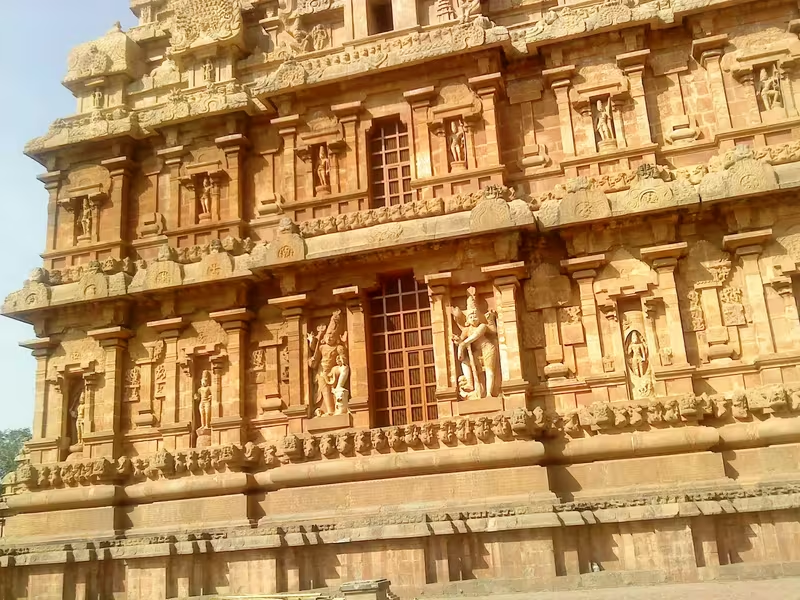
Thanjavur, one of South India's most historically significant cities, served as the glorious capital of the Chola Empire during its golden age from the 9th to 13th centuries CE. Located in the heart of the fertile Cauvery Delta in Tamil Nadu, this ancient city witnessed the zenith of Dravidian architecture, Tamil literature, and classical arts. The magnificent Brihadeeswara Temple, built by the great emperor Raja Raja Chola I around 1010 CE, stands as an enduring testament to the city's architectural and cultural supremacy, earning its place among UNESCO's World Heritage Monuments as part of the Great Living Chola Temples.
The city's strategic location in the agriculturally rich Cauvery Delta provided the economic foundation for the Chola Empire's military campaigns and cultural patronage. Known today as the "Rice Bowl of Tamil Nadu," Thanjavur's prosperity enabled the Cholas to maintain powerful armies and naval fleets that extended their influence across the Indian Ocean to Southeast Asia. This wealth also supported an unprecedented flowering of temple architecture, bronze sculpture, and Tamil literature that continues to influence South Indian culture.
Throughout its post-Chola history, Thanjavur remained a significant cultural and political center under successive rulers including the Pandyas, Vijayanagar Empire, Thanjavur Nayaks, and Thanjavur Marathas, each contributing to its rich heritage. The city became synonymous with classical South Indian arts—particularly Bharatanatyam dance, Carnatic music, and the distinctive Tanjore painting style. Today, with a population of over 220,000, Thanjavur continues as a major pilgrimage destination and cultural hub, preserving centuries of artistic traditions while serving as an important agricultural and educational center.
Etymology and Names
The name "Thanjavur" derives from "Thanjai," the traditional Tamil name for the city. The etymology is debated, with local tradition connecting it to "Tanjan," a legendary demon said to have been vanquished by the Hindu deity Anaikaatha Vinayakar (a form of Ganesha), after whom the city was supposedly named. However, historical documentation of this origin myth is limited.
During the British colonial period, the city became known as "Tanjore," an anglicized version of the Tamil name that appeared in official British records, maps, and publications from the late 18th century onward. This colonial-era name persisted in English usage well into the 20th century and remains familiar in historical literature and art references, particularly in connection with "Tanjore paintings."
After Indian independence in 1947, there was a gradual movement across Tamil Nadu to restore traditional Tamil names to cities and places. Officially, the city's name reverted to "Thanjavur" in government records and signage, though "Tanjore" continues to be used colloquially and in certain cultural contexts, especially regarding traditional art forms. The demonym for residents is "Thanjavurkaaran" in Tamil.
Throughout various historical periods, the city was referenced in inscriptions and literature under slight variations of its Tamil name, but the core identity remained consistent, unlike some Indian cities that underwent more dramatic name changes under different ruling dynasties.
Geography and Location
Thanjavur occupies a strategic position in the Cauvery River Delta region of Tamil Nadu, approximately 340 kilometers southwest of Chennai. The city sits at an elevation of 77 meters (253 feet) above sea level in the heart of one of India's most fertile agricultural zones. The Cauvery River, considered sacred in Hindu tradition, branches into multiple distributaries as it approaches the Bay of Bengal, creating a network of water channels that have sustained intensive agriculture for over two millennia.
The delta's alluvial soil, regularly enriched by river sediments, made Thanjavur ideally suited for wet rice cultivation, earning the region its designation as the "Rice Bowl of Tamil Nadu." This agricultural productivity provided the economic surplus that enabled the Chola rulers to establish Thanjavur as their capital and fund their ambitious temple-building programs and military expeditions. The reliable water supply and fertile land attracted settlement from ancient times and supported dense populations.
The city experiences a tropical wet and dry climate with temperatures ranging from 20°C to 37°C throughout the year. The region receives rainfall from both the southwest monsoon (June-September) and the northeast monsoon (October-December), with the latter being more significant for agriculture. This dual monsoon system, combined with the elaborate irrigation infrastructure developed over centuries, including ancient canal systems and tanks, ensured agricultural stability.
Geographically, Thanjavur's location in the relatively flat delta plain offered few natural defensive advantages compared to hill forts, but the surrounding network of rivers and irrigation channels could be manipulated for defensive purposes. The city's accessibility via waterways connected it to coastal ports, facilitating maritime trade and naval operations that were crucial to Chola power. The nearest seaport historically was Nagapattinam on the Coromandel Coast, though modern transportation infrastructure now connects Thanjavur primarily by road and rail, with Tiruchirappalli International Airport located 59.6 kilometers away serving as the nearest air gateway.
Ancient History
While Thanjavur rose to true prominence only during the Chola period beginning in the 9th century CE, the region has evidence of much earlier settlement. Archaeological surveys in the Cauvery Delta have revealed megalithic burial sites and iron-age artifacts, indicating human habitation dating back to at least the early centuries CE. However, specific pre-Chola historical records for the city itself are limited.
The earliest documented rulers of the Thanjavur region were the Mutharaiyar dynasty, a local chieftain family who controlled parts of the Cauvery Delta before the rise of Chola power. The Mutharaiyars appear to have governed as feudatories under the Pallavas of Kanchipuram during the 7th and 8th centuries CE. Their inscriptions can be found in some temples in and around Thanjavur, though little is known about the extent or nature of settlement during their rule.
The transformation of Thanjavur from a regional center to an imperial capital began when Vijayalaya Chola captured the region from the Mutharaiyars around 848 CE. Vijayalaya, who founded the medieval Chola dynasty, built a temple to the goddess Nisumbhasudani (Durga) in Thanjavur, marking the beginning of the city's association with monumental temple architecture. However, it was under his successors, particularly Aditya I and Parantaka I, that Thanjavur began developing as an administrative center.
Tamil Sangam literature, composed between 300 BCE and 300 CE, contains references to the fertile Cauvery Delta region, though specific mentions of Thanjavur by name are uncertain in these early texts. The area was clearly recognized in ancient Tamil tradition as agriculturally prosperous and strategically significant, forming part of the core territory contested by the three ancient Tamil kingdoms: the Cholas, Pandyas, and Cheras.
Historical Timeline
The Chola Imperial Period (848-1279 CE)
The establishment of Thanjavur as the Chola capital marked the beginning of South India's most celebrated imperial age. Vijayalaya Chola's capture of the city around 848 CE laid the foundation, but it was under Raja Raja Chola I (985-1014 CE) that Thanjavur reached unprecedented glory. Raja Raja transformed the city into a magnificent imperial capital, constructing the Brihadeeswara Temple (completed around 1010 CE), which remains one of the finest examples of Dravidian architecture. This massive temple, with its 66-meter-high vimana (tower), served not only as a religious center but also as a symbol of Chola imperial power and artistic achievement.
Raja Raja's son, Rajendra Chola I (1014-1044 CE), continued his father's expansionist policies, extending Chola power to the Ganges in the north and across the seas to Sri Lanka and parts of Southeast Asia. Though Rajendra built a new capital at Gangaikonda Cholapuram, Thanjavur remained culturally and religiously significant. The city became the administrative hub for managing the Chola Empire's vast territories, maritime trade networks, and temple endowments.
During this period, Thanjavur evolved into more than just a political capital—it became the cultural heart of Tamil civilization. The royal court patronized Tamil literature, with poets like Ottakoothar and Kambar producing masterworks. The city's temples functioned as economic centers, educational institutions, and repositories of art. Bronze casting reached extraordinary sophistication, producing the iconic Chola bronzes that are now treasured in museums worldwide. The city's prosperity attracted scholars, artists, and merchants, creating a cosmopolitan urban culture.
The later Chola period saw gradual decline as the Pandyas and Hoysalas challenged Chola supremacy. By 1279 CE, the Pandyas captured Thanjavur, ending nearly 400 years of Chola dominance.
Pandya and Vijayanagar Periods (1279-1565 CE)
The Pandya conquest of Thanjavur in 1279 CE was relatively brief, lasting only until about 1311 CE, when the armies of the Delhi Sultanate under Malik Kafur raided deep into South India. The subsequent political instability created opportunities for the emerging Vijayanagar Empire, founded in 1336 CE, to expand its influence southward.
By the mid-14th century, Thanjavur came under Vijayanagar control, either directly or through local governors. The Vijayanagar rulers, while Hindu themselves, adopted many administrative practices from the Delhi Sultanate they opposed, creating an efficient imperial system. Thanjavur's agricultural wealth made it a valuable province, and the city continued as an important regional center, though it no longer served as an empire's capital.
The Vijayanagar period saw some architectural additions to Thanjavur's temples and the continuation of agricultural development. However, the city's most significant transformation during this era came with the establishment of the Thanjavur Nayak kingdom in 1532 CE. The Nayaks, who began as governors appointed by Vijayanagar, gradually assumed independence as the empire weakened, particularly after the catastrophic Battle of Talikota in 1565 CE, which shattered Vijayanagar power.
The Nayak Period (1532-1673 CE)
The Thanjavur Nayak dynasty, though founded as Vijayanagar vassals, developed Thanjavur into a significant independent kingdom during the 16th and 17th centuries. The Nayaks were Telugu-speaking warriors originally from the Balija community, but they became great patrons of Tamil culture and Hindu temple traditions.
Sevappa Nayak, the dynasty's founder, established Thanjavur's autonomy around 1532 CE. His successors, particularly Achuthappa Nayak (1561-1614) and Raghunatha Nayak (1614-1634), were renowned for their cultural patronage. Raghunatha Nayak's court was celebrated for its support of music, dance, and literature. He expanded the city's temples, built new structures within the palace complex, and maintained sophisticated diplomatic relations with European trading companies establishing themselves on India's coasts.
The Thanjavur Nayaks developed a distinctive style of temple architecture, adding mandapas (pillared halls) and gopurams (tower gateways) to existing Chola-era temples, including modifications to the Brihadeeswara Temple complex. They also promoted classical dance and music, with the Nayak court becoming a center for Bharatanatyam, which was systematized during this period.
However, internal succession disputes and external pressures weakened the Nayak kingdom. Conflicts with the neighboring Madurai Nayaks and interference from the Bijapur Sultanate destabilized the region.
The Maratha Period (1674-1855 CE)
In 1674 CE, Ekoji (also known as Venkoji), the half-brother of the great Maratha ruler Chhatrapati Shivaji, conquered Thanjavur with support from the Bijapur Sultanate, establishing the Thanjavur Maratha kingdom. This brought a Marathi-speaking dynasty to rule a predominantly Tamil region, creating an interesting cultural synthesis.
The Thanjavur Marathas proved to be exceptional cultural patrons. Though they maintained their Marathi identity and brought Marathi Brahmin administrators, they enthusiastically supported Tamil arts and literature. The most celebrated ruler was Serfoji II (1798-1832), an enlightened monarch who established the Saraswathi Mahal Library, collected scientific instruments, supported European-style education, and patronized traditional arts. Serfoji's collection of over 49,000 manuscripts in multiple languages remains one of India's important repositories of traditional knowledge.
During this period, Thanjavur became renowned for the distinctive Tanjore painting style, characterized by rich colors, surface richness through gold foil, and compact composition. These paintings, typically depicting Hindu deities, combined South Indian iconographic traditions with Maratha and Deccani influences. The city also became a center for Carnatic music, with the famous composer-saint Tyagaraja and his contemporaries (the Trinity of Carnatic music) active in the region.
The Maratha rulers' relationship with the British East India Company grew increasingly complex. In 1799 CE, following the defeat of Tipu Sultan of Mysore, the British intervened in Thanjavur's affairs, and the kingdom became a princely state under British suzerainty. Real power shifted to British Residents, though the Maratha dynasty retained nominal authority until 1855 CE, when the British annexed the kingdom following a succession dispute, incorporating it into the Madras Presidency.
British Colonial Period (1799-1947 CE)
Under direct British rule from 1855, Thanjavur became an important district headquarters in the Madras Presidency. The British developed the city's infrastructure, including roads, railways, and administrative buildings, while systematically surveying and documenting the region's temples and monuments. British scholarship, though often colonialist in perspective, produced important studies of Chola architecture and Tamil literature, bringing international attention to Thanjavur's heritage.
The colonial administration reorganized agricultural land holdings, introducing new revenue systems that often disadvantaged traditional cultivators. However, the Cauvery Delta remained agriculturally productive, and Thanjavur continued as a major rice-producing region. The British also established English-language schools and colleges, creating a Western-educated elite that would later play roles in the independence movement.
Thanjavur participated in India's freedom struggle, with local leaders organizing under the Indian National Congress. The city witnessed protests during the Non-Cooperation Movement and the Quit India Movement, though it did not experience the same level of violent confrontation seen in some other regions.
Political Significance
Throughout its history, Thanjavur's political importance derived from its economic foundation. As the capital of the Chola Empire during its most powerful phase (10th-13th centuries CE), the city served as the administrative hub for territories extending from the Tungabhadra River in the north to Sri Lanka in the south, and across the seas to parts of Southeast Asia including the Malay Peninsula and Sumatra. The efficient Chola administrative system, documented in thousands of temple inscriptions, was centered in Thanjavur, managing revenue collection, military organization, and temple endowments across this vast domain.
The city's political role evolved under subsequent dynasties. During the Nayak period, Thanjavur was the capital of a significant regional kingdom that maintained diplomatic relations with Portuguese, Dutch, and English trading companies, navigating the complex politics of 16th and 17th-century South India. The Nayak rulers balanced competing interests of declining Hindu kingdoms, expanding Muslim sultanates, and emerging European powers.
Under Maratha rule, Thanjavur's political significance diminished as it became a secondary capital compared to major Maratha centers in western India. However, it remained an important princely state in South India, and the Maratha court continued to exercise considerable cultural influence even as real political power increasingly fell to the British East India Company.
In the post-independence period, Thanjavur serves as the headquarters of Thanjavur District in Tamil Nadu, administered by a municipal corporation. While no longer a royal capital, the city remains politically significant within the state, typically represented in both state and national legislatures.
Religious and Cultural Importance
Thanjavur's religious significance centers on its status as home to some of South India's most sacred temples. The Brihadeeswara Temple (also called Periya Kovil or Big Temple) stands as the crown jewel, dedicated to Lord Shiva. Built by Raja Raja Chola I and completed around 1010 CE, this architectural marvel features a 66-meter-high pyramidal vimana, one of the tallest in India. The temple complex includes a massive monolithic Nandi bull statue carved from a single piece of granite weighing approximately 25 tons—one of the largest in India. The temple's walls bear extensive inscriptions documenting the Chola administrative system, land grants, and cultural practices, making it not just a religious monument but also a historical archive.
The Brihadeeswara Temple, along with the Gangaikonda Cholapuram Temple and Airavateswara Temple at Darasuram, forms the UNESCO World Heritage Site designation "Great Living Chola Temples," recognized for their architectural excellence and influence on temple construction across South and Southeast Asia. These temples pioneered architectural techniques, including the construction of hollow granite blocks to reduce weight while maintaining structural integrity at great heights.
Beyond monumental architecture, Thanjavur became intimately associated with South Indian classical arts. The city is considered one of the birthplaces of Bharatanatyam, the classical dance form that was systematized and refined in Thanjavur's temples and royal courts. The Tanjore Quartet—four brothers who were court musicians and dance teachers in the early 19th century—codified Bharatanatyam's basic structure and composed many of its foundational pieces.
Thanjavur is also deeply connected to Carnatic music. The legendary composer-saint Tyagaraja (1767-1847), though based in nearby Tiruvaiyaru, performed throughout the Thanjavur region, and the Maratha court provided crucial patronage for Carnatic music's development. The city remains a major center for Carnatic music education and performance.
The distinctive Tanjore painting style emerged during the Maratha period, combining traditional South Indian iconography with Marathi and Deccani artistic influences. These paintings, characterized by rich colors, embedded precious stones, and extensive use of gold foil, typically depicted Hindu deities and remain highly valued art forms produced by traditional artists in Thanjavur today.
The Saraswathi Mahal Library, established by the Nayak rulers and expanded significantly by the Maratha king Serfoji II, houses over 49,000 manuscripts in Sanskrit, Tamil, Marathi, and other languages, covering subjects from palm-leaf medical texts to astronomy. This institution represents Thanjavur's role as a center of traditional learning.
Economic Role
Thanjavur's economic significance throughout history rested primarily on agriculture. The fertile Cauvery Delta, with its reliable water supply and rich alluvial soil, enabled intensive wet rice cultivation that produced substantial surpluses. This agricultural wealth funded the Chola Empire's military campaigns, temple construction, and administrative apparatus. Temple inscriptions reveal elaborate systems of irrigation management, land classification, and agricultural taxation that formed the economic foundation of Chola power.
During the Chola period, Thanjavur was also connected to extensive maritime trade networks. While the city itself was not a port, it controlled coastal ports like Nagapattinam, through which goods moved between South India, Sri Lanka, Southeast Asia, and regions beyond. Chola naval expeditions secured these trade routes, and Thanjavur's temples received donations of goods from distant lands, indicating the empire's economic reach.
Traditional crafts thrived in Thanjavur, including bronze casting, silk weaving, and musical instrument making. Chola bronze sculptures, many produced in Thanjavur workshops, are considered among the finest metalwork in world art history. The city's artisans developed sophisticated techniques for large-scale bronze casting using the lost-wax process, creating the iconic Nataraja (dancing Shiva) sculptures and other deities.
Under Maratha rule, Thanjavur remained an important center for handloom weaving, particularly silk saris, and the production of distinctive Tanjore paintings. The city's artisans also specialized in making veenas and other classical musical instruments, supplying instruments to musicians across South India.
In the modern era, Thanjavur continues as an agricultural hub, with rice milling and processing remaining major industries. The district produces not only rice but also sugarcane, cotton, and groundnuts. The city has also developed educational institutions, including medical colleges and engineering schools, creating an economy increasingly balanced between agriculture, education, and heritage tourism. Tourism related to the city's temples and cultural heritage generates significant economic activity, supporting hotels, restaurants, handicraft shops, and guide services.
Monuments and Architecture
The architectural heritage of Thanjavur spans over a millennium, with the Brihadeeswara Temple dominating both physically and historically. This temple exemplifies the pinnacle of Chola architecture—its 66-meter-high vimana constructed entirely of granite, with each stone precisely cut and assembled without mortar. The capstone alone weighs approximately 80 tons and was likely raised to its height using an inclined plane several kilometers long. The temple's inner sanctum houses a massive Shiva lingam, and the walls display intricate sculptures of deities, celestial beings, and narrative panels from Hindu mythology.
The Nandi mandapa, housing the monolithic bull statue, sits on the temple's main axis facing the sanctum. This Nandi, measuring about 4.9 meters long and 3.7 meters high, carved from single granite rock, demonstrates the Chola sculptors' technical mastery. The temple complex originally included elaborate gardens, water bodies, and subsidiary shrines, forming a complete sacred landscape.
The Thanjavur Palace, though primarily associated with the Nayak and Maratha periods, incorporates earlier Chola-period structures. The palace complex includes the Durbar Hall, the Saraswathi Mahal Library, and the Art Gallery housing Chola bronzes. The palace architecture reflects multiple periods—Nayak contributions include massive pillared halls with Indo-Islamic architectural influences, while Maratha additions show a synthesis of Deccani and South Indian styles.
Other significant temples include the Schwartz Church, built by the Danish missionary Christian Friedrich Schwartz in 1779, representing European architectural influence during the late Maratha period. The Gangaikonda Cholapuram Temple, while not in Thanjavur city itself, lies within the greater Thanjavur region and forms part of the UNESCO World Heritage designation, built by Rajendra Chola I to commemorate his northern conquests.
Modern Thanjavur has largely preserved its historic core, with many traditional Tamil residential structures (agraharam houses) still standing in streets surrounding major temples, though urbanization threatens some heritage structures.
Famous Personalities
Raja Raja Chola I (985-1014 CE) stands as Thanjavur's most celebrated historical figure. His reign marked the Chola Empire's zenith, and his construction of the Brihadeeswara Temple represents one of humanity's great architectural achievements. Raja Raja's administrative reforms, military conquests, and cultural patronage transformed Thanjavur from a regional capital into the center of a maritime empire.
Rajendra Chola I (1014-1044 CE), Raja Raja's son, continued his father's expansionist policies, extending Chola power to the Ganges and across Southeast Asia. Though he built a new capital at Gangaikonda Cholapuram, he maintained Thanjavur's cultural institutions.
Serfoji II (1798-1832 CE), the Maratha king, was an enlightened ruler and scholar who transformed Thanjavur into a center of learning. He expanded the Saraswathi Mahal Library, collected European scientific instruments, promoted vaccination against smallpox, and patronized both traditional Tamil arts and Western education.
Tyagaraja (1767-1847), though based in nearby Tiruvaiyaru, is inextricably linked with Thanjavur's musical tradition. One of Carnatic music's greatest composers, his devotional compositions in Telugu and Sanskrit remain central to the Carnatic repertoire.
The Tanjore Quartet—Chinnaiah, Ponniah, Sivanandam, and Vadivelu—were court musicians and dance teachers in early 19th-century Thanjavur who systematized Bharatanatyam, composing many of its foundational pieces.
Christian Friedrich Schwartz (1726-1798), the Danish-German Protestant missionary, though not native to Thanjavur, spent significant time in the city, serving as an advisor to the Maratha court while conducting missionary activities. His church in Thanjavur represents an interesting chapter in the city's religious history.
Modern City
Contemporary Thanjavur, with a municipal corporation area of 36.31 square kilometers and a population of 222,943 (as of recent census), balances heritage preservation with modern development. The city functions as an important educational center, hosting several colleges including medical, engineering, and arts institutions. Thanjavur is particularly noted for Tamil studies, with institutions dedicated to Tamil language, literature, and culture.
The city's economy remains significantly agricultural, with rice milling and related agro-industries employing substantial populations. The Cauvery Delta continues as one of Tamil Nadu's most productive agricultural regions, though water availability has become increasingly contested due to disputes with neighboring Karnataka over river water sharing.
Heritage tourism represents a growing economic sector. The Brihadeeswara Temple attracts hundreds of thousands of visitors annually, both pilgrims and tourists. The city has developed supporting infrastructure including hotels, restaurants, and guide services. However, tourism development faces challenges in balancing visitor access with monument preservation.
Traditional crafts continue, though on a reduced scale. Tanjore painting remains a living tradition with workshops training new artists, and some families maintain traditional bronze-casting and musical instrument-making practices. However, these crafts face economic challenges from mass production and changing consumer preferences.
Transportation infrastructure connects Thanjavur to major Tamil Nadu cities. National highways link the city to Chennai (340 km), Tiruchirappalli (59 km), and Madurai (190 km). The Southern Railway's Thanjavur Junction serves as an important railhead on the Chennai-Trichy-Thanjavur line. For air travel, Tiruchirappalli International Airport, 59.6 kilometers away, provides the nearest access, with regular domestic flights and some international connections.
The city faces typical challenges of Indian urbanization—infrastructure strain, traffic congestion, and pressure on historic neighborhoods. The Archaeological Survey of India manages major monuments, but many smaller heritage structures lack protection. Water management remains critical given the city's dependence on the Cauvery system and competing demands from agriculture and urban use.
Culturally, Thanjavur maintains strong traditions of classical music and dance, with numerous schools (kalakshetras) teaching Bharatanatyam and Carnatic music. The annual Tyagaraja Aradhana festival at nearby Tiruvaiyaru attracts musicians from across India. The Margazhi season (December-January) sees intensified cultural activities with music and dance performances in temples and cultural venues.