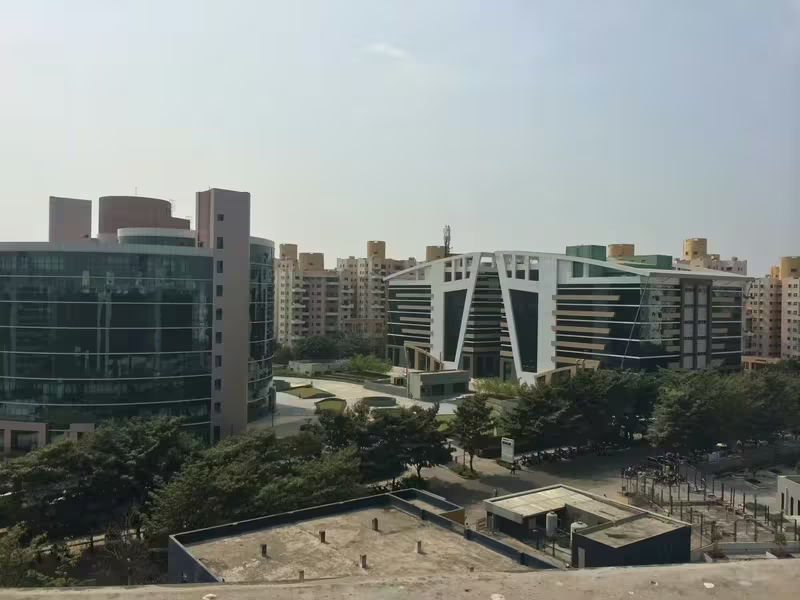
Overview
Pune, historically known as Poona during the British colonial era, stands as one of India's most historically significant and culturally vibrant cities. Established in 758 CE according to historical records, this ancient settlement on the Deccan Plateau has witnessed over twelve centuries of continuous habitation and transformation. Today, Pune serves as the administrative headquarters of both Pune district and Pune division in the state of Maharashtra, while holding the distinction of being the largest city in Maharashtra by geographical area at 516.18 square kilometers.
The city's evolution from a medieval settlement to a modern metropolitan hub exemplifies India's broader historical trajectory. Once a crucial center of Maratha power, Pune has seamlessly transformed into a contemporary economic powerhouse, housing one of India's largest IT sectors and serving as a critical automobile and manufacturing hub. The Pune Metropolitan Region encompasses 7.2 million residents according to the 2011 Census of India, making it the seventh-most populous metropolitan area in the country.
Pune's enduring reputation as the "Oxford of the East" reflects its exceptional concentration of educational and research institutions, a legacy that continues to attract students and scholars from across India and beyond. This unique combination of historical significance, educational excellence, and economic dynamism has earned Pune the recognition of being India's "most liveable city" on multiple occasions, showcasing how ancient heritage and modern progress can coexist harmoniously.
Etymology and Names
The name "Pune" has ancient roots, though its exact etymological origins remain subject to scholarly debate. The city was historically known by various names including "Punavadi," reflecting its long history predating the formal establishment date of 758 CE. During the British colonial period, the English rendering "Poona" became standard in official documentation and remained in use until India's independence.
The spelling transformation from "Poona" to "Pune" in the post-independence era represented more than mere linguistic adjustment—it symbolized the broader movement to restore indigenous names and reclaim cultural identity. The modern name "Pune" is used consistently in contemporary Marathi and other Indian languages, while "Poona" remains recognizable in historical contexts and among older generations, particularly in references to the colonial period.
Residents of the city are known as "Punekars" in common parlance, a designation that carries cultural significance and pride. The formal English demonym "Poonaite" exists but is rarely used in contemporary discourse, serving primarily as a historical curiosity from the colonial era.
Geography and Location
Pune occupies a strategic position on the Deccan Plateau in Western India, situated at an elevation of approximately 570.62 meters (1,872.1 feet) above sea level. This elevated location on the plateau has profoundly influenced the city's climate, strategic importance, and historical development. The geographical positioning places Pune in Maharashtra's western region, making it a natural gateway between the coastal Konkan region and the interior Deccan territories.
The city's terrain consists primarily of undulating plateau land characteristic of the Deccan region, providing natural defensive advantages that historical rulers recognized and exploited. The area experiences a tropical wet and dry climate, with the elevation moderating temperatures compared to lower-lying regions. This climatic advantage has historically made Pune an attractive location for settlement and contributed to its role as a summer retreat during various historical periods.
With a jurisdictional area spanning 516.18 square kilometers, Pune holds the distinction of being Maharashtra's largest city by land area, surpassing even the megacity of Mumbai in terms of geographical extent under its administrative control. The Pune Municipal Corporation manages this vast urban landscape, which has expanded significantly from its historical core. The metropolitan region's density varies considerably, with the municipal corporation area showing higher concentration at approximately 12,000 persons per square kilometer, while the broader metropolitan region maintains a more moderate density of about 1,003 persons per square kilometer.
Ancient and Medieval History
The formal establishment of Pune is traditionally dated to 758 CE, though archaeological evidence and historical references suggest human settlement in the region predates this considerably. The Deccan Plateau's strategic location made it an attractive site for various ruling dynasties throughout ancient and medieval Indian history, though specific details about Pune's earliest centuries remain limited in available sources.
During the medieval period, Pune gradually evolved from a modest settlement into a more significant regional center. Its location on the Deccan Plateau positioned it advantageously for trade routes and military campaigns that characterized the medieval era in this part of India. The city's importance grew substantially with the rise of Maratha power, when it transformed from a regional town into a center of political authority.
The transition from medieval settlement to prominent city accelerated during the Maratha period, though the precise timeline and details of this transformation require deeper historical documentation than currently available in the provided sources. What remains clear is that by the time of British colonial engagement with the region, Pune had already established itself as a significant urban center with considerable administrative, military, and cultural importance.
Colonial Period and the British Era
Under British rule, the city became officially known as "Poona" in English records and documentation. The colonial period marked a significant transformation in Pune's character and infrastructure, as British administrative systems, educational institutions, and urban planning concepts were introduced. The city served as an important military cantonment and administrative center during the British Raj, contributing to its development of modern infrastructure and civic amenities.
The establishment of numerous educational institutions during this period laid the groundwork for Pune's eventual reputation as an educational hub. Christian missionary organizations, British administrators, and progressive Indian reformers collaborated in creating schools, colleges, and research institutions that would eventually earn the city its distinctive sobriquet as the "Oxford of the East."
British urban planning introduced new architectural styles and civic infrastructure that complemented rather than entirely replaced the existing urban fabric. Areas like Budhwar Peth retained their traditional character while new cantonment areas developed according to colonial urban design principles, creating a dual character that persists in the modern city's landscape.
Educational Legacy and Cultural Significance
Pune's designation as the "Oxford of the East" reflects a educational tradition that predates but flourished during and after the colonial period. The city emerged as Maharashtra's intellectual capital, attracting students, scholars, and educational institutions in unprecedented numbers. This concentration of learning establishments transformed Pune's economy, culture, and social character.
The educational ecosystem encompasses institutions ranging from schools to specialized research centers, covering disciplines from traditional humanities to cutting-edge technology. This diversity has created a unique urban environment where academic discourse, cultural activities, and progressive social movements have traditionally flourished. The student population significantly influences the city's demographics, contributing to its reputation for cultural vibrancy and progressive outlook.
Beyond formal education, Pune has served as a center for Marathi literature, theater, and cultural production. The city's role in preserving and promoting Marathi cultural heritage while embracing modernity exemplifies the broader synthesis that characterizes contemporary Maharashtra. Cultural institutions, libraries, and performance venues contribute to an intellectual atmosphere that distinguishes Pune from purely commercial metropolitan centers.
Economic Transformation and Modern Development
The late 20th and early 21st centuries witnessed Pune's dramatic transformation into a major economic center. The city evolved into one of India's largest IT hubs, with technology parks and software companies establishing significant operations. This IT sector growth attracted educated professionals from across India, further diversifying the city's population and contributing to its cosmopolitan character.
Parallel to IT development, Pune emerged as a crucial automobile manufacturing center, hosting major Indian and international automotive companies and their ancillary industries. The manufacturing sector's presence provides economic diversification, creating employment across skill levels and contributing to the city's GDP, which reached $69 billion according to available economic data.
The Pune Metropolitan Region Development Authority oversees urban planning for the expanding metropolitan area, attempting to manage growth while preserving livability. The municipal corporation area houses approximately 6.2 million residents, while the broader metropolitan region encompasses 7.276 million people, making coordinated urban planning essential for sustainable development.
Modern Infrastructure and Urban Systems
Contemporary Pune boasts sophisticated urban infrastructure reflecting its status as a major Indian metropolis. The Pune Metro provides rapid transit services, representing a significant investment in public transportation infrastructure. This metro system, combined with the Pune Suburban Railway and PMPML bus rapid transit system (BRTS), creates a multi-modal transportation network attempting to address the mobility needs of millions of residents.
Pune International Airport (PNQ) connects the city to domestic and international destinations, facilitating business travel and tourism. The airport's designation as an international facility underscores Pune's significance in India's economic geography and its connections to global networks of commerce, education, and culture.
The city's modern infrastructure extends beyond transportation to include telecommunications, utilities, and civic amenities. The Pune Municipal Corporation, led by an IAS-cadre Municipal Commissioner (currently Rajendra Bhosale), manages these urban services for the municipal corporation area. The complexity of managing a city with 12,000 persons per square kilometer in its core areas presents ongoing challenges in service delivery, environmental management, and urban planning.
Recognition and Liveability
Pune's achievement of being ranked "the most liveable city in India" on multiple occasions reflects success in balancing economic growth with quality of life considerations. This recognition considers factors including climate, infrastructure, educational facilities, healthcare, cultural amenities, and environmental conditions. The city's moderate climate, extensive educational infrastructure, and relatively organized urban development contribute to this positive assessment.
However, this "most liveable" status must be understood in the context of Indian urban development, where rapid growth often strains infrastructure and services. Pune's liveability advantage derives partly from its planning heritage, educational character, and civic consciousness that distinguish it from purely industrial or commercial cities. The challenge for urban planners involves maintaining these qualities while accommodating continued metropolitan expansion.
The designation as most liveable also reflects Pune's success in maintaining cultural identity while embracing economic modernization. Unlike cities that have experienced rapid transformation at the cost of cultural heritage, Pune has managed to preserve historical neighborhoods, cultural institutions, and social traditions while developing as a contemporary economic center.
Contemporary Demographics and Society
The 2011 Census of India recorded the Pune Metropolitan Region population at 7.2 million, positioning it as India's seventh-most populous metropolitan area. This population represents considerable diversity in terms of linguistic backgrounds, professional occupations, and regional origins, though Marathi remains the official language and majority native tongue.
The demographic composition reflects Pune's dual character as both a traditional Maharashtrian cultural center and a modern metropolitan hub attracting migrants from across India. The student population constitutes a significant demographic segment, contributing to the city's youthful character and cultural dynamism. Additionally, the IT and manufacturing sectors have attracted professionals creating a substantial middle-class population.
Population density varies significantly across the metropolitan region. The core municipal corporation area shows high density at approximately 12,000 persons per square kilometer, comparable to major Indian cities, while peripheral areas maintain lower densities. This gradient reflects typical metropolitan development patterns, with implications for infrastructure planning, service delivery, and environmental management.
Administrative Structure
Pune serves as administrative headquarters for both Pune district and Pune division, making it a center of governmental authority for a significant region of Maharashtra. The Pune Municipal Corporation (PMC) functions as the primary civic body, managing urban services, infrastructure development, and local governance for the municipal corporation area covering the city proper.
The administrative structure includes elected representatives and career bureaucrats. The mayor's office provides political leadership (currently vacant according to available data), while the Municipal Commissioner, an Indian Administrative Service (IAS) officer, serves as the chief executive managing day-to-day operations. This dual structure attempts to balance democratic accountability with professional administrative expertise.
The Member of Parliament representing Pune (currently Murlidhar Mohol) connects local constituencies to national governance. The city's political significance extends beyond local administration, as it plays an important role in Maharashtra's political landscape. The urban planning authority, Pune Metropolitan Region Development Authority, operates at a broader metropolitan scale, coordinating development across municipal boundaries.
Tourism and Accessibility
Modern Pune offers considerable accessibility for visitors and newcomers through multiple transportation modes. Pune International Airport provides direct connectivity to major Indian cities and select international destinations, making the city easily reachable for domestic and foreign visitors. The airport code PNQ has become widely recognized among frequent travelers to the region.
Rail connectivity through the Pune Suburban Railway integrates the city into India's extensive rail network, while the expanding Pune Metro system improves intracity mobility. These systems, combined with road connectivity, make Pune accessible and navigable despite its extensive geographical spread. The city's infrastructure supports both heritage tourism focused on historical sites and business travel related to its IT and manufacturing sectors.
Tourism infrastructure includes hotels ranging from budget accommodations to international luxury chains, reflecting the diverse needs of business travelers, educational tourists, and heritage enthusiasts. The city's recognition as highly liveable translates into tourist appeal, as visitors experience not just historical sites but a functioning modern Indian metropolis that has maintained quality of life while growing economically.