
The Siege of Jhansi: A Queen’s Defiant Stand
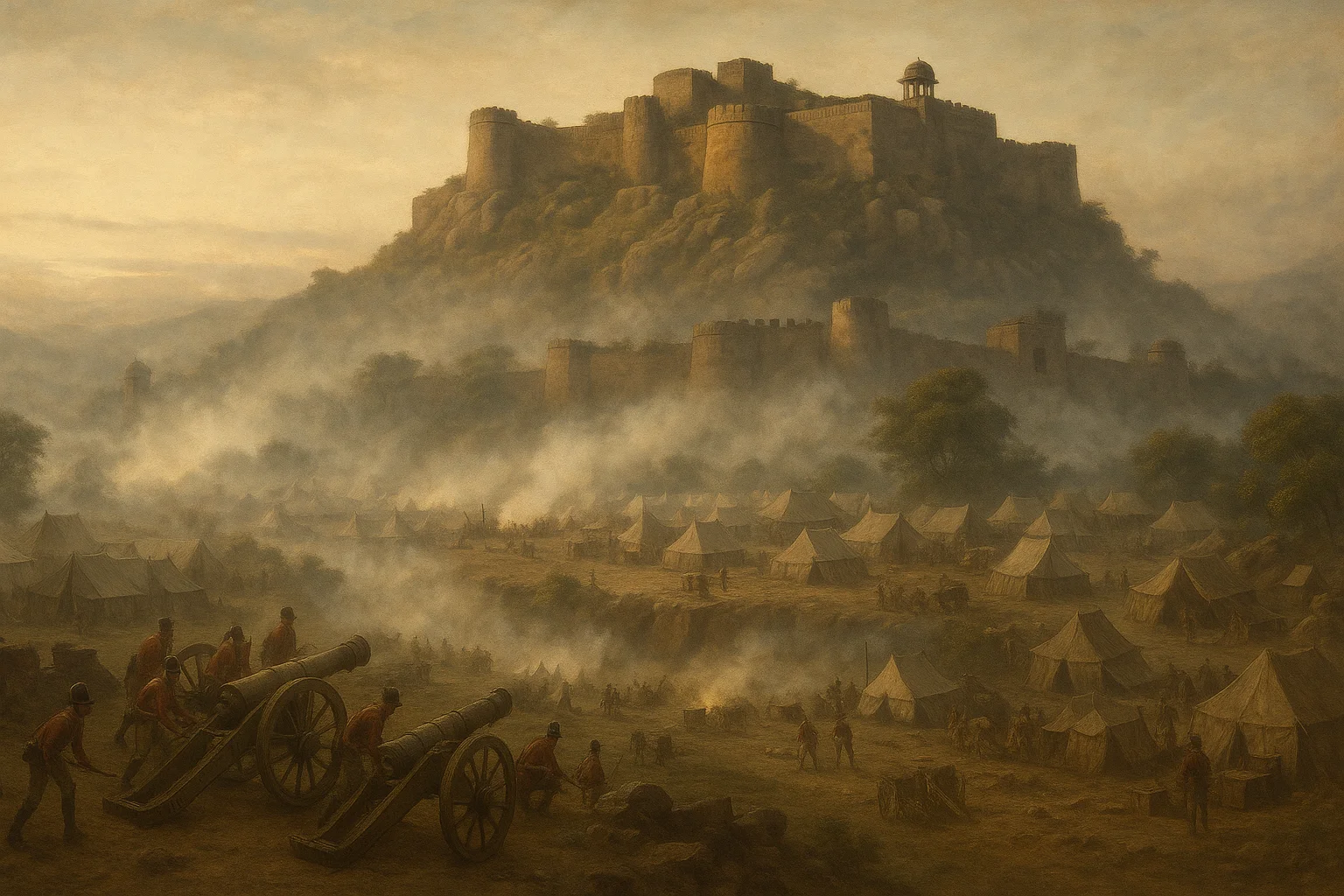
The drums began before dawn. Deep, rhythmic thunder that rolled across the plains surrounding Jhansi, announcing what every person within the fortress city already knew: the British were coming. From the high ramparts of her palace, the Rani of Jhansi—once known as Manikarnika Tambe of Varanasi, now Rani Lakshmibai, queen of a princely state that had chosen rebellion over submission—watched the horizon lighten to reveal what she had long expected. British encampments formed a tightening noose around her city, their white tents gleaming in the emerging light like scattered bones across the landscape. Artillery pieces, those terrible instruments of modern warfare, were being positioned on elevated ground. The iron mouths of cannons pointed toward walls that had stood for generations but had never faced an assault of this magnitude.
The air carried the scent of cooking fires from both within the city and the enemy camps beyond, mixing with the acrid smell of powder and metal being prepared for battle. Somewhere in the city behind her, a child cried—perhaps sensing the tension that gripped every adult, the knowledge that everything they knew stood on the precipice of irrevocable change. The Rani’s hand rested on the cold stone of the battlement, the same stone her husband Gangadhara Rao had once walked, before his death in 1853 had thrust her into a role no one could have anticipated: not merely a queen consort, but the leader of a state at war.
It was March 1858, and the Indian Rebellion that had erupted across northern India the previous year had reached its critical phase. What had begun as a sepoy mutiny had transformed into something far larger—a widespread challenge to British authority that drew in princes, peasants, soldiers, and civilians. The Rani had tried, initially, to remain neutral after her husband’s death, to protect her adopted son’s claim to the throne that the British East India Company had refused to recognize under their doctrine of lapse. But neutrality had proven impossible when rebellion swept through Jhansi in 1857, and the choice became stark: side with the revolutionaries or be destroyed by them, resist the British or submit to their vengeance. She had made her choice, and now, months later, that choice was coming home with fire and iron.
The siege was about to begin.
The World Before
To understand how a widowed queen came to stand alone against the greatest empire the world had known, one must understand the India of the 1850s—a subcontinent in the final throes of transformation from ancient kingdoms to colonial possession. For centuries, India had been a tapestry of princely states, each with its own ruler, traditions, and complex relationships with neighbors. The Mughal Empire, once the dominant power across northern India, had faded to a shadow of its former glory, its emperor reduced to a symbolic figure in Delhi while real power fragmented among regional powers.
Among these regional powers, the Maratha Empire had emerged as particularly significant. The Marathas, warrior-administrators who had challenged Mughal supremacy and carved out extensive territories across India, represented a distinct Hindu political resurgence. Though the great Maratha confederacy had been weakened by internal divisions and defeats—most notably at the Third Battle of Panipat in 1761—Maratha successor states continued to hold considerable territory and influence. Jhansi was one such state, part of the Maratha sphere of influence, owing allegiance to the Peshwa of Pune before the British systematically dismantled Maratha power in three Anglo-Maratha Wars between 1775 and 1818.
By the time Manikarnika Tambe was born in Varanasi—the holy city on the Ganges, center of Hindu learning and spirituality—the British East India Company had become the de facto ruler of much of India. This was not yet the British Raj of Crown rule, but something perhaps even more ruthless: a commercial corporation wielding military force, extracting revenue, and steadily annexing territory through warfare, treaty, and a policy called the Doctrine of Lapse. This doctrine, implemented aggressively by Governor-General Lord Dalhousie, declared that any princely state whose ruler died without a natural heir would be annexed by the Company. Adopted heirs, a traditional practice in Hindu succession, were not recognized. It was a policy that combined legalistic pretense with naked expansionism, and it threatened every princely house in India.
The social fabric of mid-19th century India was complex and deeply hierarchical. The caste system structured Hindu society, though with regional variations and practical flexibilities that pure theological accounts often miss. Women’s roles were particularly circumscribed—especially among the upper classes where purdah (seclusion) was often practiced. Yet India’s history was also punctuated by exceptional women who had wielded power: Razia Sultana who ruled the Delhi Sultanate in the 13th century, the Maratha queen Tarabai who led armies in the early 18th century, and others whose examples suggested that when circumstances demanded, Indian women could step beyond conventional boundaries. Still, for a young woman born into a Brahmin family in Varanasi in the 1820s, the expected life was one of devotion, domesticity, and deference.
The Indian Rebellion of 1857 emerged from multiple grievances that had accumulated over decades of British expansion. Sepoys—Indian soldiers in the Company’s army—objected to new cartridges rumored to be greased with cow and pig fat, offensive to both Hindu and Muslim religious sensibilities. This was the spark, but the fuel had been accumulating for years: dispossessed princes and nobles whose territories had been annexed, religious authorities who feared British interference with traditional practices, artisans and traders whose livelihoods were destroyed by British economic policies, and a general resentment of foreign domination that cut across class and caste. When the rebellion exploded in Meerut in May 1857 and spread rapidly across northern India, it drew in military and civilian populations alike, creating a challenge to British rule more serious than anything the Company had faced before.
Jhansi, by 1858, stood as one of the significant centers of resistance. The Rani’s assumption of leadership after the outbreak of rebellion had been both pragmatic and symbolic. Pragmatically, someone had to maintain order and organize defense in a chaotic situation. Symbolically, her leadership represented continuity with the state’s Maratha heritage and indigenous rulership against foreign domination. She commanded a force of rebels and loyalists, managed a city preparing for siege, and embodied resistance for a cause that already looked increasingly desperate as British forces, reinforced and reorganized after initial setbacks, systematically recaptured rebel-held territories.
The Players
Manikarnika Tambe’s early life in Varanasi shaped the woman who would become the warrior queen of Jhansi. Born into a Brahmin family in the holy city—exact dates are debated by historians, but likely in the late 1820s—she received an education unusual for girls of her time. Varanasi, as the spiritual heart of Hindu civilization, offered exposure to learning, religious discourse, and a sense of cultural continuity stretching back millennia. According to tradition, young Manikarnika was given more freedom than typical for upper-class girls, learning to ride horses and even some weapons training, though how much of this is historical fact versus later romanticization remains uncertain.
Her marriage to Raja Gangadhara Rao of Jhansi in 1842 transformed her from Manikarnika into Lakshmibai and brought her into the complex world of princely state politics. Gangadhara Rao ruled a relatively small but strategically located state in Bundelkhand, the rocky region of central India that had historically been a contested zone between various powers. The marriage placed her in a position of influence but also constraint—a queen consort’s power was derivative of her husband’s position and, traditionally, her role in producing an heir.
The death of her son in infancy and her husband’s declining health created a succession crisis that would prove pivotal. Before his death in 1853, Gangadhara Rao adopted a child, Damodar Rao, attempting to secure the succession. This was entirely within Hindu tradition and customary law. But the British authorities, under the aggressive annexation policies of Lord Dalhousie, refused to recognize the adoption. Jhansi, they declared, would lapse to the Company. The Rani was offered a pension and told to leave. It was an experience of dispossession and disrespect that thousands of Indian nobles had suffered, but it came at a moment when patience with British high-handedness was exhausted across northern India.
The outbreak of rebellion in 1857 placed the Rani in an impossible position. Historical accounts vary—and this is crucial to acknowledge—about her initial role when rebel forces and local crowds attacked British officials and residents in Jhansi in June 1857. Some sources suggest she was forced into accepting rebel leadership to prevent complete chaos. Others argue she seized the opportunity to reclaim her state’s independence. What is clear from the historical record is that following this outbreak, she assumed control of Jhansi, organized its administration and defense, and ruled as its effective sovereign while the rebellion raged across northern India.
The British forces approaching Jhansi in March 1858 were led by Sir Hugh Rose, a determined and capable military commander charged with suppressing the rebellion in central India. Rose represented the British response to 1857: methodical, ruthless, and uncompromising. After initial panic when the rebellion erupted, British authorities had regrouped, brought in reinforcements from other parts of the empire, and launched systematic campaigns to recapture rebel-held cities. Rose’s Central India Field Force had already retaken several important locations and now focused on Jhansi, both for its strategic importance and for what it symbolized—a princely state in open rebellion under the leadership of a queen who had rejected British authority.
The forces within Jhansi included the Rani’s own troops, consisting of both trained soldiers and civilians who had taken up arms. Historical records indicate she had organized the city’s defenses with considerable skill, preparing for the siege she knew was inevitable. The population of Jhansi faced the grim reality that the British were coming not just to conquer but to punish. After the violence of 1857—including massacres of British civilians in various locations—British reprisals had been savage. Captured rebels were hanged or blown from cannons, cities were sacked, and mercy was rare. Everyone in Jhansi understood that surrender offered no guarantee of safety, and for the Rani personally, capture would almost certainly mean execution.
Other significant figures were connected to Jhansi’s fate, though details are sometimes sparse or contested. Tantia Tope, one of the rebellion’s key military leaders, moved through the region with his forces. Rao Sahib, nephew of the deposed Peshwa, represented Maratha legitimacy and coordinated resistance across central India. These figures occasionally cooperated, though the rebellion never achieved the unified command structure that might have made it more effective. The Rani’s relationship with these other rebel leaders—whether she acted independently or in coordination, whether she trusted them or maintained wary distance—is a matter where historical sources offer varying accounts.
Rising Tension
The British approach to Jhansi was systematic and deliberate. Rose’s forces moved through the countryside, dealing with smaller resistance points, gathering intelligence, and preparing for what they knew would be a significant engagement. The fortress of Jhansi was formidable—built on a rocky hill, its walls had been strengthened over generations, and it had adequate supplies for a prolonged defense. The Rani had used the months since assuming control to prepare for this moment: stockpiling ammunition, training defenders, and ensuring the civilian population understood what was at stake.
As British forces established their siege positions in early March 1858, the daily reality within Jhansi became increasingly tense. Scouts reported on enemy movements, watching as artillery pieces were hauled into position, as trenches were dug for the approach, as the professional machinery of Victorian military power prepared to break the city’s defenses. Within the walls, the Rani moved through different quarters of the fort and city, her presence meant to reassure and inspire. According to accounts from the period—though we must be cautious about which details are verified and which are later embellishments—she wore male attire suitable for military command, rode through the defenses checking preparations, and addressed her troops and the civilian population about the necessity of resistance.
The psychological dimension of the siege was as significant as the physical preparations. Everyone knew the stories of what had happened at other locations after British recapture. The retribution at Delhi, after its recapture in September 1857, had been particularly brutal. Cawnpore, where British civilians had been massacred during the rebellion, had seen vengeful reprisals. The pattern was clear: the British were not coming to negotiate or to show mercy to those they deemed rebels. For the Rani, who the British blamed for the deaths of British officials in Jhansi in 1857—whether fairly or not—there was no possibility of honorable surrender.
The Bombardment Begins
The thunder of cannons announced the beginning of the active siege. British artillery opened fire on Jhansi’s walls with the methodical precision that characterized Victorian military operations. Day after day, the bombardment continued, iron balls smashing into stone, seeking weak points in the fortifications. The noise was constant and terrifying—the shriek of incoming projectiles, the crash of impact, the rumble of collapsing masonry. Inside the city, families huddled in whatever shelter they could find, while defenders worked frantically to repair damage, shore up weakened sections, and return fire with their own lighter artillery.
The Rani’s leadership during this period was crucial. Historical accounts indicate she was visible throughout the siege, personally overseeing the defense, making decisions about where to concentrate defenders, how to respond to British tactics, and how to maintain morale as the situation grew increasingly desperate. The challenge of command in such circumstances is difficult to overstate: maintaining order among both soldiers and civilians, managing limited supplies, making life-and-death decisions about where to allocate scarce resources, all while under constant bombardment and with no realistic hope of relief.
The British, meanwhile, followed their siege doctrine systematically. Bombardment was meant not just to create physical breaches in the walls but to exhaust and demoralize defenders. As days turned into weeks, the material damage accumulated. Sections of wall weakened or collapsed. Buildings within the fort were damaged or destroyed. Casualties mounted among defenders and civilians alike. Fire control became critical—in the dry heat of central India in March, fires started by hot shot could spread rapidly through the crowded city.
The Question of Relief
One of the critical questions during the siege was whether relief forces might arrive to aid Jhansi. Tantia Tope, commanding a rebel force in the region, attempted to approach Jhansi to relieve the siege. The historical record shows that British forces under Rose had to divide their attention between maintaining the siege and defending against this external threat. In late March, a battle was fought near Jhansi as British forces engaged Tantia Tope’s army. The defeat of this relief force was a devastating blow to those defending Jhansi—it meant no help was coming, that they stood alone against the full force of the British assault.
Within Jhansi’s walls, this news must have spread with soul-crushing weight. Hope, that essential sustainer of morale during desperate sieges, received a mortal wound. The defenders now faced the clear reality: they would either break the siege themselves, achieve some negotiated settlement (which seemed impossibly unlikely given British determination for retribution), or fight to the end. The Rani’s response to this moment, according to historical accounts, was to continue organizing the defense with undiminished determination. Whether this reflected supreme courage, strategic calculation that resistance remained the best option, or simply recognition that surrender offered no safety, is a question where we cannot know her inner thoughts with certainty.
The Turning Point
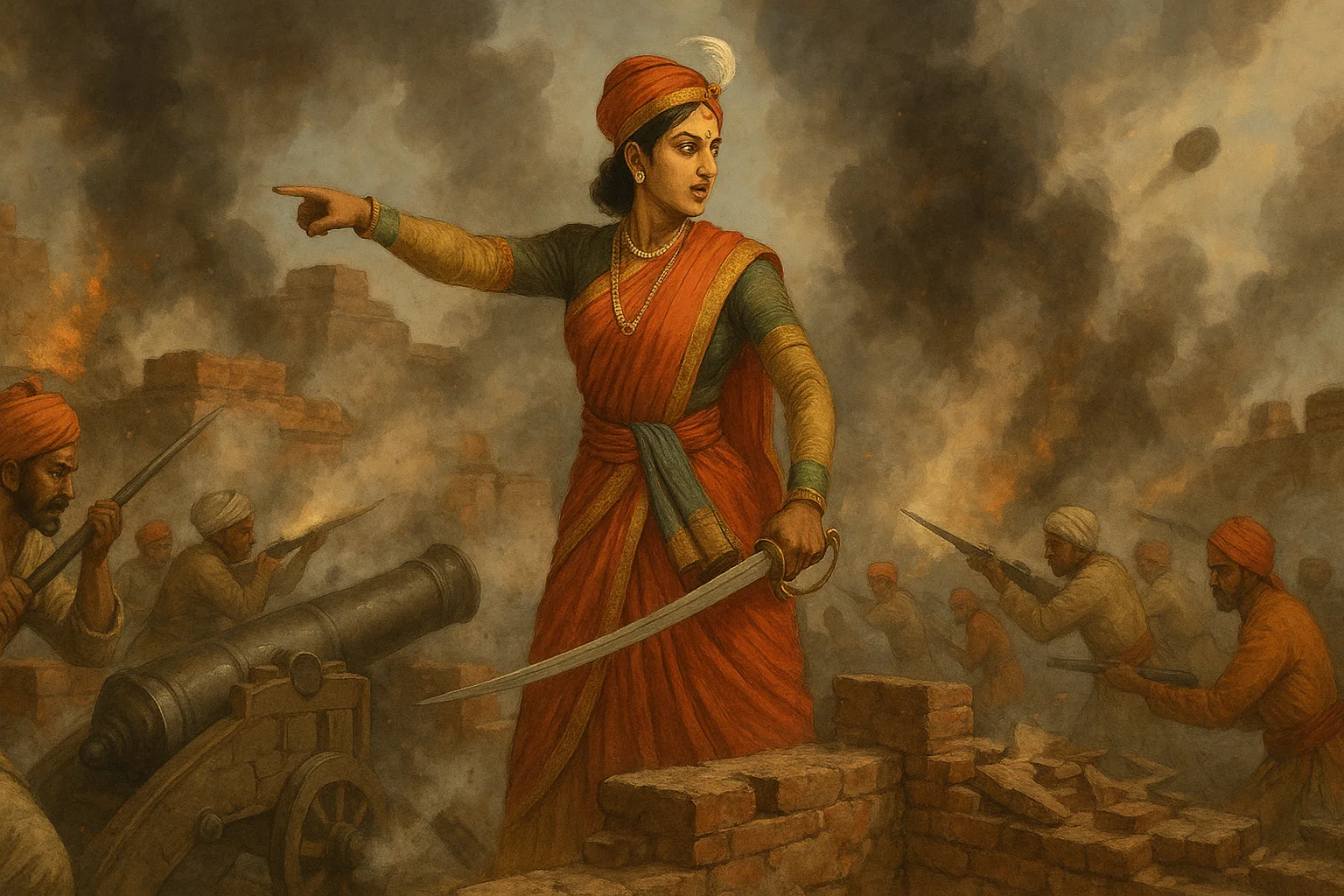
The British assault on Jhansi reached its climax in early April 1858, after weeks of bombardment had created breaches in the walls and exhausted the defenders. Rose ordered the final assault, and British and loyalist Indian troops advanced toward the weakened fortifications. The fighting that followed was brutal and desperate—the kind of close-quarters combat that characterized urban warfare, where every street and building became a contested position.
The Rani’s forces fought with the ferocity of those who knew they faced annihilation if defeated. Historical records from British sources acknowledge the fierce resistance they encountered as they forced their way into the city. Street by street, building by building, the defense contracted as British forces advanced through Jhansi. The noise must have been overwhelming: musket fire echoing between stone walls, the clash of close combat, shouted orders in multiple languages, the cries of wounded, the crash of structures collapsing.
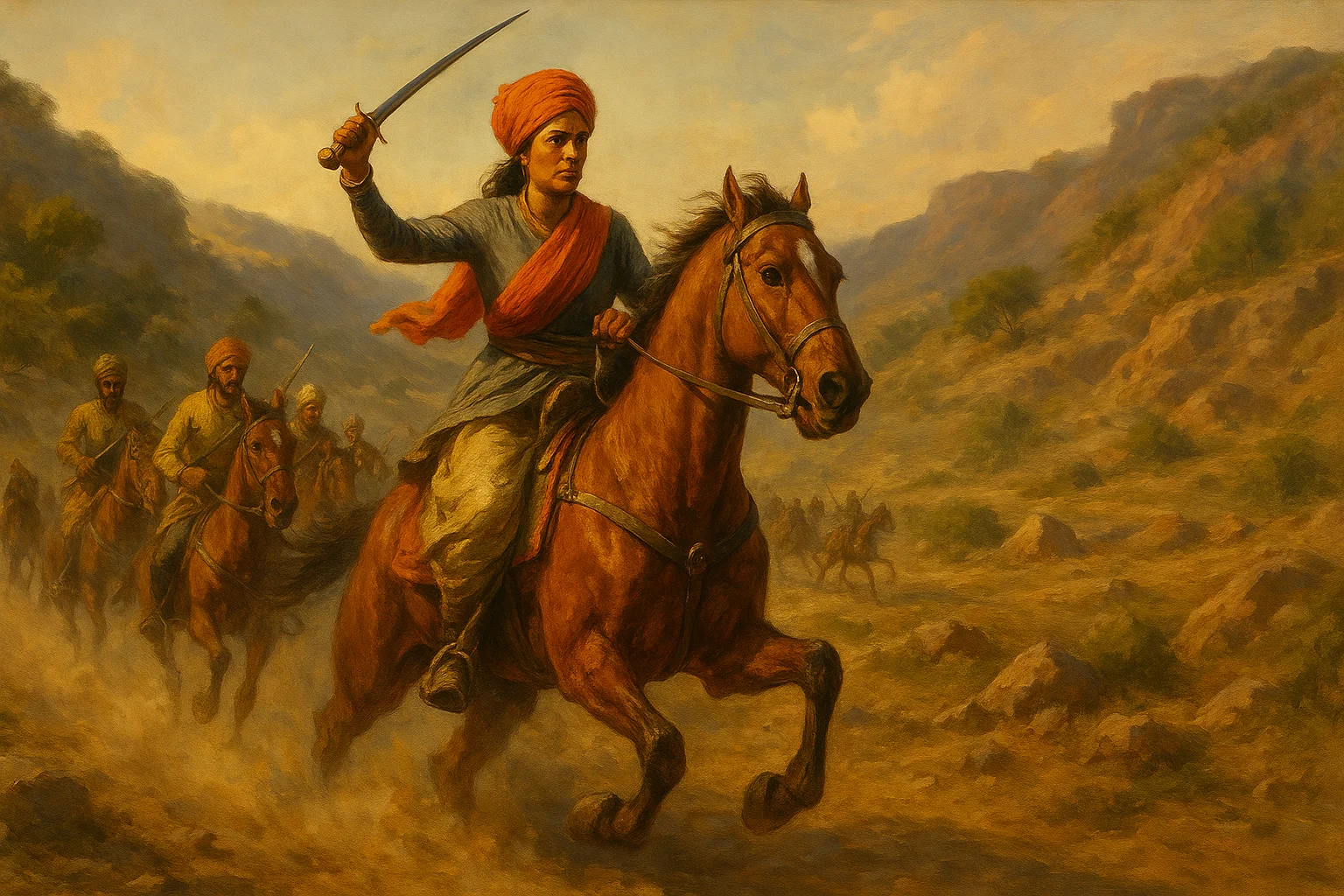
The Rani herself, according to the historical accounts, was in the thick of the defense. The image that has come down through history—of her fighting sword in hand, on horseback, rallying her troops—may contain elements of later romantic embellishment, but the core fact appears to be supported: she was an active commander during the siege, not a symbolic figure removed from the fighting. As the British advance became unstoppable and the fall of the city inevitable, she faced a final decision: die in the ruins of Jhansi or attempt escape to continue resistance elsewhere.
She chose escape. With a small group of loyal followers, the Rani managed to break out of the falling city. The details of this escape are debated by historians—some accounts describe a dramatic nighttime ride through British lines, others suggest she left before the final assault was complete. What is certain is that she succeeded in evading capture and made her way to Kalpi, where other rebel forces were regrouping. This escape ensured that the story of resistance did not end with Jhansi’s fall, that the rebellion would have its symbolic figure for a few more critical months.
For those left behind in Jhansi, the British recapture meant savage reprisals. The pattern that had been established elsewhere was repeated: rebels, or those identified as rebels, were executed. The city that had defied British authority for nearly a year faced the full weight of imperial vengeance. The exact number of casualties—both during the siege itself and in its aftermath—is not precisely recorded in the sources available, but contemporary accounts speak of extensive bloodshed.
The fall of Jhansi in April 1858 was militarily significant for the British campaign to suppress the rebellion. It removed a major center of resistance in central India and demonstrated that even well-defended positions could not withstand sustained British assault. But the siege’s ultimate significance would prove to be as much symbolic as strategic, particularly because of what happened afterward.
Aftermath
The Rani’s flight from fallen Jhansi led her to Kalpi, where she joined with other rebel leaders including Rao Sahib and Tantia Tope. The rebellion, by mid-1858, was clearly failing—the British had recaptured most major centers of resistance, and rebel forces were being hunted down systematically. Yet the fighting continued, driven by those who had nothing left to lose and everything to avenge.
From Kalpi, the rebel forces moved on Gwalior, a major princely state whose ruler had remained loyal to the British. In a brief reversal of fortunes, the rebels captured Gwalior in early June 1858, though this success would prove short-lived. The Maharaja of Gwalior fled, and for a few weeks, the rebels held this important strategic position. For the Rani, now leading cavalry and fighting alongside male commanders as an equal, Gwalior represented perhaps a final chance to establish a base for continued resistance.
But the British were coming. Rose’s forces advanced on Gwalior, and in June 1858, battle was joined. The details of the fighting at Gwalior are, like much of the rebellion’s military history, complex and sometimes contradictory in different sources. What is historically established is that Rani Lakshmibai died in battle near Gwalior. The exact circumstances—whether she fell in cavalry combat, was shot while fighting, died immediately or after being wounded—vary in different accounts. What is not in dispute is that she died as she had chosen to live in the rebellion’s final year: fighting, rather than surrendering to an enemy who would have shown no mercy.
Her death marked the end of one of the rebellion’s most prominent leaders and one of its most powerful symbols. The British recaptured Gwalior shortly afterward, and the rebellion continued its terminal decline. By the end of 1858, organized resistance had effectively ceased, though guerrilla fighting and British reprisals continued into 1859.
The immediate aftermath of the rebellion saw the formal end of the East India Company’s rule. The British Crown assumed direct control of India, beginning the period known as the British Raj. The rebellion’s failure meant that Indian hopes for overthrowing or limiting British power were crushed for generations. The British implemented policies designed to prevent any future uprising: reorganization of the military to prevent another sepoy mutiny, cultivation of “loyal” princes as a conservative bulwark, and the beginning of the divide-and-rule policies that would characterize British Indian administration.
For Jhansi itself, British control was reestablished, and the state’s independent existence ended. The city’s role as a center of resistance was punished and then, gradually, forgotten in British administrative documentation, reduced to a footnote in the history of the rebellion’s suppression. But memory, particularly Indian memory, would preserve a very different account.
Legacy
The transformation of Rani Lakshmibai from failed rebel to national icon is one of the more fascinating aspects of Indian historical consciousness. In the immediate aftermath of the rebellion, British sources typically portrayed her as a murderess and traitor—someone who had betrayed British trust and participated in the killing of British civilians. Indian sources, particularly those emerging in the late 19th and early 20th centuries as Indian nationalism developed, told a different story: that of a righteous queen defending her state against foreign aggression, a warrior woman who chose honor over submission.
As Indian nationalism developed in the decades after the rebellion, the events of 1857—which the British called the “Indian Mutiny” or “Sepoy Mutiny”—were reinterpreted as India’s “First War of Independence.” This reframing transformed the rebellion from a failed uprising into the precursor of the eventual independence movement. The rebels became freedom fighters, their defeats became sacrifices for the nation, and their leaders became heroes. In this process of nationalist myth-making, the Rani of Jhansi emerged as perhaps the most powerful symbol of all.
Several factors contributed to her iconic status. First, she was a woman leading armed resistance, which made her unusual and memorable. In a culture where women’s public roles were constrained, her military leadership was exceptional and therefore inspiring. Second, her story had the elements of classical tragedy: the wronged queen, defending her adopted son’s inheritance, fighting against overwhelming odds, dying in battle rather than accepting defeat. Third, her connection to the Maratha tradition resonated with those seeking to invoke pre-British Indian power and dignity. The Marathas represented Hindu political and military success, and her Maratha identity linked her to that heritage.
By the early 20th century, when the Indian independence movement gained momentum, Rani Lakshmibai had become firmly established in nationalist iconography. Writers, poets, and political leaders invoked her memory to inspire resistance to British rule. Subhadra Kumari Chauhan’s famous Hindi poem “Jhansi ki Rani,” written in 1930, cemented her status in popular consciousness with its stirring lines celebrating her courage. Political speeches referenced her as proof that Indians could fight British power. Her image appeared in nationalist publications, always showing her as a warrior on horseback, armed and defiant.
This process of creating a national hero inevitably simplified and sometimes embellished the historical reality. The Rani became, in nationalist mythology, a figure of pure patriotic resistance, her motivations reduced to love of country (before “India” as a nation existed) and opposition to foreign rule. The more complex reality—that she was defending a princely state’s autonomy, that her initial stance toward the rebellion was ambiguous, that she was caught in circumstances partly not of her choosing—receded behind the powerful image of the warrior queen.
Yet the core of the legend rests on historical truth: she did lead Jhansi’s defense, she did fight against British forces, and she did die in battle rather than surrender. These facts provided the foundation for her transformation into a symbol of resistance that has endured for over 165 years. In modern India, she remains one of the most celebrated figures of the independence struggle, though she died nearly ninety years before independence was achieved.
Her legacy appears in countless forms throughout India: statues in public squares, schools and institutions named in her honor, her story taught to schoolchildren as a example of courage and patriotism. The city of Jhansi itself has made her its defining identity—the fort where she made her stand is a major tourist attraction, and the city’s own narrative is inseparable from her story. Significantly, she is also invoked in discussions of women’s empowerment, as an example of female leadership and courage that challenges traditional gender limitations.
In the broader context of Indian history, Rani Lakshmibai’s place is secure as one of the leading figures of the Indian Rebellion of 1857. Historical scholarship continues to examine the rebellion, its causes, its course, and its significance, and her role receives serious academic attention alongside the mythologizing. The challenge for historians is to recover the human reality—the actual woman who made difficult choices in impossible circumstances—from beneath the layers of symbolism and nationalism. But perhaps both are important: the historical figure, whose actions can be studied and analyzed, and the symbolic figure, whose story continues to inspire.
What History Forgets
Amid the dramatic narratives of siege and battle, certain aspects of the Rani’s story are less frequently emphasized but reveal important dimensions of her experience and the period she lived in. Her education in Varanasi, in the holy city where Hindu learning flourished, gave her exposure to religious and philosophical traditions that shaped Indian worldviews. The city’s intellectual environment, its tradition of debate and learning, provided context for understanding someone capable of transitioning from traditional queen consort to military commander. Varanasi represented continuity with ancient Indian civilization, and her birth there symbolically linked her to that heritage.
Her marriage to Gangadhara Rao and her role as queen consort before the rebellion receive less attention than her military leadership, yet these years shaped her understanding of statecraft and administration. The experience of running a princely court, managing its complex social hierarchies, navigating relationships with British political agents, and understanding the fiscal and administrative challenges of a small state—all this provided practical education that would prove valuable when she assumed full leadership during the rebellion.
The personal tragedy of losing her son in infancy is mentioned in biographical accounts but rarely dwelt upon. Yet the grief of that loss and its implications for her position—a queen consort’s security depended heavily on producing an heir—must have profoundly affected her. The subsequent adoption of Damodar Rao was an attempt to provide that heir and secure the succession, an act of hope that British refusal to recognize would dash cruelly.
Her religious practice as a Hindu, particularly her devotion to Hindu traditions, is acknowledged but not always explored in depth. For her and for many who fought in the rebellion, the threat to religious and cultural traditions posed by British rule was a powerful motivator. The fear—justified or not—that the British intended to forcibly convert Indians to Christianity, combined with actual British interference in traditional practices, created genuine anxiety about cultural survival. Her resistance was not just political but also defensive of a way of life and system of beliefs that she saw threatened.
The practical challenges she faced as a military commander also receive less attention than the dramatic image of the warrior queen. Managing supplies, maintaining discipline, coordinating between different groups of defenders with potentially conflicting loyalties, making tactical decisions with limited intelligence about enemy movements—these mundane but critical aspects of leadership during siege would have occupied much of her attention. The administrative and logistical dimensions of resistance are less romantic than battlefield valor but equally essential.
Her relationships with other rebel leaders—Tantia Tope, Rao Sahib, and others—remain somewhat unclear in historical sources. Did she function as an independent commander, making her own strategic decisions? Was she part of a coordinated rebel leadership? The evidence suggests she maintained considerable autonomy but also sought cooperation when advantageous. The dynamics of these relationships, particularly as a woman commanding alongside male leaders in a patriarchal society, would have been complex and sometimes fraught.
Finally, the fate of those who fought alongside her receives less attention than her own story. The soldiers who defended Jhansi, the civilians who supported the resistance, the families torn apart by the siege and its aftermath—their stories are largely lost to history, subsumed into the larger narrative of the rebellion. They too made choices, endured hardships, and died in large numbers. The Rani’s story, powerful and important as it is, represents thousands of individual stories of courage, suffering, and loss during those turbulent months of 1858.
The siege of Jhansi and the Rani’s subsequent death at Gwalior marked both an ending and a beginning. An ending of the immediate hopes of the 1857 rebellion, of the possibility that British rule might be overthrown by armed resistance in the mid-19th century. But also a beginning of her transformation into a symbol that would outlive the British Empire itself, that would inspire generations of Indians in their own struggles, and that would ensure that a woman born as Manikarnika in Varanasi would be remembered and celebrated as one of history’s defiant heroes. History may forget many details, may leave many questions unanswered, but it has not forgotten Rani Lakshmibai, the Rani of Jhansi, warrior and queen, who fought several battles against the British and remains, more than 165 years after her death, a potent symbol of resistance and courage.