Overview
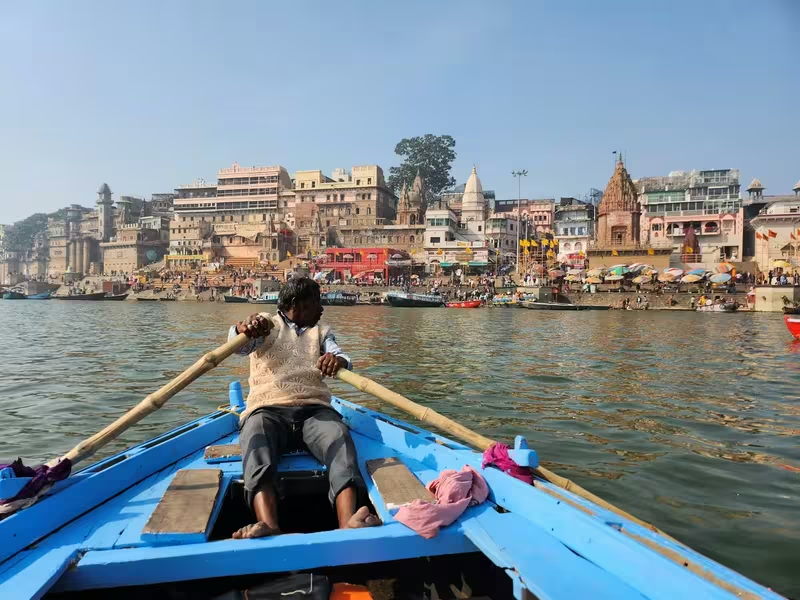
Varanasi, also known as Kashi and Benares, stands as one of the world's oldest continuously inhabited cities and the spiritual heart of Hinduism. Located on the left bank of the sacred Ganges River in southeastern Uttar Pradesh, this ancient city has served as a center of pilgrimage, learning, death rituals, and spiritual liberation for over three millennia. The city's name derives from its location between two tributaries of the Ganges—the Varuna River to the north and the Assi River to the south.
The city occupies a unique position in Hindu cosmology as one of the seven sacred cities (Sapta Puri) where devotees can attain moksha, or liberation from the cycle of rebirth. This spiritual significance has attracted millions of pilgrims throughout history who come to bathe in the Ganges, perform ancestral rites, and seek spiritual enlightenment. The famous ghats—stone steps leading down to the river—create an iconic riverside landscape where religious rituals, cremations, and daily life unfold in a continuous cycle that has remained largely unchanged for centuries.
Beyond its religious importance, Varanasi has historically served as a major center of Sanskrit learning, classical arts, and traditional crafts. The city developed a distinctive syncretic culture, combining Hindu traditions with Islamic artisanship, particularly evident in its world-famous Banarasi silk weaving industry. Located 692 kilometers southeast of New Delhi and 320 kilometers from the state capital Lucknow, Varanasi lies 121 kilometers downstream from Prayagraj (Allahabad), another major Hindu pilgrimage site at the confluence of the Ganges and Yamuna rivers.
Etymology and Names
The name "Varanasi" derives from the city's geographical position between two rivers—the Varuna River on the northern boundary and the Assi River on the southern edge. The Sanskrit name combines these river names, reflecting the city's integral relationship with water and the sacred Ganges that flows through it.
The ancient name "Kashi" (also spelled Kasi), meaning "the luminous one" or "city of light" in Sanskrit, has been used since Vedic times and remains popular in religious contexts. In Hindu texts and spiritual discourse, the city is often referred to as Kashi, emphasizing its reputation as a center of enlightenment and divine illumination. This name appears in ancient texts and scriptures dating back thousands of years.
During the medieval period and British colonial rule, the city became known as "Benares" or "Banaras," anglicized versions of the name that were widely used in European languages and official British documentation. While "Benares" appeared on colonial-era maps and administrative records until India's independence in 1947, the official name reverted to "Varanasi" following independence, though "Banaras" continues in common usage, particularly in the famous Banaras Hindu University and the traditional Banarasi silk industry.
Geography and Location
Varanasi is situated in the middle Ganges valley in the southeastern part of Uttar Pradesh state. The city occupies the left (northern) bank of the Ganges River, built on a crescent-shaped elevated terrain that creates a natural amphitheater overlooking the sacred river. This elevated position provides natural drainage and has historically protected the city from the worst flooding during monsoons, though the lower ghats regularly experience seasonal inundation.
The terrain consists of fertile alluvial plains characteristic of the Ganges basin, with an average elevation of approximately 80.71 meters above sea level. The city's metropolitan area covers 163.8 square kilometers, with the urban agglomeration extending along the riverbank for several kilometers. The Ganges flows from northwest to southeast through this section, creating the famous eastern-facing ghats where pilgrims perform morning rituals facing the rising sun over the sacred river.
The climate is humid subtropical, with hot summers, a monsoon season from July to September, and mild winters. This climate has historically supported agriculture in the surrounding countryside while the river provided water, transportation, and spiritual sustenance. The city's strategic location on the Ganges placed it on major trade and pilgrimage routes connecting the upper Gangetic plain with eastern India and beyond.
The geographical position between the Varuna and Assi tributaries created natural boundaries that defined the sacred zone of the ancient city. This area contained the densest concentration of temples, ghats, and religious institutions. Over centuries, the urban area expanded well beyond these original boundaries, but the riverside zone remains the spiritual and historical core of Varanasi.
Ancient History
Varanasi claims to be one of the world's oldest living cities, with archaeological and textual evidence suggesting continuous habitation for over 3,000 years. The city's origins likely predate written records, rooted in prehistoric settlements along the fertile Ganges riverbank. Ancient Hindu texts, including the Rigveda (composed circa 1500-1200 BCE), mention Kashi as an important center, indicating the city's antiquity extends into the second millennium BCE.
In Vedic literature, Kashi appears as one of the sixteen Mahajanapadas (great kingdoms) of ancient India, a significant political and cultural entity during the first millennium BCE. The city served as the capital of the Kashi kingdom before being conquered and incorporated into the neighboring kingdom of Kosala. This early period established Varanasi's reputation as a center of learning, where Brahmin scholars studied and taught Vedic texts, philosophy, and ritual practice.
The city gained additional religious significance with the rise of Buddhism in the 6th century BCE. While Siddhartha Gautama (the Buddha) achieved enlightenment at Bodh Gaya, he delivered his first sermon at nearby Sarnath (just 10 kilometers from Varanasi), establishing the Deer Park as a major Buddhist site. This event, known as "turning the wheel of dharma," made the Varanasi region central to Buddhist tradition, attracting monks, scholars, and pilgrims from across Asia.
Similarly, Varanasi holds importance in Jainism as the birthplace of several Tirthankaras (spiritual teachers). The city thus became a meeting point for multiple religious and philosophical traditions, fostering a cosmopolitan intellectual culture. Ancient texts describe Varanasi as a major urban center with sophisticated architecture, busy markets, and renowned educational institutions that attracted students from distant regions.
Historical Timeline
Ancient Period (1200 BCE - 600 CE)
During the ancient period, Varanasi established itself as a premier center of Vedic learning and religious practice. The city's location in the prosperous middle Ganges valley supported a thriving economy based on agriculture, trade, and craft production. Textile manufacturing, particularly fine cotton and silk weaving, began in this era, laying foundations for the city's later fame in textile arts.
The rise of Buddhism and Jainism in the 6th century BCE added new dimensions to the city's religious landscape. While remaining predominantly Hindu, Varanasi welcomed Buddhist monasteries and Jain temples, creating a diverse spiritual ecosystem. Chinese Buddhist pilgrims, including Faxian (5th century CE) and Xuanzang (7th century CE), visited Varanasi and left detailed accounts describing numerous temples, monasteries, and the city's bustling religious life.
Medieval Period (600 - 1757 CE)
The medieval period saw Varanasi experience both continuity and change as various dynasties controlled northern India. The city maintained its religious significance throughout this era despite periodic political upheaval. The Kashi Vishwanath Temple, dedicated to Lord Shiva, became the most important shrine in the city, attracting pilgrims from across the Hindu world.
Islamic rule began in the region with the Delhi Sultanate's expansion in the 12th-13th centuries, and the city came under Mughal control in the 16th century. While some temples were destroyed during periods of conflict, the city's religious importance ensured its survival and often its protection by rulers who recognized its economic and cultural value. The Mughal period witnessed the development of the city's distinctive syncretic culture, as Muslim artisans, particularly weavers, settled in Varanasi and developed the famous Banarasi brocade tradition, combining Persian designs with Indian techniques.
Colonial Period (1757 - 1947)
The British East India Company gained control of Varanasi after the Battle of Buxar in 1764, and the city became part of British India. The colonial administration anglicized the name to "Benares" and established it as an important administrative center. The British made significant changes to the city's infrastructure, including new roads, a cantonment, and modern civic amenities, though they generally avoided interfering with religious institutions and practices.
The colonial period brought Western education to Varanasi, culminating in the establishment of Banaras Hindu University in 1916 by Pandit Madan Mohan Malaviya. This institution became one of Asia's largest residential universities and a center of the Indian independence movement. The city played a role in the nationalist struggle, with Mahatma Gandhi visiting multiple times and many residents participating in civil disobedience campaigns.
Modern Era (1947 - Present)
Since India's independence in 1947, Varanasi has evolved into a major urban center while maintaining its traditional character as a pilgrimage destination. The city's population has grown significantly, from hundreds of thousands to over 1.4 million in the metropolitan area. Modern infrastructure, including Lal Bahadur Shastri International Airport and improved rail connections, has made the city more accessible to both pilgrims and tourists.
The city continues to face challenges balancing heritage preservation with urban development. Recent initiatives have focused on cleaning the Ganges River, improving infrastructure along the ghats, and managing the pressures of religious tourism. Varanasi remains a living embodiment of ancient Indian traditions while adapting to contemporary needs and aspirations.
Political Significance
Varanasi's political importance varied throughout its long history, sometimes serving as a capital city and at other times existing primarily as a religious center under external political control. During the ancient period, the city functioned as the capital of the Kashi Mahajanapada, one of sixteen great kingdoms that dominated northern India before the rise of larger empires.
The city's strategic location on the Ganges made it valuable to successive dynasties that controlled the region. While rarely serving as an imperial capital after the ancient period, Varanasi remained an important provincial center whose control signaled authority over the religiously and economically significant middle Ganges valley. Muslim rulers, from the Delhi Sultanate to the Mughals, recognized the city's importance and generally allowed Hindu religious institutions to continue functioning, understanding that the city's prosperity depended on pilgrimage traffic.
Under British rule, Benares became a district headquarters and an important administrative center in the United Provinces. The colonial government maintained a relatively light touch regarding religious matters, recognizing that interference could spark unrest. Post-independence, Varanasi became part of Uttar Pradesh state and serves as the headquarters of Varanasi division and district. The city has produced several notable political figures and remains politically significant in contemporary Indian politics.
Religious and Cultural Importance
Varanasi's religious significance in Hinduism cannot be overstated. As one of the seven sacred cities (Sapta Puri) in Hindu tradition, the city is believed to be the earthly abode of Lord Shiva. The Kashi Vishwanath Temple, dedicated to Shiva, serves as the city's spiritual heart and attracts millions of devotees annually. According to Hindu belief, dying in Varanasi and having one's ashes scattered in the Ganges grants moksha, liberation from the cycle of birth and death (samsara), making the city the most auspicious place for death rituals.
The city's 88 ghats extend along the Ganges for approximately six kilometers, each with its own religious significance and associated rituals. Pilgrims perform ritual bathing (snana) at dawn, particularly at auspicious ghats like Dashashwamedh Ghat and Assi Ghat, believing the sacred waters cleanse sins and confer spiritual merit. Two ghats—Manikarnika and Harishchandra—serve as cremation grounds where funeral pyres burn continuously, performing the sacred duty of releasing souls from their earthly bodies.
Beyond Hinduism, Varanasi holds significance in Buddhism and Jainism. The nearby Sarnath, where Buddha delivered his first sermon, draws Buddhist pilgrims from around the world. Jain tradition honors the city as the birthplace of the seventh Tirthankara, Suparshvanatha, and the childhood home of the twenty-third Tirthankara, Parshvanatha. This multi-religious heritage creates a unique spiritual atmosphere.
Culturally, Varanasi has been a center of classical Indian arts for centuries. The city nurtured gharanas (schools) of Hindustani classical music, producing legendary musicians and continuing as a major center for classical music education and performance. Classical dance forms, particularly Kathak, flourished here. Sanskrit scholarship and traditional Hindu learning thrived in the city's numerous ashrams and educational institutions, preserving ancient knowledge systems.
Economic Role
Varanasi's economy has historically centered on its religious significance, with pilgrimage-related services providing livelihoods for a large portion of the population. Priests, guides, boat operators, hotel owners, and merchants catering to pilgrims' needs have created a robust religious tourism economy that continues to drive the city's prosperity.
The city gained international fame for its textile industry, particularly Banarasi silk saris and brocades. This craft tradition developed during the Mughal period when Muslim weavers settled in Varanasi, bringing Persian and Central Asian weaving techniques and designs. They combined these with local traditions to create the distinctive Banarasi style, characterized by intricate gold and silver brocade work (zari) on silk fabric. These textiles became prized possessions across India and important export commodities. Today, the weaving industry continues to employ thousands of artisans, though it faces challenges from mechanization and changing market demands.
The city's position on the Ganges facilitated trade throughout its history. Merchants traded agricultural products from the fertile surrounding countryside, textiles, and other manufactured goods. The river provided transportation for bulk goods, connecting Varanasi to markets across the Gangetic plain and beyond. Traditional crafts beyond textiles—including brass work, woodcarving, and glass bead-making—contributed to the local economy.
In modern times, Varanasi's economy has diversified. The city's GDP reached approximately $5.2 billion in 2024-25, with per capita income around INR 90,028. Tourism remains vital, but education (particularly Banaras Hindu University), trade, and service sectors now play major roles. The city's economy continues evolving while maintaining its distinctive character rooted in spiritual tourism and traditional crafts.
Monuments and Architecture
Varanasi's architectural heritage spans millennia, though much of the ancient city's original structures have been rebuilt multiple times due to periodic destruction and the continuous renewal characteristic of living religious sites. The city's architectural landscape consists primarily of temples, ghats, and traditional urban residential buildings (havelis).
The Kashi Vishwanath Temple represents the city's most important religious monument. The current structure, rebuilt in 1780 by Maratha ruler Ahilya Bai Holkar, features a gold-plated spire and dome. The temple complex has undergone recent expansion and renovation, creating a large corridor project that has transformed the surrounding area. The temple's sanctum houses one of twelve Jyotirlingas (sacred manifestations of Shiva) across India.
The ghats themselves constitute Varanasi's most distinctive architectural feature. These stone embankments and steps, many built or renovated by various rulers and wealthy patrons over centuries, create a remarkable riverside landscape. Each ghat has associated temples, shrines, and pavilions. Dashashwamedh Ghat, one of the oldest and most important, hosts the spectacular Ganga Aarti (river worship ceremony) each evening, attracting thousands of spectators.
Beyond Hindu architecture, Varanasi contains numerous Muslim structures reflecting the city's syncretic heritage, including the Gyanvapi Mosque built during Mughal emperor Aurangzeb's reign. Buddhist sites at nearby Sarnath include the Dhamek Stupa and ruins of ancient monasteries, attracting Buddhist pilgrims and archaeological tourists.
Traditional residential architecture in the old city features narrow, winding lanes with multi-story buildings constructed close together, creating a dense urban fabric that has remained largely unchanged for centuries. Many wealthy families built elaborate havelis (mansions) with internal courtyards, intricate carved wooden balconies, and frescoed walls.
Famous Personalities
Varanasi has been home to and attracted numerous notable figures throughout history. The city's reputation as a center of learning drew scholars, saints, and artists who contributed to Indian intellectual and spiritual traditions.
Among religious figures, Guru Nanak, founder of Sikhism, visited Varanasi in the early 16th century, and the city contains several gurudwaras commemorating his visits. The Hindu philosopher-saint Ramananda established his ashram in Varanasi in the 15th century, and his disciple Kabir, one of India's greatest mystical poets, was born and lived in the city. Kabir's syncretic teachings, drawing from both Hindu and Muslim traditions, exemplified Varanasi's inclusive spiritual culture.
In classical music, Varanasi produced and nurtured legendary musicians including Bismillah Khan, the shehnai virtuoso who popularized the instrument and performed at Varanasi's ghats for decades. The city's music gharana contributed significantly to North Indian classical music tradition.
Modern notable figures include Pandit Madan Mohan Malaviya, founder of Banaras Hindu University and freedom fighter, who transformed the city's educational landscape. Writers and scholars associated with the city include Bharatendu Harishchandra, father of modern Hindi literature, and Munshi Premchand, one of India's greatest Hindi-Urdu writers who studied and taught in Varanasi.
Modern City
Contemporary Varanasi functions as a major urban center of Uttar Pradesh with a metropolitan population exceeding 1.4 million. The city serves as divisional and district headquarters, providing administrative services for the surrounding region. The Varanasi Municipal Corporation governs the city, currently led by Mayor Ashok Tiwari.
Infrastructure development has accelerated in recent years. Lal Bahadur Shastri International Airport connects Varanasi to major Indian cities and some international destinations, facilitating tourism and business travel. The city serves as a major railway junction with connections across India. A new metro system is under development to ease urban transportation challenges. National highways connect Varanasi to Delhi, Lucknow, and other major cities, though traffic congestion remains a challenge in the historic core.
Education plays a significant role in the modern city. Banaras Hindu University, one of Asia's largest residential universities, enrolls thousands of students in diverse disciplines. Numerous other colleges and institutions provide higher education. The city's literacy rate of 80.31% reflects ongoing educational development, though challenges remain in ensuring universal education access.
The city faces typical challenges of rapid urbanization, including pressure on infrastructure, pollution (particularly of the Ganges), and balancing heritage preservation with development needs. The Namami Gange program and other government initiatives focus on river cleaning and ghat area improvements. Tourism infrastructure continues expanding with new hotels and facilities, making the city more accessible while trying to maintain its traditional character.
Religious tourism remains central to the city's identity, with millions of pilgrims visiting annually. The city has adapted to accommodate modern tourism expectations while preserving traditional practices and spaces. The nightly Ganga Aarti at Dashashwamedh Ghat has become a major tourist attraction, showcasing traditional Hindu worship rituals in a spectacular ceremony.
Timeline
See Also
- Sarnath - Buddhist pilgrimage site where Buddha delivered his first sermon
- Prayagraj - Another major Hindu pilgrimage city at the confluence of Ganges and Yamuna
- Ganges River - The sacred river central to Varanasi's spiritual significance
- Banaras Hindu University - Major educational institution in the city