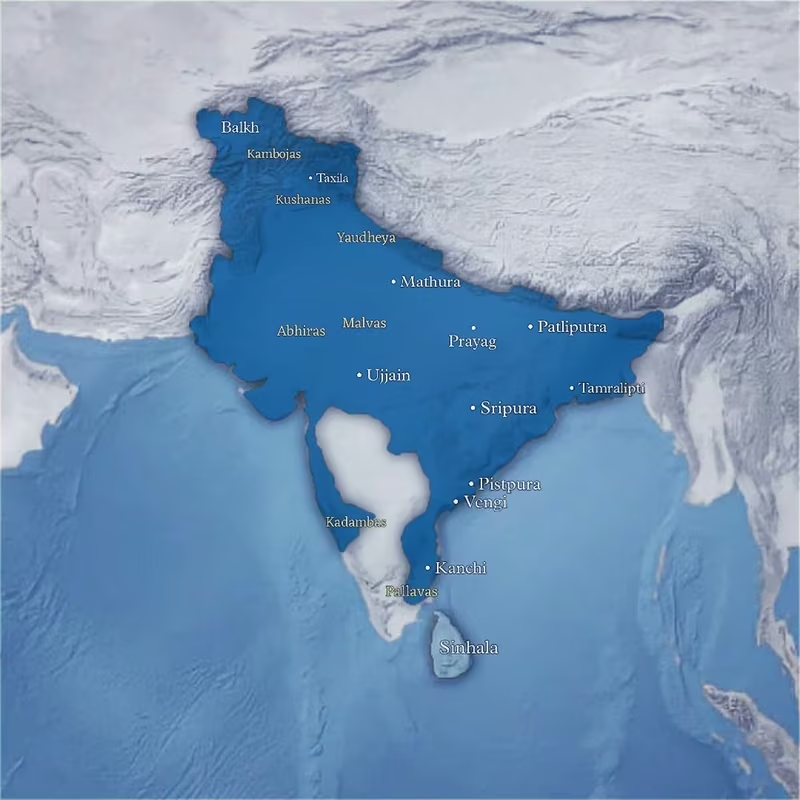
Overview
The Gupta Empire stands as one of ancient India's most illustrious dynasties, reigning over much of the northern Indian subcontinent from approximately the mid-3rd century to the mid-6th century CE. Founded by a ruler known simply as Gupta around 240 CE, the dynasty achieved its zenith under emperors like Samudragupta and Chandragupta II, when it controlled vast territories extending from the Himalayas to the Narmada River and from the Bay of Bengal to the Arabian Sea. This period has been characterized by many historians as the "Golden Age of India," though this designation remains a subject of scholarly debate.
The empire's significance extends far beyond its political and military achievements. The Gupta period witnessed unprecedented advancements in art, architecture, literature, science, and mathematics. Sanskrit literature flourished with poets like Kalidasa producing masterpieces, while mathematicians and astronomers like Aryabhata made groundbreaking discoveries, including crucial developments in the decimal system and the concept of zero. The empire's cultural and intellectual achievements established templates that would influence Indian civilization for centuries to come.
What distinguished the Gupta Empire was its sophisticated administrative system, prosperous economy, and remarkable religious tolerance. Despite Vaishnavism being the official religion, Buddhism and Jainism flourished under imperial patronage. This pluralistic approach, combined with efficient governance and stable currency systems, created an environment conducive to cultural flowering and economic prosperity that left an indelible mark on Indian history.
Rise to Power
The origins of the Gupta dynasty remain somewhat obscure, with the first ruler known simply as Gupta establishing the dynasty around 240 CE. The early Guptas likely ruled as feudatories or local chiefs in the Magadha region, gradually consolidating their power in the politically fragmented landscape following the decline of the Kushan Empire and other regional powers like the Western Satraps and Bharshiva dynasty.
The dynasty's transformation from regional rulers to major imperial power began with Chandragupta I, who ascended to power around 320 CE. His coronation on February 26, 320 CE, marks a watershed moment in Gupta history. Chandragupta I significantly enhanced the dynasty's prestige and territorial holdings through a strategic matrimonial alliance with the Licchavi clan, one of the most powerful republican tribes of the era. This alliance not only provided political legitimacy but also access to the wealthy and strategically important regions of northern Bihar and Nepal.
Chandragupta I adopted the title "Maharajadhiraja" (King of Kings), signaling the Guptas' imperial ambitions. He established Pataliputra (modern-day Patna) as the capital, a city with a glorious past as the seat of the Mauryan Empire. This choice symbolically linked the Guptas to earlier Indian imperial traditions while providing a strategic base for controlling the fertile and wealthy Gangetic plains. By the time of his death around 335 CE, Chandragupta I had laid the foundations for what would become one of India's greatest empires.
Golden Age
The Gupta Empire reached its apogee during the reigns of Samudragupta (c. 335-375 CE) and Chandragupta II (c. 375-415 CE). Samudragupta, often called the "Napoleon of India" by historian V.A. Smith, embarked on extensive military campaigns that expanded the empire dramatically. His famous Allahabad Pillar inscription describes his Digvijaya (conquest of the four quarters), listing numerous kings defeated and kingdoms annexed or made tributary.
Samudragupta's campaigns extended Gupta power deep into central and southern India, though his approach varied by region. In northern India, he pursued direct annexation, incorporating kingdoms into the imperial structure. In southern India and the Deccan, he adopted a more flexible policy of establishing tributary relationships, allowing local rulers to maintain their thrones in exchange for acknowledging Gupta suzerainty and paying tribute. This pragmatic approach to empire-building minimized administrative costs while maximizing territorial influence.
Chandragupta II, also known as Vikramaditya (Sun of Valor), further enhanced the empire's glory. His most significant military achievement was the defeat and annexation of the Western Satraps around 388-409 CE, bringing the wealthy ports of Gujarat and access to lucrative maritime trade under Gupta control. This victory not only expanded territorial holdings but also significantly boosted imperial revenues through control of trade routes connecting India with the Roman Empire and Southeast Asia.
During this golden age, the empire's territorial extent reached its maximum, with estimates ranging from 1.7 to 3.5 million square kilometers. The population under Gupta rule in the 5th century was approximately 75 million, making it one of the world's most populous empires of its time. The period witnessed unprecedented prosperity, with agriculture, trade, and commerce flourishing under stable political conditions.
Administration and Governance
The Gupta Empire developed a sophisticated administrative system that balanced centralized authority with considerable local autonomy. The emperor, bearing titles like "Maharajadhiraja" and "Paramabhattaraka," stood at the apex of the political hierarchy. The imperial bureaucracy was organized hierarchically, with ministers (amatyas), military commanders (senapatis), and a council of advisors assisting the emperor in governance.
The empire was divided into provinces called "bhuktis," governed by officials known as "uparikas." These provinces were further subdivided into districts (vishayas) administered by "vishayapatis." At the village level, local governance was often left to traditional institutions, including village councils (gram sabhas) and hereditary headmen. This multi-tiered administrative structure allowed for effective governance while accommodating regional diversity.
The Gupta revenue system relied primarily on agricultural taxation, with the standard land tax being one-sixth of the produce, though rates could vary based on land quality and local conditions. The empire also collected taxes on trade, crafts, and various commercial activities. To facilitate administration and reward loyal officials and Brahmins, the Guptas expanded the system of land grants (agraharas), which exempted certain lands from taxation in exchange for religious or administrative services.
The legal system during the Gupta period saw significant codification, with texts like the Narada Smriti and Brihaspati Smriti providing comprehensive legal frameworks. Justice was dispensed through a hierarchy of courts, with the emperor serving as the final court of appeal. The period emphasized dharma (righteousness) as the foundation of governance, with rulers expected to protect their subjects and uphold moral and ethical standards.
Military Campaigns
The Gupta military machine was formidable, comprising all four traditional divisions (chaturanga): infantry, cavalry, elephants, and chariots. Samudragupta's military campaigns, documented in the Allahabad Pillar inscription, reveal a sophisticated strategy combining direct conquest, diplomatic subjugation, and tributary relationships. His campaigns extended from the Himalayan foothills to southern India, defeating numerous kings and establishing Gupta supremacy across much of the subcontinent.
The Gupta-Saka Wars (c. 375-385 CE) represented a crucial phase in territorial expansion. Chandragupta II's systematic campaign against the Western Satraps involved multiple military engagements culminating in the complete annexation of their territories, including the prosperous regions of Malwa, Gujarat, and Saurashtra. This victory not only eliminated a major rival but also secured control over ports facilitating trade with the Roman Empire.
The empire faced significant military challenges from the Kidarites (c. 390-450 CE) and later the Hephthalites or White Huns (c. 460-500 CE). Under Kumaragupta I and especially Skandagupta, the Guptas initially successfully repelled these Central Asian invaders. Skandagupta's victory over the Hunas was celebrated in contemporary inscriptions as saving Indian civilization from barbarian hordes. However, these prolonged conflicts drained imperial resources and weakened central authority.
The Gupta military relied on a combination of standing armies maintained by the emperor and feudal levies provided by subordinate rulers and land-grant holders. The empire maintained strategic fortifications at key points and developed sophisticated logistics systems to support large-scale military campaigns. Naval power, though less documented, played a role in controlling coastal regions and protecting maritime trade routes.
Cultural Contributions
The Gupta period represents a pinnacle of classical Indian cultural achievement, often justifying its characterization as a golden age. Sanskrit literature reached extraordinary heights with the works of Kalidasa, whose plays like "Shakuntala" and poems like "Meghaduta" are considered masterpieces of world literature. Other notable literary figures included Bharavi, Sudraka, and Vishakhadatta, whose works explored themes ranging from romance to statecraft.
In the visual arts, the Gupta period established classical standards for Indian iconography and sculpture. The refined, idealized human forms seen in Gupta sculpture, particularly Buddhist images from Sarnath and Mathura, influenced artistic traditions across Asia. The period saw the development of distinctive temple architecture, with structures like the Dashavatara Temple at Deogarh and the brick temple at Bhitargaon demonstrating evolving architectural sophistication. Cave temples at sites like Ajanta and Udayagiri featured magnificent sculptures and paintings that continue to inspire admiration.
Scientific and mathematical achievements during the Gupta period had far-reaching global impact. Aryabhata (476-550 CE) made groundbreaking contributions to astronomy and mathematics, including accurate calculations of pi, trigonometric functions, and understanding of planetary motion. The concept of zero as both a placeholder and a number, along with the decimal place-value system, developed during this period, revolutionizing mathematics worldwide. Medical sciences advanced significantly, with physicians like Dhanvantari and Vagbhata contributing to Ayurvedic knowledge.
Religious and philosophical thought flourished with state patronage of diverse traditions. While Vaishnavism enjoyed official favor, with rulers like Chandragupta II being devotees of Vishnu, Buddhism continued to thrive, particularly in educational centers like Nalanda. The period saw the composition of important Puranic texts and the systematization of Hindu philosophical schools. Jainism also maintained a significant presence, particularly in western India.
Economy and Trade
The Gupta economy was remarkably prosperous, based on a strong agricultural foundation supplemented by extensive trade networks. The fertile Gangetic plains formed the economic heartland, producing surplus grain that supported urbanization and commercial activities. Agricultural productivity benefited from advanced irrigation techniques and stable political conditions that encouraged cultivation of previously fallow lands.
The empire's currency system reflected its economic sophistication. Gold dinars featuring royal portraits and religious symbols maintained remarkable purity and weight standards, facilitating long-distance trade. Silver rupakas and copper karshapanas served domestic transactions, while cowrie shells continued as small-denomination currency, particularly in rural areas. The standardization and reliability of Gupta coinage enhanced commercial confidence and economic integration.
Trade flourished both domestically and internationally during the Gupta period. Control of Gujarat's ports following the defeat of the Western Satraps provided access to maritime trade routes connecting India with the Roman Empire, Southeast Asia, and East Africa. Indian exports included textiles, particularly fine cotton and silk, spices, precious stones, and manufactured goods. In return, India imported horses, gold, silver, and luxury goods. Overland trade routes connected the empire with Central Asia and China.
Urban centers thrived as commercial and manufacturing hubs. Pataliputra, Ujjain, Varanasi, and other cities hosted markets, workshops, and merchant guilds (shrenis) that regulated trade and production. These guilds played crucial economic roles, providing capital, ensuring quality standards, and mediating disputes. The period saw the growth of a prosperous merchant class and sophisticated banking practices, including the use of credit instruments.
Decline and Fall
The decline of the Gupta Empire was a gradual process resulting from multiple interconnected factors. The most immediate threat came from repeated invasions by the Hephthalites (White Huns) from Central Asia, beginning around 460 CE. While Skandagupta initially repelled these invasions, the prolonged conflicts drained imperial resources and disrupted trade routes. Subsequent rulers proved less capable of maintaining territorial integrity against these persistent threats.
The Huna invasions had devastating economic consequences. Loss of control over northwestern regions meant reduced revenue from wealthy provinces and disrupted access to Central Asian trade routes. The military expenses of defending the empire forced increased taxation, straining the agricultural base and causing economic distress. The circulation of debased coinage during later Gupta reigns indicates fiscal problems undermining economic stability.
Internal factors compounded external pressures. The system of land grants, while initially strengthening imperial administration, gradually created powerful feudatories who challenged central authority. Provincial governors increasingly asserted autonomy, transforming from appointed officials to hereditary rulers. The weakening of centralized control allowed regional powers to emerge, fragmenting the empire into smaller kingdoms.
Succession disputes and weak rulers following Skandagupta accelerated decline. The empire fractured into smaller entities, with different branches of the Gupta family ruling diminished territories. By the mid-6th century, the empire had effectively dissolved into regional kingdoms. The last recognized Gupta ruler, Vishnugupta, lost effective control around 550 CE, with the dynasty formally ending around 579 CE.
Legacy
The Gupta Empire's legacy extends far beyond its political boundaries and temporal existence, profoundly influencing subsequent Indian history and world civilization. The period's cultural and intellectual achievements established standards that defined classical Indian civilization for centuries. Sanskrit literature, art, architecture, and philosophical systems developed during this era became reference points for later dynasties across the subcontinent.
The empire's mathematical and scientific contributions had global significance. The decimal system and concept of zero, developed during the Gupta period, spread through the Islamic world to Europe, revolutionizing mathematics and enabling modern science and technology. Aryabhata's astronomical calculations and methods influenced astronomical traditions from the Middle East to Southeast Asia.
Political and administrative models established by the Guptas influenced subsequent Indian states. The balance between centralized authority and local autonomy, the system of provincial governance, and concepts of dharmic kingship provided templates for later empires. The Gupta ideal of a prosperous, culturally sophisticated empire patronizing learning and arts became an aspiration for successive rulers.
The Gupta period's emphasis on religious tolerance and cultural synthesis created a model of pluralistic society that, despite later challenges, remained influential in Indian civilization. The coexistence of Hinduism, Buddhism, and Jainism under imperial patronage demonstrated possibilities for religious harmony that continue to resonate in contemporary discussions of secularism and multiculturalism.
Modern Indian nationalism has drawn extensively on Gupta heritage, viewing the period as evidence of India's historical greatness and cultural sophistication. Archaeological sites, coins, inscriptions, and artistic monuments from the Gupta period continue to attract scholarly attention and popular fascination, serving as tangible connections to this formative period in Indian history.
Timeline
See Also
- Chandragupta I - Emperor who established Gupta imperial power
- Samudragupta - The "Napoleon of India" who greatly expanded the empire
- Chandragupta II - Emperor during the golden age of the dynasty
- Kalidasa - Greatest Sanskrit poet of the Gupta period
- Aryabhata - Mathematician and astronomer of the Gupta era
- Pataliputra - Imperial capital of the Gupta Empire
- Nalanda - Great center of learning during Gupta period
- Kushan Empire - Predecessor empire in northern India
- Empire of Harsha - Successor state attempting to reunify northern India
- Western Satraps - Rival power defeated by the Guptas