Overview
Chandragupta II, honored with the title Vikramaditya ("Sun of Valor"), ruled the Gupta Empire from approximately 375 or 380 CE until about 415 CE, presiding over what historians consider the zenith of ancient Indian civilization. His reign of 35-40 years marked the Golden Age of the Gupta dynasty, characterized by territorial expansion, political stability, economic prosperity, and unprecedented cultural achievements. Modern scholars generally identify him with "King Chandra" mentioned in the famous Delhi Iron Pillar inscription, one of ancient India's most remarkable metallurgical achievements.
The son of the great conqueror Samudragupta and Queen Dattadevi, Chandragupta II inherited a vast empire and expanded it further through military conquests and diplomatic marriages. His most significant military achievement was the decisive defeat of the Western Satraps (Shakas), which brought the prosperous regions of Malwa, Gujarat, and Saurashtra under Gupta control and gave the empire access to the Arabian Sea's lucrative maritime trade routes. Under his patronage, Indian art, literature, science, and philosophy flourished, making his court the intellectual and cultural center of the ancient world.
Chandragupta II's reign exemplified effective governance, religious tolerance, and cultural synthesis. His capital at Pataliputra became a magnet for scholars, artists, poets, and scientists, while his administrative reforms and economic policies created conditions for widespread prosperity. The legendary association of his court with the Navaratnas (Nine Jewels)—including the immortal poet Kalidasa—reflects the extraordinary cultural brilliance of his era, an achievement that would influence Indian civilization for centuries to come.
Early Life
Chandragupta II was born around 345-350 CE in Pataliputra (modern Patna), the magnificent capital of the Gupta Empire, though the exact date remains uncertain. He was the son of Emperor Samudragupta, one of ancient India's greatest military conquerors, and Queen Dattadevi. Growing up in the imperial palace during his father's glorious reign, young Chandragupta would have witnessed the height of Gupta military power and administrative efficiency, formative experiences that shaped his later policies as emperor.
As a prince, Chandragupta received the comprehensive education befitting a future emperor, including training in warfare, statecraft, philosophy, literature, and the arts. The Gupta court maintained high scholarly standards, and princes were expected to be accomplished in both martial and intellectual pursuits. The cultural environment of Pataliputra, with its scholars, poets, and philosophers, exposed him to the rich intellectual traditions of ancient India, fostering the appreciation for learning and arts that would characterize his later reign.
The circumstances of Chandragupta's youth remain somewhat obscure in historical records. Some scholars suggest he may not have been the immediate heir, with historical references to an elder brother named Ramagupta appearing in later literary sources, though this remains debated among historians. What is certain is that Chandragupta eventually succeeded to the throne, whether directly after his father Samudragupta or after a brief intervening reign, around 375-380 CE.
Rise to Power
Chandragupta II's ascension to the Gupta throne around 375-380 CE occurred during a period of relative stability and prosperity for the empire. His father Samudragupta had left him a vast domain stretching across northern India, from the Himalayas to the Narmada River, and from the Bay of Bengal deep into central India. However, the succession may not have been entirely straightforward, with some literary sources suggesting complications that remain debated by modern historians.
Upon assuming power, Chandragupta II faced the strategic challenge of consolidating his authority and determining the direction of his reign. Rather than simply maintaining his father's conquests, he displayed remarkable vision in recognizing that the Western Satraps—a dynasty of Scythian origin ruling over western India—represented both a threat to Gupta security and an opportunity for expansion. These Western Kshatrapas controlled the prosperous regions of Malwa, Gujarat, and Saurashtra, including important ports on the Arabian Sea coast.
Chandragupta demonstrated political acumen even before his major military campaigns through strategic matrimonial alliances. His marriage to Kuberanaga, from the Naga dynasty, helped secure relationships with important regional powers. More significantly, he arranged the marriage of his daughter Prabhavatigupta to Rudrasena II of the Vakataka dynasty in the Deccan. When Rudrasena died young, Prabhavatigupta served as regent for her minor sons, effectively extending Gupta influence deep into southern India without military conquest—a masterpiece of diplomatic strategy.
Military Campaigns and Territorial Expansion
The defining military achievement of Chandragupta II's reign was his successful campaign against the Western Satraps, which fundamentally altered the geopolitical landscape of ancient India. The Western Kshatrapas, descendants of Scythian invaders who had established themselves in western India centuries earlier, controlled territories that included modern Gujarat, Malwa, and parts of Rajasthan and Maharashtra. Their defeat required careful planning and sustained military effort over several years.
The Gupta-Saka Wars, as these conflicts are known, likely began in the late 380s CE and continued into the 390s. Chandragupta II personally led his armies, demonstrating the martial valor celebrated in his title Vikramaditya. The campaigns involved not just pitched battles but also siege warfare against fortified cities and strategic maneuvering across the diverse terrains of western India. The Gupta military machine, combining heavy cavalry, war elephants, and infantry, proved superior to the Saka forces, and by approximately 395 CE, Chandragupta had completely annexed their territories.
The conquest of western India brought immense benefits to the Gupta Empire. Control of the ports on the Arabian Sea, particularly Bharuch and Sopara, opened lucrative maritime trade routes with the Roman Empire, Southeast Asia, and East Africa. The region's agricultural wealth and established trade networks added significantly to imperial revenues. Additionally, the victory eliminated a long-standing rival power and extended Gupta authority from coast to coast across northern India, creating unprecedented political unity.
Following these conquests, Chandragupta established Ujjain as a secondary capital, recognizing its strategic importance in western India. From this base, he could effectively administer the newly acquired territories while maintaining Pataliputra as the empire's traditional capital. This dual-capital system demonstrated sophisticated administrative thinking and helped integrate the diverse regions under Gupta rule.
Administration and Governance
Chandragupta II inherited and refined an administrative system that balanced centralized imperial authority with significant regional autonomy. The empire was divided into provinces (bhuktis) governed by royal appointees, often princes or trusted nobles, who administered through local officials and maintained their own administrative apparatus. This system allowed for effective governance across the empire's vast territories while respecting local customs and traditions.
The emperor maintained a sophisticated bureaucracy at the imperial capital, with specialized departments handling different aspects of governance—military affairs, revenue collection, public works, justice, and diplomatic relations. Chandragupta's administration emphasized efficient tax collection, which funded the imperial court, military, and public works, while apparently avoiding excessive taxation that might burden the population. Contemporary accounts suggest widespread prosperity during his reign, indicating successful economic management.
Religious policy under Chandragupta II exemplified the Gupta tradition of tolerance and pluralism. Though himself a devotee of Vishnu, as evidenced by his patronage of Vaishnavite temples and his association with the Udayagiri caves, he extended support and protection to all religious communities. Buddhist monasteries continued to flourish, Jain communities thrived, and diverse Hindu sects received imperial patronage. This tolerant approach created social harmony and encouraged cultural productivity across religious boundaries.
The Gupta legal system under Chandragupta maintained sophisticated codes of law based on dharmashastra texts while adapting to practical needs. Justice was administered through a hierarchy of courts, with the emperor as the supreme judicial authority. The system emphasized restoration and compensation rather than purely punitive measures, and apparently maintained relatively humane standards compared to many ancient civilizations.
Cultural Flourishing and the Golden Age
Chandragupta II's reign witnessed an extraordinary flowering of Indian culture that justifies its designation as a Golden Age. The emperor actively patronized arts, literature, science, and philosophy, making his court at Pataliputra and later Ujjain the intellectual center of the ancient world. This patronage wasn't merely financial but involved genuine appreciation and participation in cultural activities, setting a tone that permeated the imperial court and wider society.
The legendary Navaratnas (Nine Jewels) of Chandragupta's court, while possibly embellished in later tradition, reflect the genuine assembly of talent during his reign. The most famous was Kalidasa, considered the greatest poet and dramatist in Sanskrit literature. His masterpieces—including the plays Abhijnanasakuntalam and Vikramorvasiyam, and the epic poems Raghuvamsa and Kumarasambhava—reached heights of literary achievement that influenced Asian literature for centuries. Whether all the traditional Navaratnas were historical contemporaries remains debated, but the association reflects the cultural brilliance of the era.
Scientific and mathematical advances flourished under Gupta patronage. Astronomers made precise observations and calculations, mathematicians developed sophisticated techniques, and the decimal system with zero as a placeholder—perhaps India's greatest intellectual gift to the world—was refined during this period. Medical knowledge advanced through systematic study and practice, with Ayurvedic texts being compiled and refined. The intellectual environment encouraged inquiry and innovation across disciplines.
Architecture and sculpture reached new heights of refinement during Chandragupta's reign. The Udayagiri caves in Madhya Pradesh, with their magnificent rock-cut sculptures including the famous Varaha panel, bear inscriptions dating to his reign and demonstrate the period's artistic achievement. The fusion of religious devotion and aesthetic sensibility produced works of enduring beauty. The Delhi Iron Pillar, likely commissioned during his reign, exemplifies the advanced metallurgical knowledge of Gupta craftsmen—its rust-resistant composition remains remarkable even by modern standards.
Personal Life and Character
Historical sources provide limited but illuminating glimpses into Chandragupta II's personal life and character. He contracted at least two significant marriages that served both personal and political purposes. His marriage to Dhruvadevi, daughter of a Naga chief, produced several children including his successor Kumaragupta I, and his daughter Prabhavatigupta, who played a crucial role in extending Gupta influence southward. His other documented spouse, Kuberanaga, also represented a political alliance that strengthened his position.
Contemporary inscriptions and coins suggest Chandragupta embodied the ideal of the philosopher-king celebrated in Indian political thought. He appears to have been personally cultured, with genuine appreciation for poetry, drama, and the arts rather than merely offering patronage for political purposes. His choice of the title Vikramaditya—combining martial valor (vikrama) with royal authority (aditya, sun)—reflected his self-image as both warrior and enlightened ruler, a synthesis of the kshatriya warrior ideal with scholarly pursuits.
The emperor's religious devotion, particularly to Vishnu, appears genuine rather than merely ceremonial. The Udayagiri cave inscriptions record his visits to this religious site and his commissioning of elaborate sculptures there. However, his devotion didn't translate into sectarian intolerance; his court welcomed scholars and artists from all religious traditions, and his administration protected diverse communities. This personal tolerance combined with political pragmatism created an environment where different traditions could coexist and cross-fertilize.
Chandragupta's role as a father and dynasty-builder proved crucial for the empire's continuity. He carefully prepared his son Kumaragupta for succession, apparently ensuring a smooth transition of power that allowed the Gupta Empire to continue flourishing for another generation. His daughter Prabhavatigupta's education and capabilities suggest he valued competence and intelligence in his children regardless of gender, enabling her to serve effectively as regent of the Vakataka kingdom.
The Delhi Iron Pillar and Material Legacy
One of the most intriguing monuments associated with Chandragupta II is the famous Iron Pillar standing in the Qutb complex in Delhi. The pillar bears a Sanskrit inscription in Brahmi script referring to "King Chandra," whom most modern scholars identify with Chandragupta II Vikramaditya. Originally erected at another location, possibly Udayagiri or a Vishnu temple in the Mathura region, the pillar was moved to its present location centuries later.
The Iron Pillar stands over seven meters tall and weighs more than six tons, forged from remarkably pure wrought iron. What makes it truly extraordinary is its resistance to corrosion—after sixteen centuries, it shows minimal rust despite Delhi's humid climate and monsoon rains. Modern metallurgical analysis reveals a high phosphorus content and specific forging techniques that created a protective passive layer, but the precision with which ancient craftsmen achieved this remains impressive. The pillar exemplifies the advanced metallurgical knowledge and technical capabilities of Gupta civilization.
The inscription on the pillar, in elegant Sanskrit verse, praises King Chandra's victories and piety, mentioning his conquest of peoples "on the other side of the seven mouths of the Sindhu" (possibly referring to campaigns in the northwest) and his devotion to Vishnu. The poetic quality of the inscription reflects the literary sophistication of the era, where even functional monuments bore aesthetic and literary merit. The pillar thus combines technical achievement, historical documentation, and artistic expression in a single monument.
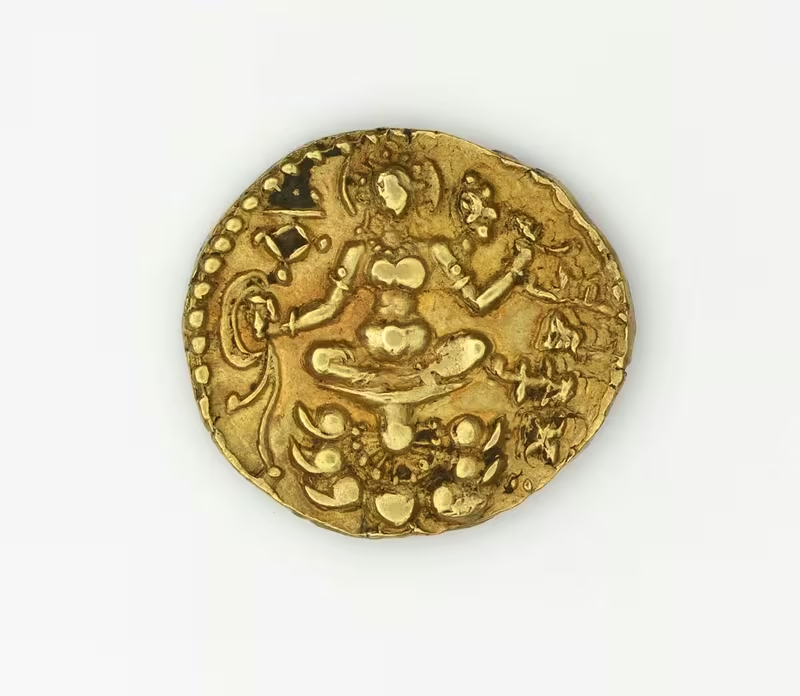
Chandragupta's coinage represents another significant material legacy. His gold and silver dinars display remarkable artistry and technical excellence, with detailed portraits, elaborate designs, and Sanskrit inscriptions. Different coin types—the archer type, the lion-slayer type, the horseman type—each carry symbolic significance while demonstrating the sophistication of Gupta minting. These coins circulated widely, facilitating trade and spreading the emperor's fame while providing modern historians with valuable evidence about his reign.
Economic Prosperity and Trade
The reign of Chandragupta II witnessed significant economic prosperity, built on agricultural productivity, flourishing trade, and efficient administration. The conquest of western India brought control of important ports and trade routes, integrating the Gupta Empire more fully into international commerce. Indian merchants traded with the Roman Empire to the west, Southeast Asian kingdoms to the east, and maintained overland connections with Central Asia and China along silk route branches.
Indian exports during this period included cotton textiles, spices, precious stones, ivory, and manufactured goods that commanded high prices in foreign markets. In return, India imported luxury goods, horses for military use, and precious metals. The balance of trade apparently favored India, as evidenced by the flow of Roman gold coins into the subcontinent and the subsequent minting of Gupta dinars using this gold. This positive trade balance contributed to imperial wealth and the remarkable cultural achievements of the period.
Agricultural productivity formed the foundation of Gupta prosperity. The empire's territories included some of the subcontinent's most fertile regions, particularly the Gangetic plain and the newly acquired western provinces. Effective administration, irrigation works, and relatively light taxation encouraged agricultural development. Surplus agricultural production supported urban centers, allowed specialization of labor, and freed resources for cultural pursuits. Contemporary accounts suggest relative prosperity even at lower social levels, though significant inequalities certainly existed.
The monetary economy expanded under Chandragupta II's rule, with standardized coinage facilitating both local and long-distance trade. The famous Gupta gold dinars maintained high purity and consistent weight, creating confidence in the currency. This monetary stability, combined with political security, encouraged commercial activity and economic growth. Urban centers flourished, with Pataliputra, Ujjain, Varanasi, and other cities serving as centers of commerce, craft production, and culture.
Relations with Foreign Powers
Chandragupta II's reign occurred during a period of significant international interaction. The Roman Empire, though declining in the west, maintained active trade with India through maritime routes connecting Red Sea ports with India's western coast. Roman accounts mention Indian embassies and traders, while Roman gold coins found in archaeological sites across India testify to commercial exchanges. Though no direct political alliance existed, mutual economic interests encouraged peaceful relations.
Relations with China during this period remain less clearly documented, but the expansion of Buddhism along the Silk Routes created cultural connections between India and the distant Chinese empires. Chinese pilgrims would visit India in succeeding generations, drawn by Buddhism's homeland, though the most famous pilgrim accounts (like Faxian's) come from slightly later or contemporary periods. The Gupta court's reputation for learning and culture likely attracted foreign scholars and travelers.
The Central Asian situation during Chandragupta's reign saw various powers and peoples in flux. The Gupta Empire's northwestern frontier apparently remained secure, unlike later periods when Hun invasions would threaten Indian kingdoms. This security on the northwestern border—a traditional route for invasions—allowed Chandragupta to focus on expansion westward against the Sakas and consolidation of his southern alliances.
The strategic marriage of Prabhavatigupta to the Vakataka king created a crucial alliance with the major power in the Deccan plateau. When Prabhavatigupta served as regent for her minor sons after her husband's death, she issued inscriptions in both her own name and acknowledging her Gupta lineage, effectively making the Vakataka kingdom a Gupta protectorate. This diplomatic achievement extended Gupta influence to central and southern India without costly military campaigns, demonstrating sophisticated foreign policy.
Later Years and Death
The final years of Chandragupta II's reign continued the prosperity and stability that characterized his entire rule. Having expanded the empire to its greatest extent, defeated major rivals, and established his dynasty's prestige, the aging emperor could take satisfaction in his achievements. He apparently maintained active involvement in governance until his death, ensuring smooth transition to his designated successor.
Chandragupta II died around 415 CE, having ruled for approximately 35-40 years—an exceptionally long and successful reign by ancient standards. The exact circumstances of his death are not recorded in surviving sources, but the orderly succession suggests he died peacefully rather than in battle or by assassination. His son Kumaragupta I succeeded him without apparent opposition or crisis, testimony to the stability Chandragupta had established and his successful preparation of his heir.
The location of Chandragupta's death remains uncertain, with sources suggesting either Pataliputra or possibly Ujjain, his western capital. Wherever he died, his passing marked the end of an era, though the Gupta Empire he had strengthened would continue to flourish under his son and grandson. The absence of major disruptions or immediate challenges following his death itself constitutes evidence of his successful statesmanship—he left his successor a stable, prosperous empire with secure borders and effective administration.
The immediate aftermath of Chandragupta's death saw appropriate mourning for the great emperor and celebrations of Kumaragupta I's accession. The new emperor continued his father's policies, maintaining the empire's prosperity and cultural achievements for another generation. This continuity suggests Chandragupta had established not just personal authority but institutional structures that could function beyond his lifetime—the mark of a truly successful ruler.
Legacy and Historical Impact
Chandragupta II's legacy extends far beyond his military conquests and territorial expansion. He presided over what many historians consider the zenith of ancient Indian civilization—a period when political unity, economic prosperity, and cultural achievement combined to create conditions for extraordinary human flourishing. The Gupta Golden Age under his rule became a reference point for later Indian kingdoms, a standard against which subsequent reigns were measured.
The cultural achievements of his era proved enduring. Kalidasa's works remained central to Sanskrit literature, studied and performed for centuries and translated into numerous languages. The artistic standards established in Gupta sculpture and architecture influenced Indian art for the next millennium. The scientific and mathematical advances, particularly in astronomy and mathematics, spread across Asia and eventually to Europe, contributing to global intellectual development. The decimal system with zero, refined during this period, revolutionized mathematics worldwide.
The memory of Chandragupta II, particularly under his title Vikramaditya, became legendary. Later rulers adopted "Vikramaditya" as a title, seeking association with his glory. Folk traditions and literature embellished his reign, sometimes conflating him with other rulers or adding mythological elements, but the core memory of a just, cultured, and powerful emperor persisted. The historical Chandragupta became a cultural archetype representing ideal kingship in Indian tradition.
Modern assessment of Chandragupta II remains overwhelmingly positive, though historians maintain appropriate critical distance from hagiographic traditions. His military successes demonstrated strategic vision and tactical skill. His administrative policies created conditions for prosperity without apparent excessive oppression. His cultural patronage left enduring monuments and masterpieces. While certainly not perfect—no historical figure is—Chandragupta II successfully balanced the demands of power with enlightened governance in ways that benefited his contemporaries and enriched human civilization.
Historical Debates and Scholarly Perspectives
Several aspects of Chandragupta II's reign remain debated among historians. The question of his succession—whether he immediately followed his father Samudragupta or came to power after an elder brother named Ramagupta—has generated significant scholarly discussion. References to Ramagupta appear in later literary sources but not in contemporary inscriptions or coins, leading some scholars to question his historicity. This debate, while interesting to specialists, doesn't fundamentally alter assessments of Chandragupta's achievement as emperor.
The identification of Chandragupta II with "King Chandra" of the Iron Pillar inscription, while accepted by most scholars, rests on circumstantial evidence rather than absolute proof. The inscription's references to the king's victories and the probable date of the pillar make Chandragupta II the most likely candidate, but absolute certainty remains elusive. Similar questions surround the precise extent of his territories and the exact chronology of his conquests, as ancient sources rarely provide the detailed documentation modern historians desire.
The cultural achievements of the Gupta period, while remarkable, raise questions about their social distribution. Did the cultural flourishing extend beyond elite circles? What were conditions for lower castes and women? The available sources, written by and for elite audiences, provide limited perspectives on the lives of common people. Modern scholars increasingly question triumphalist narratives and seek to understand ancient societies in their full complexity, including social hierarchies and exclusions alongside cultural achievements.
The relationship between Chandragupta's conquests and cultural patronage also invites analysis. Did military expansion provide resources for cultural achievement, or did prosperity from trade and agriculture matter more? How did the emperor balance military expenditure with cultural patronage? These questions about the material foundations of the Golden Age remain relevant as historians work to understand the complex factors enabling historical flourishing.
Timeline
Birth
Born in Pataliputra
Became Emperor
Ascended to Gupta throne
Western Campaigns
Defeated Western Kshatrapas
Death
End of reign