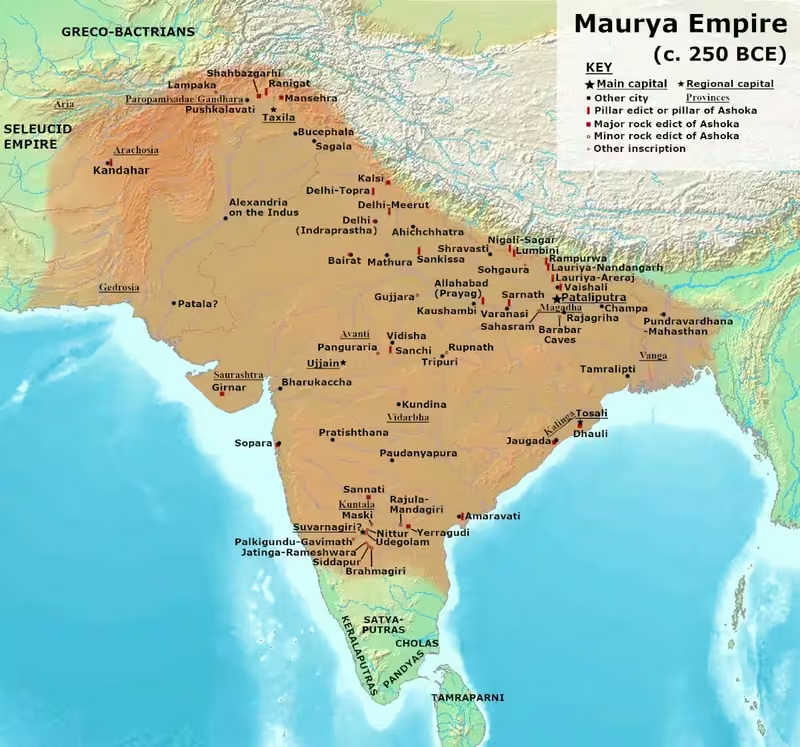
Overview
Pataliputra stands as one of the most significant cities in ancient Indian history, serving as the imperial capital for over a millennium. Founded in 490 BCE by Magadha ruler Ajatashatru as a small fort (pāli) near the Ganges river, it was strategically expanded by his successor Udayin at the confluence of the Ganges and Son rivers. The city's central location in the empire prompted Udayin to shift the Magadha capital from the mountainous Rajgriha to this more accessible site on the fertile Gangetic plain.
From this strategic position, Pataliputra became the nerve center of some of India's most powerful empires. Under the Mauryas (322-185 BCE), it commanded an empire spanning most of the Indian subcontinent. During the Gupta period (320-550 CE), the city experienced a second golden age as a flourishing center of arts, sciences, and Sanskrit literature. Throughout its history, Pataliputra was renowned not only as a political capital but also as a major center of Buddhist learning, hosting the Third Buddhist Council under Emperor Ashoka and attracting scholars and pilgrims from across Asia.
At its zenith during the Mauryan period, Pataliputra was one of the largest cities in the ancient world, with an estimated population of 400,000. The Greek ambassador Megasthenes, who visited the city in the 4th century BCE, described it with awe in his work "Indica," marveling at its size, fortifications, and prosperity. Today, the ancient city continues as modern Patna, capital of Bihar state, where archaeological excavations continue to reveal the grandeur of this once-magnificent metropolis.
Etymology and Names
The name "Pataliputra" derives from the Sanskrit words "pāṭali" (a type of trumpet flower, Bignonia suaveolens) and "putra" (son or city). According to tradition, the site was abundant with pāṭali trees, lending the city its botanical name. In Pali texts, the city appears as "Pāṭaliputta" or "Pātaliputt," the language used in early Buddhist scriptures.
During different historical periods, the city was known by various names reflecting its character and significance. In the Gupta period, it was often called "Kusumapura" or "Pushpapura," both meaning "city of flowers," emphasizing its reputation for gardens and natural beauty. This name appears frequently in Sanskrit literature and inscriptions from the 4th to 6th centuries CE.
The city's founding legend is preserved in Buddhist texts, which describe how King Ajatashatru established a fort at this location to counter threats from the neighboring Vajji confederacy. The site's original name reflected the natural vegetation that characterized the landscape before urbanization transformed it into one of ancient India's greatest metropolises. Through successive dynasties - Haryankas, Shishunagas, Nandas, Mauryas, Shungas, Guptas, and Palas - the name Pataliputra remained constant, testifying to the city's enduring identity despite political changes.
Geography and Location
Pataliputra's geographical position was its greatest strategic asset. Located in the heart of the Gangetic plain at the confluence of two major rivers - the Ganges and the Son - the city commanded vital trade and communication routes across northern India. The site lies at coordinates 25°36'45"N, 85°7'42"E, at an altitude of approximately 53 meters (174 feet) above sea level, in what is now the Patna district of Bihar state.
The city was built on an alluvial plain characterized by fertile soil deposited by annual monsoon floods. This agricultural wealth supported a large urban population and generated surplus for trade. The Ganges provided transportation and trade connections eastward to Bengal and the Bay of Bengal, while the Son river connected the city to the mineral-rich regions of central India, including important trade routes to the Deccan plateau.
Ancient descriptions indicate the city stretched approximately 14.5 kilometers (9 miles) in length along the southern bank of the Ganges, with a width of about 2.4 kilometers (1.5 miles). This elongated shape followed the river's course, maximizing access to water transport while the fortifications protected against land-based threats. The humid subtropical climate brought heavy monsoon rains that swelled the rivers annually, necessitating sophisticated drainage systems and flood management - engineering challenges that ancient architects successfully addressed.
The strategic advantages of this location were immediately apparent to Udayin when he moved the capital from the hilly terrain of Rajgriha. Pataliputra offered easier access for administration, trade, and military movements across the flat plains, while the rivers served as natural moats supplementing the city's formidable artificial defenses. Control of this junction meant control of the Gangetic trade network, a reality that sustained the city's importance through multiple dynasties.
Ancient History and Foundation
The story of Pataliputra begins in 490 BCE during the reign of Ajatashatru, one of the most ambitious rulers of the Haryanka dynasty of Magadha. Facing threats from the powerful Vajji confederacy to the north across the Ganges, Ajatashatru established a small fortified outpost (pāli) at a strategic point near the river. This modest fort was the seed from which one of the ancient world's greatest cities would grow.
The transformation from fort to capital occurred under Ajatashatru's successor, Udayin (ruled circa 460-444 BCE). Recognizing the limitations of Rajgriha's mountainous location for administering an expanding kingdom, Udayin chose the confluence of the Ganges and Son rivers as the site for a new capital. Buddhist texts, particularly the Mahavamsa, record that Udayin "laid the foundation of the city of Pataliputra at the confluence of two rivers." This deliberate founding reflects early urban planning, with the king personally overseeing the establishment of what would become his capital.
Archaeological evidence suggests that the earliest settlement at Pataliputra dates to this period, with excavations revealing layers of habitation beginning in the 5th century BCE. The Northern Black Polished Ware pottery characteristic of this era has been found extensively at the site, indicating sophisticated urban culture from the city's earliest days. The strategic location quickly attracted merchants, craftsmen, and administrators, accelerating urban growth.
Under subsequent Haryanka and Shishunaga rulers, Pataliputra developed from a regional capital into a major urban center. The city's population grew as Magadha expanded its territory and influence across the Gangetic plain. By the time the Nanda dynasty came to power in the 4th century BCE, Pataliputra had become one of northern India's preeminent cities, setting the stage for its imperial destiny under the Mauryas.
The Mauryan Golden Age
The zenith of Pataliputra's glory arrived with the Mauryan Empire (322-185 BCE). When Chandragupta Maurya overthrew the Nanda dynasty and established his empire, he inherited a already-impressive capital and proceeded to transform it into a wonder of the ancient world. Under three generations of Mauryan rulers - Chandragupta, Bindusara, and Ashoka - Pataliputra became the administrative heart of an empire spanning most of the Indian subcontinent.
The Greek ambassador Megasthenes, who resided in Pataliputra as Seleucid envoy to Chandragupta's court (circa 302-298 BCE), provided detailed descriptions of the city in his work "Indica" (preserved in fragments by later Greek historians). He described a magnificent city protected by a massive wooden palisade with 570 towers and 64 gates, surrounded by a wide moat. The fortifications stretched along the Ganges for approximately nine miles, creating what must have been an imposing sight for visitors approaching by river or land.
Within these walls lay a cosmopolitan metropolis. The royal palace, according to Megasthenes, surpassed the splendor of Persian palaces at Susa and Ecbatana, featuring pillared halls, gardens, artificial lakes, and pavilions. The city was laid out in a grid pattern with wide streets, separate quarters for different crafts and trades, sophisticated drainage systems, and public buildings including administrative offices, treasuries, and arsenals. The population swelled to an estimated 400,000, making it comparable to Rome or Alexandria in size and likely the largest city in the world at that time.
Emperor Ashoka (ruled 268-232 BCE) elevated Pataliputra to new heights of religious and cultural significance. After his conversion to Buddhism following the bloody Kalinga War, Ashoka made the capital a center of Buddhist missionary activity. The Third Buddhist Council, held at Pataliputra around 250 BCE under Ashoka's patronage, standardized Buddhist doctrine and dispatched missionaries throughout Asia, establishing Buddhism as a world religion. The emperor's palace hosted scholars, monks, and visitors from across his vast empire and beyond, making Pataliputra a truly international city.
Archaeological excavations have confirmed many aspects of Megasthenes' descriptions. The remains of a massive wooden palisade have been discovered at various points around ancient Pataliputra, along with portions of the royal palace complex. The Mauryan polish on stone pillars and sculptures from this period demonstrates highly advanced stone-working techniques. Artifacts recovered include Northern Black Polished Ware pottery, terracotta figurines, punch-marked coins, and luxury goods from across the empire and from international trade networks reaching to the Mediterranean and Southeast Asia.
Post-Mauryan Period
After the Mauryan Empire's collapse around 185 BCE, Pataliputra remained an important political center under successive dynasties, though it never again achieved quite the same imperial grandeur. The Shunga dynasty (185-73 BCE), founded by the Mauryan general Pushyamitra Shunga, continued to rule from Pataliputra, though controlling a significantly reduced territory primarily in the Gangetic plain.
During this period, the city maintained its role as a commercial hub and cultural center, though the magnificent wooden structures of the Mauryan period gradually deteriorated. The shift from Buddhism back to Brahmanical Hinduism under the Shungas altered the city's religious character but did not diminish its importance as an urban center. Archaeological evidence shows continued occupation and commercial activity, with the city adapting to changing political circumstances.
The Gupta Empire (320-550 CE) brought a remarkable revival to Pataliputra. Under rulers like Chandragupta I, Samudragupta, and Chandragupta II, the city experienced what historians call India's "Golden Age." While the Guptas may have had other important centers, Pataliputra remained a major administrative and cultural hub. The period saw extraordinary achievements in Sanskrit literature, mathematics, astronomy, medicine, and art, with the capital serving as a magnet for scholars and artists.
Chinese Buddhist pilgrims Faxian (visiting circa 405 CE) and Xuanzang (visiting circa 637 CE) both left accounts of Pataliputra during and after the Gupta period. Faxian described the ruins of Ashoka's palace, which he claimed was built by spirits so excellent was its construction, and noted the continued presence of Buddhist monasteries and stupas. By Xuanzang's time, the city showed signs of decline but remained an important Buddhist pilgrimage site and a city of considerable size.
The Pala Empire (750-1174 CE) represented the last major dynasty to rule from the Pataliputra region, though by this period the city's importance had declined relative to other centers. The gradual silting of rivers, shifts in trade routes, and the rise of new regional capitals slowly diminished Pataliputra's preeminence, though it never disappeared entirely.
Political Significance Through the Ages
For over a millennium, Pataliputra functioned as the primary or secondary political center for successive Indian empires, a remarkable record of sustained political importance. The city's strategic location made it the natural choice for rulers seeking to control the wealthy Gangetic plain and project power across northern India.
Under the Nanda dynasty (345-322 BCE), Pataliputra was already recognized as a formidable center of power. Greek sources describe the Nanda military machine operating from this base, reportedly maintaining standing armies of unprecedented size. The city's fortifications and central position made it nearly impregnable to external attack, a reality that shaped military and political calculations throughout the ancient period.
The Mauryan period represented the apex of Pataliputra's political significance. From this capital, Chandragupta Maurya coordinated the administration of territories stretching from Afghanistan to Bengal, from the Himalayas to Karnataka. The sophistication of Mauryan administration, described in Kautilya's Arthashastra (a manual of statecraft possibly composed at Pataliputra), required a efficient bureaucratic center, which the capital provided. Revenue collection, military coordination, diplomatic relations, and legal administration all flowed through Pataliputra's offices.
The city's political culture was characterized by elaborate court rituals, a complex administrative hierarchy, and sophisticated diplomatic protocol. Foreign ambassadors, including Greeks, Persians, and later Chinese pilgrims, resided in the capital and participated in this political culture. Their accounts provide valuable external perspectives on how power was exercised and displayed in ancient India's greatest city.
Even during periods of political fragmentation, Pataliputra retained symbolic importance as the historic seat of great empires. Rulers of successor states sought legitimacy by controlling the ancient capital or at least paying homage to its heritage. This continuity of political significance, despite dynasty changes and territorial fluctuations, testifies to the city's deep roots in Indian political consciousness.
Religious and Cultural Importance
Pataliputra's religious significance evolved dramatically across its long history. Initially, the city reflected the Vedic religious traditions of its Magadhan founders. However, the presence of heterodox movements - particularly Buddhism and Jainism - in the Magadha region meant that Pataliputra was exposed to religious pluralism from its earliest days.
The city's transformation into a major Buddhist center occurred during the Mauryan period, particularly under Emperor Ashoka. The Third Buddhist Council, held at Pataliputra around 250 BCE, was a watershed moment in Buddhist history. This council, attended by monks from across the empire, resolved doctrinal disputes, compiled Buddhist scriptures, and organized missionary activities that would carry Buddhism to Sri Lanka, Central Asia, and Southeast Asia. Pataliputra thus became the launching point for Buddhism's transformation into a world religion.
The capital hosted numerous Buddhist monasteries, stupas, and viharas. Ashoka's patronage attracted scholars and monks who made Pataliputra a center of Buddhist learning and philosophy. The city became a pilgrimage destination, with devotees coming to visit sites associated with the Buddha's teachings and with Ashoka's legendary acts of piety. Relics of the Buddha were reportedly enshrined in stupas throughout the city.
Chinese Buddhist pilgrims who visited Pataliputra centuries later documented the continued presence of Buddhist institutions. Faxian in the 5th century CE described monasteries, stupas, and the ruins of Ashoka's palace, which had become pilgrimage sites themselves. Xuanzang in the 7th century CE noted both Buddhist and Hindu establishments, reflecting the religious diversity that characterized the city in later periods.
The Gupta period saw a revival of Brahmanical Hinduism alongside continued Buddhist presence. The Guptas, while primarily Hindu in their patronage, maintained religious tolerance that allowed multiple traditions to flourish. This period saw the composition of classical Sanskrit literature, including plays by Kalidasa that may have been performed at the imperial court. The city became associated with refined Sanskrit culture, earning its alternative name Kusumapura ("city of flowers") during this aesthetically brilliant era.
Culturally, Pataliputra served as a crucible where diverse Indian traditions merged and evolved. The cosmopolitan nature of the imperial capital brought together people from across the subcontinent and beyond, fostering exchange of ideas, artistic styles, and literary traditions. The city was home to major developments in Sanskrit grammar, mathematics (including early work on zero and decimal notation), astronomy, medicine (the foundations of Ayurveda), and metallurgy. The famous Iron Pillar of Delhi, originally erected at Pataliputra during the Gupta period, demonstrates the advanced metallurgical knowledge centered in the capital.
Economic Role and Trade Networks
Pataliputra's economic importance matched its political significance. The city served as the hub of trade networks spanning from the Mediterranean to Southeast Asia, making it one of the ancient world's great commercial centers. Control of the Ganges-Son river confluence gave Pataliputra merchants access to India's most extensive river transport system, while land routes connected the capital to all corners of the empire and beyond.
The agricultural prosperity of the Gangetic plain provided the foundation for the city's wealth. Surplus grain production supported the large urban population and generated tax revenue that funded imperial administration and military operations. The fertile alluvial soil, reliable monsoon rains, and sophisticated irrigation systems made this region one of the world's most productive agricultural zones.
Manufacturing and craft production flourished in Pataliputra. The city was renowned for fine cotton textiles, particularly the legendary "Gangetic muslins" prized across the ancient world for their fineness. Metalworking produced weapons, tools, luxury items, and the high-quality punch-marked coins that facilitated regional and long-distance trade. Ivory carving, jewelry making, and the production of luxury goods employed skilled artisans organized in professional guilds (shreni) that regulated quality and training.
Trade connections extended in all directions. To the west, routes led through Taxila to Central Asia and the Persian world, ultimately connecting to Mediterranean markets. Eastern routes followed the Ganges to Bengal and the sea ports that traded with Southeast Asia. Southern routes crossed the Deccan to reach ports on the Indian Ocean, connecting to maritime trade networks. Chinese silk reached Pataliputra via Central Asian routes, while Indian goods - textiles, spices, ivory, precious stones - flowed outward through these same networks.
The Mauryan government actively promoted trade through standardization of weights and measures, provision of security for merchants, maintenance of roads and river ports, and diplomatic relations with neighboring states. The Arthashastra describes elaborate regulations governing commerce, market operations, and taxation, indicating the sophistication of economic administration centered in Pataliputra.
Foreign merchants were a common sight in the capital. Greek, Persian, Central Asian, Southeast Asian, and later Chinese traders resided in the city, creating cosmopolitan commercial quarters. This international presence brought not only goods but also ideas, technologies, and cultural influences that enriched Pataliputra's civilization. The city's prosperity attracted immigration from across India, creating the diverse urban population that Megasthenes described with admiration.
Architecture and Urban Planning
The archaeological and textual evidence for Pataliputra's architecture reveals a city designed on a grand scale with sophisticated urban planning. The elongated shape following the Ganges, stretching approximately 14.5 kilometers in length and 2.4 kilometers in width, created a unique urban form adapted to the riverine location.
The most striking feature was the fortification system. Built primarily of timber (due to the scarcity of stone in the alluvial plain), the defensive palisade consisted of two parallel wooden walls filled with earth, creating a massive rampart. The 570 towers described by Megasthenes provided defensive positions and surveillance points, while the 64 gates regulated entry and exit, allowing authorities to control movement and collect customs duties. Outside this wooden wall ran a moat reportedly 60 feet wide and 30-45 feet deep, filled with water from the river, creating a formidable obstacle to attackers.
Within the walls, the city was organized in a grid pattern with broad main streets and narrower side streets, a sophisticated urban layout that facilitated movement and commerce. Different quarters specialized in particular crafts and trades - textile manufacturing, metalworking, pottery, jewelry making - a pattern of occupational clustering common in ancient Indian cities and regulated by guild organizations.
The royal palace complex occupied a prime location, described by Megasthenes as rivaling Persian imperial palaces in splendor. Archaeological excavations at the Kumrahar site in modern Patna have revealed portions of what may be the Mauryan palace, including a pillared hall with massive stone columns displaying the characteristic Mauryan polish. The hall, measuring approximately 80 by 70 feet, featured 80 sandstone columns arranged in ten rows of eight columns each, supporting a roof and creating a spacious assembly space.
Water management was crucial for a city of this size. Archaeological evidence shows elaborate drainage systems, with terra-cotta pipes and brick-lined drains removing wastewater and monsoon runoff. Wells, tanks, and ghats (river steps) provided water for domestic use, ritual purification, and commerce. The annual flooding of the Ganges necessitated careful construction techniques, with buildings elevated on platforms and foundations designed to withstand seasonal water level changes.
Religious architecture included numerous Buddhist stupas, monasteries (viharas), and temples. The Ashokan stupa at Pataliputra was reportedly one of the emperor's 84,000 stupas built to house Buddhist relics. Hindu temples from the Gupta period displayed the developing classical Indian temple architecture that would influence later styles across South and Southeast Asia.
Private housing varied according to social class, from substantial brick structures for wealthy merchants and officials to simpler dwellings for common workers. The use of timber for construction, while practical given local resources, meant that most ancient structures have perished, leaving primarily stone elements and subterranean remains for modern archaeologists to study.
Archaeological Discoveries and Excavations
Modern archaeological investigation of ancient Pataliputra began in the early 19th century and continues today, gradually revealing the city's buried magnificence. The primary excavation sites lie within and around modern Patna, though urban development has complicated archaeological work and destroyed many ancient remains.
The most significant discoveries have occurred at several key sites:
Kumrahar: Excavations here revealed the remains of the Mauryan palace, including the famous pillared hall (eighty-pillar hall). The massive sandstone columns, displaying the characteristic highly-polished surface, demonstrate Mauryan masonry skills. The discovery of this structure in the early 20th century provided physical confirmation of Megasthenes' descriptions written over two millennia ago.
Bulandi Bagh: This site yielded portions of the wooden palisade fortifications described in ancient texts. The preserved timber, protected by waterlogged soil conditions, allowed archaeologists to study construction techniques. Additionally, artifacts including the famous chariot wheel now housed in Patna Museum were recovered here, along with pottery, coins, and terracotta items spanning several historical periods.
Agam Kuan: A remarkable ancient well, traditionally associated with Emperor Ashoka, demonstrates impressive engineering. The well, approximately 105 feet deep, was constructed with bricks and plaster, testimony to construction capabilities in the Mauryan period.
Archaeological surveys have also identified the approximate extent of the ancient city and mapped portions of the fortification system. The challenge facing archaeologists is that many ancient sites lie beneath modern Patna, one of India's largest cities, making excavation difficult or impossible. However, salvage archaeology during construction projects occasionally reveals new evidence about the ancient capital.
Artifacts recovered from Pataliputra excavations are housed primarily in the Patna Museum, including Northern Black Polished Ware pottery, punch-marked and cast coins, terracotta figurines, stone sculptures, and metal objects. These items provide tangible connections to daily life in the ancient capital, revealing details about technology, trade, religious practices, and social organization.
The continued presence of the Ganges and Son rivers has both preserved and destroyed archaeological evidence. Shifting river courses have buried some areas in protective alluvial deposits while eroding others. Archaeological Survey of India continues to monitor known sites and investigate new discoveries, gradually expanding our understanding of this crucially important ancient city.
Decline and Transformation
The decline of Pataliputra as a great imperial capital was gradual rather than catastrophic. Several factors contributed to its diminishing importance after the Gupta period.
Environmental changes played a significant role. The gradual silting and shifting of river courses affected the city's river access and flood control systems. The Son river, which had provided access to central Indian trade routes, changed its confluence point, reducing Pataliputra's strategic trade advantages. Similar changes in the Ganges course gradually altered the relationship between the city and its primary transportation artery.
Political fragmentation after the Gupta collapse meant no single empire commanded the vast territories the Mauryas and Guptas had ruled from Pataliputra. Regional kingdoms established alternative capitals closer to their power bases. The rise of Kannauj as a major northern Indian capital in the 7th-8th centuries drew political importance away from Pataliputra.
Economic changes also contributed to decline. The growth of maritime trade routes to Southeast Asia and the Indian Ocean world reduced the relative importance of overland and riverine routes through the Gangetic plain. Coastal ports became more significant commercial centers, while interior cities like Pataliputra lost some of their trade volume.
The Muslim conquests beginning in the 12th century transformed northern India's political landscape. Though Pataliputra/Patna remained an important regional center, it no longer functioned as an imperial capital. The city that Turkic and Afghan conquerors encountered was already much diminished from its Mauryan and Gupta glory.
However, Pataliputra never disappeared. The site's inherent advantages - fertile hinterland, river access, central location - ensured continued habitation. Medieval Patna remained a significant provincial center through various sultanate and Mughal periods. The city experienced revival under Sher Shah Suri in the 16th century, who made it an important administrative center and called it by new names including Patna, which eventually replaced the ancient name Pataliputra in common usage.
Modern Patna and Heritage Preservation
Today, the ancient site of Pataliputra continues as Patna, the capital of Bihar state with a population exceeding 2.5 million in the metropolitan area. Modern Patna is a major educational, commercial, and administrative center for eastern India, though the ancient glory is largely buried beneath the modern city.
Heritage preservation faces significant challenges in Patna. Urban development, population pressure, and limited resources have made systematic archaeological investigation difficult. Many ancient sites have been destroyed or compromised by modern construction. However, efforts continue to protect and study known archaeological sites.
The Patna Museum houses the most important artifacts recovered from ancient Pataliputra, including Mauryan-period sculptures, coins, and the famous Didarganj Yakshi, a magnificent polished stone sculpture exemplifying Mauryan artistic achievement. The museum serves as a crucial resource for researchers and provides public access to the region's ancient heritage.
Several archaeological sites remain accessible to visitors. The Kumrahar excavation site preserves portions of the Mauryan palace foundations, allowing visitors to walk among the ancient column bases. Agam Kuan, the ancient well attributed to Ashoka's time, is maintained as a heritage site. These locations provide tangible connections to the city's illustrious past.
The Archaeological Survey of India maintains responsibility for protected monuments and coordinates research at Pataliputra sites. Ongoing work includes documentation, conservation of known remains, and monitoring during urban development to identify and salvage newly discovered archaeological materials.
Tourism to Patna focuses partly on its ancient heritage, though the city offers limited visible remains compared to sites like Hampi or Khajuraho where extensive ruins survive above ground. The primary appeal for heritage tourists is the historical significance rather than spectacular architecture, as most of ancient Pataliputra remains buried.
Modern Patna's educational institutions, including Patna University and various research centers, contribute to studying and preserving knowledge about the ancient capital. The Bihar Heritage Development Society and similar organizations work to promote awareness of the region's historical importance and advocate for better heritage protection.
The city is well-connected by air (Jay Prakash Narayan International Airport), rail (Patna Junction is a major railway hub), and road, making it accessible for visitors interested in exploring the site of ancient Pataliputra. While much remains buried beneath the modern city, the combination of museum collections, archaeological sites, and the location's inherent historical significance makes Patna an important destination for those interested in ancient Indian history.
Legacy and Historical Significance
Pataliputra's legacy extends far beyond its physical remains. As the capital of India's first major empire and a center of Buddhist missionary activity that carried that religion across Asia, the ancient city's influence shaped the course of Asian history.
The Mauryan administrative systems developed at Pataliputra influenced governance structures throughout Indian history. The concept of a centralized imperial administration coordinating diverse regions, the bureaucratic organization described in the Arthashastra, and the use of edicts and inscriptions for communicating imperial policy all originated or were refined in this capital. Subsequent Indian empires, including the Mughals millennia later, drew on these precedents.
In Buddhist history, Pataliputra holds a sacred status as the site of the Third Council and as Emperor Ashoka's capital during the faith's most significant period of expansion. The missionary activities organized from Pataliputra established Buddhism in Sri Lanka, where it has remained the majority religion for over two millennia, and carried the faith into Central Asia and Southeast Asia. Pilgrims from these regions continued to visit Pataliputra for centuries, maintaining connections across Buddhist Asia.
The cultural achievements associated with Pataliputra during the Gupta period - in literature, art, mathematics, astronomy, and medicine - established standards and created works that influenced Indian civilization thereafter. The Sanskrit literary works composed at or associated with the Gupta court remain classics of world literature. Mathematical and astronomical knowledge developed in this period spread to the Islamic world and eventually to Europe, contributing to the global development of these sciences.
For historians, Pataliputra provides crucial evidence about ancient Indian urbanization, governance, international relations, and cultural development. The descriptions by Megasthenes and later Chinese pilgrims offer rare external perspectives on ancient India, while archaeological remains provide material evidence about technologies, trade, and daily life. The city serves as a case study in ancient urban planning, administrative organization, and the rise and fall of imperial centers.
In modern India, Pataliputra holds symbolic importance as evidence of ancient Indian civilization's achievements. The fact that an Indian city was among the world's largest and most sophisticated urban centers over two thousand years ago is a source of cultural pride and historical identity. The city appears frequently in popular culture, literature, and historical narratives as a symbol of India's ancient glory.
Timeline
The following timeline captures the major events in Pataliputra's long history:
- 490 BCE: Ajatashatru of Magadha founds a small fort (pāli) near the Ganges river, the seed of future Pataliputra
- 460 BCE (circa): Udayin shifts the Magadha capital from Rajgriha to Pataliputra, developing the city at the confluence of the Ganges and Son rivers
- 345 BCE: The Nanda dynasty comes to power; Pataliputra is already a major urban center
- 322 BCE: Chandragupta Maurya overthrows the Nandas and establishes the Mauryan Empire with Pataliputra as capital
- 302-298 BCE (circa): Greek ambassador Megasthenes resides in Pataliputra, later writing detailed descriptions of the city
- 268-232 BCE: Emperor Ashoka's reign; Pataliputra reaches its zenith as capital of the largest empire in ancient Indian history
- 250 BCE (circa): Third Buddhist Council held at Pataliputra under Ashoka's patronage, organizing Buddhist missionary activity
- 185 BCE: Fall of the Mauryan Empire; Pushyamitra Shunga establishes the Shunga dynasty, ruling from Pataliputra
- 320 CE: Chandragupta I establishes the Gupta Empire; Pataliputra experiences revival as a major center
- 335-375 CE: Reign of Samudragupta; continuation of Gupta power based in Pataliputra region
- 405 CE (circa): Chinese Buddhist pilgrim Faxian visits Pataliputra, documenting the city and Buddhist sites
- 550 CE (circa): Decline of Gupta power; Pataliputra's importance begins to wane
- 637 CE (circa): Chinese pilgrim Xuanzang visits Pataliputra, noting both its continued Buddhist presence and signs of decline
- 750-1174 CE: Pala dynasty period; Pataliputra remains an important regional center though no longer a major imperial capital
- 1541 CE: Sher Shah Suri revives the city during his reign, contributing to its transformation into modern Patna
- 1764 CE: Battle of Buxar fought nearby; British gain control over region
- 1912 CE: Bihar and Orissa separated from Bengal; Patna becomes capital of Bihar province
- 1947 CE: Indian independence; Patna continues as capital of Bihar state
- 1912-Present: Archaeological excavations gradually reveal remains of ancient Pataliputra beneath modern Patna
See Also
- Maurya Empire - The first major Indian empire that made Pataliputra its magnificent capital
- Gupta Empire - Dynasty that revived Pataliputra's glory during India's Golden Age
- Ashoka - The great Mauryan emperor who ruled from Pataliputra and spread Buddhism from this capital
- Chandragupta Maurya - Founder of the Mauryan Empire who established Pataliputra as an imperial capital
- Magadha - The ancient kingdom of which Pataliputra was capital
- Rajgriha - The earlier capital of Magadha before the shift to Pataliputra
- Nalanda - The great ancient university located near Pataliputra
- Third Buddhist Council - The pivotal Buddhist council held at Pataliputra under Ashoka's patronage