Overview
The Maurya Empire stands as one of the most significant political entities in ancient Indian history, representing the first successful attempt at creating a pan-Indian empire. Founded around 322 BCE by Chandragupta Maurya, this Iron Age superpower emerged from the power vacuum following Alexander the Great's retreat from the Indian subcontinent. With its capital at Pataliputra (near modern-day Patna) in the resource-rich region of Magadha, the Mauryas transformed the political landscape of South Asia through military conquest, administrative innovation, and cultural patronage.
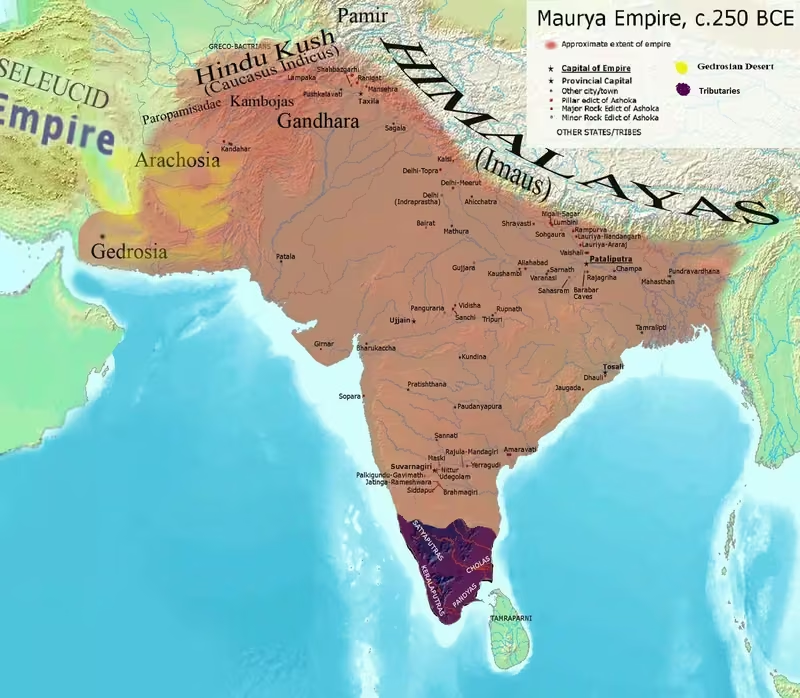
The empire existed for approximately 137 years, from its foundation around 321 BCE until its dissolution in 185 BCE when the last ruler, Brihadratha, was assassinated by his general Pushyamitra Shunga. During this period, nine rulers from the Mauryan dynasty governed an empire that, at its zenith under Ashoka the Great (268-232 BCE), encompassed virtually the entire Indian subcontinent except its southern tip. The empire's territorial extent ranged from present-day Afghanistan and Balochistan in the northwest to Bengal and Assam in the east, covering an estimated 3.4 to 5 million square kilometers.
The Mauryan period marks a watershed moment in Indian history, characterized by unprecedented political centralization, economic integration, and cultural efflorescence. The empire's legacy extends far beyond its political achievements - it fostered the spread of Buddhism across Asia, established administrative systems that influenced subsequent Indian states, and created monumental architecture that continues to inspire awe today. The primary sources for understanding this remarkable period include the fragmented accounts from Megasthenes' lost work "Indica" preserved in later Roman texts, and more importantly, the extensive Edicts of Ashoka carved on rocks and pillars throughout the empire. Archaeologically, the Mauryan era corresponds with the Northern Black Polished Ware (NBPW) culture, marking significant advances in pottery, metallurgy, and urban planning.
Rise to Power
The rise of the Maurya Empire is inextricably linked to the strategic genius of its founder, Chandragupta Maurya, and his mentor, the legendary political theorist Chanakya (also known as Kautilya or Vishnugupta). The story begins in the declining years of the Nanda dynasty, which ruled from Magadha but had become increasingly unpopular due to heavy taxation and perceived low-born origins. Chanakya, a Brahmin scholar humiliated by the Nanda king, vowed to overthrow the dynasty and found a new order.
The Nanda-Mauryan War (circa 320 BCE) marked the birth of the empire. Chandragupta, possibly of humble origins himself, was trained and prepared by Chanakya to challenge the militarily powerful but politically vulnerable Nanda state. Through a combination of guerrilla warfare, strategic alliances with regional powers, and exploitation of popular discontent, Chandragupta systematically conquered the Nanda territories. The relatively swift victory can be attributed to superior strategy rather than overwhelming force - Chanakya's political treatise, the Arthashastra, emphasizes the use of diplomacy, espionage, and psychological warfare alongside military might.
Following the conquest of Magadha, Chandragupta rapidly expanded his domains. He conquered the Mahajanapadas (great kingdoms) of northern India, bringing under his control the fertile Gangetic plains and the commercially important regions of eastern India. However, his most significant military achievement came around 305 BCE, when he confronted Seleucus I Nicator, one of Alexander's successors who controlled the eastern territories of the former Macedonian empire.
The Seleucid-Mauryan War demonstrated Chandragupta's military prowess and diplomatic acumen. Rather than engaging in a prolonged and costly conflict, the two rulers reached a settlement: Seleucus ceded the satrapies of Aria, Arachosia, Gedrosia, and Paropamisadae (roughly corresponding to parts of modern Afghanistan, Balochistan, and Pakistan) to the Mauryas. In exchange, Chandragupta provided 500 war elephants - a transaction that highlights the military value the Hellenistic world placed on Indian elephants. The treaty was sealed through a matrimonial alliance, and Seleucus dispatched Megasthenes as ambassador to the Mauryan court, whose observations would become crucial historical sources.
By 300 BCE, Chandragupta had established an empire that stretched from the Bay of Bengal to the Arabian Sea, and from the Himalayan foothills to the northern Deccan Plateau. He had created not just a large territory, but a centralized administrative apparatus capable of governing it - a system that would be refined by his successors and become the template for imperial governance in Indian history.
Golden Age
The Maurya Empire reached its apogee during the reign of Ashoka the Great (268-232 BCE), grandson of Chandragupta Maurya. While his father Bindusara (298-272 BCE) had consolidated and expanded the empire, earning the epithet "Amitraghata" (slayer of enemies), it was Ashoka who transformed the Mauryan state from a powerful but typical ancient empire into something unprecedented in Indian history - a realm governed by ethical principles and dedicated to the welfare of its subjects.
Ashoka's early reign followed the traditional pattern of territorial expansion. His conquest of Kalinga (modern-day Odisha and northern Andhra Pradesh) in 261 BCE proved to be a turning point not just for his reign, but for Indian history. The Kalinga War was exceptionally brutal - Ashoka's own inscriptions record that 100,000 people were killed in battle, 150,000 were deported, and many more died from famine and disease. The scale of suffering profoundly affected the emperor, leading to his conversion to Buddhism and adoption of "Dhamma" (righteousness) as state policy.
Post-Kalinga, Ashoka renounced aggressive warfare and instead pursued what he termed "Dhamma-vijaya" (victory through righteousness). His Edicts, carved on rocks and polished sandstone pillars throughout the empire, articulated a philosophy of governance based on Buddhist and Jain ethical principles, though not exclusively Buddhist in content. These edicts promoted religious tolerance, animal welfare, medical care for humans and animals, construction of roads and rest houses, and moral conduct. The empire under Ashoka thus represented one of history's earliest experiments in ethical governance and religious pluralism.
During Ashoka's reign, the empire reached its maximum territorial extent, covering an estimated 5 million square kilometers. Only the southernmost parts of the Indian peninsula remained outside Mauryan control. The empire encompassed diverse peoples, languages, and cultures, from the Hellenistic-influenced northwest to the tribal regions of central India. Ashoka's administration maintained this vast realm through a sophisticated bureaucracy, efficient communication networks, and a policy of religious and cultural tolerance that allowed local traditions to flourish under imperial oversight.
The Mauryan golden age witnessed unprecedented cultural achievements. Buddhist missions, actively supported by Ashoka, spread Buddhism to Sri Lanka, Central Asia, and Southeast Asia, fundamentally shaping Asian civilization. The Third Buddhist Council, held at Pataliputra under Ashoka's patronage, systematized Buddhist doctrine and scripture. Architecturally, this period saw the creation of monolithic pillars with their famous animal capitals, rock-cut caves at Barabar for Ajivika ascetics, and numerous stupas commemorating Buddhist sites. The Mauryan artistic style, characterized by highly polished stone surfaces and naturalistic animal sculptures, influenced Indian art for centuries.
Ashoka's grandson Samprati (224-215 BCE) continued the tradition of religious patronage, but focused primarily on Jainism, constructing thousands of Jain temples and supporting Jain monks. This religious pluralism at the imperial level allowed India's diverse spiritual traditions to flourish and interact, creating a unique cultural synthesis.
Administration and Governance
The Mauryan administrative system represented a quantum leap in Indian political organization, establishing structures and practices that influenced governance for centuries. At its apex stood the emperor (chakravarti), whose authority theoretically extended to all aspects of state and society. However, the Mauryan rulers, particularly after Ashoka, increasingly presented themselves as paternal figures ruling for the welfare of their subjects rather than absolute despots.
The empire was divided into multiple provinces, with the capital territory of Magadha forming the imperial core. Major provincial capitals included Taxila in the northwest (controlling the vital trade routes to Central Asia), Ujjain in western India, and Suvarnagiri in the south. These provinces were governed by members of the royal family or trusted officials with significant autonomy in day-to-day administration but answerable to the central government. The provincial structure allowed for administrative flexibility while maintaining imperial unity - a balance that proved crucial for governing such a vast and diverse territory.
Below the provincial level, the empire was further divided into districts (janapadas) and villages (gramas). Village administration remained largely in the hands of local councils, maintaining traditional governance structures while integrating them into the imperial framework. This pragmatic approach - centralized control over strategic matters combined with local autonomy in routine administration - proved remarkably effective.
The Mauryan bureaucracy was extensive and specialized. According to Megasthenes, the administration of Pataliputra alone involved multiple departments handling different aspects of urban governance. The Arthashastra, traditionally attributed to Chanakya, provides detailed descriptions of various administrative offices: superintendents of agriculture, commerce, crown lands, forests, mines, toll collection, and many others. This bureaucratic apparatus required a large literate class, stimulating education and the development of administrative skills.
Revenue collection formed the backbone of imperial administration. The Mauryans employed a sophisticated tax system including land taxes (typically one-sixth of the produce), taxes on trade and commerce, taxes on various professions, and revenue from crown lands and state enterprises like mines and forests. This substantial revenue supported the massive standing army estimated at 600,000 infantry, 30,000 cavalry, and 9,000 war elephants, along with the extensive bureaucracy and public works.
The judicial system combined royal justice with local customary law. The emperor served as the supreme judge, but most cases were handled by local courts. Megasthenes noted the relatively low crime rate and honest conduct of Indians, suggesting that the system functioned effectively. Punishments, as described in the Arthashastra, could be severe, including fines, imprisonment, mutilation, and execution, though Ashoka's edicts advocated for moderation and the possibility of appeal.
Infrastructure development was a major governmental priority. The Mauryans constructed extensive road networks connecting the major cities of the empire, with the Grand Trunk Road linking Pataliputra to Taxila becoming particularly famous. These roads featured rest houses, wells, and shade trees, facilitating both commerce and communication. A sophisticated postal system and network of spies ensured that the central government remained informed about developments throughout the realm.
Military Campaigns
The Mauryan military machine was one of the most formidable forces in the ancient world, combining massive size with organizational sophistication and tactical flexibility. Ancient sources consistently emphasize the army's enormous scale - Megasthenes reported figures that, while possibly exaggerated, indicate a force of unprecedented size in Indian history. This military power enabled the Mauryas to first conquer and then maintain their vast empire.
The founding of the empire through the Nanda-Mauryan War (circa 320 BCE) demonstrated innovative military thinking. Rather than relying solely on frontal assaults, Chandragupta and Chanakya employed guerrilla tactics, systematically weakening Nanda control over peripheral regions before striking at the core. This strategy, described in the Arthashastra, involved winning popular support, gathering intelligence, and creating fifth columns within enemy territory - a sophisticated approach to warfare that went beyond mere battlefield tactics.
The Seleucid-Mauryan conflict (circa 305 BCE) showcased Chandragupta's military capabilities against Hellenistic professional armies. The war's outcome - with Seleucus ceding vast territories - indicates either Mauryan military superiority or, more likely, Chandragupta's strategic brilliance in making the conflict too costly for the Seleucids to pursue. The 500 war elephants provided to Seleucus as part of the treaty proved valuable at the Battle of Ipsus (301 BCE), demonstrating the military importance of Indian elephants, which formed a key component of Mauryan power.
Bindusara's reign (298-272 BCE) witnessed continued military expansion. Known as Amitraghata (destroyer of enemies), Bindusara extended Mauryan control deeper into the Deccan Plateau. While specific military campaigns are poorly documented, the empire's southern boundary clearly moved significantly southward during his reign, bringing most of the Indian peninsula except the extreme south under Mauryan control.
The Kalinga War (261 BCE) represents the Mauryan military at its most devastating. Ashoka's 13th Rock Edict provides rare details about the campaign's human cost: 100,000 killed in battle, 150,000 deported, with countless others dying from war's indirect effects. Kalinga's fierce resistance - the region had a strong maritime tradition and warrior culture - required the full weight of Mauryan military power. The war's brutality, while achieving territorial conquest, led to Ashoka's renunciation of aggressive warfare and adoption of dhamma.
Post-Kalinga, Mauryan military policy shifted dramatically. While the empire maintained its massive standing army and fortifications, offensive campaigns ceased. Instead, the military served defensive and internal security functions, protecting trade routes, maintaining order, and deterring external threats. This shift represents a unique instance in ancient history where a powerful state voluntarily renounced aggressive expansion at its military peak.
The Mauryan army's organization reflected its sophisticated administration. It consisted of multiple components: infantry formed the largest contingent, equipped with various weapons including bows, swords, and spears; cavalry provided mobility and shock force; war elephants served as the ancient equivalent of tanks, breaking enemy formations and providing psychological impact; chariots, though declining in importance, remained part of the force structure. Support services including engineers, medical units, and supply trains enabled sustained campaigns far from base territories.
Cultural Contributions
The Mauryan period represents a cultural renaissance in Indian history, marking the transition from the primarily oral tradition of the Vedic period to a more diverse and materially documented civilization. The empire's patronage of religion, art, and learning created cultural forms and institutions that shaped Indian civilization for millennia.
Buddhist patronage under Ashoka fundamentally transformed Buddhism from a regional sect into a world religion. The emperor's conversion following the Kalinga War led to unprecedented state support for Buddhist institutions. Ashoka sponsored the construction of thousands of stupas - Buddhist monuments containing relics - throughout the empire. He also commissioned viharas (monasteries) that served as centers of learning and meditation. Most significantly, Ashoka dispatched Buddhist missions to regions far beyond the empire's boundaries, including Sri Lanka, Central Asia, and possibly even Egypt and Greece, as mentioned in his Rock Edicts.
The Mauryan architectural style achieved remarkable technical and artistic sophistication. The monolithic Ashoka Pillars, carved from single blocks of sandstone and transported hundreds of kilometers to their locations, showcase both engineering skill and artistic vision. Standing up to 50 feet tall and weighing up to 50 tons, these pillars featured exquisitely carved animal capitals - the Lion Capital from Sarnath, now India's national emblem, exemplifies the naturalistic yet stylized Mauryan artistic approach. The highly polished surface of these pillars, achieved through techniques that remain partially mysterious, creates a mirror-like finish that has endured for over two millennia.
Rock-cut architecture reached new heights during the Mauryan period. The Barabar Caves near Gaya in Bihar, dedicated to Ajivika ascetics by Ashoka and his grandson Dasharatha, feature extraordinarily smooth interior surfaces created through laborious rock-polishing. These caves demonstrate advanced understanding of geology, architecture, and aesthetic principles, establishing the rock-cut tradition that would flourish in later Indian history at sites like Ajanta and Ellora.
The Edicts of Ashoka represent a unique historical treasure - direct communication from an ancient ruler to his subjects and posterity. Inscribed on rocks and pillars throughout the empire in various languages (Prakrit in different dialects, Greek, Aramaic), these edicts articulate Ashoka's dhamma philosophy, record historical events, and reveal the workings of the Mauryan state. The use of multiple languages and scripts reflects the empire's cosmopolitan character and Ashoka's desire to communicate effectively with diverse populations.
Art and sculpture flourished under Mauryan patronage. The characteristic Mauryan style - highly polished surfaces, naturalistic yet idealized forms, and technical perfection - influenced Indian art for centuries. The Didarganj Yakshi, a life-sized sculpture of a female figure holding a fly-whisk, exemplifies the sensuous naturalism and technical mastery of Mauryan sculptors. Stone sculpture largely replaced earlier traditions in wood and terracotta, marking a significant technological and artistic evolution.
Religious pluralism characterized Mauryan cultural policy. While Ashoka personally embraced Buddhism and Samprati patronized Jainism, the state supported various religious traditions. Ashoka's edicts explicitly advocated religious tolerance, stating that "all sects deserve reverence." This policy allowed Brahmanism, Buddhism, Jainism, Ajivikism, and other traditions to coexist and interact, creating a rich religious and philosophical environment.
Literature, though largely preserved through later copies and oral transmission, flourished during this period. The Arthashastra, attributed to Chanakya, represents sophisticated political and economic thought. Sanskrit grammar was systematized by Panini shortly before the Mauryan period, creating the linguistic foundation for classical Sanskrit literature. Prakrit literature, including early Buddhist and Jain texts, developed alongside Sanskrit, reflecting the linguistic diversity of the empire.
Economy and Trade
The Mauryan economy represented the most sophisticated economic system in ancient India up to that point, characterized by extensive state involvement, long-distance trade networks, and agricultural productivity. The empire's economic success underpinned its military and administrative apparatus, while its extensive infrastructure facilitated commercial expansion.
Agriculture formed the economic foundation of the Mauryan state, with the fertile Gangetic plain providing surplus production that supported urbanization and state activities. The Arthashastra describes detailed regulations for agricultural management, including state support for irrigation, seed distribution, and protection of cultivated areas from wildlife. The state maintained crown lands worked by hired laborers or slaves, while collecting taxes (typically one-sixth of produce) from private landowners. Agricultural innovation, including iron plows and improved irrigation techniques, increased productivity during this period.
Trade and commerce flourished under Mauryan rule, facilitated by political stability, infrastructure development, and standardization. The empire's road network, particularly the Grand Trunk Road connecting Pataliputra to Taxila, enabled efficient movement of goods across vast distances. Rest houses, wells, and security provisions made long-distance trade less hazardous. The standardization of weights and measures, documented in archaeological finds, facilitated commerce by reducing transaction costs.
The Mauryan economy was highly monetized, with the karshapana (also called pana) serving as the standard silver coin. These punch-marked coins, featuring various symbols, circulated throughout the empire and beyond, indicating extensive commercial networks. Copper coins for smaller transactions complemented the silver coinage, creating a practical monetary system for various scales of commerce.
International trade expanded significantly under Mauryan rule. The northwestern territories provided access to Central Asian trade routes, connecting India to the Hellenistic world and beyond. Trade with the Seleucid Empire and, through them, the Mediterranean world, brought Indian goods like spices, textiles, and precious stones to Western markets. The maritime trade with Southeast Asia and Sri Lanka, though not directly controlled by the state, benefited from the empire's stability and commercial policies.
Urban centers prospered as commercial and manufacturing hubs. Pataliputra, described by Megasthenes as one of the world's largest cities, featured a sophisticated urban economy with specialized craftsmen, merchants, and service providers. Other major cities like Taxila, Ujjain, and Vaishali served as regional commercial centers, each with distinctive economic specializations. Archaeological evidence of Northern Black Polished Ware pottery distributed across the empire indicates extensive commercial networks connecting urban production centers with rural markets.
State economic intervention was extensive. The Arthashastra describes numerous state monopolies and regulations, including control over mining, forestry, liquor production, and various strategic goods. The state also operated workshops producing goods for the military and administration. This level of state involvement in the economy, while potentially reducing private sector dynamism, ensured resource mobilization for state purposes and may have contributed to economic stability.
Taxation provided the state with substantial revenue to maintain its extensive administrative and military apparatus. Beyond agricultural taxes, the state collected customs duties, sales taxes, professional taxes, and various fees. The Arthashastra's detailed tax regulations suggest a sophisticated fiscal system, though the actual tax burden and enforcement practices remain debated by historians.
Decline and Fall
The decline of the Maurya Empire following Ashoka's death in 232 BCE was remarkably swift for such a powerful state, with the empire fragmenting within five decades. Multiple factors contributed to this collapse, reflecting both structural weaknesses and contingent circumstances.
Succession crises weakened imperial authority immediately after Ashoka's death. The sources for this period are fragmentary and sometimes contradictory, but indicate disputed successions and division of the empire among Ashoka's descendants. Dasharatha, who succeeded Ash