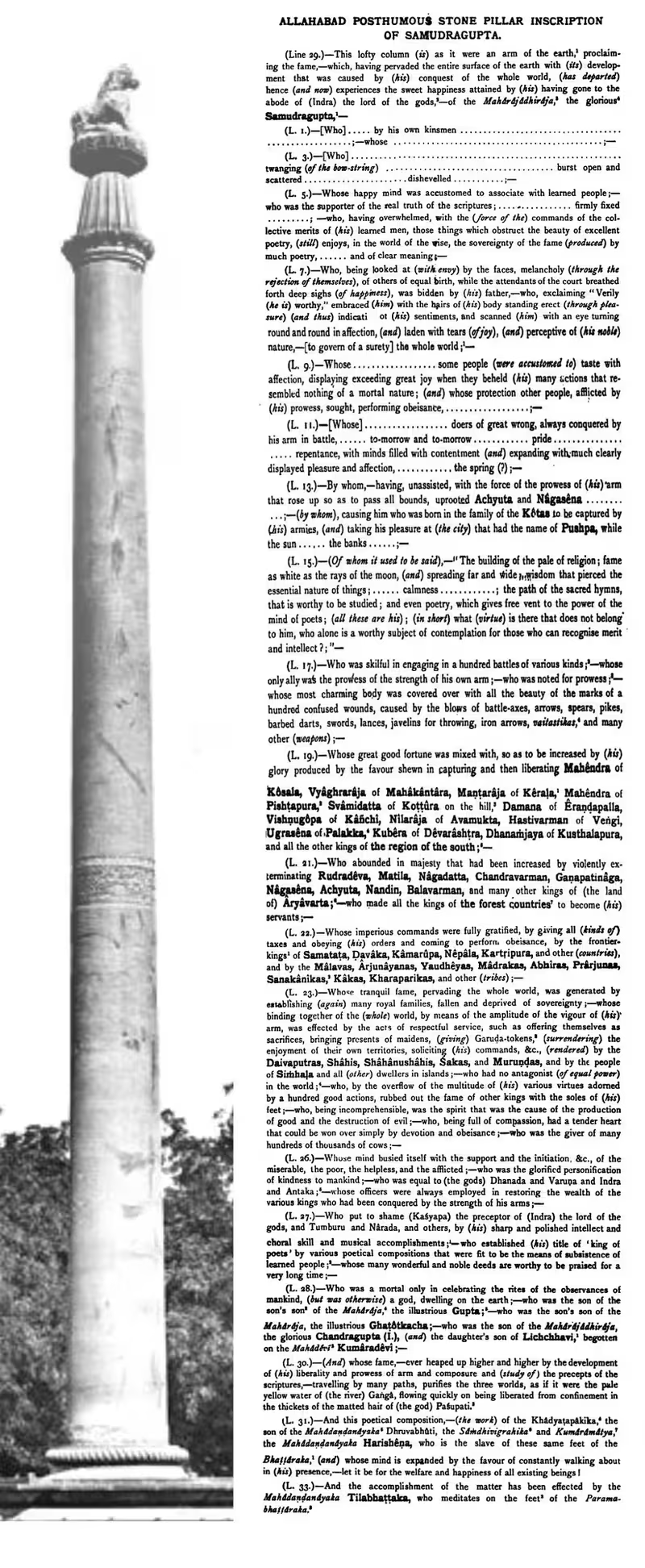
Samudragupta: The Great Unifier and Poet King
In the grand tapestry of Indian history, few figures loom as large as Samudragupta. He was a conqueror of unparalleled genius, a statesman of profound vision, and a connoisseur of the arts whose personal accomplishments rivaled his imperial ambitions. Ascending the throne of a modest kingdom in Magadha, he unleashed a whirlwind of military campaigns that, for the first time since the Mauryan empire, brought a vast swathe of the Indian subcontinent under a single, unifying authority. His reign was not merely one of conquest; it was the dawn of a classical age, a period of cultural efflorescence and political stability that would rightly be called the Golden Age of India. He was the Maharajadhiraja (Great King of Kings), the Sarva-rajochchhetta (Uprooter of All Kings), and the Kaviraja (King of Poets)—a ruler whose legacy is etched into stone, stamped onto gold, and woven into the very fabric of Indian civilization.
Early Life & A Fated Accession
Born into the nascent Gupta dynasty, Samudragupta was the son of its founder, Chandragupta I, and his queen, Kumaradevi. This was no ordinary political union. Kumaradevi hailed from the ancient and powerful Lichchhavi clan, a republican confederacy whose prestige lent immense legitimacy to the new Gupta monarchy. So proud was Samudragupta of this lineage that he consistently referred to himself as Lichchhavi-dauhitra (the grandson of the Lichchhavis) on his coinage, a clear acknowledgment of the crucial role his maternal heritage played in his family's rise to power.
While details of his early education are not explicitly recorded, his later life provides ample evidence of a formidable and well-rounded upbringing. He was clearly trained in the arts of war and statecraft, mastering strategy and diplomacy. Yet, his education went far deeper. He possessed a profound love for music and poetry, becoming an accomplished musician, particularly on the veena (a stringed lute), and a composer of such skill that he earned the title Kaviraja.
His accession to the throne, around 335 CE, was a moment of high drama, immortalized in the official court account. The primary source for his reign is the Prayag Prashasti, a magnificent eulogy inscribed on a polished sandstone pillar of Ashoka, located in the sacred city of Prayagraj (formerly Allahabad). Composed by his court poet and minister of war and peace, Harishena, the inscription describes a pivotal scene in the court of Chandragupta I. Overlooking his other sons, the aging king embraced Samudragupta, his “hairs standing on end” with emotion, and declared him the one worthy to “protect the whole world.”
While this is the official narrative, the existence of gold coins bearing the name of an obscure ruler, Kacha, has led some historians to speculate about a possible succession struggle. Some scholars believe Kacha was a rival brother whom Samudragupta had to overcome, while others suggest that Kacha was simply another name for Samudragupta himself, used before he assumed his imperial title. Whatever the truth, Samudragupta emerged as the undisputed master of the Gupta throne, ready to fulfill the destiny his father had envisioned for him.
Career & Major Contributions: The Architect of an Empire
Samudragupta’s reign was defined by relentless and brilliantly executed military campaigns. The Prayag Prashasti provides a detailed, almost geographical, account of his conquests, which can be divided into several distinct phases, each with its own strategic objective.
The Conquest of Aryavarta (Northern India)
Samudragupta’s first priority was to consolidate his power in the heartland of northern India, known as Aryavarta. Here, his policy was one of prashabhoddharana—forceful and violent extermination. He systematically uprooted the rival kingdoms that stood in his way, directly annexing their territories into the expanding Gupta empire. The prashasti lists nine kings of Aryavarta who were crushed by his might, including Nagasena of the Naga dynasty, Ganapatinaga, and Achyuta. This campaign secured the fertile and populous Gangetic plains, establishing a powerful core for his empire and providing the resources for his future expeditions.
The Southern Expedition (Dakshinapatha)
Perhaps his most audacious military achievement was his long march into the southern peninsula, the Dakshinapatha. Here, Samudragupta displayed remarkable strategic flexibility. Recognizing the immense difficulty of directly administering these distant lands from his capital in Pataliputra, he adopted a pragmatic three-fold policy known as grahaṇa-mokṣā-nugraha—capturing the enemy king, liberating him, and then showing favor by reinstating him as a vassal.
His army marched deep into the south, following the eastern coast. The prashasti names twelve rulers he defeated, including Mahendra of Kosala, Vyaghraraja of Mahakantara, and, most significantly, Vishnugopa of the Pallava dynasty at Kanchipuram. He did not seek to annex their lands but to establish his undisputed suzerainty. These southern kings were allowed to keep their thrones in exchange for acknowledging Gupta overlordship and paying handsome tributes. This brilliant stroke of diplomacy secured for him immense wealth, protected his southern flank, and ensured control over lucrative trade routes without overextending his administrative machinery.
Subjugation of Frontier States and Tribal Republics
With the north and south subdued, Samudragupta turned his attention to the periphery. The frontier kingdoms ringing his empire, such as Samatata (in modern Bengal), Davaka and Kamarupa (in Assam), and the kingdoms of Nepal and Karttripura, wisely chose submission over confrontation. According to Harishena, they paid him tribute (sarva-kara-dānā), obeyed his commands (ājñā-karaṇa), and performed obeisance in person (praṇāmā-gamana).
Similarly, the powerful autonomous tribal republics that had long flourished in regions like Punjab and Rajasthan—including the Malavas, Arjunayanas, Yaudheyas, and Abhiras—also bowed to his supremacy. By bringing these fierce, independent groups into his imperial system, Samudragupta eliminated potential threats and created a secure, unified political landscape.
Diplomacy with Distant Powers
Samudragupta’s fame spread far beyond the borders of India. The prashasti records that foreign kings, including the Daivaputra-Shahi-Shahanushahi (descendants of the Kushans in the northwest), the Saka satraps of western India, and rulers from Simhala (Sri Lanka) and “all other islands,” sought his favor. They engaged in acts of submission, offering their own daughters in marriage (kanyopayana-dana) and requesting charters bearing the imperial Gupta Garuda seal to validate their rule over their own territories.
A concrete example of this international diplomacy survives in later accounts. King Meghavarna of Sri Lanka (c. 352-379 CE) sent an embassy with rich gifts to Samudragupta, seeking permission to build a monastery and rest house for Sinhalese pilgrims near the sacred Bodhi tree at Bodh Gaya. Samudragupta graciously granted the request, a testament to his stature as a paramount sovereign whose goodwill was sought by rulers far and wide.
The Ashvamedha and Imperial Coinage
To solemnize his status as a Chakravartin (universal monarch), Samudragupta performed the ancient and prestigious Ashvamedha Yajna, or horse sacrifice. In this ritual, a consecrated horse was set free to wander for a year, followed by the king’s army. Any ruler who challenged the horse was met in battle; if it returned unchallenged, the king’s supreme authority was established, and the horse was sacrificed. To commemorate this event, he issued special gold coins depicting the sacrificial horse on one side and the chief queen on the other, with the legend Ashvamedhaparakramah (He whose prowess was validated by the horse sacrifice).
His coinage is a remarkable chronicle of his reign. The gold dinaras issued by Samudragupta were of high artistic merit and showcased his multifaceted personality:
- Standard Type: Depicts the king holding a royal standard, with the Garuda emblem of the Guptas.
- Archer Type: Shows him holding a bow, a motif that became the dynasty's most iconic coin design.
- Battle-Axe Type: Portrays him as a formidable warrior holding a parashu (battle-axe).
- Tiger-Slayer Type: A powerful image of him wrestling a tiger, bearing the legend Vyaghraparakramah (He who has the prowess of a tiger).
- Lyrist Type: In stark contrast, this coin shows a serene Samudragupta seated on a couch, gracefully playing the veena, a testament to his celebrated artistic accomplishments.
These coins were not mere currency; they were instruments of imperial propaganda, broadcasting the emperor’s martial strength, divine sanction, and cultural refinement across his vast domains.
Legacy & Influence
Samudragupta’s reign, spanning nearly half a century until his death around 375 CE, fundamentally reshaped the Indian subcontinent. His legacy is immense and enduring.
The Great Unifier
His most tangible achievement was the political unification of India. He inherited a small principality and bequeathed a mighty empire to his successors. This newfound stability, after centuries of political fragmentation following the fall of the Mauryas, ushered in an era of unprecedented peace and prosperity. The 20th-century historian V. A. Smith famously dubbed him the “Napoleon of India” for the speed and brilliance of his military victories. While the comparison highlights his martial genius, it doesn't fully capture the sophistication of his statecraft, particularly his nuanced policy of suzerainty rather than outright annexation in the south.
The Dawn of the Golden Age
Samudragupta was the true architect of the Gupta Golden Age. The political unity he forged created the perfect conditions for a cultural renaissance. Trade flourished, cities grew, and wealth accumulated, allowing for generous patronage of art, architecture, literature, and science. Though a devout follower of Vaishnavism (a sect of Hinduism), he was a tolerant ruler, as evidenced by his patronage of the Buddhist monastery for Sri Lankan monks. It was on the secure foundations he laid that his son and successor, Chandragupta II Vikramaditya, would build a court of legendary brilliance.
The Ideal of the Indian King
In Indian tradition, Samudragupta came to embody the ideal of a universal monarch. He was both a warrior and a scholar, a conqueror and a connoisseur. He was powerful enough to defeat any foe yet gracious enough to reinstate a vanquished king. He was a master of the battlefield and a master of the veena. This synthesis of strength and refinement, of martial prowess (vikrama) and cultural grace, made him a paragon for future rulers.
Today, Samudragupta is remembered not just as a conqueror, but as the emperor who gave India one of its most glorious chapters. The Prayag Prashasti, still standing in Allahabad, serves as his timeless monument, its elegant Sanskrit verses a powerful echo of the emperor who was as adept with a poet’s pen as he was with a warrior’s sword.