
The Night That Shook the Mountains: The Daring Assault on Sinhagad
The wind howled through the rocky crags of the Sahyadri mountains as shadows moved like phantoms across the treacherous slopes. In the darkness of that February night in 1670, the very stones seemed to hold their breath. High above, the fortress of Sinhagad—then known as Kondhana—stood like a sleeping giant, its massive walls carved from the living rock of the mountain itself. Mughal sentries paced the ramparts, their torches casting dancing circles of light that barely penetrated the thick darkness beyond. They had no idea that death was climbing toward them, hand over hand, up the sheer cliff faces that had protected this stronghold for generations.
The fortress had been considered impregnable for good reason. Perched on a ridge of the Western Ghats, nearly 4,300 feet above sea level, it commanded a view of the entire Pune valley below. Its walls rose directly from precipitous cliffs, and the only conventional approach was a narrow, winding path that could be easily defended by a handful of men against an army. For the Mughals, it was the perfect sentinel, watching over the rich lands of the Deccan and the vital trade routes that connected the empire’s heartland to its southern territories.
But on this night, conventional wisdom would prove fatally inadequate. Somewhere in the darkness below, Maratha warriors were putting into motion one of the most audacious military operations in Indian history—a plan so bold, so seemingly impossible, that its very audacity would become its greatest weapon. The assault on Sinhagad would not come from the expected direction, nor would it follow the rules of siege warfare that had governed such conflicts for centuries. Instead, it would emerge from the darkness itself, from the very cliffs that the Mughals believed made their position unassailable.
The night air carried the scent of wild jasmine and the distant sound of jackals calling from the valleys below. In a few hours, this peaceful mountain stronghold would become the stage for a battle that would echo through the corridors of history, a testament to the changing balance of power in the Deccan and the rise of a new force that would reshape the political landscape of India.
The World Before
The year 1670 found the Indian subcontinent in the grip of profound transformation. The mighty Mughal Empire, which had dominated the northern plains for over a century, was extending its reach ever southward into the Deccan plateau. Under the iron will of Emperor Aurangzeb, Mughal armies had been pushing relentlessly into territories that had long remained independent, seeking to bring the entire subcontinent under imperial control. The Deccan, with its patchwork of kingdoms, fortified cities, and strategic mountain passes, represented both the greatest prize and the greatest challenge to Mughal ambitions.
The fortress of Kondhana, as Sinhagad was then known, stood as a crucial link in the chain of Mughal defenses that stretched across the Western Ghats. These mountains formed a natural barrier between the coastal regions and the inland plateau, and whoever controlled the passes controlled the flow of trade, armies, and information between these vital regions. The Mughals understood this geography intimately, and they had invested heavily in fortifying key positions throughout the range.
But the Deccan was not merely a passive theater of Mughal expansion. The region had given birth to a new power that was beginning to challenge the established order with increasing boldness. The Marathas, emerging from the rugged terrain of the Western Ghats themselves, had developed military tactics and organizational structures uniquely suited to their homeland’s challenging geography. Unlike the Mughal armies, which relied heavily on cavalry and artillery suited to the open plains of northern India, the Marathas had mastered the art of mountain warfare.
The political landscape of the Deccan in 1670 was a complex web of shifting alliances and competing interests. The Mughal Empire sought to impose its centralized authority over the region, but faced resistance not only from emerging powers like the Marathas but also from established Deccan sultanates that had ruled these lands for generations. Local zamindars and jagirdars found themselves caught between these larger forces, often switching sides as circumstances dictated.
The economic stakes were enormous. The Deccan was one of the richest regions of India, its fertile black soil producing abundant crops that fed millions and generated substantial tax revenues. The region’s strategic position also made it a crucial link in the trade networks that connected India to the wider world. Ports along the western coast handled goods flowing to and from the Middle East and Europe, while inland routes carried precious commodities to the markets of northern India.
In this context, fortresses like Kondhana were far more than mere military installations. They were symbols of authority, centers of administration, and guardians of economic lifelines. The Mughals had recognized the fortress’s importance and had invested considerable resources in strengthening its defenses and maintaining a strong garrison. The fort’s position allowed it to control movement through several key passes, making it an essential component of Mughal strategy in the region.
The social fabric of the Deccan was equally complex. The region was home to diverse communities speaking different languages, following different religious traditions, and maintaining distinct cultural practices. The Mughals, as relative newcomers to the region, had to navigate these complexities while attempting to impose their administrative systems and cultural norms. This created tensions that skilled local leaders could exploit, building coalitions that transcended traditional boundaries.
The military technology of the era was also in flux. While traditional weapons like swords, spears, and bows remained important, firearms were becoming increasingly common on Indian battlefields. The Mughals had access to some of the most advanced military technology of their time, including heavy artillery that could breach fortress walls. However, the mountainous terrain of the Deccan often negated these technological advantages, favoring forces that could move quickly and strike unexpectedly.
The Players

In the shadows of that February night, the men preparing for the assault on Kondhana represented a new breed of warrior that was emerging from the hills and valleys of the Deccan. These Maratha fighters were not the products of royal courts or military academies, but rather men forged by the harsh realities of mountain life and guerrilla warfare. They had learned their craft in countless skirmishes among the rocky peaks and dense forests of the Western Ghats, developing skills and tactics that would prove devastatingly effective against conventional military forces.
The Maratha military system that produced these warriors was unlike anything the Mughal Empire had previously encountered. Rather than relying on the traditional model of heavy cavalry and massed infantry formations, the Marathas had developed a highly mobile, decentralized approach to warfare. Their forces were organized into small, flexible units that could move rapidly across difficult terrain, strike hard at vulnerable targets, and disappear before enemy reinforcements could arrive.
These warriors were intimately familiar with every ridge, valley, and hidden path in their mountainous homeland. Many had grown up in villages perched on seemingly impossible cliff faces, where daily life required the kind of climbing skills that would prove invaluable in military operations. They knew which routes could be traveled in darkness, where water could be found during long marches, and how to read the subtle signs of weather and terrain that could mean the difference between success and disaster.
The men gathered for the assault on Kondhana were also products of a society that was undergoing rapid social and political transformation. The traditional hierarchies of the Deccan were being challenged and reshaped by new ideas about governance, military organization, and social mobility. Merit and courage were becoming more important than birth and lineage in determining advancement within Maratha ranks, creating opportunities for talented individuals from all levels of society.
On the other side of the fortress walls, the Mughal garrison represented the established order that had dominated Indian warfare for generations. These soldiers were part of a military machine that had conquered vast territories and defeated numerous enemies through superior organization, discipline, and technology. They were well-trained, well-equipped, and confident in their ability to defend their position against any conventional attack.
The Mughal military system was built around the concept of overwhelming force applied through coordinated action. Their armies featured heavy cavalry units that could break enemy formations through shock action, supported by disciplined infantry armed with firearms and traditional weapons. Artillery played an increasingly important role in Mughal tactics, with skilled gunners capable of reducing fortress walls to rubble given sufficient time and ammunition.
The garrison at Kondhana included soldiers from various parts of the Mughal Empire, reflecting the cosmopolitan nature of imperial forces. There were cavalry troopers from the plains of northern India, infantry soldiers from various regions, and specialized troops trained in fortress defense. Many of these men were veterans of campaigns across the subcontinent, experienced in the conventional warfare that had brought the Mughals their greatest victories.
However, the very strengths of the Mughal military system also contained the seeds of potential weakness when confronted with unconventional tactics. The emphasis on formal organization and established procedures could make it difficult to respond quickly to unexpected threats. The reliance on heavy equipment and large supply trains made rapid movement challenging, particularly in mountainous terrain where roads were poor or nonexistent.
The commanders on both sides brought different philosophies and experiences to the coming confrontation. The Mughal officers had been trained in the classical traditions of Islamic military science, with its emphasis on careful planning, methodical execution, and overwhelming force. They understood siege warfare, cavalry tactics, and the coordination of large military formations. Their approach to fortress defense was based on proven principles that had worked successfully in countless previous conflicts.
The Maratha leadership, by contrast, had developed their military philosophy through practical experience in the unique conditions of Deccan warfare. They understood that conventional tactics often failed in mountainous terrain, and they had learned to exploit the weaknesses of traditional military systems. Their approach emphasized speed, surprise, and intimate knowledge of local conditions over formal military doctrine.
The cultural backgrounds of the opposing forces also shaped their approach to warfare. The Mughal military tradition drew on centuries of Islamic military science, with its emphasis on discipline, hierarchy, and formal organization. This tradition had proven highly effective in the conquest and administration of vast territories, but it was primarily designed for warfare on open terrain against conventional enemies.
The Maratha military culture, by contrast, was rooted in the specific conditions of their homeland and the particular challenges they faced. It emphasized individual initiative, local knowledge, and the ability to adapt quickly to changing circumstances. This approach had evolved through generations of conflict in terrain that favored defenders and made conventional military operations extremely difficult.
Rising Tension
The months leading up to that fateful February night had seen a steady escalation of conflict throughout the region around Pune. The Mughal administration, confident in their control of key fortresses like Kondhana, had been tightening their grip on the surrounding countryside, imposing new taxes and administrative measures designed to integrate the region more fully into the imperial system. These policies, while successful in generating revenue for the imperial treasury, had also created widespread resentment among local populations who found their traditional ways of life increasingly constrained.
The Maratha response to these pressures had been characteristically unconventional. Rather than confronting Mughal forces directly in pitched battles where imperial advantages in numbers and equipment would prove decisive, they had adopted a strategy of persistent harassment designed to make Mughal control of the region as costly and difficult as possible. Small Maratha bands would strike at supply convoys, isolated outposts, and administrative centers before melting away into the mountains where pursuit was nearly impossible.
These tactics had proven increasingly effective at disrupting Mughal operations throughout the Deccan. Supply lines that had once been secure became dangerous to traverse without heavy escorts. Administrative officials found themselves virtual prisoners in their fortified compounds, unable to venture into the countryside without substantial military protection. The cost of maintaining Mughal control was rising steadily, while the benefits of that control were diminishing as economic activity was disrupted by constant conflict.
The fortress of Kondhana had become a symbol of this broader struggle. Its commanding position made it a crucial link in the Mughal defensive network, but its very prominence also made it a tempting target for Maratha forces seeking to demonstrate their growing power. Previous attempts to capture the fortress through conventional siege tactics had failed, largely due to its formidable natural defenses and the strength of its garrison. These failures had only enhanced the fortress’s reputation for impregnability and increased its symbolic importance to both sides.
The Gathering Storm
Intelligence networks on both sides had been working overtime in the weeks before the assault, each trying to gain advantage through superior information about enemy intentions and capabilities. The Mughals had received reports of increased Maratha activity in the region, but these reports were often contradictory and difficult to verify. The Maratha practice of operating in small, independent units made it nearly impossible to determine their true strength or intentions through conventional intelligence gathering.
The Maratha intelligence network, by contrast, had significant advantages in operating within their home territory. Local villagers, many of whom had suffered under Mughal taxation and administrative policies, were often willing to provide information about imperial troop movements and fortress activities. This grassroots intelligence network gave Maratha commanders a detailed understanding of Mughal strengths and weaknesses that would prove crucial in planning their assault.
Weather conditions in the weeks before the attack had also played a role in shaping the tactical situation. The winter months in the Western Ghats brought cool temperatures and occasional mists that could provide cover for military movements. The monsoon season was still months away, meaning that rivers and streams were at their lowest levels, making movement across the landscape easier for forces that knew the terrain well.
The Final Preparations
The decision to attempt a night assault on Kondhana represented a calculated gamble based on careful analysis of the fortress’s weaknesses and the tactical capabilities of Maratha forces. Traditional siege warfare would have required months of preparation and enormous resources that the Marathas simply did not possess. A direct assault during daylight hours would have been suicidal against the fortress’s formidable defenses. Only an attack under cover of darkness, using unconventional tactics that exploited the specific geography of the site, offered any realistic chance of success.
The planning for the assault required intimate knowledge of the fortress’s layout, defensive arrangements, and daily routines. This information had been gathered over months through a combination of direct observation, intelligence from sympathetic sources, and careful analysis of the site’s natural features. Every detail mattered: the timing of guard changes, the location of sentries, the condition of walls and gates, and the presence of any weak points that might be exploited.
The selection and training of the assault force represented another crucial element in the operation’s planning. The men chosen for this mission were not merely brave warriors, but specialists in the particular skills required for such an operation. They needed to be expert climbers capable of scaling sheer rock faces in complete darkness. They had to be able to move silently across difficult terrain while carrying weapons and equipment. Most importantly, they needed the discipline and coordination to execute a complex plan under the most challenging possible conditions.
Equipment for the assault had to be carefully selected and prepared. Traditional siege equipment would be useless for this type of operation, and even conventional weapons had to be modified or replaced with alternatives better suited to the mission’s requirements. Ropes, climbing gear, and specialized tools for scaling walls became as important as swords and spears. Every piece of equipment had to be tested and proven reliable, as there would be no opportunity for replacement or repair once the operation began.
The Turning Point
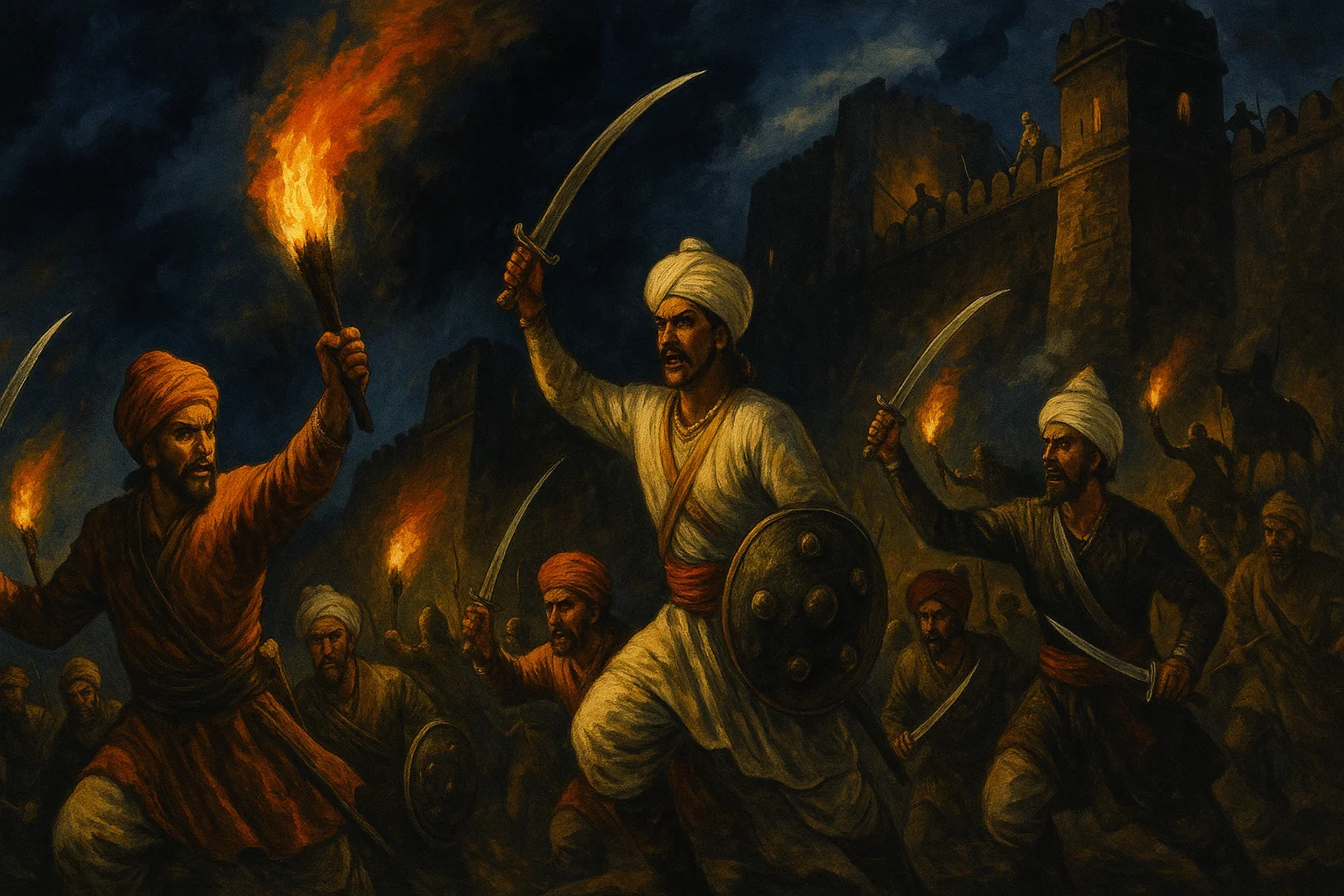
As the clock moved past midnight on February 4, 1670, the assault force began its final approach to the fortress of Kondhana. The night was moonless, providing the cover of darkness that was essential to their plan, but also making the already treacherous climb even more dangerous. The warriors moved in small groups, each following predetermined routes up different sections of the cliff face that surrounded the fortress. Their movements were coordinated by signals that could barely be detected even by those who knew to look for them.
The ascent itself was a feat of extraordinary skill and courage. The cliff faces around Kondhana rose hundreds of feet almost vertically, with few handholds and numerous loose rocks that could betray a climber’s presence with a single misplaced step. The warriors had to climb while carrying their weapons and equipment, making every movement more difficult and dangerous. A single fall would not only mean death for the individual climber but could also compromise the entire operation by alerting the garrison to the attack.
The Maratha climbers had trained for months to develop the skills necessary for this assault. They had practiced on similar cliff faces throughout the region, learning to read the rock in darkness and to move silently even under the most challenging conditions. They had developed techniques for securing ropes and supporting each other during the most difficult sections of the climb. Most importantly, they had learned to maintain their composure and effectiveness even when exhausted and under extreme stress.
As the first warriors reached the top of the cliffs, they found themselves facing the outer walls of the fortress itself. These walls, while formidable, were not as heavily defended as the main gates and approaches that the Mughals expected any attack to target. The sentries on this section of the wall were fewer in number and less alert, having grown complacent after months of quiet duty on what they believed to be an impregnable position.
The initial moments of the assault were crucial. The first warriors to reach the walls had to eliminate the sentries silently and quickly, before any alarm could be raised. This required not only physical skill but also precise timing and coordination. Each group of climbers had to reach their assigned positions simultaneously, so that the entire outer perimeter could be secured before the garrison could respond.
The surprise was complete. The Mughal sentries, expecting no threat from the cliff side of the fortress, were caught completely off guard by the sudden appearance of armed warriors emerging from the darkness. The few guards who managed to raise an alarm found that their calls for help were answered too late, as Maratha forces were already inside the fortress perimeter and moving toward their primary objectives.
Once inside the outer defenses, the assault force moved with practiced efficiency toward the fortress’s key strategic points. Some groups moved to secure the main gates, preventing reinforcements from entering and ensuring that the fortress could not be relieved from outside. Others targeted the armory and supply stores, denying the defenders access to additional weapons and ammunition. The most elite warriors moved toward the central keep, where the fortress commander and his staff would be located.
The fighting that followed was intense but brief. The Mughal garrison, awakened from sleep and caught completely unprepared for an attack from an unexpected direction, struggled to organize an effective defense. Their training and equipment were designed for conventional warfare, not for the close-quarters combat that now raged throughout the fortress. The Maratha warriors, by contrast, were fighting exactly the kind of battle for which they had trained and prepared.
The fortress’s layout, which had been designed to channel attackers into killing zones where they could be destroyed by concentrated defensive fire, now worked against the defenders. The narrow passages and confined spaces that should have favored the defense instead became traps where small groups of Maratha warriors could isolate and defeat larger numbers of Mughal soldiers who could not effectively coordinate their response.
As dawn approached, it became clear that the fortress was lost. The Maratha forces had achieved complete tactical surprise and had exploited that advantage with devastating effectiveness. The Mughal garrison, despite their training and equipment advantages, had been unable to mount an effective defense against an attack that violated all the conventional rules of siege warfare.
The capture of Kondhana represented more than just a tactical victory for the Maratha forces. It demonstrated that even the most formidable Mughal fortifications could be taken through innovative tactics and superior knowledge of local conditions. The psychological impact of the victory was enormous, proving to both sides that the balance of power in the Deccan was shifting in ways that conventional military wisdom had not anticipated.
Aftermath
The immediate aftermath of the successful assault on Kondhana sent shockwaves throughout the Mughal administrative and military hierarchy in the Deccan. News of the fortress’s fall reached Mughal commanders and officials with stunning speed, carried by survivors of the garrison and witnesses from nearby settlements who had seen the Maratha banners flying from the fortress walls at dawn. The psychological impact was immediate and profound—if Kondhana could fall, then no Mughal position in the region could be considered truly secure.
The Mughal response to the loss of such a strategically important fortress was swift but revealed the limitations of their military system when confronted with unconventional tactics. Orders went out immediately for the mobilization of forces to retake the fortress, but the very strengths that made Kondhana valuable as a defensive position now worked in favor of its new occupants. The same cliff faces that had been scaled in darkness by the Maratha assault force would be nearly impossible to attack with conventional siege equipment and tactics.
For the Maratha forces, the successful capture of Kondhana represented a triumph that exceeded even their most optimistic expectations. The fortress not only provided them with a powerful strategic position from which to control movement through the region, but it also served as a symbol of their growing military capabilities. The victory demonstrated that Maratha forces could successfully challenge Mughal power even in its most heavily fortified positions.
The transformation of Kondhana into a Maratha stronghold required immediate attention to both military and administrative concerns. The fortress needed to be resupplied and reinforced to withstand the inevitable Mughal attempts at recapture. New defensive arrangements had to be established that took advantage of the site’s natural strengths while compensating for any weaknesses that the assault had revealed. The administrative systems needed to govern the surrounding territory also had to be established or modified to reflect the change in control.
The broader strategic implications of the fortress’s capture became apparent in the weeks and months that followed. Mughal supply lines and communication networks throughout the region had to be rerouted to avoid the threat posed by Maratha forces operating from their new stronghold. Trade routes that had been secure under Mughal control now became dangerous for merchants and travelers who could not be certain of safe passage.
The economic impact of the fortress’s capture extended far beyond immediate military considerations. The surrounding countryside, which had been generating substantial tax revenues for the Mughal treasury, was now effectively under Maratha control. Local zamindars and village leaders who had been compelled to support Mughal administration found themselves with new options and opportunities as the balance of power shifted.
The success at Kondhana also had important implications for Maratha recruitment and morale throughout the region. Young men who might have been reluctant to join what seemed like a hopeless cause against the mighty Mughal Empire now saw evidence that victory was possible. The demonstration of Maratha military effectiveness attracted new recruits and encouraged existing supporters to take more active roles in the growing movement.
Legacy
The Battle of Sinhagad, as the fortress came to be known after its capture, marked a crucial turning point in the military and political evolution of the Deccan region. The successful night assault demonstrated that innovative tactics and intimate knowledge of local conditions could overcome even the most formidable conventional defenses. This lesson would be applied repeatedly in subsequent conflicts throughout the region, fundamentally changing the nature of warfare in the Western Ghats and beyond.
The tactical innovations demonstrated during the assault on Kondhana became part of a broader military revolution that was transforming warfare throughout the Indian subcontinent. The emphasis on mobility, surprise, and unconventional approaches to traditional military problems would influence military thinking for generations to come. The success of the operation proved that smaller, more flexible forces could achieve decisive victories against larger, more conventionally organized armies when they possessed superior knowledge of terrain and conditions.
The fortress itself became a powerful symbol of resistance to imperial authority and the possibility of successful challenge to established power structures. The story of its capture was told and retold throughout the region, inspiring others to take up arms against Mughal rule and demonstrating that even the most seemingly impossible military objectives could be achieved through courage, skill, and innovative thinking.
The administrative and political changes that followed the fortress’s capture also had lasting implications for the development of alternative forms of governance in the Deccan. The Maratha administrative systems that were established in the territory controlled from Sinhagad provided models for more decentralized, locally responsive forms of government that contrasted sharply with the centralized imperial system favored by the Mughals.
The economic implications of the fortress’s capture extended far beyond the immediate region. The disruption of Mughal trade routes and tax collection systems contributed to broader economic pressures on the imperial administration throughout the Deccan. The demonstration that Mughal control could be successfully challenged encouraged other local leaders to resist imperial authority, creating a cascade of political and economic disruptions that would have long-term consequences for imperial stability.
The cultural impact of the victory at Sinhagad was equally significant. The successful assault became the subject of songs, stories, and artistic works that celebrated the courage and skill of the warriors who had achieved the impossible. These cultural productions helped to create and maintain a sense of shared identity and purpose among diverse communities throughout the region, contributing to the development of a broader movement for political and cultural autonomy.
The military lessons learned from the assault on Sinhagad were studied and applied in numerous subsequent conflicts throughout the Indian subcontinent. The emphasis on night operations, unconventional approaches to fortified positions, and the exploitation of terrain advantages became standard elements of military planning for forces operating in mountainous regions. The success of these tactics influenced military thinking far beyond the immediate region where they were first employed.
The fortress of Sinhagad itself continued to play an important role in regional politics and military strategy for decades after its initial capture. Its strategic position made it a valuable prize that changed hands several times as different forces sought to control the crucial passes through the Western Ghats. Each successive conflict added new chapters to the fortress’s legendary status and reinforced its symbolic importance as a site where the impossible had been achieved.
What History Forgets
While the dramatic story of the night assault on Sinhagad has captured the imagination of generations, many of the human details that made the operation possible have been lost to time or overshadowed by the larger narrative of military and political conflict. The individual stories of the warriors who risked their lives climbing those treacherous cliff faces in darkness remain largely untold, their names and personal motivations forgotten in favor of the broader strategic and symbolic significance of their achievement.
The preparation and training that made the assault possible required months of careful work by individuals whose contributions are rarely acknowledged in historical accounts. The scouts who mapped every inch of the fortress’s defenses, the climbers who tested routes up the cliff faces, and the intelligence gatherers who provided crucial information about garrison routines and weaknesses all played essential roles in the operation’s success. Their patient, dangerous work in the months before the assault was as crucial to victory as the courage displayed during the actual attack.
The impact of the fortress’s capture on local communities throughout the region was complex and varied in ways that simple narratives of liberation or conquest cannot fully capture. While many villagers and local leaders welcomed the change from Mughal to Maratha control, others found their lives disrupted by the constant warfare and political instability that followed. The economic consequences of the shifting political situation affected different communities in different ways, creating winners and losers whose stories are rarely told in traditional historical accounts.
The technical aspects of the assault also reveal fascinating details about the state of military technology and tactics in 17th-century India. The climbing equipment and techniques used by the Maratha warriors represented sophisticated adaptations of traditional tools and methods to military purposes. The coordination and communication systems that allowed multiple groups of climbers to execute their complex plan simultaneously demonstrated organizational capabilities that are often underestimated in historical accounts of the period.
The role of weather and environmental conditions in the assault’s success highlights the importance of factors that are often overlooked in military histories focused on human agency and strategic planning. The specific atmospheric conditions on the night of February 4, 1670, the seasonal patterns that affected visibility and climbing conditions, and the intimate knowledge of local environmental patterns that allowed Maratha forces to choose the optimal timing for their operation all played crucial roles in determining the outcome.
The psychological dimensions of the assault reveal insights into the mental and emotional challenges faced by warriors on both sides of the conflict. The Maratha climbers had to overcome not only physical obstacles but also the natural human fear of heights, darkness, and death that would have paralyzed most people attempting such a feat. The Mughal defenders, awakened suddenly from sleep to find their supposedly impregnable position under attack from an impossible direction, faced their own psychological challenges in trying to mount an effective response under such disorienting circumstances.
The aftermath of the assault also included numerous small-scale human dramas that are rarely mentioned in broader historical narratives. The fate of individual members of the Mughal garrison, the impact on their families, and the personal stories of survival and loss that resulted from the fortress’s capture all represent important human dimensions of the conflict that are often overlooked in favor of larger political and military considerations.
The long-term environmental impact of the increased military activity around Sinhagad following its capture also represents an aspect of the story that is rarely considered. The movement of large numbers of troops through the region, the construction of new defensive works, and the disruption of traditional land use patterns all had consequences for the local ecosystem that extended far beyond the immediate military and political effects of the fortress’s change of control.