Overview
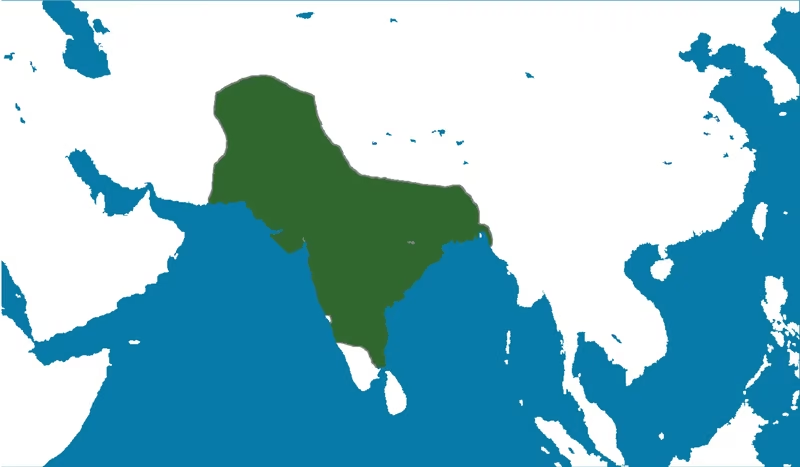
The Mughal Empire stands as one of the most significant political entities in Indian history, ruling most of the Indian subcontinent from 1526 to 1857. Founded by Babur, a descendant of both Timur and Genghis Khan, the empire represented a remarkable synthesis of Turkic, Persian, and Indian cultures that would leave an indelible mark on South Asian civilization. At its zenith in the late 17th century, the empire stretched from the outer fringes of the Indus River Basin in the west to the highlands of present-day Assam and Bangladesh in the east, encompassing an area of approximately 4 million square kilometers and governing a population that reached 158.4 million by 1700.
The Mughal Empire was characterized by its sophisticated administrative machinery, cultural patronage, and architectural grandeur. Persian served as the official language of the court and administration, while the empire's rulers promoted a remarkable degree of religious tolerance for much of their reign, particularly under emperors like Akbar. The empire's cultural achievements—from the ethereal beauty of the Taj Mahal to the refined art of miniature painting—continue to captivate the world centuries after its decline.
Despite beginning as a foreign dynasty, the Mughals successfully integrated themselves into the Indian political and cultural landscape, creating a unique Indo-Islamic civilization that blended Persian administrative practices, Islamic art and architecture, and Hindu traditions. This cultural synthesis, along with their military prowess and administrative innovations, enabled the Mughals to establish one of the most enduring empires in Indian history, lasting over three centuries until their final dissolution by the British in 1858.
Rise to Power
The Mughal Empire's foundation was laid on the battlefield of Panipat on April 21, 1526, when Babur, a Central Asian prince and descendant of Timur, defeated Ibrahim Lodi, the Sultan of Delhi. This First Battle of Panipat marked a watershed moment in Indian history, introducing gunpowder warfare on a massive scale to the subcontinent. Despite being outnumbered, Babur's superior military tactics, including the use of field artillery and matchlock firearms arranged in a defensive formation, proved decisive against Lodi's larger but less technologically advanced forces.
Babur, who had been pushed out of his ancestral kingdom of Fergana in Central Asia, had spent years consolidating power in Kabul before turning his attention to India. His victory at Panipat gave him control of the Delhi Sultanate's territories, but establishing Mughal rule proved challenging. Babur faced resistance from various quarters, including the Rajputs under Rana Sanga of Mewar and the Afghan nobles who had served the Lodi dynasty. His subsequent victories, particularly at the Battle of Khanwa in 1527 against the Rajput confederacy, solidified Mughal control over northern India.
However, the empire's future remained uncertain after Babur's death in 1530. His son Humayun faced severe challenges, including an invasion by Sher Shah Suri that forced him into exile in Persia from 1540 to 1555, a period known as the Mughal Interregnum. It was only after Humayun's restoration in 1555 and the subsequent reign of his son Akbar (1556-1605) that the Mughal Empire truly consolidated its power. The Second Battle of Panipat in 1556, where Akbar's forces defeated Hemu, the Hindu general who had briefly captured Delhi, marked the beginning of sustained Mughal dominance over northern India.
Golden Age
The Mughal Empire reached its apogee during the reigns of Akbar (1556-1605), Jahangir (1605-1627), Shah Jahan (1628-1658), and the early years of Aurangzeb (1658-1707). This period, often considered the empire's golden age, witnessed unprecedented territorial expansion, administrative sophistication, and cultural flourishing. Under Akbar, the empire expanded significantly through a combination of military conquest and diplomatic marriage alliances with Rajput kingdoms, extending Mughal authority across most of northern and central India.
Akbar's reign was particularly notable for its religious tolerance and administrative reforms. He abolished the discriminatory jizya tax on non-Muslims, married Rajput princesses to forge political alliances, and even attempted to create a syncretic religion called Din-i Ilahi. His administrative system, including the mansabdari system of ranking officials and the zabt revenue system, provided the empire with a stable bureaucratic foundation that would endure for generations. By 1595, the empire's population had grown to approximately 125 million people.
The architectural achievements of this period remain among the most celebrated in world history. Shah Jahan's reign saw the construction of the Taj Mahal in Agra, one of the Seven Wonders of the Modern World, along with the Red Fort and Jama Masjid in Delhi. The planned city of Fatehpur Sikri, built by Akbar, showcased the distinctive Mughal architectural style that blended Islamic, Persian, and Hindu elements. The Badshahi Mosque in Lahore, completed under Aurangzeb, stood as a testament to Mughal architectural ambition.
By 1690, during the early years of Aurangzeb's reign, the empire reached its maximum territorial extent of 4 million square kilometers, making it one of the largest empires in the world at that time. The empire's wealth was legendary, supported by sophisticated trade networks, productive agriculture, and a thriving manufacturing sector that produced textiles, metalwork, and luxury goods sought after across Asia and Europe.
Administration and Governance
The Mughal Empire developed one of the most sophisticated administrative systems in early modern Asia. At its apex was the emperor, who held absolute authority but governed through an elaborate bureaucratic hierarchy. The empire was divided into provinces (subahs), which were further subdivided into districts (sarkars) and smaller units (parganas). Each level had its own administrative officials responsible for revenue collection, law enforcement, and military affairs.
The mansabdari system, refined under Akbar, formed the backbone of Mughal civil and military administration. Officials were assigned ranks (mansabs) that determined their salary and the number of troops they were required to maintain. This system created a service nobility dependent on imperial favor rather than hereditary rights, allowing emperors to maintain centralized control. The mansabdari system was meritocratic in principle, with appointments based on capability rather than solely on birth, though in practice, noble families often dominated higher ranks.
Revenue administration was equally sophisticated. The zabt system of land revenue assessment, implemented by Akbar's finance minister Todar Mal, involved detailed surveys of land productivity and fixed revenue demands based on crop types and land quality. This system provided the empire with predictable revenue streams and reduced the arbitrary exploitation of peasants that had characterized earlier regimes. Revenue was collected in cash or kind, and the empire standardized its currency system, minting silver rupees, copper dams, and gold mohurs that facilitated trade across its vast territories.
Persian served as the official language of administration, law, and high culture, creating a unified administrative culture across the empire's diverse regions. However, local languages continued to be used at lower administrative levels, and the empire generally respected local customs and legal traditions. The judicial system operated at multiple levels, with the emperor serving as the ultimate court of appeal, while qazis (Islamic judges) handled cases involving Islamic law, and local customary law governed many civil matters.
Military Campaigns
The Mughal military machine was formidable, combining Central Asian cavalry traditions with Indian warfare methods and incorporating new gunpowder technologies. The empire's military campaigns began with Babur's conquests in the 1520s and continued for over two centuries, characterized by both expansionist wars and defensive operations to maintain territorial integrity.
The Mughal-Afghan Wars (1526-1752) represented a prolonged struggle for control of northern India and Afghanistan. These conflicts began with Babur's defeat of the Lodi dynasty and continued intermittently as various Afghan groups challenged Mughal authority. Sher Shah Suri's successful campaign that drove Humayun into exile demonstrated the formidable nature of Afghan resistance. Even after Humayun's restoration, Afghan nobles in Bengal and Bihar remained sources of instability for decades.
The Deccan Wars (1680-1707) under Aurangzeb represented the empire's most ambitious but ultimately exhausting military enterprise. Aurangzeb spent the last 26 years of his life campaigning in the Deccan, attempting to subdue the Maratha confederacy and the independent sultanates of Bijapur and Golconda. While he succeeded in conquering these sultanates and bringing the Deccan under nominal Mughal control, the prolonged warfare drained the imperial treasury, diverted attention from northern India, and ultimately weakened the empire's ability to respond to emerging threats.
The empire also faced external invasions that severely undermined its power. Nader Shah's invasion of India (1738-1740) was particularly devastating. The Persian ruler defeated Mughal forces, sacked Delhi, and carried away immense wealth, including the Peacock Throne and the Koh-i-Noor diamond. This invasion exposed the empire's military weakness and encouraged regional governors to assert greater independence. Throughout their reign, the Mughals also conducted diplomatic and military interactions with various Rajput kingdoms, sometimes as allies through marriage alliances, other times as adversaries.
Cultural Contributions
The Mughal Empire's cultural legacy represents one of its most enduring achievements, creating a distinctive Indo-Persian civilization that profoundly influenced South Asian art, architecture, literature, and music. The empire's rulers were renowned patrons of the arts, supporting poets, painters, musicians, and architects who created works of lasting significance.
Mughal architecture achieved a remarkable synthesis of Islamic, Persian, and Hindu styles, creating a distinctive aesthetic that remains iconic. The Taj Mahal, built by Shah Jahan as a mausoleum for his wife Mumtaz Mahal, represents the pinnacle of Mughal architectural achievement with its perfect proportions, intricate marble inlay work, and harmonious integration with its gardens and surroundings. Other architectural marvels include the Red Fort in Delhi with its magnificent Diwan-i-Khas (Hall of Private Audience), the Jama Masjid, and the planned city of Fatehpur Sikri, which showcased innovative urban planning and water management systems.
The Mughal miniature painting tradition flourished under imperial patronage, blending Persian painting techniques with Indian sensibilities. Court ateliers produced illustrated manuscripts of historical chronicles, Persian classics, and Hindu epics, developing a distinctive style characterized by fine detail, vibrant colors, and naturalistic portrayal of human figures and animals. The Akbarnama and the Padshahnama manuscripts exemplify this tradition's sophistication.
Literature thrived in multiple languages during Mughal rule. Persian poetry reached new heights with poets like Faizi and Abdul Rahim Khan-i-Khana. Urdu emerged as a literary language, developing from the interaction between Persian, Arabic, and local languages in military camps and urban centers. The Mughal court also patronized Sanskrit scholarship, with translations of Hindu texts into Persian facilitating cultural exchange.
Music and dance flourished under Mughal patronage, with the development of Hindustani classical music. The empire's rulers supported master musicians, and several emperors, including Bahadur Shah I, were accomplished musicians themselves. The period saw the codification of ragas and the development of musical forms like the dhrupad and khayal that continue to define North Indian classical music.
Economy and Trade
The Mughal Empire presided over one of the world's most productive economies in the early modern period. Agriculture formed the economic foundation, with the empire's fertile river valleys producing abundant crops including rice, wheat, sugarcane, cotton, and indigo. The sophisticated revenue system ensured a steady flow of resources to the imperial treasury while generally maintaining agricultural productivity.
Manufacturing flourished across the empire, particularly in textile production. Mughal India was renowned worldwide for its fine cotton muslins, silk fabrics, and elaborately designed carpets. Cities like Dhaka, Surat, Lahore, and Agra became major manufacturing centers, their products sought after in markets from Europe to Southeast Asia. The empire's artisans excelled in various crafts, including metalwork, jewelry, arms manufacturing, and shipbuilding.
Trade networks connected the Mughal Empire to the broader Asian and global economy. Overland trade routes linked India to Central Asia and Persia, while maritime trade connected Indian ports to the Middle East, Southeast Asia, and increasingly to European trading companies. Major port cities like Surat, Cambay, and later Calcutta became cosmopolitan trading hubs where merchants from diverse backgrounds conducted business.
The empire standardized its currency system with the rupee, dam, and taka, facilitating commercial transactions across vast distances. The silver rupee became widely accepted beyond Mughal territories, and its weight and purity standards influenced currency systems across Asia. The empire's mints produced coins with standardized specifications, supporting the monetization of the economy and the growth of banking and credit systems.
European trading companies, particularly the English East India Company and the Dutch VOC, established factories and trading posts in Mughal territories during the 17th century. Initially operating with imperial permission and paying customs duties, these companies gradually gained political influence, a process that would ultimately contribute to the empire's demise. The influx of American silver through trade helped monetize the Mughal economy but also contributed to inflation in later periods.
Decline and Fall
The Mughal Empire's decline was a gradual process spanning over a century, resulting from multiple interrelated factors. Aurangzeb's prolonged Deccan campaigns (1680-1707) severely strained imperial resources and diverted attention from northern India, where new powers like the Marathas, Sikhs, and Jats were emerging. His more orthodox religious policies, including the reimposition of the jizya tax on non-Muslims, alienated important segments of the population and weakened the political alliances that had sustained earlier emperors.
After Aurangzeb's death in 1707, the empire experienced a succession crisis and rapid territorial fragmentation. Weak emperors ruled from Delhi while provincial governors (nawabs and subahdars) asserted increasing independence, transforming their provinces into virtually autonomous states. Bengal, Awadh, and Hyderabad became independent in all but name, though their rulers continued to acknowledge nominal Mughal suzerainty.
Nader Shah's devastating invasion in 1738-1740 dealt a crushing blow to Mughal prestige and finances. The sack of Delhi and the loss of the imperial treasury exposed the empire's military weakness and encouraged further fragmentations. Regional powers including the Marathas, who had expanded across central and northern India, and the Afghan Ahmad Shah Abdali, who repeatedly invaded northern India, further weakened Mughal authority.
The rise of the British East India Company transformed it from a trading concern into a territorial power. The Company's victory at the Battle of Plassey in 1757 gave it control of Bengal, the empire's richest province. Through a combination of military conquest, diplomatic manipulation, and alliances with Indian rulers, the Company expanded its territories while reducing the Mughal emperor to a pensioner dependent on British subsidies.
The Indian Rebellion of 1857 marked the empire's final chapter. Rebel forces declared the elderly Bahadur Shah II their leader, making him a symbolic figurehead of resistance against British rule. After the rebellion's suppression, the British besieged Delhi on September 21, 1857. Bahadur Shah II was captured, tried for treason, and exiled to Rangoon, Burma, on October 7, 1858, where he died in 1862. The British Crown formally assumed direct control of India, ending over three centuries of Mughal rule.
Legacy
The Mughal Empire's legacy profoundly shaped the Indian subcontinent's cultural, architectural, and political landscape. The empire's administrative innovations, including revenue systems and bureaucratic structures, influenced subsequent governments, including British colonial administration. The concepts of centralized governance and professional bureaucracy that the Mughals developed continued to inform statecraft in South Asia.
Architecturally, the Mughal heritage remains visible across South Asia in monuments that have become national symbols. The Taj Mahal serves as India's most recognizable landmark, while structures like the Red Fort, Humayun's Tomb, and numerous mosques, forts, and gardens continue to define cityscapes from Lahore to Dhaka. Mughal architectural principles influenced later building traditions and continue to inspire contemporary architects.
The Indo-Persian cultural synthesis initiated under Mughal patronage fundamentally shaped South Asian high culture. Urdu emerged as a major literary language, carrying forward the Persian literary tradition while incorporating indigenous elements. The Hindustani classical music tradition developed under Mughal patronage remains vibrant today. Mughal miniature painting influenced later artistic traditions, and Mughal decorative arts, including textile designs and jewelry patterns, continue to resonate in contemporary South Asian aesthetics.
Mughal cuisine, blending Central Asian, Persian, and Indian culinary traditions, created distinctive dishes that remain popular across South Asia and beyond. Dishes attributed to Mughal court cuisine, including various biryanis, kormas, and kebabs, form an integral part of modern South Asian gastronomy.
The Mughal period also witnessed significant literary production in multiple languages, with chronicles, poetry, and translations creating a rich textual heritage. Persian historical chronicles provide crucial sources for understanding not only Mughal history but also the broader history of early modern South Asia. The administrative and diplomatic documents from the period offer invaluable insights into governance, commerce, and social relations.
However, the Mughal legacy remains contested in contemporary South Asian politics, with debates over religious tolerance, cultural synthesis, and historical interpretation reflecting modern political divisions. Despite these controversies, the Mughal period's contributions to South Asian civilization remain undeniable, representing a crucial chapter in the region's history that continues to influence contemporary culture, architecture, and governance.