Overview
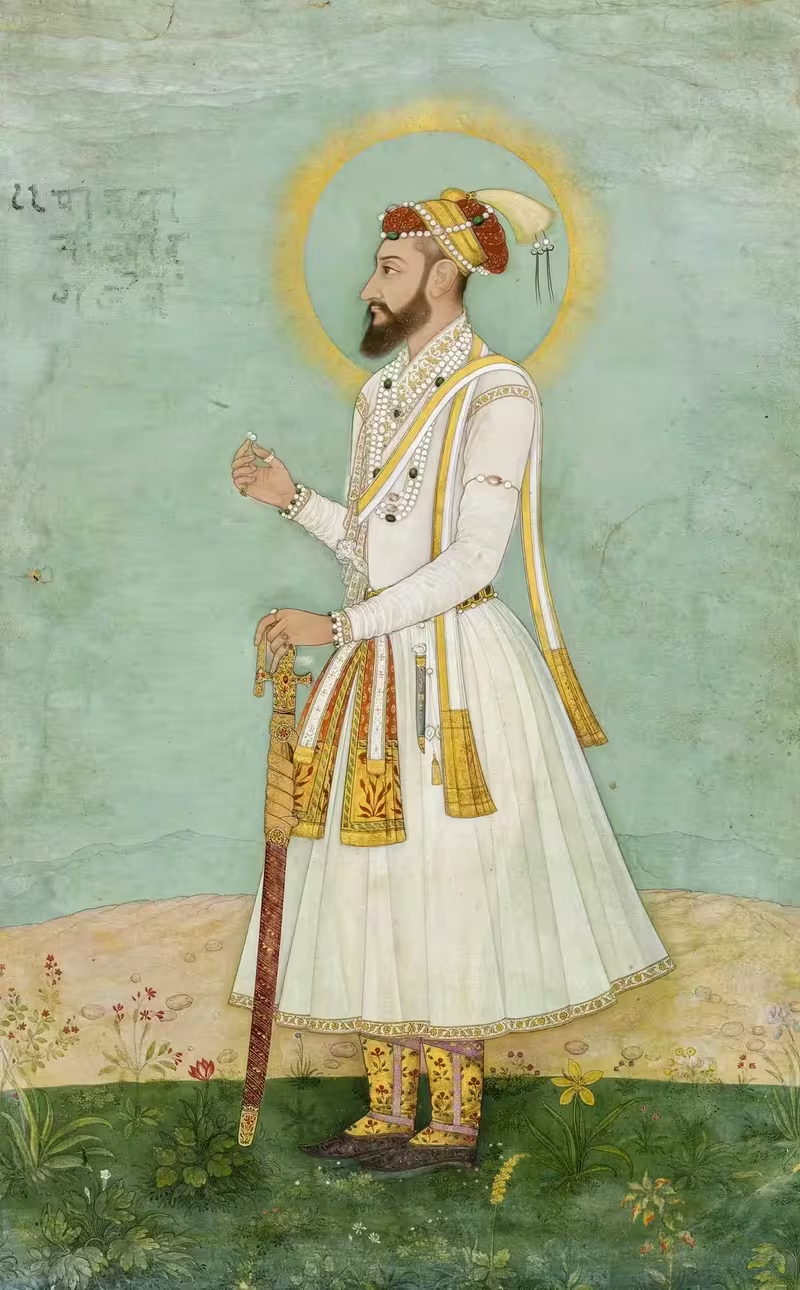
Aurangzeb, formally known as Abul Muzaffar Muhi-ud-Din Muhammad Aurangzeb and styled as Alamgir I ("Conqueror of the World"), was the sixth Mughal Emperor who ruled from 1658 until his death in 1707. His 49-year reign represents both the zenith and the beginning of the decline of the Mughal Empire. Born on November 3, 1618, in Dahod, Gujarat, as the third son of Emperor Shah Jahan and Mumtaz Mahal, Aurangzeb would become one of the most powerful yet controversial rulers in Indian history.
Under Aurangzeb's military leadership and administrative control, the Mughal Empire reached its greatest territorial extent, spanning nearly the entire Indian subcontinent with an estimated area of 4 million square kilometers. His relentless military campaigns, particularly in the Deccan region, brought the independent sultanates of Bijapur and Golconda under Mughal control, fulfilling a long-standing imperial ambition. However, these same campaigns would drain the empire's resources and create the conditions for its eventual fragmentation.
Aurangzeb's reign is marked by paradoxes: he was a devout Muslim who lived with remarkable personal austerity despite commanding immense wealth, a capable military commander who spent decades away from his capital in grueling campaigns, and an administrator who implemented both effective revenue reforms and controversial religious policies. His legacy remains deeply contested, viewed by some as a great Islamic ruler and military genius, and by others as a religious zealot whose policies alienated large segments of his diverse empire and sowed the seeds of Mughal decline.
Early Life
Aurangzeb was born on November 3, 1618 (some sources suggest October 24), in Dahod, Gujarat, during his father Shah Jahan's tenure as a Mughal prince. As the third son of Shah Jahan and his beloved wife Mumtaz Mahal (for whom the Taj Mahal would later be built), Aurangzeb grew up in the luxurious yet intensely competitive environment of the Mughal court. He had several siblings, including his elder brothers Dara Shikoh and Shah Shuja, and younger brother Murad Bakhsh, all of whom would later become rivals in the war of succession.
Unlike his eldest brother Dara Shikoh, who was known for his intellectual pursuits and syncretic religious views, Aurangzeb developed a reputation for orthodox Islamic piety and martial discipline from an early age. He received a comprehensive education befitting a Mughal prince, studying Persian and Arabic literature, Islamic jurisprudence, military tactics, and statecraft. Historical accounts describe him as serious, disciplined, and devoted to prayer, characteristics that would define his personal life throughout his reign.
Aurangzeb's relationship with his father Shah Jahan appears to have been complex. While Shah Jahan favored his eldest son Dara Shikoh as his successor, Aurangzeb proved himself a capable military commander and administrator, earning respect if not paternal warmth. This dynamic would have profound consequences for the succession crisis that eventually brought Aurangzeb to power.
Rise to Power
Aurangzeb's path to the imperial throne was marked by military service, administrative experience, and ultimately, fratricidal conflict. His first major appointment came in February 1645, when Shah Jahan appointed him Subahdar (governor) of Deccan, a position he held until January 1647. During this tenure, Aurangzeb gained valuable experience in military campaigns and regional administration, though his relationship with the emperor remained strained.
The succession crisis began in 1657 when Shah Jahan fell seriously ill, creating uncertainty about the imperial succession. The Mughal tradition of imperial succession was notoriously brutal, with princes expected to prove their worthiness through combat rather than automatic primogeniture. Aurangzeb, then serving in the Deccan, began to position himself for the throne, despite Shah Jahan's clear preference for Dara Shikoh, who had been given the title of heir apparent.
What followed was the War of Succession (1657-1659), one of the bloodiest succession contests in Mughal history. Aurangzeb initially formed an alliance with his younger brother Murad Bakhsh, who governed Gujarat. Together, they defeated their brother Shah Shuja, governor of Bengal, and then marched north toward Agra. In a decisive confrontation, Aurangzeb defeated Dara Shikoh's forces at the Battle of Samugarh in May 1658, near Agra.
Following his military victory, Aurangzeb made the controversial decision to imprison his father Shah Jahan in Agra Fort, where the former emperor would spend the last eight years of his life, reportedly gazing at the Taj Mahal across the Yamuna River. Aurangzeb then systematically eliminated his rivals: he betrayed and imprisoned Murad Bakhsh (who was later executed), defeated and eventually captured Dara Shikoh (who was executed for heresy in 1659), and drove Shah Shuja into exile where he disappeared.
On July 31, 1658, Aurangzeb was formally crowned emperor in the Sheesh Mahal at the Shalimar Gardens in Lahore, taking the regnal title Alamgir, meaning "Conqueror of the World" or "Seizer of the Universe."
Reign and Imperial Administration
Aurangzeb's nearly 50-year reign was characterized by military expansion, administrative centralization, and religious orthodoxy. Upon ascending the throne, he inherited an already vast empire but was determined to extend Mughal authority over the remaining independent territories of the subcontinent, particularly in the Deccan and the south.
In terms of administrative structure, Aurangzeb maintained and refined the mansabdari system established by his predecessors, which organized the nobility and military into ranks based on cavalry command. He appointed capable grand viziers throughout his reign, including Fazil Khan (1658-1663), Jafar Khan (1663-1670), and Asad Khan (1676-1707), who helped manage the sprawling imperial bureaucracy. However, unlike his great-grandfather Akbar, who had built a diverse coalition including Hindu Rajputs in positions of power, Aurangzeb's court became increasingly dominated by Muslim nobility, though he did continue to employ Hindu administrators and military commanders.
The emperor was known for his personal austerity and strict adherence to Islamic law. Despite controlling immense wealth, he allegedly lived simply, earning money by copying the Quran by hand and sewing caps. He banned music at court, prohibited alcohol, and restricted various activities he deemed un-Islamic. However, the extent and uniformity of these restrictions across the empire remain debated by historians.
Aurangzeb's religious policies represent one of the most controversial aspects of his reign. He reimposed the jizya (tax on non-Muslims) in 1679, which had been abolished by Akbar nearly a century earlier. This decision alienated many Hindu subjects and contributed to rebellions, particularly among the Rajputs and Marathas. He also ordered the destruction of several Hindu temples, though the extent, motivation, and systematic nature of these destructions continue to be debated among historians, with some arguing they were primarily political rather than purely religious acts.
Military Campaigns and Territorial Expansion
The Deccan campaigns dominated the latter half of Aurangzeb's reign and fundamentally shaped both his legacy and the empire's future. In 1681, Aurangzeb personally moved to the Deccan, where he would remain for the last 26 years of his life, commanding military operations from mobile camps that functioned as temporary capitals.
The primary objectives were the conquest of the Deccan sultanates of Bijapur and Golconda, and the suppression of the Maratha rebellion led by Shivaji and later his successors. After prolonged sieges, Aurangzeb successfully annexed Bijapur in 1686 and Golconda in 1687, bringing these wealthy kingdoms under direct Mughal control. These victories represented the culmination of Mughal imperial ambition, extending the empire to its greatest territorial extent.
However, the Maratha resistance proved far more intractable. Shivaji, the founder of the Maratha Empire, had established a effective guerrilla warfare strategy that proved difficult for Mughal conventional forces to counter. Even after Shivaji's death in 1680, his successors continued the resistance. Aurangzeb captured Shivaji's son Sambhaji in 1689 and executed him, but this did not end Maratha resistance. Instead, under the leadership of Rajaram and later figures like Tarabai, the Marathas continued their raids and gradually expanded their territory.
The prolonged Deccan campaigns proved enormously costly in terms of resources, manpower, and imperial attention. Aurangzeb's absence from the northern capitals weakened control over those regions, allowing regional powers to assert greater autonomy. The constant warfare drained the imperial treasury despite the empire's vast resources, and the difficult terrain and guerrilla tactics of the Marathas prevented decisive victory.
Major Achievements
Despite the controversies surrounding his reign, Aurangzeb's achievements in expanding and administering the empire were substantial. Under his rule, the Mughal Empire reached its maximum territorial extent of approximately 4 million square kilometers, encompassing almost the entire Indian subcontinent except for the southern tip. This made it one of the largest empires in the world at the time and certainly the largest in Indian history.
Aurangzeb proved himself an effective military commander and strategist, personally leading campaigns well into his old age. His conquest of Bijapur and Golconda completed the Mughal imperial project in the Deccan, bringing these wealthy sultanates with their diamond mines and trade networks under imperial control. His military organization and logistics, necessary to sustain armies in the field for decades, demonstrated considerable administrative capability.
In terms of revenue administration, Aurangzeb implemented reforms to the jagir system (land revenue assignments) and worked to prevent corruption among revenue collectors. His reign saw systematic land surveys and attempts to standardize revenue collection, though the effectiveness of these reforms varied by region. The empire's revenue during his reign was substantial, though the military campaigns consumed much of it.
Aurangzeb also patronized Islamic scholarship and the compilation of Islamic legal codes, most notably the Fatawa-e-Alamgiri, a comprehensive collection of Islamic jurisprudence compiled by scholars at his court. Despite his prohibition of music at court, his reign saw continued architectural activity, including the Badshahi Mosque in Lahore (completed in 1673), one of the largest mosques in the world, and the Bibi Ka Maqbara in Aurangabad, built as a mausoleum for his wife Dilras Banu Begum.
Personal Life
Historical sources depict Aurangzeb as a man of contradictions: an emperor who commanded vast wealth yet lived austerely, a devoted Muslim who spent decades in military camps, and a father whose relationships with his sons mirrored his own troubled relationship with Shah Jahan.
Aurangzeb married multiple wives, including Dilras Banu, who died in 1657, Nawab Bai, and Zainabadi Mahal. His marriage to Dilras Banu appears to have been particularly significant; after her death, his son Azam Shah commissioned the Bibi Ka Maqbara in her memory. He fathered numerous children, including five sons who survived to adulthood: Muhammad Sultan, Muazzam (later Bahadur Shah I), Muhammad Azam, Muhammad Akbar, and Kam Bakhsh.
Historical accounts emphasize Aurangzeb's personal piety and asceticism. He reportedly prayed five times daily without fail, even during military campaigns, and copied the Quran by hand, selling these copies to earn personal income rather than relying solely on the imperial treasury. He allegedly sewed caps and sold them, again to earn money independently. These habits distinguished him from the more luxurious lifestyles of most Mughal emperors.
His relationships with his daughters were complex. His eldest daughter, Zeb-un-Nisa, was a noted poet and patron of the arts, but Aurangzeb reportedly imprisoned her for years, allegedly for supporting her rebellious brother Muhammad Akbar. This action reflected the emperor's willingness to subordinate family bonds to political necessity, a pattern established when he imprisoned his own father.
His relationship with his sons deteriorated as they matured, mirroring the pattern of Mughal succession conflicts. His son Muhammad Akbar rebelled against him in 1681 with Rajput support, though the rebellion failed and Akbar fled to Maratha territory and eventually to Persia. The succession conflict that erupted immediately after Aurangzeb's death among his surviving sons demonstrated that he had not resolved the fundamental problem of Mughal succession despite his long reign.
Challenges and Controversies
Aurangzeb's reign was marked by numerous rebellions and persistent resistance to Mughal authority, many of which were exacerbated by his religious and political policies. The Rajput rebellion, which began after he ordered the seizure of certain Rajput territories and temples, significantly weakened a traditional pillar of Mughal military power. The Rajputs had been crucial allies since Akbar's reign, but many now turned against the empire.
The Maratha resistance, led initially by Shivaji and continuing under his successors, proved to be Aurangzeb's most intractable problem. Despite capturing and executing Sambhaji, Shivaji's son, in 1689, the Marathas continued their guerrilla warfare and gradually expanded their control over significant territories. The empire's inability to decisively defeat the Marathas despite decades of effort and enormous expenditure of resources demonstrated the limits of Mughal military power.
The Sikh community also faced persecution during Aurangzeb's reign. The execution of the ninth Sikh Guru, Guru Tegh Bahadur, in 1675, reportedly for refusing to convert to Islam and defending religious freedom, led to lasting Sikh opposition to Mughal authority. This action and subsequent policies toward Sikhs contributed to the militarization of the Sikh community under the tenth Guru, Guru Gobind Singh.
The reimposition of the jizya tax on non-Muslims in 1679 generated widespread resentment and had significant economic and political consequences. While Aurangzeb justified this as a return to Islamic law, it alienated Hindu subjects and contributed to economic disruption as some Hindu merchants relocated to territories beyond Mughal control.
Historians continue to debate the nature and extent of Aurangzeb's temple destruction policies. While it is documented that he ordered the destruction of several prominent temples, including those at Varanasi and Mathura, scholars debate whether this represented systematic religious persecution or selective political acts targeting centers of rebellion. Some historians argue that Aurangzeb also provided grants to some Hindu temples and employed Hindu administrators, suggesting a more complex picture than simple religious bigotry.
The prolonged Deccan campaigns, while militarily successful in conquering Bijapur and Golconda, proved strategically problematic. The enormous cost in resources and the emperor's decades-long absence from the northern capitals weakened imperial control and allowed regional powers to grow stronger. The campaigns failed to achieve lasting pacification of the Deccan, and the resources expended arguably weakened the empire more than the territorial gains strengthened it.
Later Years and Death
The final decades of Aurangzeb's life were spent almost entirely in the Deccan, commanding military operations from mobile camps. Contemporary accounts describe an aging emperor, increasingly aware of his mortality and the fragility of his accomplishments. His letters from this period reveal a man conscious of his approaching death and concerned about the legacy he would leave.
As Aurangzeb aged, he continued to lead campaigns despite declining health, driven by determination to subdue the Marathas and consolidate Mughal control over the Deccan. However, the guerrilla tactics of the Marathas prevented decisive victory, and the emperor's extended absence from the northern capitals allowed regional governors and zamindars to assert greater autonomy.
In his final years, Aurangzeb reportedly expressed regret about certain aspects of his reign. Letters attributed to him suggest remorse for the time spent in military campaigns and concern about the succession that would follow his death. Despite his long reign and multiple sons, he had not established a clear succession mechanism, virtually guaranteeing another war of succession.
Aurangzeb died on March 3, 1707, in Ahilyanagar (formerly Aurangabad), Maharashtra, at the age of 88, having ruled for 49 years. In accordance with his wishes, he was buried in a simple, open-air grave at Khuldabad, near the shrine of the Sufi saint Shaikh Burhan-ud-din Gharib. This contrasted dramatically with the elaborate mausoleums of his predecessors, including the Taj Mahal built by his father. The modest grave, as requested, had no structure over it initially, reflecting his stated preference for austerity even in death.
His death triggered the War of Succession (1707-1709) among his surviving sons, with Muazzam eventually emerging victorious to become Bahadur Shah I. However, the empire Bahadur Shah inherited was vastly different from the one Aurangzeb had ruled at its height—overextended, financially strained, and facing rebellions and autonomous regional powers.
Legacy
Aurangzeb's legacy remains one of the most debated and contested in Indian history. His reign represents a watershed in Mughal history: the empire reached its greatest territorial extent under his rule, yet the seeds of its decline were also sown during his long reign. Within a few decades of his death, the Mughal Empire had fragmented into effectively independent regional kingdoms, though the imperial title continued until the British formally abolished it in 1857.
Militarily, Aurangzeb's conquests expanded the empire significantly, but the methods and costs of expansion created new problems. The prolonged Deccan campaigns drained resources that might have been used to strengthen control over existing territories. The Maratha resistance continued to grow stronger, and by the mid-18th century, the Marathas would dominate much of India. Regional powers in Bengal, Awadh, and Hyderabad became effectively independent, nominally acknowledging Mughal sovereignty while acting autonomously.
The religious policies of Aurangzeb's reign had lasting consequences for Indian society and politics. The reimposition of the jizya, the destruction of temples, and the executions of religious figures like Guru Tegh Bahadur created lasting resentments that continued long after his death. These policies contrasted sharply with Akbar's policy of sulh-i-kul (peace with all) and alienated the Hindu majority population, weakening one of the foundations of Mughal power.
Architecturally, Aurangzeb's reign is less celebrated than those of his predecessors, partly due to his personal austerity and partly due to the shift of resources toward military campaigns. The Badshahi Mosque in Lahore and the Bibi Ka Maqbara in Aurangabad stand as major architectural achievements of his era, though the latter, sometimes called the "Taj of the Deccan," lacks the grandeur of Shah Jahan's monuments.
In historiography, Aurangzeb has been portrayed in dramatically different ways. Colonial British historians often depicted him as a religious fanatic whose policies destroyed the harmonious empire created by Akbar, though these accounts were colored by colonial prejudices and agendas. Nationalist historians in the 20th century similarly criticized his religious policies as divisive. However, some historians have argued for a more nuanced understanding, suggesting that his policies were primarily political rather than purely religious, and that he maintained diverse administration despite his personal religious orthodoxy.
Modern scholarship on Aurangzeb emphasizes the complexity of his reign and cautions against simplistic characterizations. Recent historians note that he patronized Hindu officials, provided grants to some temples, and that many of his actions need to be understood in their political and strategic context rather than purely religious terms. However, this scholarly revisionism remains contested, and Aurangzeb continues to be a polarizing figure in Indian historical consciousness and politics.
Aurangzeb's tomb at Khuldabad remains a site of pilgrimage and tourism, its simplicity standing in stark contrast to the grandeur of other Mughal monuments. The Bibi Ka Maqbara in Aurangabad and the Badshahi Mosque in Lahore serve as his most prominent architectural memorials. Cities like Aurangabad bear his name, though this has occasionally become controversial in contemporary Indian politics.
The debate over Aurangzeb's legacy reflects broader questions about how India remembers and interprets its past—questions about religious pluralism, the nature of political authority, and the relationship between different communities that remain relevant in contemporary India.
Timeline
Birth
Born in Dahod, Gujarat
Became Emperor
Crowned Mughal Emperor after defeating brothers
Deccan Campaigns Begin
Began prolonged military campaigns in the Deccan
Death
Died at Ahmednagar