Overview
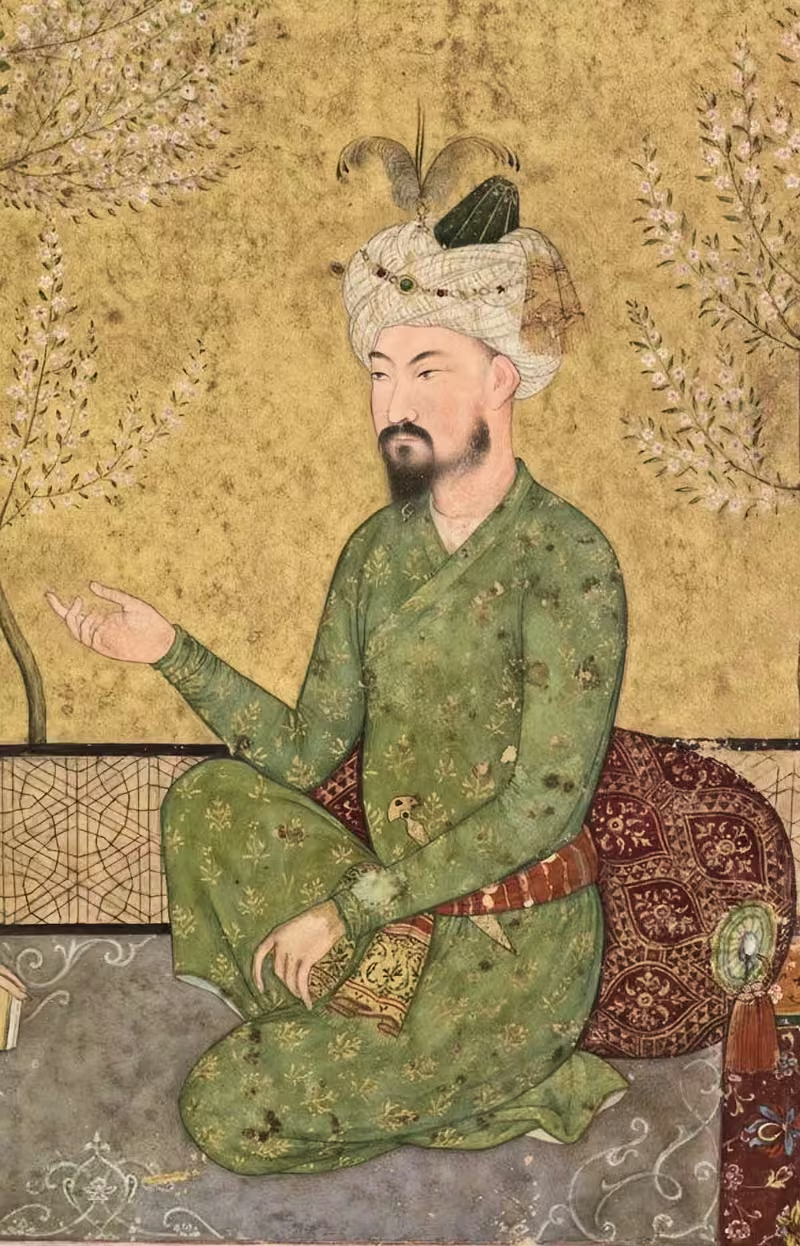
Zahir-ud-Din Muhammad Babur (1483-1530) was the founder of the Mughal Empire in the Indian subcontinent, establishing a dynasty that would dominate the region for over three centuries. Born into the Timurid dynasty in Fergana (modern-day Uzbekistan), Babur carried the prestigious lineage of two of history's most renowned conquerors—Timur (Tamerlane) through his father and Genghis Khan through his mother. This dual heritage of Central Asian warrior aristocracy shaped his ambitions and military prowess throughout his life.
Babur's journey to becoming the founder of one of India's greatest empires was marked by decades of struggle, loss, and perseverance. After losing his ancestral kingdom of Fergana and failing repeatedly to capture Samarkand, the jewel of Central Asia, Babur turned his attention southward. His conquest of Kabul in 1504 provided him with a stable base, and eventually, his ambitions led him to India. In 1526, at the First Battle of Panipat, Babur's small but technologically superior army defeated the much larger forces of Ibrahim Lodi, the Sultan of Delhi, marking the beginning of Mughal rule in India.
Beyond his military achievements, Babur was a Renaissance man of his age—a cultured poet, a keen observer of nature, a passionate gardener, and most notably, the author of the Baburnama, one of the finest autobiographical works in world literature. Written in Chagatai Turkish, his memoirs provide invaluable insights into 16th-century Central Asian and Indian history, culture, and society. Despite his success in establishing an empire in India, Babur never fully embraced his new homeland, frequently expressing his longing for the fruits, climate, and landscapes of Central Asia. He was posthumously given the title "Firdaws Makani" (Dwelling in Paradise), a testament to the reverence in which he was held by his descendants.
Early Life
Babur was born on February 14, 1483, in Andijan, the capital of the Fergana Valley, a fertile region in what is now eastern Uzbekistan. He was the eldest son of Umar Shaikh Mirza II, the ruler of Fergana, and Qutlugh Nigar Khanum, a descendant of Genghis Khan through the Chagatai Khanate. This extraordinary lineage placed young Babur at the intersection of two great Central Asian imperial traditions—the Timurid and the Mongol.
Babur's childhood was spent in the sophisticated court culture of the Timurids, where he received an education befitting a prince. He was trained in Persian and Chagatai Turkish literature, military arts, and statecraft. The Timurid courts were centers of learning and artistic achievement, and Babur developed a lifelong appreciation for poetry, calligraphy, and garden design. From an early age, he showed exceptional intelligence and a keen interest in documenting his observations, a habit that would later result in his famous memoirs.
Tragedy struck when Babur was just eleven years old. In 1494, his father, Umar Shaikh Mirza, died in a bizarre accident when his dovecote collapsed while he was tending to his birds. The sudden death thrust young Babur into the dangerous world of Central Asian politics, where he inherited not just a kingdom but also a web of complex rivalries, ambitious relatives, and external threats. The Fergana Valley, though prosperous, was surrounded by more powerful neighbors, and Babur's maternal relatives, the Mongol khans, and his Timurid cousins all harbored their own ambitions.
Rise to Power
Babur's ascension to the throne of Fergana in November 1496 was immediate but precarious. At just thirteen years old, he faced challenges from multiple directions—rebellious nobles within his own kingdom, ambitious relatives seeking to usurp his position, and the powerful Uzbek Shaybanids under Muhammad Shaybani Khan, who were sweeping through Central Asia, destroying Timurid principalities.
The young ruler's obsession became Samarkand, the legendary capital of his ancestor Timur and the most prestigious city in Central Asia. Babur captured Samarkand briefly in 1497, but his tenure lasted only a hundred days before he was forced to retreat. During his absence, he also lost Fergana to rebellious nobles. At fourteen, Babur found himself a king without a kingdom, wandering with a small band of loyal followers. This period of hardship forged his character and military skills. He lived the life of a nomadic warrior, constantly fighting to regain his patrimony.
Babur made another attempt to capture Samarkand in 1501, and this time he succeeded in holding it for several months. However, the rising power of the Uzbek Shaybanids proved insurmountable. Muhammad Shaybani Khan defeated Babur decisively, forcing him to flee across the mountains. At this low point in his fortunes, with no kingdom and dwindling supporters, Babur made a crucial strategic pivot. Instead of continuing his futile attempts to reclaim his Central Asian territories, he turned his attention to Afghanistan.
In 1504, Babur captured Kabul, which would serve as his base for the next twenty years. Though smaller and less prestigious than Samarkand or Fergana, Kabul's strategic location and relative stability gave Babur the foundation he needed. From this position, he made several expeditions into India, initially as raids for plunder but gradually developing grander ambitions. His first major foray into India occurred in 1505, and over the next two decades, he conducted numerous campaigns to test the defenses of the Delhi Sultanate.
Conquest of India and Establishment of the Mughal Empire
By the 1520s, the Delhi Sultanate under the Lodi dynasty had weakened considerably. Ibrahim Lodi, the Sultan of Delhi, faced rebellions from his own nobles and had alienated many of his Afghan chiefs. Daulat Khan Lodi, the Governor of Punjab, and Alam Khan, an uncle of Ibrahim Lodi who had his own claim to the throne, invited Babur to invade India and overthrow Ibrahim. They believed they could use Babur as a tool and then dismiss him, fatally underestimating the Timurid prince's ambitions and capabilities.
Babur accepted the invitation and marched toward Delhi with a relatively small but highly disciplined army of about 12,000 men. On April 21, 1526, the two armies met at Panipat, about 90 kilometers north of Delhi. Ibrahim Lodi commanded a massive force estimated at 100,000 soldiers and 1,000 war elephants. On paper, the battle seemed hopelessly one-sided. However, Babur possessed two crucial advantages: superior military technology and tactical genius.
Babur employed artillery and matchlock guns, relatively new technologies in the Indian context, and arranged his forces using the tulughma (flanking) tactic he had learned from the Uzbeks. He also used a defensive technique involving carts (araba) chained together to create a mobile fortification. When Ibrahim Lodi's army attacked, Babur's cannons and firearms created devastating casualties. The flanking cavalry then attacked the Lodi forces from both sides, creating chaos in their ranks. Ibrahim Lodi died fighting on the battlefield, and his army disintegrated. The First Battle of Panipat ranks among the most decisive battles in Indian history, as it marked the end of the Delhi Sultanate and the beginning of Mughal rule.
Following his victory, Babur entered Delhi and then Agra, proclaiming himself Badshah (Emperor). However, his position remained precarious. Many of his soldiers, uncomfortable with India's heat and longing for Central Asia, wanted to return home with their plunder. Babur himself shared their sentiments about India's climate but recognized the strategic and economic importance of his conquest. He persuaded his followers to stay, promising them the riches of a vast empire.
Babur faced immediate challenges to his newly won empire. The Rajput confederacy under Rana Sanga of Mewar posed the most serious threat. Rana Sanga had been preparing to attack the Delhi Sultanate himself and viewed Babur as a foreign invader who had stolen his opportunity. In 1527, at the Battle of Khanwa, Babur again faced a numerically superior force. Rana Sanga commanded about 80,000 Rajput warriors, while Babur's force was even smaller than at Panipat. Using similar tactics—artillery, defensive positions, and disciplined cavalry charges—Babur achieved another decisive victory, solidifying his control over northern India.
Reign and Administration
Babur's reign as Emperor of Hindustan lasted only four years, from 1526 to 1530, but he laid the essential foundations of Mughal administration and established the dynasty's presence in India. Unlike many conquerors, Babur did not merely plunder and leave; he worked to create a stable administrative structure, though many of his systems were still evolving at the time of his death.
Babur faced the enormous challenge of governing a vast territory with diverse populations, religions, and cultures. Coming from the Central Asian Timurid tradition, he initially attempted to apply familiar administrative models, but he gradually recognized the need to adapt to Indian conditions. He appointed governors (subahdars) to major provinces and distributed jagirs (land grants) to his military commanders and nobles to ensure their loyalty and provide them with revenue.
Despite his military success, Babur never felt truly at home in India. His memoirs contain numerous passages expressing his dislike of India's heat, its lack of running water and good melons, and what he perceived as the aesthetic inferiority of Indian architecture compared to Central Asian styles. He wrote extensively about his longing for the fruits, gardens, and cool breezes of Kabul and Samarkand. Yet, even while complaining about India, Babur demonstrated his typical attention to detail by documenting Indian flora, fauna, customs, and geography with remarkable accuracy and insight.
Babur's passion for gardens found expression even in India. Following the Central Asian tradition of charbagh (four-part) gardens, he ordered the creation of several gardens, though few survived. He saw gardens as symbols of paradise on earth and as spaces for both contemplation and celebration. The most famous garden associated with his legacy is the Bagh-e Babur (Gardens of Babur) in Kabul, where he would eventually be buried according to his wishes.
The Baburnama: Literary Achievement
Among Babur's many accomplishments, his autobiography, the Baburnama (also called Tuzk-e Babri), stands as a unique achievement in world literature. Written in Chagatai Turkish, the language of his childhood and the literary language of the Timurid court, the Baburnama is remarkable for its honesty, detail, and literary quality. Unlike many royal chronicles that focus solely on military victories and political achievements, Babur's memoirs reveal a multi-dimensional personality.
The Baburnama covers the period from 1494, when Babur inherited Fergana at age eleven, until shortly before his death in 1530. In it, Babur describes his military campaigns, political intrigues, and administrative challenges with surprising candor, often admitting his own mistakes and failures. But the work transcends mere military and political history. Babur writes extensively about Central Asian and Indian geography, systematically describing the regions he encountered. He documents plants, animals, and agricultural practices with the precision of a naturalist.
Babur's literary style combines the refined sophistication of Persian court literature with a directness and personal voice that was unusual for the time. He writes movingly about his love for his companions, his grief at losing friends and family members, and his appreciation for beauty in nature and art. He includes poetry—both his own compositions and works by others—demonstrating his engagement with the rich literary culture of his time. The Baburnama also reveals Babur's sense of humor and his ability to laugh at himself, qualities rarely found in royal memoirs.
The historical value of the Baburnama cannot be overstated. It provides firsthand accounts of major events and offers insights into early 16th-century Central Asian and Indian history that would otherwise be lost. The work has been translated into Persian, English, and numerous other languages, and it remains an essential primary source for historians studying the period.
Personal Life and Character
Babur married multiple times, following the custom of his time and social position. His first marriage was to Aisha Sultan Begum in 1499, though this marriage ended in divorce in 1503. His most important marriage politically was to Maham Begum in 1506, who came from a powerful noble family. He also married Zainab Sultan Begum in 1504, Masuma Sultan Begum in 1507, and Bibi Mubarika in 1519. These marriages served both personal and political purposes, cementing alliances with various noble families.
From these marriages, Babur had numerous children. His most famous son was Humayun, who succeeded him as the second Mughal emperor. Babur's other sons included Kamran Mirza, Askari Mirza, and Hindal Mirza, all of whom would play important roles (sometimes contentious) in the early Mughal period. His daughters included Gulbadan Begum, who would later write her own historical work, the Humayun-nama, and Fakhr-un-Nissa.
Contemporary accounts and Babur's own writings reveal a complex personality. He was deeply cultured, with genuine interests in literature, art, and natural science. He enjoyed drinking parties with his companions, a common practice in Central Asian court culture, and wrote frankly about these gatherings in his memoirs. He formed intense emotional bonds with his male companions, expressing these feelings in the literary conventions of his time. He was physically brave, repeatedly fighting in the front lines of battles, and demanded similar courage from his followers.
Babur was also known for his generosity to his followers and his relatives, even when such generosity stretched his limited resources. He distributed the wealth gained from his Indian conquests lavishly, understanding that loyalty had to be purchased and maintained. However, he could also be ruthless when necessary, ordering executions of rivals and rebels without apparent remorse, a pragmatism essential for survival in the brutal politics of his era.
According to legend, late in his life, Babur performed an act of ultimate paternal love. When Humayun fell seriously ill in 1529, Babur reportedly walked around his son's sickbed several times, praying that God would take his life instead of his son's. Whether through divine intervention or coincidence, Humayun recovered while Babur's health declined rapidly afterward. While this story may be embellished, it reflects the genuine affection between father and son documented in historical sources.
Later Years and Death
Babur's final years were spent consolidating his empire and attempting to extend its boundaries. He continued military campaigns against various regional powers that refused to acknowledge Mughal authority. However, his health began to decline in 1529, possibly exacerbated by his years of constant campaigning, harsh living conditions in his youth, and the physical toll of warfare.
In 1530, at the age of forty-seven, Babur died in Agra. The exact cause of death remains uncertain; some sources suggest natural illness, while others mention the possibility of poisoning, though no conclusive evidence supports the latter theory. His death came at a critical moment for the empire he had founded. While he had established Mughal authority in northern India, the dynasty's hold remained tenuous, dependent largely on Babur's personal prestige and military reputation.
Before his death, Babur had expressed his wish to be buried in Kabul, the city he loved far more than any of his Indian territories. Initially buried in Agra, his remains were later transferred to Kabul according to his wishes, where they rest in the Bagh-e Babur, the garden he himself had laid out. The garden and tomb complex in Kabul have been restored several times over the centuries and remain an important cultural site in Afghanistan, though they have suffered damage during the country's many conflicts.
Legacy
Babur's legacy extends far beyond his relatively brief four-year reign as Emperor of Hindustan. He founded a dynasty that would rule most of the Indian subcontinent for over three centuries, reaching its zenith under his grandson Akbar and great-grandson Shah Jahan. The Mughal Empire became synonymous with artistic brilliance, architectural magnificence, administrative sophistication, and cultural synthesis, creating a unique Indo-Islamic civilization that profoundly shaped South Asian culture.
The Mughal administrative system, though only embryonic under Babur, would evolve into one of the most efficient and sophisticated governance structures in the early modern world. Mughal architecture, beginning with Babur's introduction of Central Asian garden design principles, would produce masterpieces like the Taj Mahal, the Red Fort, and numerous other monuments that remain among the world's most celebrated buildings. Mughal miniature painting, court culture, and literary patronage created an artistic golden age.
Babur's Baburnama established a tradition of royal autobiography and historical documentation that his descendants continued. Subsequent Mughal emperors commissioned elaborate illustrated manuscripts and maintained detailed court records, providing historians with extraordinary documentation of their reigns. This tradition of record-keeping gives scholars unparalleled insights into Mughal history.
The military tactics and technologies Babur introduced—particularly the effective use of artillery and gunpowder weapons—revolutionized warfare in the Indian subcontinent. His combination of mobility, firepower, and tactical flexibility became the model for subsequent Mughal military campaigns and influenced military thinking throughout the region.
Culturally, Babur's legacy is complex and sometimes controversial. He arrived as a foreign conqueror from Central Asia but established a dynasty that became thoroughly Indian in many ways while maintaining connections to its Persian and Central Asian roots. The Mughals' policy of cultural synthesis, particularly developed under Akbar, created a unique fusion that influenced art, architecture, language, cuisine, and customs throughout South Asia. The Urdu language itself emerged partly from this cultural mixing.
In modern times, Babur's legacy has been subject to various interpretations and political uses. In Pakistan, he is celebrated as the founder of Muslim rule in the subcontinent. The Babur cruise missile, a key component of Pakistan's strategic deterrent, was named in his honor. In India, his legacy is more contested, particularly regarding structures like the Babri Masjid (mosque), which was destroyed in 1992, leading to communal violence. In Afghanistan and Uzbekistan, Babur is claimed as part of their respective national heritages, with his garden-tomb in Kabul serving as an important cultural monument.
Despite these varying modern interpretations, Babur's historical significance remains clear: he was a remarkable individual whose military genius, cultural sophistication, and literary talent combined to establish one of history's great empires. His autobiography ensures that we know him not just as a conqueror and emperor, but as a complex human being with personal flaws, artistic sensibilities, and genuine emotional depth—a rare gift from history.