Overview
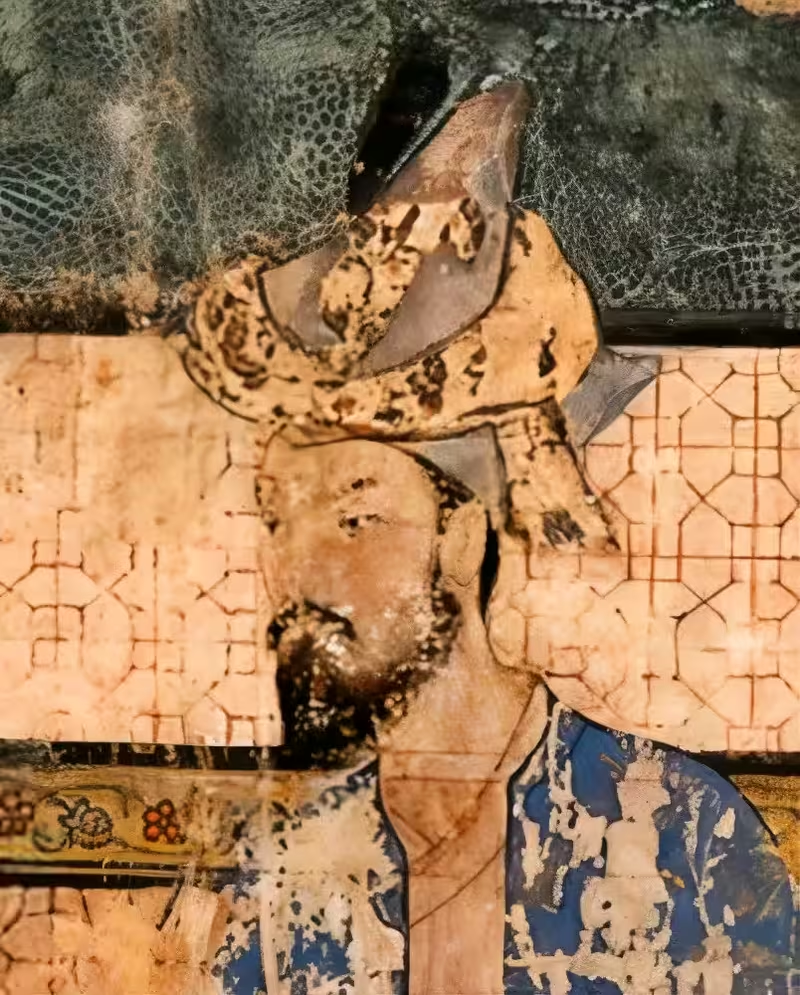
Nasir al-Din Muhammad Humayun, commonly known as Humayun (meaning "the fortunate"), was the second emperor of the Mughal Empire who ruled over territory in what is now Eastern Afghanistan, Bangladesh, Northern India, and Pakistan. His reign was characterized by two distinct periods: his first reign from 1530 to 1540, and his restoration from 1555 until his death in 1556. Despite the brevity of his rule and the challenges he faced, Humayun's significance in Indian history lies in his role as the crucial link between the empire's founder Babur and its greatest ruler, his son Akbar.
Born on March 6, 1508, in Kabul, Humayun inherited a young and fragile empire from his father Babur in 1530. At the time of his death in 1556, the Mughal Empire spanned almost one million square kilometers, though much of this expansion occurred during his brief second reign. His life story is one of dramatic reversals of fortune—from inheriting an empire at age 22, to losing it completely to the Afghan leader Sher Shah Suri, to living in exile in Persia for 15 years, and finally reclaiming his throne just months before his untimely death.
Humayun's reign and life represent a pivotal transition period in Mughal history. His struggles and ultimate perseverance ensured the survival of the Mughal dynasty during its most vulnerable phase. His exile in Persia brought significant cultural influences that would enrich Mughal art, architecture, and court culture. Most importantly, his restoration of Mughal power created the stable foundation upon which his son Akbar would build one of the greatest empires in Indian history.
Early Life
Humayun was born in Kabul on March 6, 1508, as the eldest son of Zahir-ud-Din Muhammad Babur, the founder of the Mughal Empire, and his wife Maham Begum. His birth name, Nasir al-Din Muhammad, reflected his father's Central Asian Turco-Mongol heritage and Islamic faith. As the son of a ambitious ruler with claims to territories across Central Asia and northern India, Humayun was raised in an environment of political intrigue, military campaigns, and cultural sophistication.
Growing up in the early 16th century, Humayun witnessed his father's remarkable conquests, including the pivotal First Battle of Panipat in 1526 that established Mughal rule in India. From his childhood, he was groomed for leadership and military command, receiving education in Persian literature, Islamic theology, military strategy, and statecraft. The peripatetic nature of his father's campaigns meant that Humayun's early years were spent moving between various centers of power, from Kabul to Lahore to Agra.
Babur recognized his son's abilities early and entrusted him with important responsibilities even as a young man. Humayun participated in military campaigns and was given experience in governance, though historical sources suggest he also displayed a somewhat contemplative and perhaps indecisive nature that would later affect his reign. Unlike his father, who was a brilliant military strategist and decisive leader, Humayun showed more interest in the arts, astronomy, and Persian culture.
The relationship between father and son was complex. Babur, in his memoirs (the Baburnama), expressed both pride in his heir and occasional frustration with his lack of ruthlessness. Nevertheless, when Babur fell ill in 1530, there was no question that Humayun would succeed him as the second Mughal emperor.
Rise to Power
Humayun's ascension to the throne came on December 26, 1530, following his father Babur's death. He was coronated on December 29, 1530, at Agra Fort, inheriting an empire that was barely four years old and still far from consolidated. The Mughal hold over northern India was tenuous, with numerous regional powers challenging their authority and Babur's own brothers and relatives posing potential succession threats.
At the age of 22, Humayun faced immediate challenges that would test his leadership. Unlike typical hereditary successions in established dynasties, the Mughal tradition followed the Turco-Mongol custom where the empire was theoretically divided among male heirs. Babur had distributed territories among Humayun and his three brothers: Kamran Mirza received Kandahar and Kabul, Askari Mirza was given portions of the Punjab, and Hindal Mirza received territories around Alwar. This division, while following tradition, fundamentally weakened the empire and created rival power centers.
The early years of Humayun's first reign were marked by military campaigns to consolidate his authority. He faced challenges from Afghan chiefs who had served the previous Lodi dynasty, ambitious provincial governors, and his own ambitious brothers. The sultanate of Gujarat under Sultan Bahadur Shah also posed a significant threat to Mughal territories. In 1535, Humayun launched a successful campaign against Gujarat, forcing Sultan Bahadur to flee and temporarily bringing the wealthy region under Mughal control.
However, Humayun's indecisiveness and his tendency to trust his brothers proved costly. While he was occupied in Gujarat and Malwa, his younger brother Hindal declared himself emperor in Agra, requiring Humayun to rush back to reassert his authority. These internal conflicts and his brothers' refusal to provide military support would prove catastrophic when facing his most formidable enemy: Sher Shah Suri.
First Reign and Loss of Empire
Humayun's first reign (1530-1540) was characterized by constant military challenges and ultimately ended in a devastating defeat that forced him into exile. The most significant threat came from an Afghan noble named Sher Khan (later Sher Shah Suri), who was initially a subordinate of the Sultan of Bengal but rapidly expanded his power in Bihar and Bengal.
Sher Shah proved to be a brilliant military strategist and administrator—perhaps the most formidable opponent any Mughal emperor would face. Between 1537 and 1540, he systematically outmaneuvered Humayun through a series of military engagements. The decisive Battle of Chausa in June 1539 resulted in a humiliating defeat for Humayun, who barely escaped with his life by swimming across the Ganges River on an inflated water carrier. According to historical accounts, Humayun was so grateful to the water carrier, Nizam, who helped him cross the river, that he gave him command of the empire for a day as a reward.
Despite this setback, Humayun attempted to regroup and mounted another campaign against Sher Shah. However, at the Battle of Kannauj (also called the Battle of Bilgram) in May 1540, Humayun suffered another crushing defeat. This loss was terminal for his first reign—he was forced to flee westward with a small group of loyal followers, abandoning Delhi, Agra, and the entire Mughal Empire to Sher Shah Suri, who established the Sur dynasty.
The loss of the empire revealed both Humayun's weaknesses as a military commander and the structural fragilities of the early Mughal state. His brothers' refusal to support him with troops at critical moments, his own tactical mistakes, and Sher Shah's superior generalship combined to destroy in a decade what Babur had built. This period established the Sur dynasty's brief but significant rule over northern India (1540-1555), during which Sher Shah implemented administrative reforms that would later influence Mughal governance.
Years of Exile
Humayun's exile period (1540-1555) represents one of the most dramatic episodes in Mughal history. After his defeat, Humayun fled westward through Rajasthan and Sindh, facing constant danger and deprivation. During this desperate flight, his entourage dwindled to a handful of loyal followers. His brothers, rather than offering support, further undermined him—Kamran Mirza seized control of Kabul and Kandahar, denying Humayun even his ancestral homeland.
During these wandering years, two significant personal events occurred. First, in 1541, while taking refuge in the Rajput state of Amarkot (in present-day Sindh, Pakistan), Humayun's wife Hamida Banu Begum gave birth to a son—the future Emperor Akbar. Born in exile and uncertain circumstances, this child would grow up to become the greatest of all Mughal emperors. Second, Humayun married several times during this period, forming political alliances that would prove useful in his eventual restoration.
Recognizing that he could not reclaim his empire without substantial military support, Humayun made the crucial decision to seek help from Shah Tahmasp I, the Safavid ruler of Persia. In 1544, Humayun arrived at the Persian court in Isfahan. The meeting between Humayun and Shah Tahmasp proved momentous—the Persian emperor, after some deliberation, agreed to provide military assistance to help Humayun reclaim his throne.
However, Persian support came at a price. Humayun had to convert (or reaffirm his conversion) to Shia Islam, at least nominally, and promise to cede Kandahar to Persia once he reclaimed his empire. More subtly, his years in Persia exposed him to Persian court culture, art, and architectural traditions that would profoundly influence Mughal culture. Persian artists, administrators, and craftsmen accompanied Humayun when he eventually returned to India, bringing with them styles and techniques that would define Mughal art for generations.
With Persian military support, Humayun first moved to reclaim Kabul and Kandahar from his brother Kamran. After several campaigns between 1545 and 1553, he finally defeated Kamran, who had repeatedly betrayed him. The treatment of Kamran—whose eyes were put out rather than executing him—showed both the ruthlessness required for survival in Mughal politics and perhaps some remaining fraternal sentiment.
Restoration and Second Reign
Humayun's opportunity for restoration came with the death of Sher Shah Suri in 1545 and the subsequent weakening of the Sur dynasty through internal conflicts among Sher Shah's successors. By 1554, the Sur Empire was fragmenting, with various nobles and family members fighting for control. Humayun, now established in Kabul with his Persian-backed forces, prepared to reclaim his father's empire.
In 1555, Humayun launched his restoration campaign. With his loyal general Bairam Khan commanding effective military operations, he marched toward India. The crucial Battle of Sirhind in June 1555 resulted in a decisive victory over the Sur forces led by Sikander Shah Suri. Following this victory, Humayun marched to Delhi and reclaimed the Mughal throne on July 23, 1555—exactly fifteen years after losing it.
Humayun's second reign, however, would prove tragically brief. He had barely six months to reestablish Mughal administration and consolidate his restored empire. During this period, he worked to reward loyal supporters, reorganize the administration, and plan further conquests to expand and secure Mughal territories. He appointed capable administrators and relied heavily on his Persian advisors and the loyal nobles who had stood by him during his exile.
The Persian influence was now clearly visible in the Mughal court. Persian became increasingly prominent as the court language, Persian artistic styles influenced Mughal miniature painting, and Persian architectural elements began appearing in Mughal constructions. Humayun's own interests in astronomy, astrology, and architecture found fuller expression during this brief period. He converted Sher Shah's octagonal tower at Purana Qila in Delhi into a library called Sher Mandal, where he spent considerable time studying manuscripts and consulting with scholars.
Death and Immediate Aftermath
On January 27, 1556, Humayun's remarkable life came to an abrupt end in circumstances that seemed almost symbolic of his turbulent reign. While descending the stairs of his library at Sher Mandal, he heard the call to prayer (azan). In his haste to respond, he caught his foot in his robe and fell down the steep stairs. He suffered severe head injuries and died three days later, on January 27, 1556, at the age of 47.
The manner of his death—falling from a library while hurrying to prayer—captured the duality of Humayun's character: a ruler who was also a scholar, a man whose intellectual and spiritual inclinations sometimes seemed at odds with the ruthless decisiveness required of an emperor. Contemporary historians and later scholars have seen in his death a certain poetic irony—the emperor who spent his life fighting for his throne died not in battle but in pursuit of knowledge and devotion.
Humayun's death created an immediate succession crisis. His son Akbar, just 13 years old, was in Punjab with Bairam Khan at the time. The restoration was so recent and the empire so incompletely secured that Humayun's death might easily have led to the dynasty's end. However, Bairam Khan acted swiftly to conceal Humayun's death temporarily while rushing Akbar back to Delhi. On February 14, 1556, Akbar was proclaimed emperor at Kalanaur in Punjab, even as his father's body was being transported to Delhi for burial.
Humayun was initially buried in his palace in Delhi, but his widow and chief consort Bega Begum (also known as Haji Begum) later commissioned the magnificent tomb that would become his final resting place. Construction of Humayun's Tomb began in 1565 and was completed in 1572, creating one of the finest examples of Mughal architecture.
Personal Life and Character
Historical sources paint a complex picture of Humayun's personality. Unlike his father Babur, who left extensive memoirs providing intimate insights into his character, our knowledge of Humayun comes primarily from court historians and observers. He appears to have been a man of intellectual curiosity, interested in astronomy, astrology, mathematics, and Persian poetry. He possessed artistic sensibilities that later fully flowered in the Mughal court culture under Akbar.
Humayun married multiple times, as was customary for Mughal emperors, with each marriage serving political and dynastic purposes. His most significant consort was Hamida Banu Begum, mother of Akbar, whom he married in 1541. Their marriage, which occurred during Humayun's exile, produced the heir who would become the greatest Mughal emperor. Another important wife was Bega Begum, who commissioned his famous tomb and wielded considerable influence at court.
Contemporary accounts suggest that Humayun could be generous and forgiving, sometimes to a fault. His repeated trust in his treacherous brothers, particularly Kamran, despite multiple betrayals, indicates either poor judgment or an unwillingness to act with the ruthlessness that Mughal politics demanded. His temporary grant of empire to the water carrier Nizam, while perhaps apocryphal, captures the perception of his generous nature.
Humayun's interest in astronomy and astrology significantly influenced his daily life and decision-making. He reportedly organized his court and activities according to astrological principles, with different days assigned to different planets, each with associated colors and activities. This systematization reflected both his intellectual interests and perhaps a desire to impose order on a chaotic political situation.
His years in Persian exile profoundly shaped his cultural outlook. He became deeply influenced by Persian courtly culture, art, and administrative practices. When he returned to India, he brought Persian artists, including the master painters Mir Sayyid Ali and Abd al-Samad, who would establish the Mughal miniature painting tradition. This cultural transmission would prove to be one of Humayun's most lasting legacies.
Legacy and Historical Significance
Humayun's historical significance lies not in conventional measures of imperial success—territorial expansion, administrative innovation, or military prowess—but in his role as the essential link in the Mughal dynasty's survival and transformation. Had he not persevered through 15 years of exile and successfully reclaimed his throne, the Mughal dynasty would have ended with Babur, becoming merely a footnote in Indian history rather than the dominant imperial power for three centuries.
His restoration ensured that his son Akbar could inherit a functioning empire rather than having to conquer one from scratch. The few months of Humayun's second reign provided just enough stability and legitimacy for the young Akbar's accession. Moreover, the loyal generals and administrators who had supported Humayun through his exile, particularly Bairam Khan, became the key figures who guided Akbar through his early reign and military campaigns.
Architecturally, Humayun's most visible legacy is the tomb built by his widow Bega Begum. Humayun's Tomb in Delhi, completed in 1572, was the first garden-tomb on the Indian subcontinent and represents a watershed moment in Mughal architecture. Designed by Persian architect Mirak Mirza Ghiyas, it synthesized Persian architectural elements with Indian craftsmanship and materials. The tomb's design—with its double dome, its integration into a large char bagh (four-part garden), and its use of red sandstone with white marble accents—became the template for subsequent Mughal mausolea, most notably the Taj Mahal.
The tomb has been recognized as a UNESCO World Heritage Site and stands as perhaps the most fitting memorial to Humayun: a structure that bridges Persian and Indian traditions, just as his reign bridged the founding and the flourishing of the Mughal Empire. The monument's garden setting reflects the Persian paradise garden concept while adapting it to Indian environmental conditions and aesthetic preferences.
Culturally, Humayun's Persian exile had profound long-term effects on Mughal civilization. The Persian artists, scholars, and administrators he brought back to India helped establish the Persian cultural template that would characterize the Mughal court for centuries. Persian became firmly established as the language of Mughal administration and high culture. Mughal miniature painting, which would reach extraordinary heights under Akbar and Jahangir, had its origins in the Persian masters Humayun recruited.
Humayun's legacy is thus fundamentally that of a transitional figure who, through sheer determination and perhaps good fortune, preserved his dynasty through its darkest hour. He lost an empire and regained it, suffered humiliation and exile but ultimately restored his family's honor, and in doing so, ensured that the Mughal name would be associated not with failure but with one of history's great imperial dynasties.
Assessment by Historians
Historical assessments of Humayun have varied considerably. Contemporary chroniclers, writing under his son Akbar's patronage, often portrayed him sympathetically while acknowledging his misfortunes. The Akbarnama and other official histories emphasized his noble character and the injustice of his exile while explaining his defeats as results of others' treachery rather than his own failings.
Later historians have been more critical, particularly regarding his military and political judgment. His indecisiveness in crucial moments, his misplaced trust in his brothers, and his defeats against Sher Shah Suri have been seen as leadership failures. Some scholars have argued that Humayun was temperamentally unsuited to the brutal realities of 16th-century Indian politics, preferring books and contemplation to the ruthless decisiveness required of a successful emperor.
However, more recent historical analysis has recognized that Humayun faced extraordinary challenges. He inherited an empire that was barely consolidated, with insufficient institutional structures and facing enemies on all sides. Sher Shah Suri was an exceptionally capable adversary—perhaps the most talented military commander and administrator of his era. The Turco-Mongol tradition of dividing the empire among male heirs, while culturally mandated, fundamentally weakened Humayun's position.
Modern historians have also emphasized Humayun's significant cultural contributions. His role in introducing and establishing Persian cultural influences in the Mughal court helped create the distinctive Indo-Persian synthesis that characterized Mughal civilization at its height. His patronage of Persian artists and scholars laid the foundation for the magnificent artistic achievements of Akbar's reign.
Perhaps most importantly, historians now recognize that Humayun's greatest achievement was simply surviving and persevering. The fact that he managed to maintain his identity as the legitimate Mughal emperor during 15 years of exile, that he assembled the resources to mount a successful restoration campaign, and that he lived just long enough to establish his son as his heir—these accomplishments, while less dramatic than battlefield victories or administrative innovations, proved essential to the Mughal dynasty's long-term success.
Timeline
Birth
Born in Kabul
Became Emperor
Succeeded Babur
Lost Empire
Defeated by Sher Shah Suri
Recaptured Delhi
Restored Mughal rule
Death
Died in Delhi