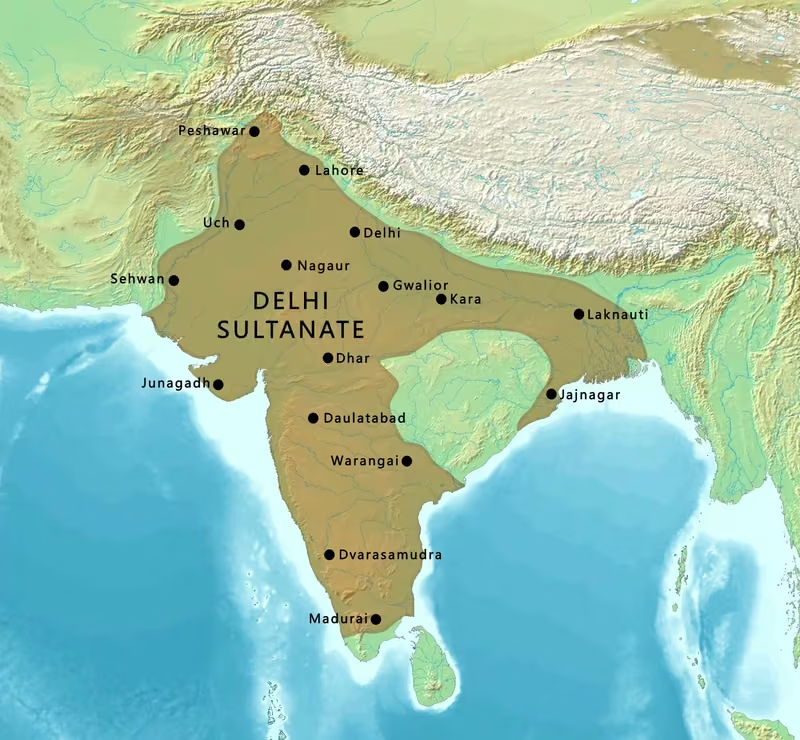
Overview
The Delhi Sultanate stands as one of the most significant political entities in medieval Indian history, representing over three centuries of Islamic rule over large portions of the Indian subcontinent. Established in 1206 CE when Qutb ud-Din Aibak declared independence from the Ghurid Empire, the Sultanate comprised five successive dynasties: the Mamluk (or Slave, 1206-1290), Khalji (1290-1320), Tughlaq (1320-1414), Sayyid (1414-1451), and Lodi (1451-1526). This period witnessed profound transformations in Indian society, culture, administration, and architecture, as Persian, Central Asian, and indigenous Indian traditions merged to create a distinctive Indo-Islamic civilization.
At its territorial zenith under Muhammad bin Tughlaq in 1312 CE, the Sultanate encompassed approximately 3.2 million square kilometers, stretching across modern-day India, Pakistan, Bangladesh, and parts of southern Nepal. The empire's capitals shifted multiple times—from Lahore (1206-1210) to Badayun (1210-1214), then to Delhi (1214-1327 and 1334-1506), with a brief interlude at Daulatabad (1327-1334), and finally to Agra (1506-1526). This geographical mobility reflected both the political instability and the ambitious territorial aspirations that characterized the Sultanate throughout its existence.
The Delhi Sultanate played a crucial role in shaping the political, cultural, and architectural landscape of medieval India. It introduced new administrative systems based on Persian models, established Sunni Islam as the state religion while maintaining a complex relationship with the Hindu majority, and created architectural masterpieces that pioneered Indo-Islamic styles. The Sultanate also served as a crucial bulwark against Mongol invasions, successfully defending India from the devastating conquests that had overwhelmed much of Central and West Asia during the 13th century.
Rise to Power
The foundation of the Delhi Sultanate emerged from the collapse of Ghurid control in northern India. Following Muhammad of Ghor's death in 1206, his former slave and military commander Qutb ud-Din Aibak seized the opportunity to establish independent rule. Aibak had served as Muhammad of Ghor's governor in India and had proven his military prowess through numerous successful campaigns. On June 25, 1206, he declared independence from the Ghurid Empire, effectively founding the Delhi Sultanate as a sovereign Islamic state in India.
The early Mamluk sultans, also known as the Slave Dynasty due to their origins as military slaves (mamluks), faced immediate challenges in consolidating their authority. Aibak initially ruled from Lahore but moved the capital to Delhi in 1214 under his successor Iltutmish. The fledgling Sultanate had to contend with rival Muslim commanders who had also carved out independent territories, Hindu Rajput kingdoms that resisted Islamic rule, and the ever-present threat of Mongol invasions from the northwest.
Iltutmish (1211-1236) proved instrumental in stabilizing the Sultanate. He established the Corps of Forty (Chihalgani), an elite council of Turkish nobles who advised the Sultan and provided a check on absolute power. This institution, though it later became a source of political intrigue, initially helped legitimize Sultanate authority. Iltutmish also secured recognition from the Abbasid Caliphate in Baghdad, receiving the title of Sultan and gaining religious legitimacy for his rule. His military campaigns extended Sultanate control across northern India, crushing rival Muslim factions and subduing Hindu kingdoms in Bengal, Gwalior, and Malwa.
The Mamluk period witnessed repeated Mongol invasions, beginning in the 1220s. The Sultanate's armies, however, successfully repelled these attacks, most notably under Sultan Ghiyath al-Din Balban (1266-1287), who reorganized the military and established a formidable defense system along the northwestern frontier. This military success prevented the catastrophic devastation that Mongol invasions had inflicted upon Persia, Central Asia, and the Middle East, preserving India as a relatively stable region during a period of widespread chaos.
The Khalji Revolution and Expansion
The transition from Mamluk to Khalji rule in 1290—often called the Khalji Revolution—marked a significant transformation in the Sultanate's character. Jalal ud-Din Khalji overthrew the last Mamluk sultan, breaking the monopoly of Turkish nobles and opening governance to Central Asian Muslims of diverse ethnic backgrounds. However, it was his nephew and successor, Alauddin Khalji (1296-1316), who would transform the Sultanate into a formidable imperial power.
Alauddin Khalji's reign represented the apex of Sultanate military expansion and administrative efficiency. Between 1296 and 1316, his armies conquered vast territories across India, pushing Sultanate authority deep into South India for the first time. His general Malik Kafur led devastating campaigns into the Deccan and beyond, conquering the Yadava kingdom of Devagiri (1307), the Kakatiya kingdom of Warangal (1310), the Hoysala kingdom (1311), and even raiding the distant Pandya kingdom in the far south. These conquests brought unprecedented wealth to Delhi through systematic plunder and tribute extraction.
Alauddin implemented revolutionary administrative and economic reforms. He established strict market controls, fixing prices for essential commodities to ensure affordable supplies for his large standing army. He reformed the revenue system, directly assessing and collecting taxes rather than relying on intermediary Hindu zamindars. His intelligence network monitored potential dissidents, and he brutally suppressed several Mongol invasions, even incorporating captured Mongol soldiers into his own army. These measures created a highly centralized, militarized state capable of sustaining continuous expansion.
The victory at the Battle of Lahrawat on September 6, 1320, marked the end of Khalji rule and the beginning of the Tughlaq dynasty. This battle resolved a succession dispute following Alauddin Khalji's death, with Ghiyath al-Din Tughlaq emerging victorious over the Khalji remnants and establishing a new dynasty that would rule for nearly a century.
The Tughlaq Era: Ambition and Chaos
The Tughlaq dynasty (1320-1414) represented a period of grand ambitions, administrative experimentation, and eventual fragmentation. Ghiyath al-Din Tughlaq (1320-1325) established the dynasty through military conquest and quickly embarked on consolidating the vast territories conquered by the Khaljis. He constructed the massive Tughlaqabad Fort complex near Delhi, symbolizing the dynasty's power and permanence. However, his reign was brief; he died in 1325 under suspicious circumstances, possibly murdered by his ambitious son.
Muhammad bin Tughlaq (1325-1351) remains one of medieval India's most controversial and complex figures. Educated, intellectually curious, and administratively innovative, he pursued policies that contemporaries and historians have alternately viewed as visionary or disastrous. In 1327, he relocated the capital from Delhi to Daulatabad in the Deccan, approximately 1,500 kilometers south, attempting to consolidate control over southern territories and establish a more central administrative location. The forced migration of Delhi's population proved catastrophic, with thousands dying during the arduous journey. After seven years, Muhammad abandoned the experiment and returned the capital to Delhi.
His most infamous administrative innovation was the introduction of token currency—copper coins that would circulate as equivalents to silver tankas. This medieval attempt at fiat currency failed spectacularly when widespread counterfeiting flooded the market with worthless copper coins, destroying public confidence in the currency system and disrupting trade throughout the empire. The economic chaos contributed significantly to the Sultanate's decline. Despite these failures, Muhammad bin Tughlaq's reign saw the Sultanate reach its maximum territorial extent of approximately 3.2 million square kilometers in 1312 CE.
Firoz Shah Tughlaq (1351-1388) attempted to repair the damage caused by his predecessor's experiments. He reduced taxes, established hospitals and educational institutions, promoted irrigation projects, and patronized Islamic scholarship. A prolific builder, Firoz Shah founded several cities and constructed numerous mosques, gardens, and public works. He also relocated ancient monuments, including Ashokan pillars, to Delhi as symbols of legitimate authority spanning India's historical traditions. Despite these efforts at stabilization, regional governors increasingly asserted independence, and the empire gradually fragmented.
The catastrophic sack of Delhi by Timur (Tamerlane) in December 1398 effectively ended Tughlaq authority. Timur's Central Asian armies devastated the city, massacring thousands and plundering its wealth. Although the Tughlaqs nominally continued until 1414, they controlled little beyond Delhi's immediate vicinity. The Sultanate would never again approach its former territorial extent or political power.
Administration and Governance
The Delhi Sultanate developed sophisticated administrative systems adapted from Persian and Central Asian Islamic models while incorporating elements of pre-existing Indian governance structures. At the apex stood the Sultan, theoretically an absolute monarch who derived legitimacy from both military power and recognition by the Abbasid Caliphate. In practice, sultans shared power with Turkish and Central Asian military nobility, religious scholars (ulama), and administrative officials.
The iqta system formed the backbone of provincial administration. Under this system, military commanders received grants of land revenue (iqta) in exchange for maintaining cavalry forces. Iqta holders (muqta) collected taxes from their assigned territories and retained a portion to support their troops, remitting the remainder to the central treasury. This system, borrowed from earlier Islamic empires, provided a method for maintaining a large military without direct salary payments while extending government authority across vast distances.
Revenue administration evolved significantly over the Sultanate's history. Early sultans relied heavily on Hindu revenue officials (zamindars and chaudharis) who understood local conditions and traditional assessment methods. Alauddin Khalji's reforms attempted to bypass these intermediaries through direct assessment and collection, employing Muslim officers to measure land and evaluate crop yields. The Sultanate's primary taxes included the kharaj (land tax), paid primarily by Hindu peasants; the jizya (poll tax on non-Muslims); and the zakat (Islamic charitable tax on Muslims).
The Corps of Forty (Chihalgani), established during Iltutmish's reign, provided a consultative council of leading Turkish nobles who advised the Sultan on major policy decisions. While intended to check arbitrary rule, this institution often became a source of political intrigue and succession disputes. The diwan-i-wizarat (finance department), diwan-i-arz (military department), diwan-i-insha (correspondence department), and diwan-i-rasalat (religious affairs department) formed the major branches of central administration.
The Sultanate maintained official languages of Persian (for administration and high culture) and Hindavi (an early form of Hindustani, for common communication). This bilingualism facilitated governance while promoting cultural synthesis. The currency system primarily used silver tankas and copper jitals, though Muhammad bin Tughlaq's disastrous token currency experiment temporarily disrupted this arrangement.
Military Campaigns and Defense
Military prowess defined the Delhi Sultanate throughout its existence. The sultans maintained large standing armies composed primarily of cavalry, with Turkish and Central Asian horsemen forming the military elite. Infantry units, often consisting of Indian converts to Islam and Hindu auxiliaries, provided support. The Sultanate also employed war elephants, adopted from Indian military traditions, though cavalry remained the decisive arm in most engagements.
The Sultanate's military history divides into two major categories: offensive campaigns of expansion and defensive operations against external threats, particularly Mongol invasions. Offensive campaigns extended Sultanate authority across northern India during the Mamluk period, conquered the Deccan and raided South India under the Khaljis, and attempted to maintain control over these far-flung territories during the Tughlaq era. These campaigns involved both pitched battles and prolonged sieges of fortified cities.
Mongol invasions posed an existential threat throughout the 13th and early 14th centuries. Beginning in the 1220s under Genghis Khan's armies and continuing through subsequent generations, Mongol forces repeatedly attempted to conquer India. The Sultanate's successful defense against these invasions—particularly under Balban and Alauddin Khalji—ranks among medieval India's most significant military achievements. Unlike Persia, Central Asia, and the Middle East, which fell to Mongol conquest, the Sultanate maintained independence, though at tremendous cost in resources and constant military vigilance.
Alauddin Khalji's reign witnessed both the most successful defense against Mongols and the most extensive campaigns of expansion. His armies repelled major Mongol invasions in 1299, 1303, and 1305-1306, with the decisive 1305 Battle of Ravi near Delhi breaking Mongol power permanently. Simultaneously, his generals conquered territories stretching to India's southern tip, establishing tributary relationships with kingdoms that maintained nominal independence while paying tribute to Delhi.
The Sultanate's military decline paralleled its political fragmentation. After Timur's devastating invasion in 1398, the reduced Sayyid and Lodi dynasties could barely maintain control over the immediate Delhi region. Regional kingdoms—many ruled by former Sultanate governors—established independence, and the military system deteriorated. The Lodi sultans' attempts at revival ultimately failed, culminating in Ibrahim Lodi's defeat at Panipat in 1526.
Cultural Contributions and Synthesis
The Delhi Sultanate's most enduring legacy lies in its cultural contributions, particularly the creation of Indo-Islamic civilization through the synthesis of Persian, Central Asian, and indigenous Indian traditions. This fusion manifested in architecture, literature, music, cuisine, language, and social customs, fundamentally transforming Indian culture while absorbing and adapting to local traditions.
Architecturally, the Sultanate pioneered Indo-Islamic styles that combined Islamic building traditions—such as domes, arches, minarets, and geometric decoration—with Indian materials, techniques, and aesthetic sensibilities. The Qutb Minar complex in Delhi, begun under Qutb ud-Din Aibak and expanded by successive sultans, exemplifies this synthesis. The soaring Qutb Minar itself, at 73 meters India's tallest brick minaret, incorporates Islamic architectural forms with Indian sandstone and intricate carved decoration. The complex also includes the Quwwat-ul-Islam mosque, built using materials from demolished Hindu and Jain temples, with Sanskrit inscriptions visible alongside Arabic calligraphy—a physical embodiment of cultural synthesis.
Alauddin Khalji's Alai Darwaza (built 1311) at the Qutb complex represents a mature Indo-Islamic style, with its innovative use of red sandstone, white marble decoration, true arches and domes, and sophisticated geometric patterns. The Tughlaq dynasty's architecture, exemplified by Tughlaqabad Fort and the tomb of Ghiyath al-Din Tughlaq, employed massive stone construction and austere decoration, creating a distinctive architectural language. Feroz Shah Tughlaq's buildings demonstrate further synthesis, incorporating Hindu architectural elements more extensively.
Persian literature and historiography flourished under Sultanate patronage. Court historians produced detailed chronicles (tawarikh) documenting sultanate affairs, including Ziauddin Barani's "Tarikh-i-Firoz Shahi" and Amir Khusrau's numerous works. Amir Khusrau (1253-1325), a polymath who served seven sultans, composed poetry in Persian while pioneering literary Hindavi (early Hindustani), creating devotional songs (qawwalis), and allegedly inventing the sitar and tabla—claims debated by scholars but reflecting his legendary cultural impact.
Sufi mystical orders (silsilas) spread throughout India during the Sultanate period, promoting Islam through devotional practices, music, and poetry that resonated with Hindu bhakti traditions. The Chishti, Suhrawardi, Qadiri, and Naqshbandi orders established khanqahs (Sufi hospices) that became centers of spiritual teaching and social welfare, often attracting both Muslim and Hindu devotees. This Sufi influence promoted religious tolerance and cultural synthesis, though relationships between orthodox ulama and Sufi shaykhs often proved contentious.
The development of Hindavi (early Hindustani) as a literary and administrative language represents another crucial cultural achievement. While Persian remained the language of high culture and administration, Hindavi emerged as a common language blending Sanskrit-derived vocabulary with Persian, Arabic, and Turkish loanwords. This linguistic synthesis laid foundations for modern Hindi and Urdu, now spoken by hundreds of millions.
Cuisine also underwent transformation, as Persian and Central Asian cooking techniques, ingredients, and dishes merged with Indian culinary traditions. Techniques like dum pukht (slow cooking in sealed vessels), dishes like biryani and korma, and ingredients like saffron and dried fruits became integrated into Indian cuisine, creating the distinctive Mughlai culinary tradition that would further develop under later Mughal patronage.
Economy and Trade
The Delhi Sultanate presided over a complex economy that combined agricultural production, urban crafts, and long-distance trade networks. Agriculture remained the economic foundation, with the majority of the population engaged in farming. The Sultanate extracted substantial agricultural surplus through systematic taxation, with rates varying from one-fifth to half of crop production depending on the period and ruler. This revenue supported the administrative apparatus, military forces, and architectural patronage.
Alauddin Khalji's market regulations (designated prices for grain, cloth, horses, and other commodities) represented unprecedented state intervention in economic affairs. He established three major regulated markets in Delhi with officers (shahna-i-mandi) enforcing price controls and preventing hoarding. While these controls ensured affordable supplies for his massive army, they disrupted normal market mechanisms and required extensive bureaucratic oversight. The system largely collapsed after Alauddin's death, though it demonstrated sophisticated economic understanding.
Urban centers flourished as administrative, commercial, and manufacturing hubs. Delhi emerged as one of medieval Asia's great cities, with contemporary accounts describing its vast size, wealthy merchants, sophisticated crafts, and cosmopolitan population. Other major urban centers included Lahore, Multan, Ajmer, Jaunpur, and Bengal's cities. These urban economies supported specialized craftspeople producing textiles, metalwork, weapons, and luxury goods.
Long-distance trade connected the Sultanate to wider Asian commercial networks. Indian textiles, particularly cotton cloth, found markets throughout Asia and East Africa. The Sultanate exported spices, indigo, and other agricultural products while importing horses from Central Asia and Arabia (essential for cavalry), Chinese ceramics, Southeast Asian spices, and African gold and ivory. The integration into Islamic commercial networks facilitated these exchanges, with Muslim merchants operating across the Indian Ocean world.
Muhammad bin Tughlaq's token currency disaster illustrated both the sophistication of Sultanate economic thinking an