Overview
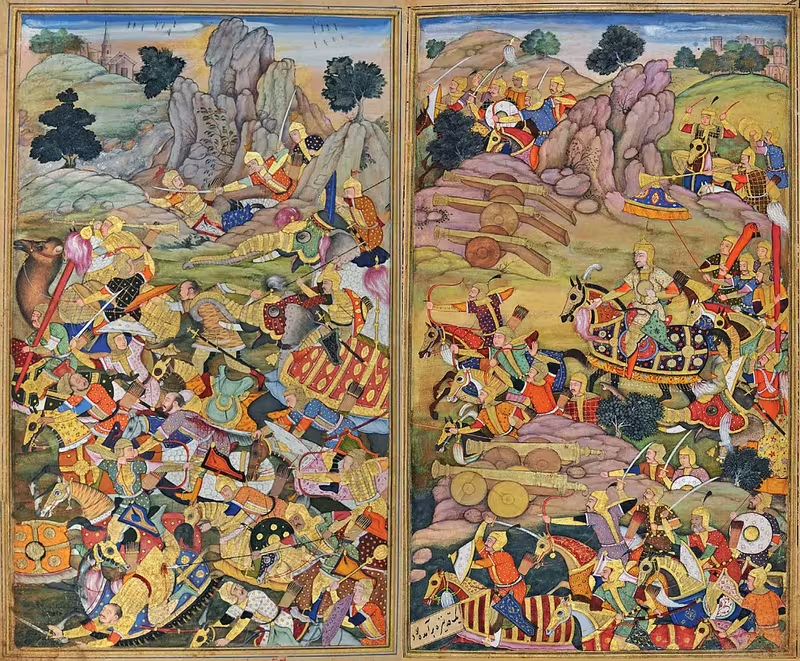
The First Battle of Panipat, fought on April 21, 1526, stands as one of the most decisive and transformative military engagements in Indian history. On that spring morning on the plains near the town of Panipat in present-day Haryana, Zahir-ud-din Muhammad Babur, a descendant of both Timur and Genghis Khan, confronted Sultan Ibrahim Lodi, the last ruler of the Delhi Sultanate. The battle was not merely a contest between two ambitious rulers—it represented a clash between medieval and early modern warfare, between traditional Indian military doctrine and revolutionary Central Asian tactics enhanced by gunpowder technology.
Despite being outnumbered by nearly eight to one, Babur's disciplined forces achieved a stunning victory through superior tactics, innovative use of artillery, and battlefield genius. The triumph resulted in the death of Ibrahim Lodi, the collapse of the Delhi Sultanate that had ruled northern India since 1206, and the establishment of the Mughal Empire—a dynasty that would dominate the Indian subcontinent for over three centuries. The battle introduced gunpowder warfare to India on a decisive scale and demonstrated the military revolution that was transforming warfare across Eurasia.
The significance of Panipat extends far beyond the military realm. The Mughal Empire that emerged from Babur's victory would fundamentally reshape Indian culture, art, architecture, administration, and society. The battle marked the beginning of a new era in Indian history, bridging the medieval and early modern periods and setting the stage for the cultural synthesis that would define Mughal India.
Background
The Delhi Sultanate in Decline
By the early 16th century, the Delhi Sultanate, which had been established in 1206, was in an advanced state of decline. The Lodi dynasty, an Afghan dynasty that had ruled since 1451, struggled to maintain control over its vast territories. Regional governors increasingly acted as independent rulers, paying only nominal allegiance to Delhi. The last Lodi sultan, Ibrahim Lodi, who ascended the throne in 1517, attempted to centralize power and assert his authority over the rebellious Afghan nobles.
Ibrahim's autocratic style and his attempts to reduce the power of the Afghan nobility alienated many of his own supporters. His harsh treatment of dissenting nobles, including the execution of several prominent figures, created a climate of fear and resentment. The Afghan confederacy that had traditionally supported the Delhi Sultanate began to fracture, with various factions plotting against the Sultan. This internal weakness would prove fatal when faced with external invasion.
Babur's Quest for Empire
Zahir-ud-din Muhammad Babur was born in 1483 in Fergana (in present-day Uzbekistan), inheriting a small kingdom at the age of eleven. A direct descendant of Timur (Tamerlane) on his father's side and Genghis Khan on his mother's side, Babur inherited both imperial ambition and military genius. His early years were marked by constant struggle—he briefly captured Samarkand, the jewel of Central Asia, twice but could not hold it. By 1504, he had lost both Samarkand and his ancestral kingdom of Fergana.
Turning south, Babur established himself in Kabul in 1504, using it as a base for raids into the wealthy plains of northern India. Between 1519 and 1524, Babur made several exploratory expeditions into the Punjab, testing the strength of the Lodi Sultanate and gauging opportunities for conquest. These raids yielded valuable intelligence about Indian military tactics, the political situation, and the geography of the region. Babur recognized that India offered the empire he had failed to establish in Central Asia.
The Invitation
The decisive catalyst for Babur's invasion came from within the Lodi establishment itself. Daulat Khan Lodi, the powerful governor of Punjab, and Alam Khan, an uncle of Sultan Ibrahim who claimed the throne for himself, invited Babur to invade India and help them overthrow the Sultan. They apparently believed they could use Babur as a tool to advance their own ambitions, expecting him to return to Kabul after helping them remove Ibrahim.
This proved to be a catastrophic miscalculation. Babur had no intention of serving as a kingmaker for others—he sought to establish his own dynasty. When he crossed into Punjab in 1525 with his veteran army, Babur moved not as a mercenary but as a conqueror. His swift capture of key Punjabi cities alarmed his erstwhile allies, who realized too late that they had invited a tiger into their house.
Prelude to Battle
Babur's Advance
After establishing control over Punjab and Lahore by early 1526, Babur began his march toward Delhi. His army, though modest in size with only about 12,000 to 15,000 men, was exceptionally well-trained and equipped. The core consisted of veteran cavalry from his Central Asian campaigns, experienced in the mobile warfare of the steppes. Crucially, Babur's army included Master Ali Quli, a Persian artillery expert, and his team of Ottoman-trained gunners who managed several pieces of field artillery—a weapon system almost unknown in India at the time.
Babur also possessed matchlock firearms (toradar), which gave his infantry significant firepower advantages over traditional bow-armed troops. Perhaps most importantly, Babur brought tactical innovations from Central Asia and the Ottoman Empire that were unknown to Indian armies. His forces had experience with the tulughma (flanking maneuver using mobile cavalry wings) and the use of fortified wagon positions.
Ibrahim Lodi's Response
News of Babur's advance threw Delhi into crisis. Sultan Ibrahim Lodi assembled a massive army, with contemporary accounts suggesting forces of 100,000 men and 1,000 war elephants, though these numbers may be exaggerated. Regardless of exact figures, the Lodi army significantly outnumbered Babur's forces. Ibrahim's army included heavy cavalry, infantry, and a large contingent of war elephants, which had been the shock troops of Indian armies for centuries.
However, the Lodi army suffered from serious deficiencies. The Afghan nobles remained divided, with many harboring resentment toward Ibrahim. The army lacked the discipline and training of Babur's veterans. Most critically, Ibrahim's forces had no experience with artillery or organized gunpowder warfare. The massive size of the army proved to be a liability, making it difficult to maneuver and coordinate.
Ibrahim marched north from Delhi in early April 1526, meeting Babur's army near Panipat. Both armies encamped near each other for several days, with minor skirmishing but no major engagement. Babur used this time to prepare the battlefield according to his tactical plan, while Ibrahim apparently waited for his full army to assemble.
The Battle
Babur's Tactical Deployment
Babur chose his battlefield with great care, selecting a position near Panipat that maximized his advantages while neutralizing Ibrahim's numerical superiority. He implemented a defensive formation based on the Ottoman tactic known as the araba—a fortified position created by chaining wagons together in a long line. Between every two wagons, Babur's men placed mantlets (large shields) behind which musketeers could fire while protected. The artillery pieces were positioned to fire through gaps in this wagon fortress.
This central fortification, approximately 1,000 yards long, was protected on the right flank by the town of Panipat and on the left by a network of hastily dug ditches and fallen trees. Only the flanks remained open for cavalry operations. Babur divided his cavalry into two wings—right and left—for executing the tulughma, a Central Asian tactical maneuver designed to envelope and attack an enemy from the sides and rear.
The entire formation was designed with a specific purpose: to channel Ibrahim's massive army into a killing zone where Babur's superior firepower and tactics would negate the Lodi numerical advantage. The narrow frontage prevented Ibrahim from deploying his full force at once, while the fortified center would break up cavalry charges and make the war elephants ineffective.
The Engagement Begins
On the morning of April 21, 1526, Babur's forces began provoking the Lodi army with raids by small cavalry units. These hit-and-run attacks were designed to frustrate Ibrahim and provoke him into attacking the prepared Mughal positions. After several hours of these provocations, Ibrahim finally ordered a full assault.
The Lodi army advanced in massive formations, with war elephants at the forefront. As the Lodi forces charged, they encountered Babur's defensive preparations. The narrow approach forced Ibrahim's troops to bunch together, preventing them from effectively utilizing their numerical superiority. The war elephants, traditionally devastating in Indian warfare, proved vulnerable to artillery fire and became uncontrollable, many turning back and trampling their own troops.
Artillery Dominance
As the Lodi forces pressed their attack, Babur's artillery opened fire with devastating effect. The field guns, operated by Master Ali Quli's expert gunners, fired round after round into the densely packed enemy formations. The noise and smoke terrified the horses and elephants, while the actual artillery rounds cut bloody swaths through the Lodi ranks. The matchlock men behind the wagon fortress maintained a steady fire, picking off enemy soldiers who attempted to breach the defenses.
For the Lodi troops, this was unlike any battle they had experienced. The thunderous roar of artillery, the acrid smoke, and the murderous crossfire created chaos in their ranks. The massive army, rather than being an advantage, became a liability as units in the rear pressed forward while those in front tried to retreat from the killing zone. The battle became what later military historians would recognize as a classic example of firepower defeating numbers.
The Tulughma Maneuver
While the Lodi army exhausted itself against the fortified center, Babur executed his master stroke. His cavalry wings, which had remained relatively inactive, suddenly wheeled outward and then inward in a great sweeping movement—the tulughma. These mobile cavalry units attacked the Lodi flanks and began working their way around to the rear, threatening to completely envelope Ibrahim's forces.
The Lodi army, already demoralized by the artillery bombardment and unable to break through the wagon fortress, found itself under attack from three sides. The carefully planned maneuver transformed the battle into a rout. Lodi soldiers began breaking and fleeing, while others found themselves trapped in the killing zone with no route of escape.
The Death of Ibrahim Lodi
Sultan Ibrahim Lodi, to his credit, fought bravely until the end. Rather than fleeing the battlefield, he led his personal guard in desperate charges against Babur's forces. According to various accounts, Ibrahim was killed in the thick of the fighting, his body later identified among the thousands of dead on the battlefield. His death marked the end not just of the battle but of the Delhi Sultanate itself, which had ruled northern India for 320 years.
The battle lasted only a few hours, but the slaughter was immense. Contemporary estimates suggest that 20,000 to 40,000 of Ibrahim's soldiers died, including many of the Afghan nobility. Babur's losses were minimal in comparison, probably only a few hundred casualties. The complete nature of the victory was unusual even by the standards of medieval warfare—Babur had not simply defeated his enemy but had annihilated the Lodi army and killed its sultan.
Aftermath
Immediate Consequences
Following the battle, Babur moved swiftly to consolidate his victory. Three days after Panipat, on April 24, he entered Delhi unopposed. The capital, which had been the seat of Muslim power in India since 1206, submitted without resistance. Babur's son Humayun was dispatched to secure Agra, where the Lodi treasury was kept. The immense wealth captured—including the famous Koh-i-Noor diamond—helped finance the establishment of the new empire.
Babur immediately began establishing the administrative framework of his new realm. He distributed rewards to his loyal followers, assigned territories to his commanders, and began the process of transforming his conquering army into a governing apparatus. The speed and efficiency of this transition demonstrated that Babur had carefully planned not just for victory but for what would come after.
Resistance and Consolidation
Despite the decisive nature of Panipat, Babur's hold on his new empire was far from secure. Afghan nobles who had escaped the battle began organizing resistance across northern India. The Rajput confederacy, led by Rana Sanga of Mewar, posed a serious military threat. Over the next four years until his death in 1530, Babur fought several more battles to secure his empire, most notably the Battle of Khanwa in 1527 where he defeated Rana Sanga.
The transition from conquest to stable rule proved challenging. Many of Babur's Central Asian followers wanted to return home, uncomfortable with India's climate and culture. Babur himself admitted in his memoirs, the Baburnama, that he initially found India unappealing compared to the gardens and mountains of Central Asia. However, he recognized that India offered the empire he had long sought and worked tirelessly to establish the foundations of what would become the Mughal dynasty.
Historical Significance
Military Revolution
The First Battle of Panipat represents a watershed moment in Indian military history. It demonstrated decisively that the era of traditional cavalry-and-elephant armies was ending, replaced by a new paradigm based on gunpowder weapons, disciplined infantry, and integrated combined-arms tactics. The battle proved that technological and tactical superiority could overcome massive numerical disadvantages.
The lessons of Panipat were not lost on Indian rulers. Within a generation, artillery and matchlock firearms became standard elements of Indian armies. The battle accelerated the military revolution in India, transforming warfare on the subcontinent. Later Indian powers, from the Marathas to Mysore to the Sikh Empire, would adopt and adapt gunpowder warfare, though none would match the Mughals in systematic application of these technologies.
Foundation of the Mughal Empire
The most profound consequence of Panipat was the establishment of the Mughal Empire, which would dominate the Indian subcontinent for over three centuries. The Mughals created one of the most powerful and wealthy empires in the world, at its peak controlling most of the Indian subcontinent and commanding roughly 25% of global GDP.
The Mughal Empire left an indelible mark on Indian civilization. In administration, the Mughals developed sophisticated systems of governance, land revenue collection, and military organization. In architecture, they created some of humanity's most magnificent buildings, including the Taj Mahal, the Red Fort, and Fatehpur Sikri. In culture, they fostered a unique synthesis of Persian, Central Asian, and Indian traditions that enriched literature, music, art, and cuisine.
Cultural Synthesis
The Mughal Empire facilitated unprecedented cultural exchange and synthesis. Persian became the court language, while also serving as a bridge for cultural transmission. The Mughal courts became centers of learning and artistic patronage, attracting scholars, poets, artists, and musicians from across Asia. The miniature painting tradition that flourished under Mughal patronage merged Persian and Indian styles into something entirely new and magnificent.
This cultural synthesis extended to religion as well. While the Mughals were Muslim rulers, many, particularly Akbar, pursued policies of religious tolerance and promoted dialogue between different faiths. The Bhakti and Sufi movements flourished, creating devotional traditions that emphasized mystical experience over formal orthodoxy. This religious and cultural interchange, made possible by Mughal rule, became a defining feature of Indian civilization.
Legacy
Panipat as Historical Symbol
Panipat itself became synonymous with decisive battles that changed dynasties. The town would be the site of two more crucial battles—in 1556 when Akbar secured the Mughal throne, and in 1761 when the Marathas were defeated by Ahmad Shah Durrani. This unique historical status has made Panipat a symbol of the rise and fall of empires, a place where the destiny of India was repeatedly decided by force of arms.
The battlefield of 1526 has largely disappeared beneath modern urban development, though the town maintains some memorials and a museum dedicated to the three battles. The site reminds visitors of how military prowess and tactical innovation can reshape history, turning a single day's engagement into centuries of consequence.
Babur's Memoirs
The First Battle of Panipat is extensively documented in Babur's own memoirs, the Baburnama, one of the great autobiographies of world literature. Written in Chagatai Turkish, Babur's account provides detailed information about his tactics, strategy, and even his thoughts and feelings during the campaign. His frank, observant writing offers historians an invaluable primary source for understanding not just the battle but the man who won it.
The Baburnama reveals Babur as a complex figure—a ruthless conqueror but also a sensitive observer of nature, a devoted father, a skilled poet, and a thoughtful memoirist. His descriptions of the battle combine military professionalism with human observation, noting details of terrain, tactics, and weapons alongside observations about his soldiers' fears and his own anxieties. This rare combination of successful generalship and literary ability has made Babur a uniquely accessible historical figure.
Modern Remembrance
In contemporary India, the First Battle of Panipat occupies an ambiguous position in historical memory. The battle represents both the introduction of a great dynasty that enriched Indian civilization and a foreign conquest that ended an existing order. Modern historians emphasize the battle's role in military history and its consequences for Indian development, while acknowledging the complex legacy of conquest and empire.
The battle remains a subject of scholarly research, with historians continuing to analyze Babur's tactics, the reasons for his success, and the battle's broader implications. Military historians study Panipat as an example of how innovative tactics and technology can overcome numerical disadvantages. Cultural historians examine how the battle initiated the cultural synthesis that would define the Mughal period. For students of Indian history, Panipat remains an essential event, a hinge on which the door between medieval and early modern India swung.
Historiography
Contemporary Accounts
The primary source for the battle remains Babur's Baburnama, written by the victor himself. His account, while naturally presenting events from his perspective, is remarkably detailed and has proven generally reliable when cross-checked with other sources. Babur describes his tactical dispositions, his use of artillery, and the execution of the tulughma maneuver with precision that suggests his account was written soon after the events.
Other contemporary sources include Persian chronicles written at the Mughal court and some Afghan accounts, though these are less detailed. The lack of extensive contemporary sources from the Lodi side—hardly surprising given their complete defeat—means our understanding of their perspective remains limited. Later historians have had to reconstruct the Lodi viewpoint from fragmentary references and general knowledge of Afghan military traditions.
Modern Interpretations
Modern historians have examined the battle from various angles. Military historians emphasize the technological and tactical dimensions, seeing Panipat as a classic example of the gunpowder revolution in warfare. The battle demonstrates how the systematic application of artillery, firearms, and coordinated tactics could overcome traditional cavalry forces, regardless of numbers.
Some historians have questioned whether the battle's outcome was as inevitable as it appears in retrospect. They note that weather, chance events, and Ibrahim's tactical decisions all played roles in the outcome. If Ibrahim had refused battle and harassed Babur's supply lines, or if he had flanked Babur's fortified position rather than assaulting it directly, the result might have been different. These counterfactual speculations, while ultimately unprovable, remind us that even decisive victories result from contingent circumstances rather than predetermined outcomes.
Cultural historians emphasize the battle's role in enabling the Mughal cultural synthesis. By establishing Mughal rule, Panipat made possible the artistic, architectural, and cultural achievements that followed. This perspective sees the battle not as an end in itself but as the beginning of a transformative historical process that enriched Indian civilization in complex ways.