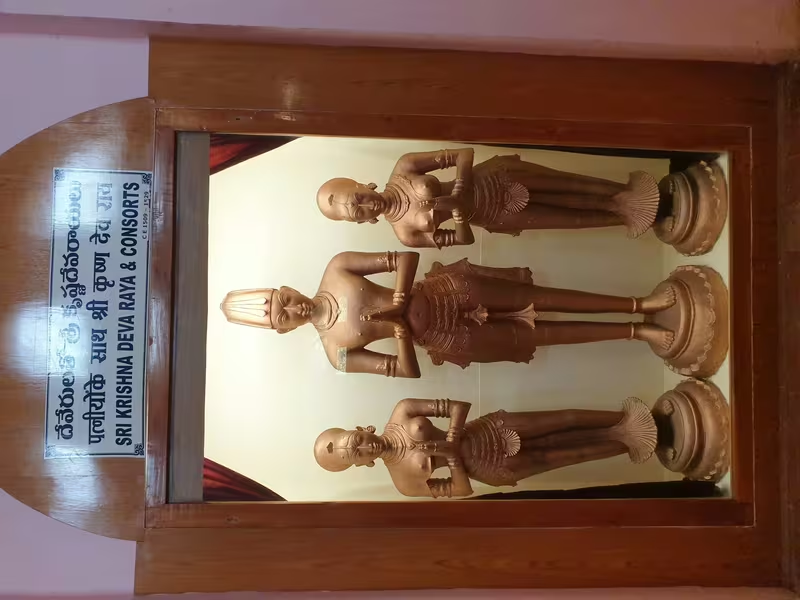
Krishnadevaraya: The Lion of Vijayanagara
In the grand tapestry of Indian history, few rulers command the reverence and admiration accorded to Krishnadevaraya. The pre-eminent emperor of the Vijayanagara Empire, his reign from 1509 to 1529 CE is not merely a chapter in a dynastic chronicle; it is the epic saga of a golden age. He was a military genius who never lost a battle, a shrewd administrator who fostered unprecedented prosperity, a devout patron who sculpted a capital of stone into a celestial city, and a gifted poet whose verses still resonate. To understand Krishnadevaraya is to witness the zenith of South Indian power and culture, a brilliant flame that illuminated the Deccan plateau before the twilight of the great empire he commanded.
Early Life & Ascension
Born in 1471 into the Tuluva dynasty, Krishnadevaraya was the son of Tuluva Narasa Nayaka, the formidable general who had usurped control of the empire to save it from disintegration, effectively founding the third dynasty of Vijayanagara. His mother was Nagala Devi. Krishnadevaraya grew up in the shadow of his powerful father and his elder half-brother, Vira Narasimha Raya, who ascended the throne in 1505.
His early years were spent in rigorous training, not just in the arts of war and statecraft, but also in literature and philosophy. He was fluent in multiple languages, including his native Tulu, as well as Kannada, Telugu, and Sanskrit. This comprehensive education would later shape him into the archetypal philosopher-king.
The circumstances of his coronation in 1509 are steeped in legend, famously recorded by the Portuguese chronicler Fernao Nuniz. As Vira Narasimha Raya lay on his deathbed, consumed by a desire for his own young son to succeed him, he allegedly ordered his trusted prime minister, Saluva Timmarusu, to blind the brilliant and popular Krishnadevaraya. Timmarusu, a man of great foresight who recognized Krishnadevaraya’s potential as the empire's only true saviour, defied the dying king. He presented the king with a pair of goat's eyes, claiming the deed was done, thus preserving the prince who would lead Vijayanagara to its greatest heights. Upon his brother's death, Krishnadevaraya ascended the throne on the auspicious day of Krishna Janmashtami, with the loyal Timmarusu, whom he affectionately called 'Appaji' (father), by his side as his chief minister.
A Reign of Military Conquests
Krishnadevaraya inherited a throne beset by thorns. The Bahmani Sultanate to the north had splintered into five hostile Deccan Sultanates, the Gajapati kings of Odisha were a constant threat on the eastern coast, and rebellious chieftains plagued the southern territories. His reign was, from the outset, a relentless series of military campaigns designed not merely to defend but to dominate.
Consolidation and Eastern Campaigns
His first seven years were dedicated to quelling internal rebellions and pushing back the Gajapatis. He subdued the rebellious chief of Ummattur in the south, securing his home front. Then, he turned his attention eastward towards the formidable Prataparudra Deva of Odisha.
Between 1513 and 1518, Krishnadevaraya led a brilliant campaign into Gajapati territory. The fortress of Udayagiri was the first to fall in 1513 after a grueling siege of over a year. To commemorate this victory, he brought the idol of Balakrishna back to his capital and consecrated it in the magnificent Krishna Temple he commissioned. Next, he captured the formidable hill fort of Kondavidu, taking the Gajapati prince Virabhadra captive. He relentlessly pushed north, conquering territories up to the Krishna River. Finally, Prataparudra Deva sued for peace. The treaty was sealed with a marriage alliance; the Gajapati king gave his daughter, Princess Jaganmohini, to Krishnadevaraya, and the Krishna River was established as the permanent boundary between the two empires.
The Battle of Raichur: The Apex of Power
The most defining military engagement of his reign was the Battle of Raichur in 1520. The Raichur Doab, the fertile land between the Krishna and Tungabhadra rivers, was a perennial point of conflict between Vijayanagara and the Sultanate of Bijapur. Ismail Adil Shah, the Sultan of Bijapur, had captured the Raichur fort, challenging Krishnadevaraya's supremacy.
What followed was a campaign of epic proportions. Krishnadevaraya marshalled a gargantuan army, described by chroniclers as comprising hundreds of thousands of infantry, tens of thousands of cavalry, and over five hundred war elephants. Crucially, his army was augmented by Portuguese mercenaries, particularly musketeers under the command of Christovão de Figueiredo, whose firearms provided a critical technological edge.
On May 20, 1520, the two armies clashed on the plains of Raichur. Krishnadevaraya led from the front, a charismatic and inspiring commander. Despite a fierce initial charge by the Adil Shahi cavalry that threatened to break the Vijayanagara lines, the emperor's calm generalship and the disciplined firepower of his army turned the tide. The victory was absolute. The Bijapur army was routed, Ismail Adil Shah barely escaped with his life, and the Raichur fort fell soon after. This victory shattered the prestige of the Deccan Sultanates and established Krishnadevaraya as the undisputed paramount lord of Southern India.
The Golden Age: Administration and Patronage
With his enemies vanquished and his borders secured, Krishnadevaraya presided over an era of unparalleled peace and prosperity. The Portuguese traveler Domingo Paes, who visited the capital during this time, left a vivid account of a magnificent, thriving metropolis, comparing it in size and grandeur to Rome.
Governance and Economy
Krishnadevaraya was a meticulous administrator. He refined the existing Nayankara system, where military chiefs (Nayakas) were granted land in exchange for maintaining a contingent of troops for the emperor. He personally toured the kingdom, ensuring justice was meted out and listening to the grievances of his people. His understanding of economics was profound. He fostered trade with the Portuguese at Goa, the Arabs, and even the Chinese, turning Vijayanagara into a major hub of international commerce dealing in spices, textiles, and precious gems.
Recognizing that agriculture was the bedrock of the economy, he invested heavily in irrigation. He commissioned the construction of a massive tank near the capital (the modern-day Hospet dam) and an intricate network of canals, a project Paes described in detail, which transformed arid lands into fertile fields.
In memory of his mother, he founded a beautiful new suburban city near Vijayanagara called Nagalapura, complete with wide streets, temples, and irrigation works.
Patronage of Arts and Literature
Krishnadevaraya’s reign is remembered as the golden age of Telugu literature. A brilliant scholar and poet himself, he cultivated a court that became a haven for the greatest literary minds of the era. His court was famously adorned by the Ashtadiggajas (the 'Eight Elephants'), a collective of the eight most eminent Telugu poets.
Among them, Allasani Peddana was considered the foremost, the Andhra Kavita Pitamaha (Grandfather of Telugu Poetry). Other luminaries included Nandi Thimmana, Dhurjati, and the witty Tenali Ramakrishna, whose tales of wisdom and humor involving the emperor have become an indelible part of Indian folklore.
The emperor himself was a writer of considerable merit. His magnum opus, the Amuktamalyada, is a masterpiece of Telugu epic poetry. It narrates the story of the Tamil Alvar saint, Andal (Goda Devi), and her divine love for Lord Vishnu. The work is celebrated not only for its devotional fervor and lyrical beauty but also for its insightful passages on statecraft and the duties of a king. He also authored a Sanskrit play, Jambavati Kalyanam.
Architectural Splendor
Under Krishnadevaraya, the capital city of Vijayanagara (modern-day Hampi) was embellished with some of its most iconic structures. He was a prodigious builder, and his commissions reflected his piety and his imperial grandeur.
- Vittala Temple Complex: While initiated earlier, the most magnificent additions to this complex were made under Krishnadevaraya. The famous Stone Chariot, a shrine carved in the form of a processional chariot, and the musical pillars of the Ranga Mandapa, which resonate with musical notes when struck, are testaments to the sublime skill of his artisans.
- Krishna Temple: Built in 1513 to celebrate the conquest of Udayagiri, this grand temple is a masterpiece of Vijayanagara architecture.
- Hazara Rama Temple: This was the emperor's private chapel. Its outer walls are covered in breathtakingly intricate bas-reliefs depicting the entire story of the Ramayana in stone.
- Monolithic Statues: He commissioned the colossal statue of Lakshmi Narasimha, a fearsome 6.7-meter-high sculpture of Vishnu's man-lion incarnation, which remains one of Hampi’s most awe-inspiring sights.
Legacy and Influence
Krishnadevaraya died in 1529, reportedly while preparing for a new campaign against Bijapur. His death created a power vacuum that the empire never truly recovered from. Though his successors managed to hold the empire together for another three decades, the unity and singular vision he provided were gone. His reign stands in stark contrast to the catastrophic decline that followed, culminating in the devastating Battle of Talikota in 1565, which saw the sacking of the glorious city he had built.
His historical significance is immense. He was the last great Hindu ruler to build and command a pan-South Indian empire, acting as a bulwark against the invasions from the north. His reign represented the pinnacle of a synthesis of Dravidian culture, art, and administration.
Today, Krishnadevaraya is remembered not just as a conqueror, but as the ideal king. He is a cultural icon in Karnataka, Andhra Pradesh, and Telangana. The folk tales of Tenali Ramakrishna have immortalized him in the popular imagination as a wise, just, and accessible monarch. The magnificent, haunting ruins of Hampi, a UNESCO World Heritage Site, are the most enduring testament to his vision. They are the stone-and-mortar legacy of an emperor who, for two brilliant decades, was the master of a realm of fabulous wealth, military might, and unparalleled cultural efflorescence—a true lion of Vijayanagara.