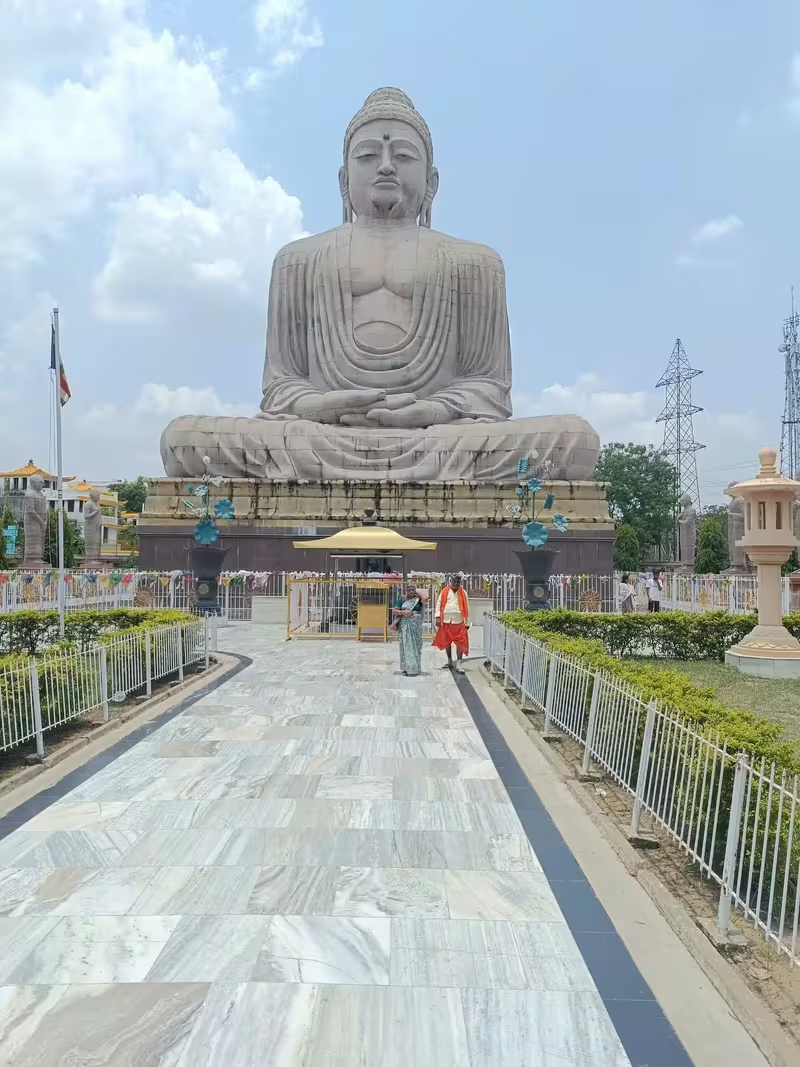
Overview
Bodh Gaya stands as one of the most sacred sites in Buddhism and a pivotal location in Indian religious history. Located in the Gaya district of Bihar, approximately 96 kilometers south of Patna, this small town holds immense significance as the place where Prince Siddhartha Gautama achieved enlightenment and became the Buddha around 2,500 years ago. The site's continuous veneration since antiquity makes it an unparalleled example of sustained religious devotion in Indian history.
The town is centered around the magnificent Mahabodhi Temple complex, which houses the sacred Bodhi Tree—believed to be a direct descendant of the original tree under which Buddha meditated. Archaeological evidence, including sculptures and architectural remains, definitively establishes that Bodh Gaya has been a site of Buddhist pilgrimage and worship since at least the Mauryan period (3rd century BCE). This makes it one of the oldest continuously venerated religious sites in the world, predating many of Christianity's and Islam's holiest locations.
Today, Bodh Gaya serves as a living bridge between ancient and modern Buddhism. The town has evolved into an international pilgrimage center, hosting Buddhist communities from Tibet, Thailand, Myanmar, Japan, Bhutan, and numerous other countries. Each community has established monasteries and temples in their distinctive architectural styles, creating a unique landscape that reflects Buddhism's global reach while honoring its Indian origins. The Mahabodhi Temple was designated a UNESCO World Heritage Site in 2002, recognizing its outstanding universal value to humanity.
Etymology and Names
The name "Bodh Gaya" derives from the Sanskrit and Hindi word "Bodh," meaning enlightenment or awakening, combined with "Gaya," the name of the district and nearby ancient city. The compound name literally translates to "the Gaya of Enlightenment," distinguishing it from the larger town of Gaya located about 13 kilometers away.
In ancient Buddhist texts written in Pali, the site was known as "Uruvela," the name of the village where the Buddha's enlightenment occurred. Early Buddhist literature refers to the exact spot of enlightenment as "Bodhimanda" (the seat of enlightenment) or "Vajrasana" (the diamond throne). The term Vajrasana particularly emphasized the belief that this was the most sacred spot on Earth, described in some texts as the navel or center of the world.
The evolution to "Bodh Gaya" as the primary name appears to have occurred gradually during the medieval period, as the site's identity became inextricably linked with the Buddha's enlightenment. The modern spelling varies slightly—"Bodh Gaya," "Bodhgaya," or "Bodh Gayā"—but all refer to the same sacred location.
Geography and Location
Bodh Gaya is situated on the relatively flat alluvial plains of Bihar, part of the greater Gangetic Plain that has supported human civilization for millennia. The town covers an area of approximately 20.2 square kilometers within its municipal limits, with a broader regional planning area extending to 83.78 square kilometers. This modest geographic footprint belies its enormous historical and religious significance.
The location experiences a humid subtropical climate typical of the Indo-Gangetic Plain. Summers are intensely hot, with temperatures often exceeding 40°C (104°F) from April to June. The monsoon season from July to September brings most of the annual rainfall, providing relief from the heat. Winters are mild and pleasant, from November to February, making this the peak pilgrimage season when devotees from colder Himalayan regions and international visitors flock to the site.
Bodh Gaya's position in the historical region of Magadha placed it at the heart of ancient Indian civilization. The kingdom of Magadha, with its capitals at Rajgir and later Pataliputra, was one of the sixteen Mahajanapadas (great kingdoms) of ancient India and would eventually give rise to the Mauryan Empire. The Buddha spent considerable time in Magadha, and many events of his life occurred within a relatively small radius of Bodh Gaya, creating a dense concentration of Buddhist sacred geography in this region.
Ancient History and the Buddha's Enlightenment
According to Buddhist tradition and textual sources, Prince Siddhartha Gautama arrived at Uruvela (ancient Bodh Gaya) around 528 BCE after abandoning extreme ascetic practices. For six years, he had practiced severe austerities in the forests of Magadha, nearly starving himself in the pursuit of spiritual liberation. Realizing that self-mortification was not the path to enlightenment, he accepted a meal of rice pudding from a village girl named Sujata, restored his strength, and resolved to sit in meditation until he achieved his goal.
Siddhartha chose a pipal tree (Ficus religiosa) on the banks of the Neranjana River as his meditation spot. He prepared a seat of kusha grass beneath the tree and took the famous vow: "Let my skin, sinews, and bones dry up, together with all the flesh and blood of my body! I welcome it! But I will not stir from this seat until I have attained the supreme and absolute wisdom!" What followed was an intense night of meditation, during which he passed through various stages of enlightenment, confronted and overcame the demon Mara (representing temptation and delusion), and finally achieved complete awakening at dawn.
This moment of enlightenment transformed Siddhartha into the Buddha—"the Awakened One." He spent seven weeks in the vicinity, experiencing the bliss of liberation and contemplating how to teach the profound truths he had realized. The tree under which he sat became known as the Bodhi Tree (the Tree of Awakening), and the spot itself became the Vajrasana, considered the most sacred location in the Buddhist world.
Archaeological evidence supports the site's antiquity and continuous occupation. Excavations have revealed structural remains and artifacts dating to the Mauryan period and earlier, confirming that the location was recognized and venerated from very early in Buddhist history. The antiquity of the site's identification is crucial—unlike many holy sites whose locations were "discovered" or disputed centuries after the events they commemorate, Bodh Gaya's identification has remained constant throughout recorded Buddhist history.
The Mauryan Period and Imperial Patronage
The transformation of Bodh Gaya from a sacred grove into a major pilgrimage complex began during the Mauryan period, particularly under Emperor Ashoka (reigned c. 268-232 BCE). After his conversion to Buddhism following the devastating Kalinga War, Ashoka became Buddhism's greatest royal patron, and his support fundamentally shaped the religion's material culture and geographic spread.
Ashoka is traditionally credited with building the first structural temple at Bodh Gaya and establishing the site's infrastructure for pilgrims. Chinese pilgrims who visited India centuries later, such as Faxian (5th century CE) and Xuanzang (7th century CE), recorded seeing inscriptions and monuments they attributed to Ashoka's time. The emperor also had stone railings erected around the Bodhi Tree and established a monastery complex nearby.
Archaeological excavations have uncovered Mauryan-period sculptures, railings, and architectural fragments at Bodh Gaya, providing physical confirmation of the site's importance during this era. The distinctive polish of Mauryan stonework, the style of carving, and the archaeological stratigraphy all support continuous use of the site from the 3rd century BCE onward. These finds represent some of the earliest Buddhist art and architecture, predating the famous stupas at Sanchi and Bharhut.
The Mauryan period established the pattern that would continue for centuries: royal and wealthy patronage funding temples, monasteries, and infrastructure at Bodh Gaya, while pilgrims from across the Buddhist world journeyed to pay homage at the site of enlightenment. This early imperial support ensured that Bodh Gaya would remain a central node in the Buddhist sacred geography that was being created across the Indian subcontinent.
Medieval Developments and the Mahabodhi Temple
The Mahabodhi Temple, which stands today as Bodh Gaya's most prominent monument, has a complex architectural history spanning many centuries. While the exact date of the first temple structure is uncertain, the current temple's main structure likely dates to the 5th-6th centuries CE during the late Gupta period, with later additions and renovations.
The temple exemplifies late Gupta architectural style—a tall, pyramidal spire (shikhara) rising to approximately 55 meters, with a square sanctum at its base. This architectural form would become influential across Southeast Asia as Buddhism spread. The temple's walls are richly decorated with niches containing Buddha images, reflecting the evolution of Buddhist iconography from the earlier aniconic period.
Chinese pilgrims provide invaluable records of Bodh Gaya during the medieval period. Faxian, visiting around 400 CE, described a thriving monastic community and well-maintained temples. Xuanzang, arriving in the 7th century, provided detailed accounts of the Mahabodhi Temple, the Bodhi Tree, and the various monasteries surrounding the main complex. His descriptions help historians understand the site's layout and importance during this period.
However, the medieval period also brought challenges. As Buddhism declined in its Indian homeland from the 8th century onward, Bodh Gaya's importance waned locally, though it continued to attract pilgrims from Buddhist countries abroad. The 12th-13th century Turkish invasions and the establishment of the Delhi Sultanate brought significant disruption. While there is debate among historians about the extent of destruction, it's clear that Buddhist institutions across northern India, including at Bodh Gaya, faced difficult times.
By the late medieval period, the Mahabodhi Temple had fallen into disrepair and was partially controlled by Hindu mahants (priests), reflecting the complex religious dynamics of medieval India. The Bodhi Tree was still venerated, but the site had lost much of its former glory.
Colonial Rediscovery and Restoration
The modern history of Bodh Gaya begins with its "rediscovery" by British colonial officials and archaeologists in the 19th century. While the site had never been completely forgotten—local traditions and some pilgrimage activity continued—its importance was not widely recognized in the West until British surveys of India began documenting ancient monuments.
Alexander Cunningham, the first Director-General of the Archaeological Survey of India, conducted extensive studies at Bodh Gaya in the 1880s. His archaeological work, documentation, and lobbying drew international attention to the site's deplorable condition. The Mahabodhi Temple was in ruins, with trees growing from its walls and sculptures scattered or damaged.
Cunningham's work sparked an international Buddhist movement to restore the temple and reclaim the site's religious significance. Buddhists from Ceylon (Sri Lanka), led by the reformer Anagarika Dharmapala, founded the Maha Bodhi Society in 1891 with the specific goal of restoring Buddhist control over Bodh Gaya. This movement represented an early example of transnational religious activism and contributed to the Buddhist revival occurring across Asia.
Major restoration work began in the late 19th century under the supervision of the Archaeological Survey of India. The temple was repaired, structural stability was restored, and the site was gradually cleared and organized. However, control over the temple remained contentious, with disputes between Hindu mahants and Buddhist organizations continuing for decades.
Modern Bodh Gaya and International Buddhism
The mid-20th century brought fundamental changes to Bodh Gaya. India's independence in 1947 and the growing international Buddhist community's interest in reclaiming their heritage sites led to new arrangements. The Bodh Gaya Temple Management Act of 1949, amended in 1953, established a mixed management committee, though control issues continued to spark occasional controversy.
The post-independence period witnessed an extraordinary flowering of international Buddhist presence at Bodh Gaya. Buddhist communities from across Asia established monasteries, temples, and cultural centers in their distinctive architectural traditions. Today, walking through Bodh Gaya is like taking a tour of pan-Asian Buddhist architecture—Tibetan gompa-style buildings with colorful murals, Thai temples with characteristic sloping roofs and golden ornamentation, Japanese Zen temples with austere elegance, Burmese pagodas, Bhutanese-style structures, and more.
This internationalization has transformed the town's economy and demographics. What was once a sleepy village has become a bustling pilgrimage center, especially during the winter months (November-February) when tens of thousands of pilgrims arrive, including many from Himalayan regions and abroad. The Dalai Lama frequently visits to give teachings, drawing thousands of Tibetan Buddhists and international practitioners.
The Mahabodhi Temple's designation as a UNESCO World Heritage Site in 2002 recognized its "outstanding universal value" and brought additional resources for conservation and management. However, it also brought new challenges related to balancing tourism, religious practice, conservation, and local development.
The Sacred Bodhi Tree
The Bodhi Tree standing at Bodh Gaya today is considered a direct descendant of the original tree under which Buddha achieved enlightenment. Buddhist tradition holds that the lineage has been carefully maintained through transplanted cuttings for over two millennia, creating an unbroken biological connection to that original tree.
Historical records describe how Emperor Ashoka's daughter, Sanghamitta, carried a cutting of the original Bodhi Tree to Sri Lanka in the 3rd century BCE, where it was planted at Anuradhapura and still survives today—possibly the oldest historically documented tree in the world. When the original tree at Bodh Gaya was damaged or destroyed several times through history (accounts vary regarding specific incidents), cuttings from the Sri Lankan tree were brought back to Bodh Gaya to maintain the lineage.
The current tree is a healthy specimen of Ficus religiosa (sacred fig or pipal), located immediately behind the Mahabodhi Temple on a raised platform. It is protected by railings, and devotees circumambulate it, offer flowers and incense, and meditate beneath its spreading branches. The tree's leaves, which flutter in the slightest breeze, are considered sacred and are often collected by pilgrims as mementos.
The Vajrasana, or Diamond Throne, sits beneath the tree—a stone platform marking the exact spot where Buddha sat during his enlightenment. This simple stone slab, possibly dating to the Gupta period, represents the axis mundi of the Buddhist universe, the unchanging center around which all else revolves.
Pilgrimage and Practice
Bodh Gaya represents one of the four primary pilgrimage sites in Buddhism, along with Lumbini (Buddha's birthplace in Nepal), Sarnath (site of his first sermon), and Kushinagar (where he attained parinirvana). However, Bodh Gaya holds special status as the site of enlightenment itself—the moment that defined Buddhism and gave birth to the Dharma.
Pilgrims to Bodh Gaya engage in various traditional practices. Circumambulation (pradakshina) of the Mahabodhi Temple and Bodhi Tree, walking clockwise while reciting prayers or mantras, is fundamental. Many practitioners perform full-body prostrations, an intensive practice involving repeatedly lying face-down on the ground as an expression of devotion and purification of negative karma. During peak pilgrimage season, hundreds of devotees can be seen performing these prostrations simultaneously.
Meditation practice is central to the Bodh Gaya experience. Practitioners sit for hours beneath the Bodhi Tree or in meditation halls around the temple complex, following in the footsteps of the Buddha himself. The site's spiritual potency is widely believed to be particularly conducive to meditation and realization.
Bodh Gaya also hosts major Buddhist events. The annual Nyingma Monlam Chenmo (Great Prayer Festival) attracts thousands of Tibetan Buddhist practitioners. The Dalai Lama's periodic teachings draw international audiences. Various Buddhist organizations conduct meditation retreats, ordination ceremonies, and religious conferences, making Bodh Gaya a living center of Buddhist practice and scholarship.
Archaeological Heritage and Museums
Beyond the Mahabodhi Temple complex, Bodh Gaya houses significant archaeological treasures that illuminate the site's long history. The Archaeological Survey of India maintains a museum near the temple complex containing sculptures, architectural fragments, and artifacts spanning from the Mauryan period through the medieval era.
The museum's collection includes exquisite Buddha images in various mudras (hand gestures), bodhisattva figures, architectural elements with intricate carvings, and inscriptions in various scripts and languages. These artifacts demonstrate the continuous evolution of Buddhist art and the international character of Buddhism, with influences from Gandhara in the northwest, the Gupta heartland, and Southeast Asian kingdoms visible in the sculptural styles.
Excavations continue to reveal new insights about the site's history. Archaeological work has established the stratigraphy of different building periods, confirmed the Mauryan-era occupation, and provided evidence for the temple's reconstruction and renovation through various dynasties. This scientific archaeology complements textual sources and religious traditions, creating a comprehensive picture of Bodh Gaya's historical development.
Conservation Challenges and Future
Despite its sacred status and UNESCO recognition, Bodh Gaya faces numerous conservation and management challenges. The rapid growth of pilgrimage tourism has strained infrastructure and raised concerns about the site's carrying capacity. Commercial development pressure around the temple complex threatens to compromise the site's spiritual atmosphere and archaeological integrity.
The Mahabodhi Temple itself requires ongoing conservation. The 19th-century restorations, while saving the structure from collapse, used some techniques that have created long-term problems. Water seepage, air pollution, the sheer number of visitors, and Bihar's challenging climate all take their toll on the ancient stonework.
The Archaeological Survey of India, in cooperation with the temple management committee and international conservation organizations, works to address these challenges. Recent projects have focused on improving drainage, controlling vegetation growth, monitoring structural stability, and implementing visitor management strategies to reduce wear on vulnerable areas.
Environmental issues also loom large. The Bodhi Tree, despite its sacred status and careful maintenance, is a living organism subject to disease, pests, and age. Arborists and botanists monitor its health closely, prepared to intervene if needed to preserve this irreplaceable heritage.
The future of Bodh Gaya will likely involve balancing competing demands: maintaining its role as a living religious site, preserving its archaeological and architectural heritage, serving the needs of an international pilgrimage community, and supporting local economic development. Success will require cooperation among diverse stakeholders—religious communities, government agencies, conservation professionals, and local residents—united by commitment to protecting this sacred landscape.