
Buddha’s Last Journey: The Final Path to Parinirvana
The road stretched before him as it had for nearly half a century—dusty, winding, endless. But the body that had walked these paths was weary now, weathered by eighty years and countless thousands of miles. Siddhartha Gautama, the Buddha, the Awakened One, moved through the lower Indo-Gangetic Plain one final time, his bare feet finding their familiar rhythm on soil he had crossed and recrossed throughout his teaching life. The disciples who walked behind him could sense it, though none dared speak it aloud: this journey would be different. The monsoon clouds gathering on the horizon seemed to understand what they could not yet accept—that the man who had shown them the path to liberation from suffering was himself preparing to demonstrate the ultimate letting go.
The Buddha’s orange robes, patched and faded from years of wear, moved with each step like a flame guttering in its final hours. Yet his posture remained upright, his gaze steady. He had spent decades as a wandering ascetic, teaching whoever would listen, building a monastic order from the ground up, refusing the comfort of permanent shelter. Now, in the final leg of his journey toward Kushinagar, every footfall was both familiar and final. The sal trees that lined the path would soon witness what no teaching, no sermon, no discourse could fully convey—the truth of impermanence embodied in the passing of the teacher himself.
The World Before
The India through which the Buddha made his final journey was a landscape in profound transformation. The 6th and 5th centuries BCE had witnessed an explosion of new ideas, new philosophies, new ways of understanding existence. The lower Indo-Gangetic Plain, that vast fertile crescent stretching across what is now northern India and parts of Nepal, had become a crucible of spiritual and intellectual ferment. The old Vedic certainties were being questioned, challenged, reimagined by a generation of wandering teachers, each offering their own path to truth.
This was an age of kingdoms and republics, of growing cities and expanding trade networks. The political landscape was dominated by the Mahajanapadas—sixteen great kingdoms that vied for power and influence. Among these, Magadha was rising to prominence, its capital at Rajagir becoming a center of political and economic power. But it was also an age of spiritual seekers, of men and women who had grown dissatisfied with ritual and sacrifice, who sought direct experience of truth rather than inherited dogma.
The society into which Buddhism emerged was rigidly stratified by birth, dominated by the Brahmanical system with its emphasis on ritual purity and social hierarchy. Yet this same society was experiencing unprecedented urbanization, creating spaces where old certainties could be questioned. Merchants and traders were gaining wealth that challenged the traditional dominance of the priestly class. The material conditions were ripe for new ideas about the nature of suffering, the self, and liberation.
In this context, the figure of the wandering ascetic had become increasingly common. These were men—and occasionally women—who had renounced household life, rejected social conventions, and taken to the roads in search of spiritual truth. They practiced extreme austerities, engaged in philosophical debates, and gathered followers around their particular teachings. Some denied the existence of the soul, others the reality of causation, still others the possibility of moral action. It was a marketplace of ideas, and the Buddha had been one of its most compelling voices.
The Buddha’s teaching had found fertile ground in this landscape of questioning. His Middle Way—rejecting both extreme indulgence and extreme asceticism—appealed to those exhausted by the demands of rigid self-denial. His emphasis on personal experience over inherited authority resonated with a generation skeptical of traditional claims. And his analysis of suffering—its origin, its cessation, and the path leading to its cessation—provided a practical framework that anyone could test through their own practice.
For decades, the Buddha had walked these plains, teaching in cities and villages, palaces and forests. He had established a sangha, a monastic community that provided an alternative to both household life and solitary asceticism. This community was revolutionary in its rejection of caste distinctions—within the sangha, birth status meant nothing. What mattered was one’s commitment to the path, one’s ethical conduct, one’s meditation practice, one’s understanding of the dharma.
The landscape itself had been shaped by his journeying. From Bodh Gaya, where he had attained nirvana beneath the Bodhi tree, to Sarnath near Varanasi, where he had delivered his first sermon, to the countless villages and towns where he had taught—the geography of the Gangetic Plain had become inseparable from his story. Now, as he made his way toward Kushinagar, he was retracing paths worn smooth by his own footsteps, passing trees beneath which he had meditated, crossing rivers where he had bathed, moving through a landscape that knew him as intimately as he knew it.
The Players
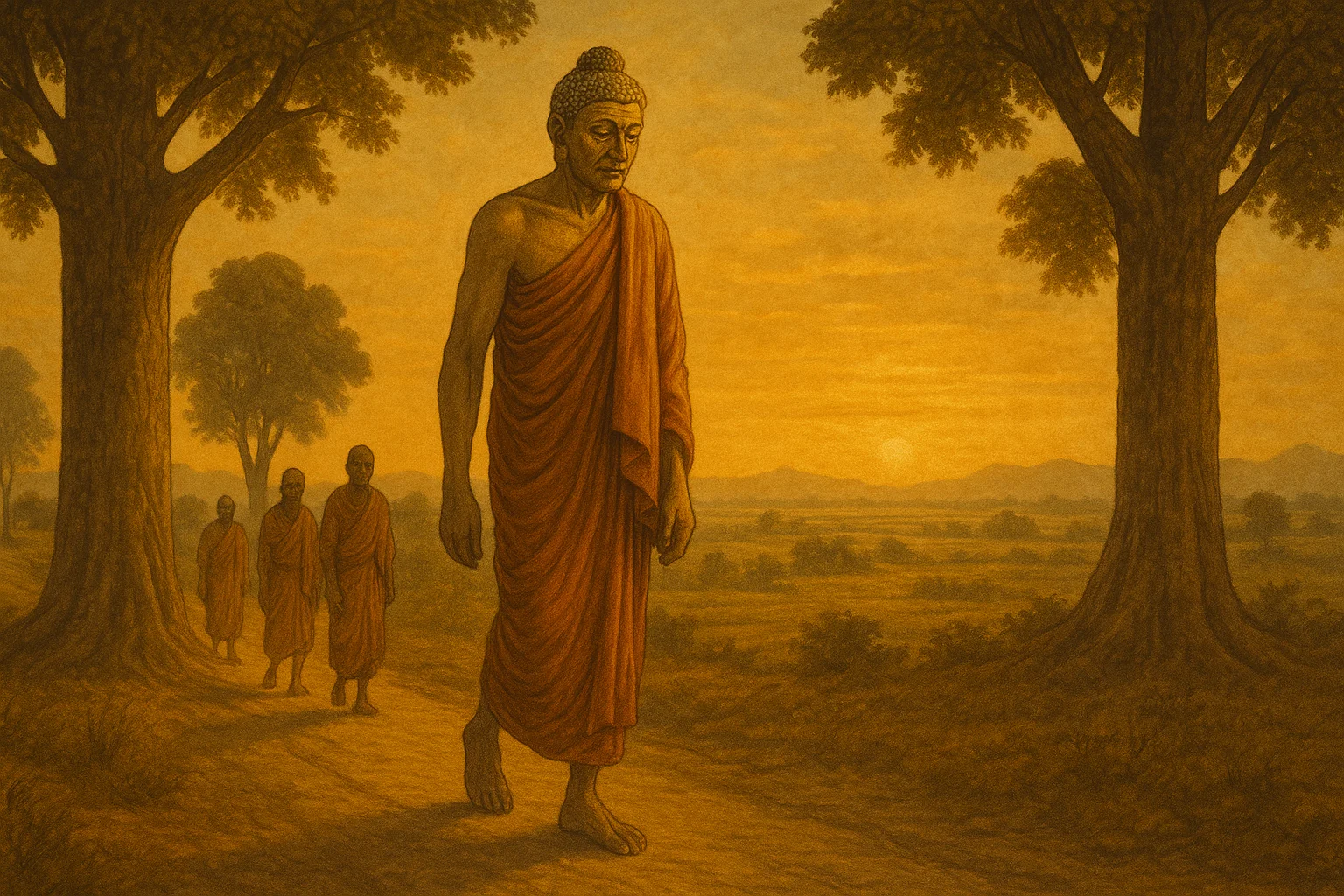
At the center of this final journey walked Siddhartha Gautama himself, though by this point in his life, the name mattered less than the title: the Buddha, the Awakened One. Buddhist legends tell us he had been born in Lumbini, in what is now Nepal, to royal parents of the Shakya clan. The circumstances of his birth were privileged—he had grown up in comfort, shielded from the harsh realities of human suffering. Yet something within him had proven unsatisfied by luxury and security. In a decision that would echo through the centuries, he had renounced his home life to live as a wandering ascetic.
The man who now walked toward Kushinagar had traveled an extraordinary path. After leaving his royal life behind, he had thrown himself into the most extreme forms of ascetic practice. Buddhist tradition records years of severe self-denial, of pushing the body to its limits in the belief that liberation could be achieved through the mortification of the flesh. He had learned from the best teachers of his age, mastered their techniques, and found them ultimately unsatisfying. The breakthrough had come at Bodh Gaya, where, after abandoning extreme asceticism and accepting a bowl of rice milk, he had sat beneath a fig tree and attained nirvana—the complete liberation from suffering and the cycle of rebirth.
But enlightenment had not led to withdrawal from the world. Instead, the Buddha had spent the next four and a half decades teaching, walking the length and breadth of the lower Indo-Gangetic Plain, sharing what he had discovered. He had developed a reputation as a masterful teacher, someone who could adapt his message to his audience, who could explain profound truths through simple stories and analogies. He had attracted followers from all walks of life—wealthy merchants and poor farmers, brahmin priests and low-caste outcasts, kings and beggars.
Surrounding the Buddha on this final journey were his disciples, the members of the sangha he had founded. These were men and women who had taken up the wandering life, who had committed themselves to the path of ethical conduct, meditation, and wisdom. They lived on alms, possessing nothing but their robes and bowls, depending on the generosity of lay supporters for their daily sustenance. They had walked with the Buddha through countless rainy seasons and dry seasons, had listened to thousands of teachings, had practiced the techniques he taught.
Among these disciples were individuals who had been with him for decades, who had witnessed the growth of the sangha from a handful of followers to a significant religious movement. They had seen the Buddha interact with kings and peasants, had watched him defuse conflicts with wisdom and compassion, had observed his unwavering commitment to the Middle Way. They knew his habits, his manner of speaking, the way he moved through the world with complete present-moment awareness.
There were also the lay supporters, the householders who had not taken up monastic life but who followed the Buddha’s teachings within the context of family and work. These were the people who offered food to the wandering monks, who provided shelter during the monsoon retreat, who gathered to hear teachings when the Buddha passed through their villages. They had integrated the Buddha’s ethical precepts into their daily lives—abstaining from killing, stealing, sexual misconduct, false speech, and intoxicants. They had found in the Buddha’s teaching a practical guide for living with less suffering, more clarity, more compassion.
The Buddha himself, at age eighty, was a figure of contradiction—physically frail yet spiritually unshakable, ancient yet somehow timeless, preparing to die yet more fully alive than anyone around him. The years of wandering had left their mark on his body, but his mind remained sharp, his presence commanding. He continued to teach, to answer questions, to guide his followers, even as the body that housed that brilliant awareness grew more fragile with each passing day.
Rising Tension
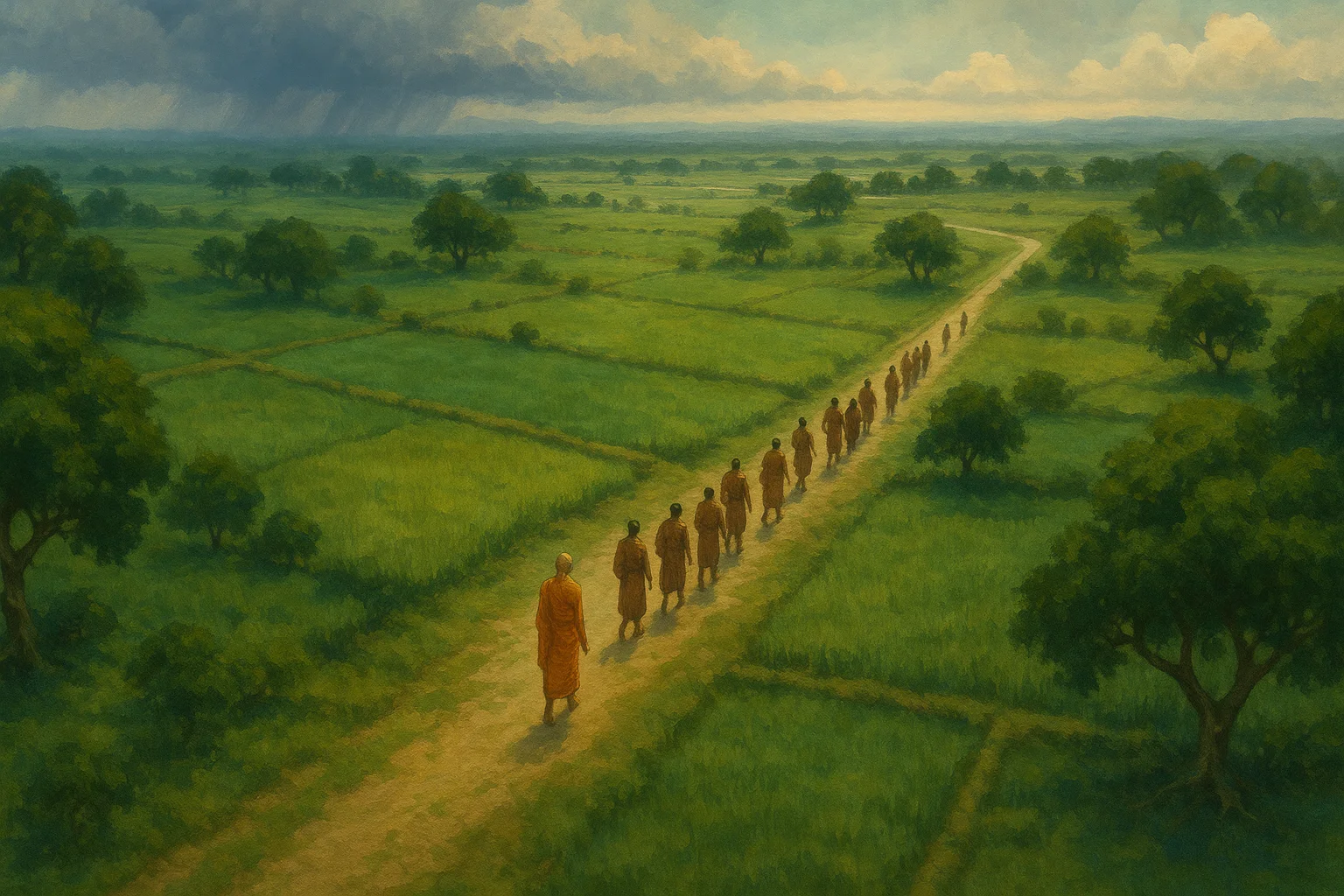
The journey toward Kushinagar was marked by a quality that the Buddha’s disciples had never quite experienced before—a sense of finality. The Buddha had made no explicit announcement, but those who knew him best could read the signs. His teaching had taken on a particular intensity, as if he were trying to compress a lifetime of wisdom into each discourse. His instructions to the sangha had become more specific, more focused on how they should continue after his death.
As they moved through the lower Indo-Gangetic Plain, stopping in villages and towns where the Buddha had taught before, there was a quality of farewell to each encounter. Old students came to pay their respects, to receive one last teaching. Lay supporters offered meals with a kind of desperate generosity, as if sensing that this might be their final opportunity to support the teacher who had changed their lives.
The physical challenges of the journey were mounting. At eighty, the Buddha’s body could no longer sustain the pace it had maintained for decades. The miles that he had once covered with ease now required rest stops, pauses beneath the shade of trees. Yet he insisted on continuing, on making the journey to Kushinagar. When disciples suggested he rest, recover his strength before continuing, he would gently refuse. There was a destination to reach, a final teaching to embody.
The Body’s Betrayal
According to Buddhist tradition, the signs of physical decline became impossible to ignore. The Buddha experienced illness during this final journey, moments when the body’s weakness threatened to overwhelm even his tremendous will. Yet he continued, demonstrating through his own example what he had taught for decades—that clinging to the body, to health, to comfort, was itself a form of suffering. The body was impermanent, subject to decay and death. Understanding this deeply, accepting it completely, was part of the path to liberation.
His disciples watched with growing anxiety as their teacher struggled with physical limitations he had always seemed to transcend. The man who had walked thousands of miles without complaint now needed help rising from seated positions. The voice that had addressed crowds of thousands now sometimes grew hoarse after brief teachings. Yet through it all, the Buddha’s awareness remained unshaken, his compassion for his disciples undiminished.
There were moments during this journey when the Buddha would speak about his own approaching death with such matter-of-fact acceptance that it left his followers stunned. He would remind them that all conditioned things are impermanent, that everything that arises must pass away. He was not exempt from this universal law. The body that had been born eighty years ago in Lumbini would die, just as all bodies die. What was there to mourn in the natural unfolding of cause and effect?
The Final Teachings
As the journey continued, the Buddha’s teachings took on a particular urgency. He spoke about the importance of the sangha maintaining its discipline after his death, about how the community should resolve disputes, about the guidelines that should govern their conduct. He was preparing them for his absence, trying to ensure that the movement he had founded would not fracture or dissolve once he was gone.
He taught about self-reliance, about being a lamp unto oneself. After his death, they should not look for another teacher to follow blindly. Instead, they should rely on the dharma itself—the teachings, the path he had laid out. They should verify everything through their own experience, test every claim against the reality of their own practice. Authority came not from a person but from truth itself.
The Buddha also addressed the question of what should be done with his remains, how his death should be marked. But more importantly, he emphasized that the physical body was not where his true teaching resided. His dharma body—the truth he had realized and taught—would continue as long as practitioners followed the path. In this sense, he would never truly be gone. The awakening he had achieved was not personal property but a universal possibility that anyone could realize through dedicated practice.
The Turning Point
The journey’s end came in Kushinagar, a small town that would achieve lasting significance solely because it was where the Buddha chose to die. Historical accounts vary on the exact circumstances of his arrival, the specific details of his final hours. But Buddhist tradition holds that the Buddha knew he had reached his destination, that this was where his final teaching—the teaching of death itself—would unfold.
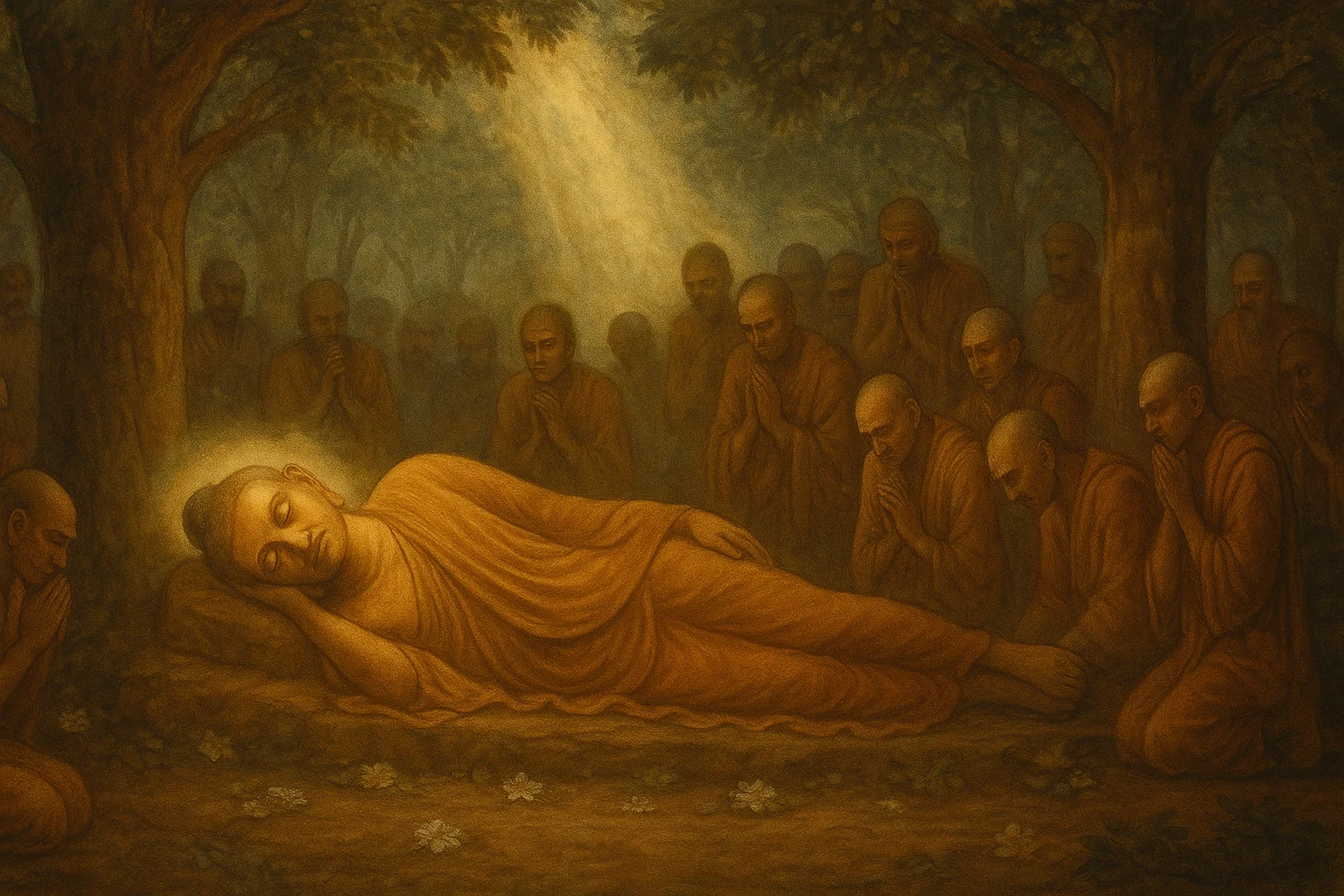
He asked his disciples to prepare a bed for him between twin sal trees in a grove outside the town. The location was not accidental—the Buddha had always preferred natural settings for his most profound teachings, and what could be more profound than the final letting go of life itself? The sal trees, with their fragrant flowers, provided a canopy overhead. The earth beneath would be his final resting place before the body was cremated.
As word spread that the Buddha was dying, disciples gathered. Some had been with him for decades; others had only recently joined the sangha. There were also lay followers, people whose lives had been transformed by his teaching, who could not bear to be absent at this crucial moment. The grove filled with people, their faces marked by grief, disbelief, and the struggle to accept what their teacher had spent his life helping them understand—that all things pass away.
The Buddha, lying on his right side in the posture that would later become iconic in Buddhist art, continued teaching until nearly the end. According to tradition, he asked his disciples three times if they had any final questions, any doubts that needed clearing. He wanted to ensure that he had fulfilled his responsibility as a teacher, that he was not leaving them with unresolved confusion. The silence that greeted his questions was not the silence of perfect understanding but of grief too deep for words.
His final teaching was simple and direct, embodying in a single sentence the essence of his forty-five years of instruction: “All conditioned things are impermanent. Strive with diligence.” This was both a reminder of the fundamental nature of reality and a call to continued practice. Death was coming for him, would come eventually for all of them, but this was no cause for despair. Instead, it was motivation to practice while life remained, to not waste the precious opportunity of human existence.
Then, according to Buddhist tradition, the Buddha entered into deep meditative states, ascending through progressively refined levels of concentration. This was not an escape from death but a meeting with it from the most awakened state possible. He was demonstrating that even the process of dying could be undertaken with complete awareness, without fear or resistance.
When the Buddha died—when he reached parinirvana, the final nirvana from which there would be no rebirth—the accounts speak of a profound stillness that settled over the grove. The man who had walked the length of the Indo-Gangetic Plain teaching liberation from suffering had himself been liberated from the cycle of birth and death. The body remained, but the consciousness that had inhabited it, that had achieved complete awakening, had passed beyond all concepts of existence and non-existence.
Aftermath
The immediate aftermath of the Buddha’s death was marked by grief and confusion. Despite decades of teaching about impermanence, despite repeated reminders that all things pass away, the disciples found themselves devastated by the loss of their teacher. Buddhist tradition records that some could not contain their tears, that the grove filled with lamentation. The Buddha was gone, and with him went the living embodiment of the teachings, the direct access to a fully awakened being.
Yet there were practical matters to attend to. The Buddha had given instructions about how his body should be treated—it should be handled like the body of a universal monarch, wrapped in fine cloth, cremated with honor. This was not out of attachment to the physical form but out of respect for what that form had represented, what it had accomplished during its eighty years of life.
The cremation, when it took place, became a significant event. Lay followers and disciples gathered to pay their final respects. The body that had walked countless miles, that had sat beneath the Bodhi tree in enlightenment, that had gestured expressively during thousands of teachings, was consumed by flames and reduced to relics. These relics would become objects of veneration, distributed to different regions, enshrined in monuments that would mark the landscape for millennia to come.
But the more significant aftermath was what happened to the teachings, to the sangha, to the movement the Buddha had founded. Without their teacher, the disciples had to determine how to continue. They gathered for what would become the First Buddhist Council, reciting and organizing the Buddha’s teachings, establishing the canon that would be passed down through generations. This was a crucial moment—the transformation of oral teachings into a preserved tradition.
The sangha survived the Buddha’s death, ultimately thriving beyond anything he might have imagined. The monastic order he had established continued to walk the roads of India, teaching the dharma, accepting alms, maintaining the discipline he had set out. Lay communities continued to support these monks and nuns, finding guidance in the teachings even without the physical presence of the teacher.
Legacy
Two and a half thousand years after the Buddha’s death in Kushinagar, his influence continues to shape lives across the globe. What began as the teaching of a wandering ascetic in the lower Indo-Gangetic Plain during the 6th or 5th century BCE became one of the world’s great religious and philosophical traditions. Buddhism spread beyond India to Southeast Asia, Central Asia, East Asia, and eventually to every continent, adapting to each culture it encountered while maintaining its core insights.
The fundamental teachings the Buddha articulated during his lifetime—the Four Noble Truths outlining the nature of suffering and the path to its cessation, the Noble Eightfold Path providing practical guidance for ethical conduct and mental cultivation, the doctrine of impermanence and non-self challenging fixed notions of identity—these continue to resonate with seekers and skeptics alike. The psychological sophistication of Buddhist analysis, its emphasis on direct experience over blind faith, and its practical methods for reducing suffering have found fresh relevance in the modern world.
The legacy of the Buddha’s final journey, particularly his death at Kushinagar, established a pattern for how Buddhists understand and approach death. The Buddha’s peaceful passing, his clear awareness in the face of mortality, his final teaching about impermanence—all of this provided a model for dying with dignity and consciousness. Death was not seen as a failure or tragedy but as a natural part of existence, an opportunity for final teaching, a transition that could be navigated with the same awareness brought to life.
Kushinagar itself became one of the four great pilgrimage sites of Buddhism, along with Lumbini (where the Buddha was born), Bodh Gaya (where he attained enlightenment), and Sarnath (where he delivered his first teaching). For Buddhists across traditions and centuries, visiting the site where the Buddha died has been a way to connect with the historical reality of the teaching, to contemplate impermanence in the place where the Awakened One demonstrated it most profoundly.
The Buddha’s establishment of the sangha proved to be one of his most enduring legacies. This monastic order, with its emphasis on ethical discipline, meditation practice, and philosophical study, created a structure that could preserve and transmit the teachings across generations. The sangha became a kind of living institution, adapting to changing circumstances while maintaining continuity with the original vision.
Perhaps most significantly, the Buddha’s life story—from his renunciation of royal privilege, through years of ascetic practice, to his enlightenment at Bodh Gaya, and finally to his death in Kushinagar—became a narrative of liberation that has inspired countless individuals to undertake their own spiritual journey. The idea that awakening is possible, that suffering can be understood and transcended, that ordinary human beings can achieve profound transformation—this has been the Buddha’s most powerful legacy.
What History Forgets
What often gets lost in the grand narrative of Buddhism’s spread and influence is the physical reality of the Buddha’s existence. He was not a supernatural being but a man who lived in a specific time and place, who experienced hunger and thirst, fatigue and illness, joy and sorrow. His enlightenment did not exempt him from the basic conditions of embodied existence. He ate food offered by supporters, slept beneath trees, felt the monsoon rains and the summer heat.
The Buddha’s life as a wandering ascetic meant that he lived without permanent shelter for decades. After his enlightenment, when he could presumably have settled somewhere and let students come to him, he instead chose to continue the itinerant life. This wandering was not romantic—it meant uncertain meals, exposure to the elements, constant movement, physical hardship. Yet he maintained this lifestyle until his death at age eighty, an extraordinary feat of physical endurance that often goes unacknowledged.
The lower Indo-Gangetic Plain that the Buddha traversed was not the sanitized landscape of religious art but a real place with real dangers. There were bandits on the roads, wild animals in the forests, diseases that modern medicine would easily cure but that were frequently fatal in the 6th or 5th century BCE. The Buddha’s wandering meant constant vulnerability, constant dependence on others for food and safety. The faith that his teaching inspired in lay supporters was not just spiritual but literal—these were people who provided the means for him and his disciples to survive.
What history also forgets is that the Buddha’s final journey was not unique in its difficulty. Every step of his forty-five years of teaching involved similar challenges. The difference was only that this journey ended with death rather than with arrival at a new teaching venue. In this sense, the final journey was just an extension of the wandering life he had chosen all those years ago when he renounced his home. Every journey was in some sense a journey toward death, a recognition that life itself is a journey with only one guaranteed destination.
The Buddha’s teachings about impermanence were not abstract philosophy but observations grounded in his direct experience of the world. Walking thousands of miles over decades, he watched seasons change, cities rise and fall, people be born and die. He saw kingdoms expand and contract, witnessed prosperity and famine, observed human nature in all its variety. His teaching emerged from this direct, sustained engagement with reality, not from withdrawal into abstract speculation.
Finally, what often gets forgotten is the sheer determination required to maintain the Buddha’s mission. Teaching the same essential message for forty-five years, adapting it to countless different audiences, responding to endless questions, managing the sangha’s internal dynamics, dealing with rival teachers and skeptical authorities—this required extraordinary persistence. The final journey to Kushinagar, undertaken by an eighty-year-old man in declining health, was the last expression of a will that had sustained itself through decades of teaching.
The Buddha died as he had lived—walking, teaching, demonstrating through his own example the truths he had realized. Kushinagar was simply where the road ended, where the body that had carried consciousness through eighty years finally released it. But the path itself—the way of awareness, ethics, and wisdom he had articulated—that path continued, walked by millions of followers across centuries and continents, a testament to the power of one wandering teacher’s vision of liberation.